Infected Tattoo Signs: Healing or Infection? When to Call
Aftercare · By CustomTattoo AI Editorial Team ·
A healing tattoo is red, swollen, tender and oozing for the first days, and that alone does not mean it is infected. The signs that point to a problem are the ones that get worse instead of better: fever or chills, redness that keeps spreading, red streaks, pus, a bad odor, heavy drainage, or pain that increases. Cleveland Clinic, the American Academy of Dermatology and the FDA all say to contact a health care professional if you see them. This page lays out each sign next to the source that lists it, separates infection from an ink allergy, and explains why a tattoo can be infected even when you did everything right. We cannot tell you what your tattoo is: only a clinician who sees it can.
How do you tell if a tattoo is infected or just healing?
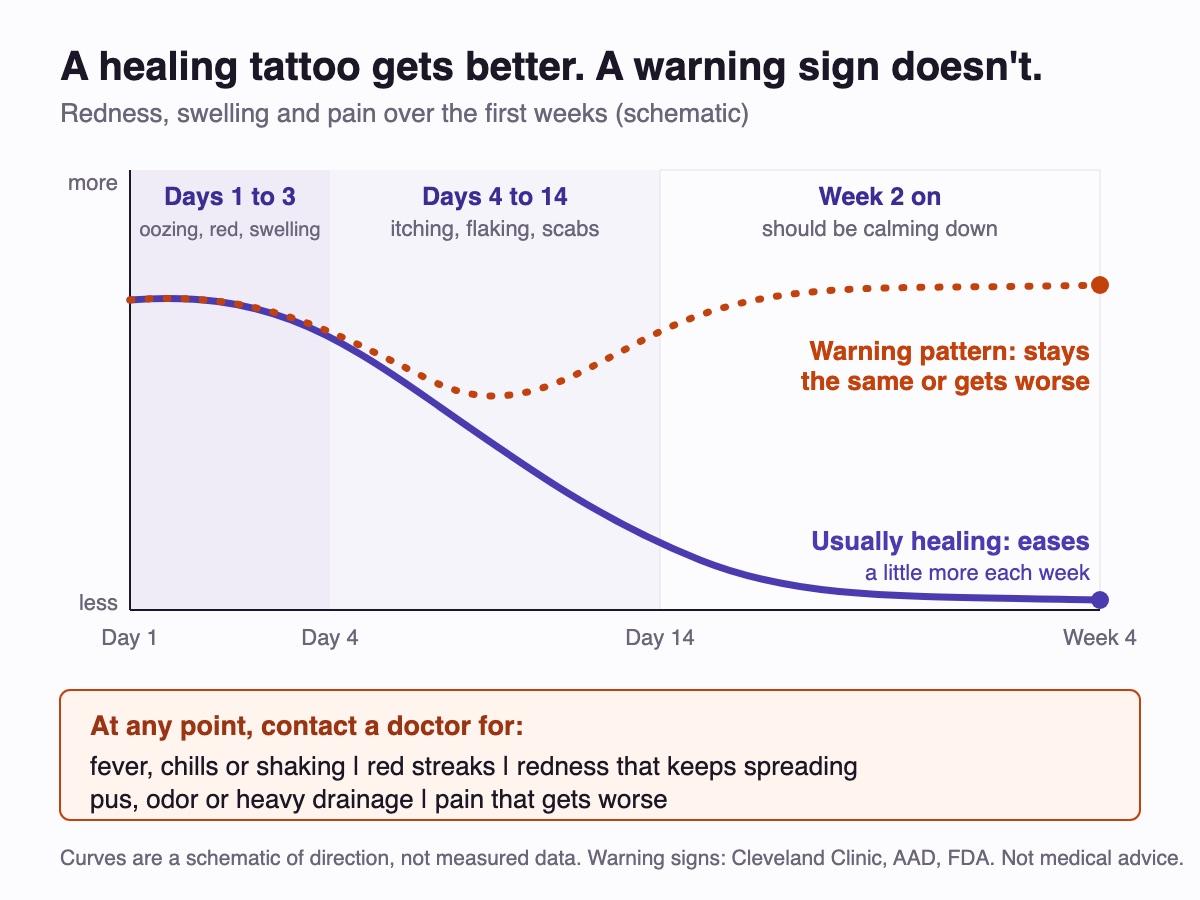
Look at the direction, not at a single day. A fresh tattoo is an open wound, and the AAD lists some redness, swelling, soreness, clear oozing, itching, flaking and scabs as normal healing, not infection. What separates the two is the trend: healing signs fade, while the AAD's signs of infection include redness that darkens or spreads instead of fading, and pain that continues or worsens. UPMC, a US hospital system, gives the same rule of thumb with a date on it: swelling, redness, itching, flaking, clear oozing and scabbing are normal in the first two weeks, and symptoms that are getting worse rather than better after two weeks may signal an infection.
For what normal looks like day by day, and how long each stage lasts, use the tattoo healing stages guide. That page owns the timeline, so we do not repeat it here. One data point is useful for comparison: in a 2022 study of 25 people tattooed at one Finnish studio, 96% had redness on day 1 and only 4% still had it on day 14 (Fauger et al., funded by the maker of the ointment tested). Redness that is still strong, or bigger, two weeks in is not that pattern.
Normal healing or a reason to call: each sign and its source
This is the comparison most pages leave out: every row says what is usually part of healing, what is a reason to get medical advice, and which source says so. Where only one source lists a sign, the table says that too.
| Sign | Usually part of healing | Reason to get medical advice | Source |
|---|---|---|---|
| Redness | Some redness early, easing day by day | Redness that keeps spreading farther from the tattoo, or darkens or spreads instead of fading | Cleveland Clinic, AAD |
| Fluid | Oozing of blood and ink, clear oozing, in the first days | Pus, odor, or significant drainage | Cleveland Clinic, AAD |
| Pain | Soreness and tenderness that settle | Pain that increases instead of getting better | Cleveland Clinic, AAD |
| Heat and feeling unwell | Warmth of the skin in the early days (FDA) | Skin hot to the touch (Cleveland Clinic); fever, chills or shivering; at the serious end, high fever, shaking and sweats | Cleveland Clinic, AAD, FDA |
| Red streaks | Not part of healing | Red streaks running from the tattoo toward the center of the body | Cleveland Clinic (only one of the four pages lists this) |
| Itch and flaking | Itching, flaking and scabs, which fall off on their own | Itchy, red, painful bumps within the tattoo; open sores; or a tattoo that seems not to be healing | AAD, FDA |
| Rash | Not part of healing | A rash of redness or bumps near the tattoo, especially with a fever (the FDA notes it can also be an allergic reaction) | FDA |
The four pages overlap more than they differ. The one sign that only one source gives is red streaks, which is why we label it rather than rank it. Every one of these is a reason to contact a health care professional, not a way to diagnose yourself, and none of the pages says that a single sign on its own proves an infection.
Which source lists which warning sign
| Warning sign | Cleveland Clinic | AAD | FDA | UPMC |
|---|---|---|---|---|
| Fever, chills or shivering | Fever | Yes | Yes (with rash; high fever, shaking, sweats if serious) | Yes (fever, chills, sweating) |
| Spreading or worsening redness | Yes | Yes (darkens or spreads) | Not healing | Yes |
| Worsening pain | Yes | Yes | No | Yes |
| Pus, odor or heavy drainage | Odor, drainage | Pus | No | Pus |
| Skin hot to the touch | Yes | No | No | No |
| Red streaks | Yes | No | No | No |
| Bumps within the tattoo | No | Yes (itchy, red, painful) | Rash of redness or bumps | Yes |
| Open sores | No | Yes | No | No |
Compiled by us from the four pages as they read on November 11, 2026. A "No" means the page does not list the sign, not that it is safe to ignore.
Is my tattoo infected if it is red, scabbing or dry?
Autocomplete shows the questions people actually type: infected "or just healing", "or just irritated", "or scabbing", "if it's red", "or just dry". The sources give a consistent answer to each, and it is rarely yes on the strength of one symptom.
- Red: redness is expected early, and the AAD counts it as normal healing. The warning version spreads, darkens, or keeps getting worse.
- Scabbing: scabs are on the AAD's normal list, and Cleveland Clinic says they fall off on their own. The warning version is open sores, pus, or crusting that comes with the signs above. In the Fauger study, about a third of people still had crusts at day 14.
- Dry and itchy: itching and flaking are listed as normal healing by the AAD. The AAD's warning version is itchy, red, painful bumps within the tattoo, which is a different picture from a dry, flaking surface.
- Irritated or "overworked": "overworked" is a tattooing term for skin that was heavily worked during the session, not a medical diagnosis, and we found no clinical source that defines it. If you are unsure whether swelling is from the session or from a problem, the useful test is the same: is it easing, and are any of the warning signs present?
A related search is infection on darker skin. We did not find an official page in this check that describes how infection looks on different skin tones, so we are not going to guess. Signs that do not depend on color are on the lists above: warmth, fever or chills, pain that is getting worse, drainage or odor, and red streaks. The AAD's wording for color is "redness that darkens or spreads", and that wording appears in its list for all skin.
When do infection signs show up, and can an old tattoo get infected?
Usually early, but not only early. The AAD says an infection can start immediately after getting the tattoo, or days or months later. UPMC says infections usually appear in the first days or weeks and can develop anytime in the first few months. We found no official page in this check that gives a precise window or a rate of infection, and the only figure we saw (a 0.5 to 6 percent range) came from commercial sites, so we left it out.
For a fully healed tattoo, a change is also a reason to ask. The AAD lists skin diseases that can appear in or around a tattoo, usually within 10 to 20 days but sometimes as early as 3 days or years later, among them psoriasis, eczema, lichen planus, keloids, sarcoidosis, scars and skin cancer. It also lists long-term swelling of lymph nodes, usually near the tattoo, and says to see a primary care doctor to rule out other causes such as infection. If a healed tattoo starts to itch, bump, change color or swell, a board-certified dermatologist is the person the AAD points to.
For comparison, in the 2011 Rochester, New York outbreak all 19 people developed a persistent, raised, red rash in the tattoo area within 3 weeks of the session (Kennedy et al., NEJM, 2012). That is one outbreak, not a rule: infections from other causes can appear on other schedules.
Tattoo allergic reaction vs infection: how do they differ?
They overlap, which is why people mix them up. UPMC notes that allergic reactions can start right away, within months, or years later, and that symptoms overlap with infection: swelling, redness, itching, bumps, blisters and scaly skin. The AAD draws the clearest line, shown below. Neither page says you can tell them apart yourself, and the FDA says a rash can be an allergic reaction that may persist because the inks are permanent.
| Infection (AAD) | Allergic reaction to ink (AAD) | |
|---|---|---|
| When | Immediately after, or days or months later | Immediately, weeks or years later, even decades |
| Where | In and around the tattoo | Usually limited to one ink color, most often red |
| What you may see | Redness that darkens or spreads, pus, open sores, itchy red painful bumps, worsening pain | Redness, swelling, itch, pimple-like bumps, raised scaly patches, deep lumps, blisters, crusting or flaking, watery leakage |
| Whole body | Fever, chills or shivering | Serious reactions: trouble breathing, racing heart, chest tightness, dizziness, stomachache, intense swelling, hives |
| What the AAD says to do | See a doctor or a board-certified dermatologist right away | Serious: immediate medical care. Mild or moderate: tell your artist and ask what to do; see a board-certified dermatologist if it lasts longer than 1 or 2 weeks |
The AAD describes other reactions that are neither infection nor ink allergy, such as a sun allergy in the tattoo, which can come back each time the tattooed skin is in the sun and can start within minutes or hours, and rare burning or swelling during an MRI (tell the technician about your tattoo first). A temporary black-ink tattoo, often containing PPD, can also cause a reaction anywhere from the day of application to three weeks later. If you are not sure which of these you have, that is the point of asking a clinician.
Can contaminated tattoo ink cause an infection, even in a clean studio?
Yes, and it is the part most infected-tattoo articles skip. The FDA says infections can come from ink contaminated with bacteria, mold or other microorganisms, that using non-sterile water to dilute pigments is a common cause, and that an ink can be contaminated even if the container is sealed or the label says the product is sterile. So an infection is not automatically proof of bad aftercare or a dirty studio.
- people in one Rochester, NY outbreak (2011)
- 19
- people in one Rochester, NY outbreak (2011)
- Same artist, premixed gray ink. The manufacturer recalled it.
- interviewed clients in a Miami-Dade, FL outbreak (2015)
- 38 of 226
- interviewed clients in a Miami-Dade, FL outbreak (2015)
- Gray-ink clients were 8.2 times as likely to report a rash.
- published bacterial infection cases, 1984 to 2015
- 67
- published bacterial infection cases, 1984 to 2015
- Systematic review. Two of 39 inks tested at a convention were contaminated.
The CDC's 2012 MMWR report describes 22 confirmed cases of tattoo-associated nontuberculous mycobacteria (NTM) skin infections in four states, with additional probable and possible cases; the New York cluster was tied to contaminated pre-diluted gray ink. It describes the picture as persistent redness, swelling or nodules within the tattoo's borders, ranging from mild inflammation to abscesses needing repeated surgical cleaning, and it says these infections are hard to treat and may need at least four months of two or more antibiotics. Its advice to clinicians is to consider NTM when a patient has a persistent papular rash or nodules in a newly tattooed area. Its advice to consumers is to use registered parlors, ask for inks made for tattooing, confirm hygienic practices, seek medical care for persistent skin problems, and report adverse events to the artist and the FDA.
In the Florida outbreak, genome sequencing matched organisms from a bottle of gray wash ink and from tap water to those in skin biopsies, and a different mycobacterium was found in five unopened bottles of gray wash ink from two other studios (Griffin et al.). The 2016 review found that opened and unopened ink bottles in earlier surveys often held clinically relevant levels of bacteria, and concluded that poor hygiene in tattoo parlors and non-medical wound care are major risk factors (Deutsches Ärzteblatt).
What this means for you is narrow. A rash or bumps that stay inside a new tattoo and do not settle are worth a medical visit, and a clinician may need to look beyond the first obvious explanation. It does not mean tattooing is unsafe in general, and these papers cannot tell you your own risk.
When should you see a doctor about a tattoo, and how fast?
The sources describe three levels of urgency. We report them as written and do not rank your situation for you.
How urgently the sources say to get care
Immediately
Emergency care
- Trouble breathing, racing heart or chest tightness
- Dizziness, stomachache, intense swelling, serious pain
- Flushing or hives
- AAD: serious allergic reaction
Right away
Doctor or dermatologist
- Fever, chills or shivering, shaking or sweats
- Red streaks, spreading redness, hot skin
- Pus, odor, heavy drainage, open sores
- Pain that is getting worse
Within 1 to 2 weeks
Mild reaction that persists
- AAD: a mild or moderate reaction that lasts longer than 1 or 2 weeks
- AAD: a temporary-tattoo reaction that lasts longer than 1 week
- FDA: a rash of redness or bumps near the tattoo (seek care)
We deliberately say nothing about creams, home remedies or over-the-counter medicines. Treating a suspected infection or an allergic reaction is a clinician's call, and the sources above point to a clinician, not to a product. The AAD's note about damage to your tattoo is the practical reason to act early rather than wait to see if it goes away.
What should you do while you wait to be seen?
Only a few steps are backed by the sources, and we keep to those. The FDA says: contact your health care professional, tell the tattoo artist so they can identify the ink and stop using it, ask for the ink's brand, color and any lot or batch number, including the diluent's, and report the reaction to the FDA with as much detail as you can about the ink, the reaction and the outcome. The 2011 and 2015 outbreaks were each first reported by a dermatologist who saw patients tattooed by the same artist or studio.
- Contact a health care professional, and say you have a recent tattoo. (FDA, Cleveland Clinic, AAD)
- Tell your tattoo artist, and ask for the ink's brand, color, and lot or batch number, including any diluent. (FDA)
- Report it to the FDA, as the FDA and the CDC's MMWR both advise (the MMWR names FDA MedWatch).
- Keep dated photos of how it changes, so a clinician can see the trend. This one is our suggestion, not from a cited source.
- Do not wait for your studio's sheet to tell you: only 19.4% of 700 US aftercare sheets said when to contact a physician (Liszewski et al., 2023).
Can you prevent an infected tattoo?
You can lower some risks but not remove them, because contaminated ink can be the cause. UPMC lists choosing a state-licensed studio, confirming its infection control practices, checking that single-use sterile needles and supplies are used, and checking for FDA ink recalls. The CDC report adds that artists should not dilute ink, or should use only sterile water if they must. Aftercare, meaning washing, protecting and not picking, is the other half, and it is covered in the tattoo aftercare guide, which compares what seven instruction sources say.
Before the appointment, our first tattoo guide lists what to ask an artist. For the pain side of the experience, see the tattoo pain chart, and keep in mind that a tattoo that hurts more as the days pass is one of the signs above, not part of the usual pattern.
Prompt to try
“fine line fern leaf tattoo for the inner forearm, minimal and delicate”
Generate this designThis guide summarizes published dermatology and public-health sources. It has not been reviewed by a clinician and is not medical advice or a diagnosis. Your artist's instructions and your doctor's advice come first. If you are worried, contact a doctor.
Related guides
Tattoo Healing Stages
What is normal day by day, with pictures of one tattoo at day 0, 10, 20 and 30.
Tattoo Aftercare
How to wash, moisturize and protect a new tattoo, and where studios disagree.
First Tattoo Guide
What to settle with your artist before the appointment.
What are the first signs of an infected tattoo?+
Redness that keeps spreading or darkens, pain that gets worse instead of better, pus, odor or significant drainage, and fever or chills. Cleveland Clinic, the AAD and the FDA all list some of these. Some redness, swelling and oozing in the first days is normal, so the first sign is usually a trend that goes the wrong way.
Is my tattoo infected or just healing?+
Healing gets a little better each day: redness, swelling and soreness ease, and flaking, itching and scabs fall off on their own. A tattoo that is getting worse, especially after the first two weeks, or that comes with fever, chills, red streaks, pus or hot skin, is a reason to contact a doctor. Only a clinician can say which it is.
How can I tell an allergic reaction from an infection?+
They overlap. The AAD says an ink allergy usually affects one color, most often red, and can start immediately or years later, while infection comes with signs such as spreading redness, pus, open sores and fever. You cannot reliably tell them apart yourself. The AAD advises seeing a board-certified dermatologist if a mild reaction lasts longer than one or two weeks, and immediate care for serious symptoms such as trouble breathing.
When should I see a doctor about my tattoo?+
Right away for fever, chills, shaking, red streaks, redness that keeps spreading, pus, odor, hot skin or worsening pain, according to Cleveland Clinic, the AAD and the FDA. Immediately for trouble breathing, a racing heart, chest tightness or hives. Also for a rash or bumps that do not settle.
Can a tattoo get infected after it has healed?+
The AAD says infection can start immediately or days or months after getting a tattoo, and that allergic reactions and some skin conditions can appear weeks, months or years later. A healed tattoo that itches, bumps, swells or changes is worth showing to a board-certified dermatologist.
Can the ink itself cause an infection?+
Yes. The FDA says ink can be contaminated even in a sealed bottle labeled sterile. Outbreaks of nontuberculous mycobacteria infections traced to gray ink were reported in New York in 2011 and Florida in 2015. If you react, tell your artist and ask for the ink's brand, color and lot number.
Sources
- Cleveland Clinic: Tattoo aftercare, with dermatologist Shilpi Khetarpal, MD (March 20, 2026) · checked November 11, 2026
- American Academy of Dermatology: Tattoos: 7 unexpected skin reactions and what to do about them · checked November 11, 2026
- FDA: Think Before You Ink: Tattoo Safety (content current as of December 17, 2024) · checked November 11, 2026
- CDC MMWR: Tattoo-Associated Nontuberculous Mycobacterial Skin Infections, Multiple States, 2011 to 2012 (August 22, 2012) · checked November 11, 2026
- Kennedy BS et al. Outbreak of Mycobacterium chelonae infection associated with tattoo ink. N Engl J Med, 2012 (abstract) · checked November 11, 2026
- Griffin I et al. Outbreak of Tattoo-associated Nontuberculous Mycobacterial Skin Infections. Clin Infect Dis, 2019 (abstract) · checked November 11, 2026
- Dieckmann R et al. The Risk of Bacterial Infection After Tattooing. Dtsch Arztebl Int, 2016 (abstract) · checked November 11, 2026
- UPMC HealthBeat: Signs My Tattoo Is Infected (last reviewed March 31, 2024) · checked November 11, 2026
- Fauger A et al. Tattoo aftercare management with a dermo-cosmetic product. J Cosmet Dermatol, 2022 · checked November 11, 2026
- Liszewski W et al. An Analysis of 700 American Tattoo Aftercare Instructions. Dermatology, 2023 · checked November 11, 2026
Pain, healing and aftercare
- Tattoo pain chart
Which body areas hurt most, from artist reports and a 1,092-person survey.
- Tattoo aftercare
Washing, moisturizing, wrapping and what to avoid, source by source.
- Tattoo healing stages
What is normal at day 1, week 2 and week 4.
- Spine tattoo pain
How much it hurts, how long it takes and designs to scale.
- Do finger tattoos fade?
Why finger tattoos blur and how to make them last.
- Tattoo size chart
How much room each body part has, in inches and cm.