
Sleeve Tattoos: Sizes, Hours, Cost and How to Plan One
A sleeve tattoo covers most or all of one arm. A quarter sleeve runs from the shoulder to about halfway to the elbow, a half sleeve from the shoulder to the elbow (some studios also use the term for elbow to wrist), a three-quarter sleeve to mid-forearm and a full sleeve from the shoulder to the wrist: about 22 inches on a median woman's arm and 24 on a man's. Artists quoted below put many sleeves at around 15 hours of tattooing and detailed realism at up to 80 hours or more, spread over several sessions.
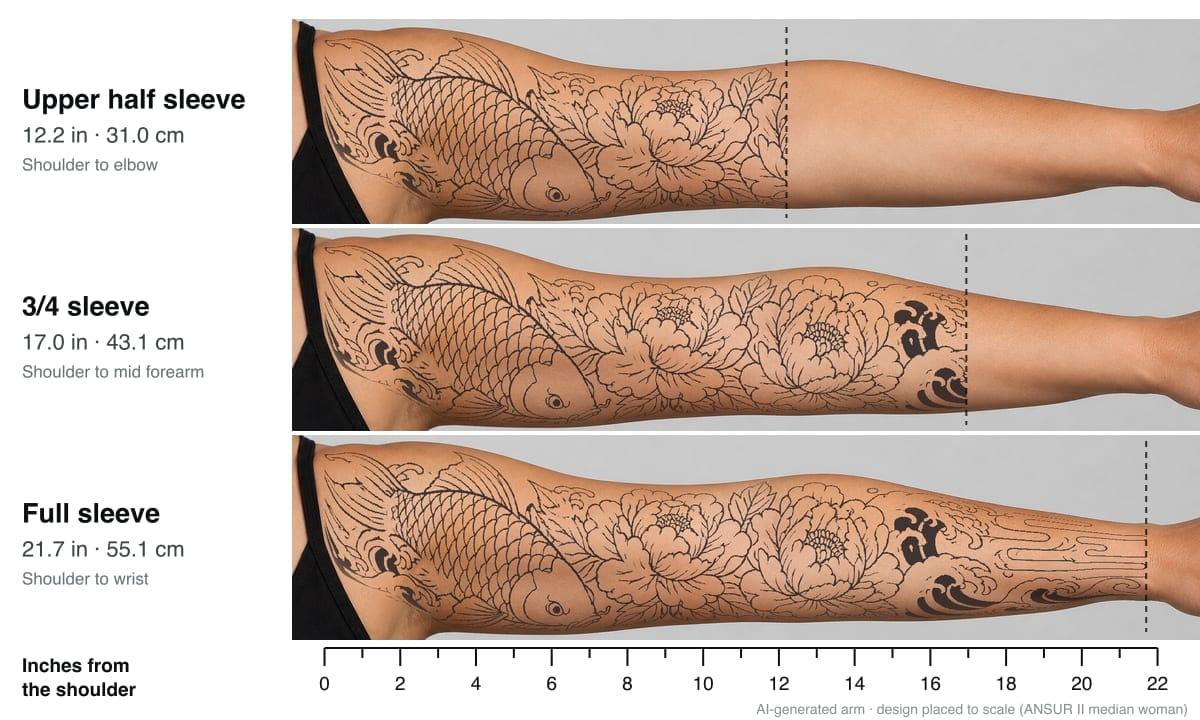
Quarter, half, three-quarter or full sleeve: how big is each?
Sleeve names describe where the tattoo starts and stops, not a number of inches, so we measured them on a median arm. ANSUR II, the US Army's body measurement survey of 1,986 women and 4,082 men (published in 2012, public since 2017), gives the median length from shoulder to elbow and from elbow to wrist. Below, the same Japanese-style design is clipped to each sleeve length on one arm, at exact scale.
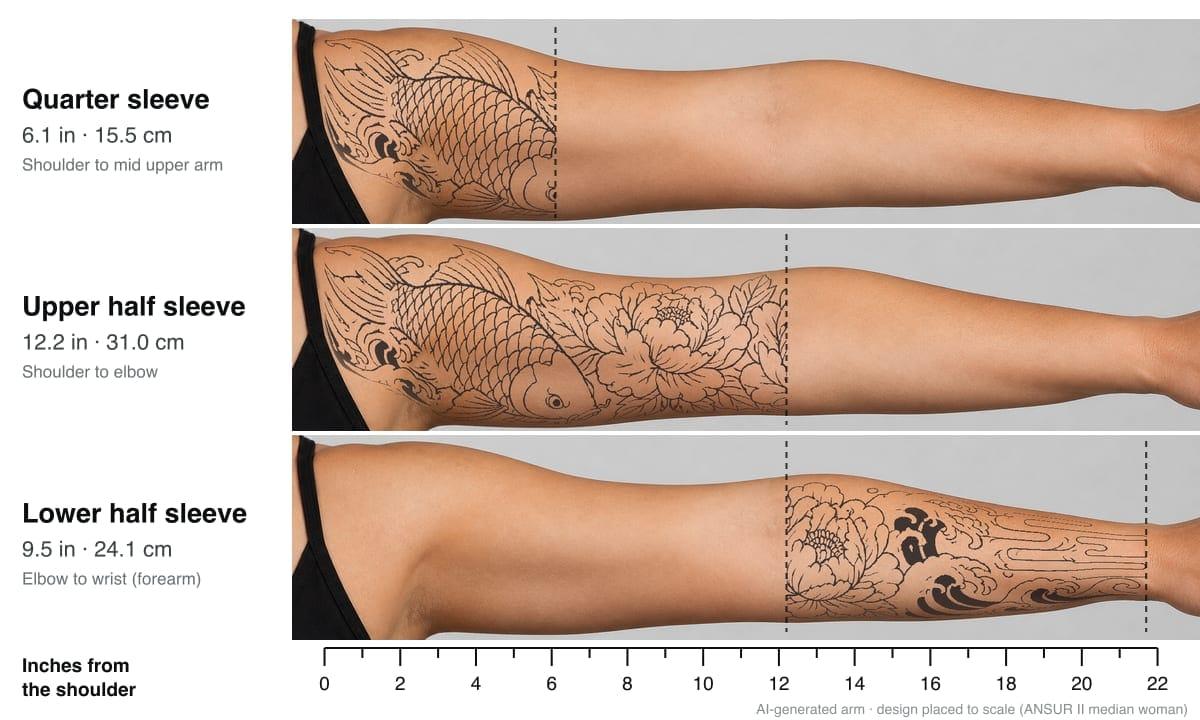 6.1, 12.2 and 9.5 inQuarter, upper half and lower half (forearm) sleeve on a median woman's arm.
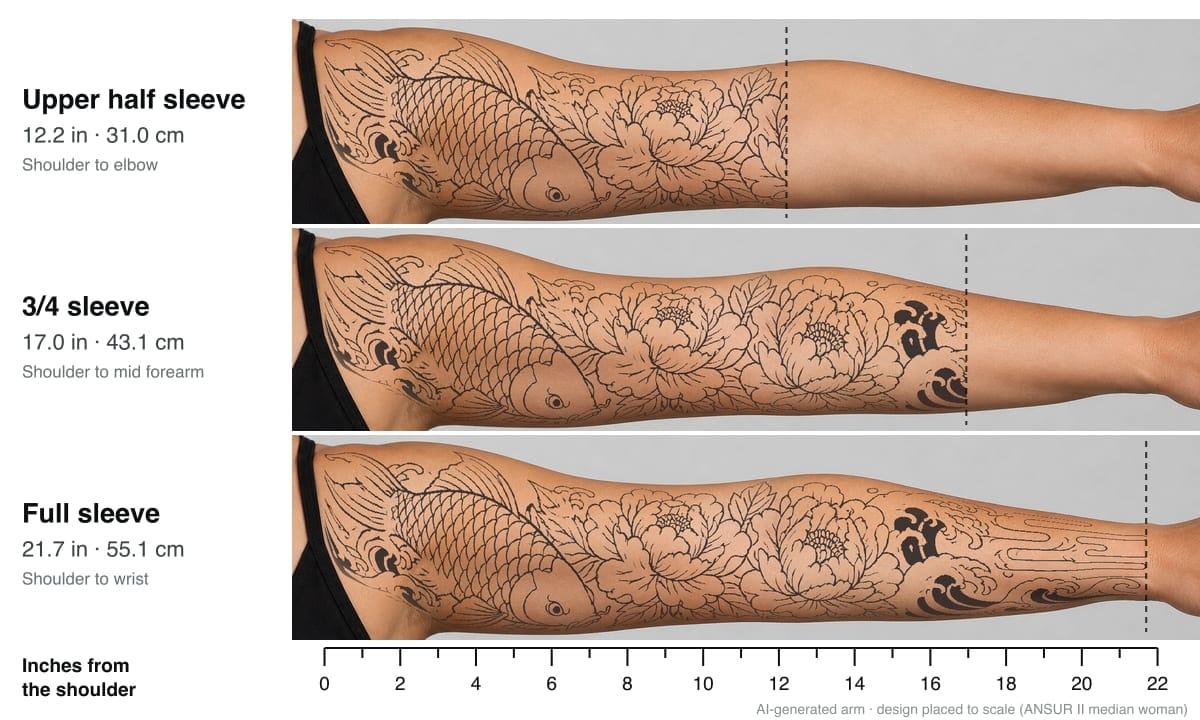 12.2, 17 and 21.7 inUpper half, 3/4 and full sleeve on the same arm.
| Sleeve | Covers | Length, women | Length, men | Around the arm, women / men |
|---|---|---|---|---|
| Quarter | Shoulder to about halfway to the elbow | 6.1 in 15.5 cm | 6.6 in 16.8 cm | 12.0 / 14.0 in 30.4 / 35.8 cm |
| Upper half | Shoulder to elbow | 12.2 in 31.0 cm | 13.2 in 33.5 cm | 12.0 / 14.0 in 30.4 / 35.8 cm |
| Lower half (forearm) | Elbow to wrist | 9.5 in 24.1 cm | 10.5 in 26.7 cm | 10.4 / 12.2 in 26.4 / 31.0 cm |
| Three-quarter | Shoulder to mid-forearm | 17.0 in 43.1 cm | 18.5 in 46.9 cm | Both of the above |
| Full | Shoulder to wrist | 21.7 in 55.1 cm | 23.7 in 60.2 cm | Both of the above |
Our calculation from ANSUR II medians: a quarter sleeve is half the shoulder-to-elbow length, a three-quarter sleeve adds half the forearm, and "around" is the flexed biceps or forearm circumference, so it slightly overstates a relaxed arm. The sample is US military personnel aged 17 to 58, not the general population. Definitions also vary: Wikipedia describes a half sleeve as usually shoulder to elbow, while Adrenaline Tattoo in Vancouver also calls an elbow-to-wrist piece a (lower) half sleeve. Tell your artist exactly where the tattoo should start and stop.
- Skin to cover in a full sleeve, median woman
- ~245 sq in
- Skin to cover in a full sleeve, median woman
- About 20 palm-size (4 × 3 in) pieces
- Skin to cover in a full sleeve, median man
- ~313 sq in
- Skin to cover in a full sleeve, median man
- About 26 palm-size pieces
How long does a sleeve tattoo take?
Nobody has surveyed sleeve hours, so the best figures are what studios and artists say about their own work. They agree on the shape: a bold, simple sleeve can take a couple of long working days of tattooing, a detailed realism sleeve several times that.
| Source | What they say |
|---|---|
| Chronic Ink Tattoo | Most sleeves take around 15 hours; some designs have taken over 80 hours. A complex full sleeve can take a year or more to finish. |
| Bustle (2015), after interviewing Brett Baumgart of Premium Tattoo | A traditional sailor-style sleeve may take as little as 10 to 15 hours; a photo-realistic one up to 80 hours, often more. Baumgart's longest project was an 80-hour sleeve. |
| Allure (2021), artist Erin Odea | Sleeves can take days and sometimes years to complete, because even seasoned collectors have a limit to how many hours they can sit. |
The hours are only half of it. How long the sleeve takes on the calendar depends on how often you book, how quickly you heal and how busy your artist is; Wikipedia sums it up as weeks, months or years for a planned sleeve. Treat these figures as a range, not an estimate for your design: only your artist can time your sleeve once they see the drawing and your arm.
How many sessions does a sleeve take, and how far apart?
Chronic Ink says most people sit for three to six hours per session (the longest sessions it mentions run around 16 hours), with sessions normally two weeks apart and three weeks to be on the safe side. At three to six hours a sitting, a 15-hour sleeve works out to roughly three to five sessions; that is our arithmetic, not a studio figure. Bustle also reports an average of two weeks between sessions: Baumgart explains that artists cannot tattoo next to skin that is still raw and healing, and that aftercare runs for weeks after every session. In Allure, Becca Genné-Bacon of Kings Avenue says she prefers to work on a sleeve one or two pieces at a time.
Two weeks is what artists report for spacing, not a healing deadline. Medical sources describe the surface of a tattoo closing in two to three weeks and the deeper layers taking months, as our tattoo healing stages guide explains. Your artist decides when the next area is ready, and anything that looks infected is a question for a doctor, not for the next session.
How much does a sleeve tattoo cost?
Most tattoo artists charge by the hour (Allure), so the price of a sleeve follows its hours. Few studios publish sleeve prices; Atlanta Ink is one that lists starting prices by size:
| Sleeve | Atlanta Ink starting price |
|---|---|
| Quarter sleeve | $500 |
| Half sleeve | $900 |
| Full sleeve | $1,700 |
Those are one studio's minimums, and the page does not say what a sleeve at the starting price includes. For studios that bill by time, multiply the hours by the rate. The median hourly rate in our sample of 25 US studios (checked November 4, 2026) is $200, which gives:
- 10 hours (the low end Bustle gives for a sailor-style sleeve): $2,000
- 15 hours (what Chronic Ink says most sleeves take): $3,000
- 80 hours (a photo-realistic sleeve, per Bustle): $16,000
For quarter, half and full sleeve prices from more studios, hours and sessions, see the sleeve tattoo cost guide.
These are multiplications, not quotes: rates in the sample range widely, and some studios sell day rates for long sittings, as the cost guide shows. For your own design, the tattoo price calculator gives a planning range, and your artist gives the real number after a consultation.
How do you plan a sleeve tattoo?
- Pick the style first. The style decides which artist you book, how the background will look and roughly how many hours it takes. If you want several styles on one arm, Genné-Bacon finds that keeping everything black and grey holds it together.
- Choose cohesive or patchwork. One planned composition, or separate pieces joined over time (compared below).
- Name your three or four biggest images and tattoo those first. Genné-Bacon asks clients for the three or four largest, most important images and starts there; the spaces between them then dictate the smaller pieces. A community guide by InkFreakz puts the main images on the outer upper arm and forearm, where they show, and background on the inner arm and elbow.
- Decide the elbow early. Genné-Bacon asks clients what they plan for their elbow early on; for something circular or symmetrical there, like a ship's wheel, she recommends starting with it.
- Decide on one artist or several. For one large image with a background, Genné-Bacon says definitely use one artist. A patchwork sleeve does not demand loyalty to one artist.
- A theme is optional. Asked whether a sleeve needs one theme, both artists in Allure answered "Not at all!" Palette, line weight and style can carry the unity instead.
- Say if you may extend it later. Chronic Ink says a good artist should be able to fold a half sleeve into a full sleeve; tell them at the first consultation so the first piece leaves room.
- Book a consultation with photos. Atlanta Ink, for example, handles sleeves through a consultation request and asks for a photo of your reference and of the placement.
Patchwork sleeve vs full sleeve: what is the difference?
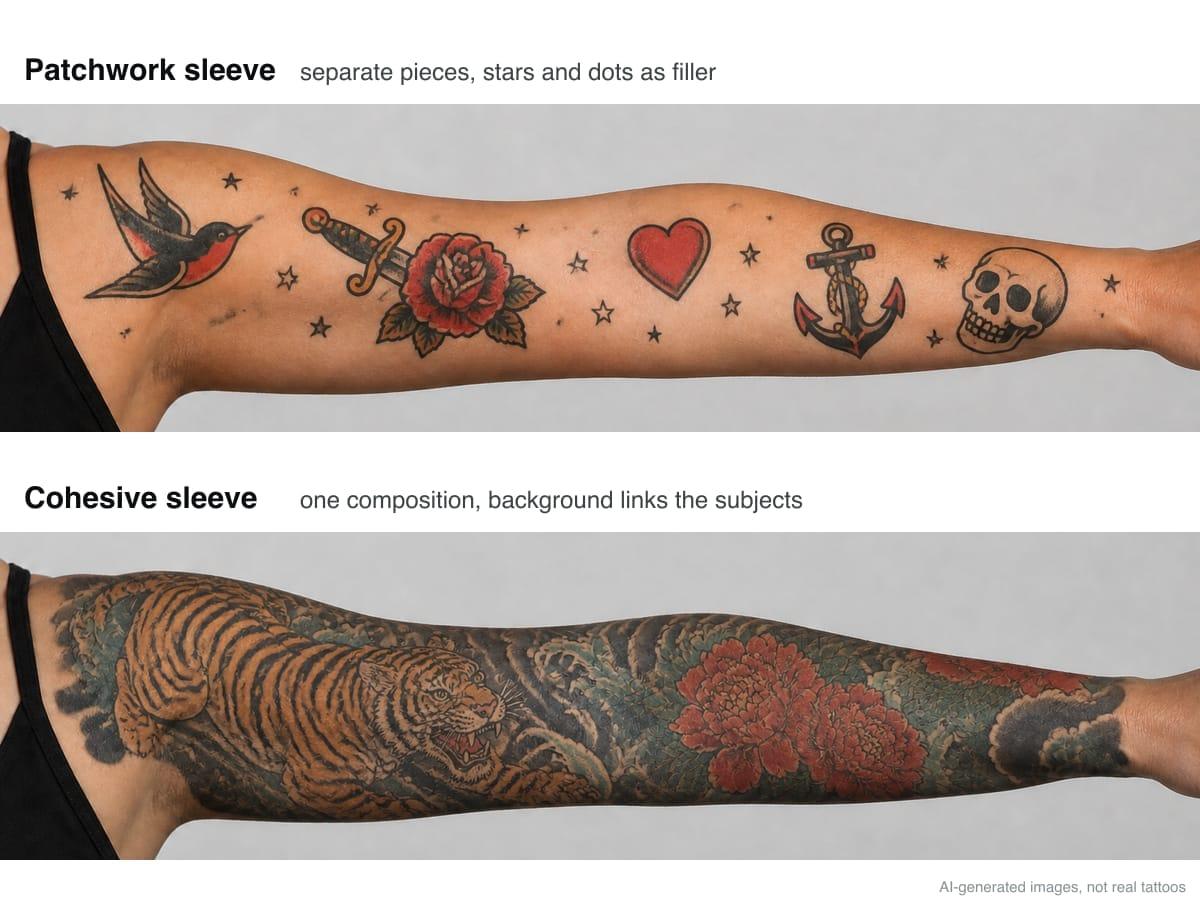
"Full" describes the length, "patchwork" describes the method, so a full sleeve can be either. Allure defines a patchwork sleeve as a sleeve made up of separate tattoos; InkFreakz adds that the pieces are often collected over time and linked later with filler. A cohesive sleeve is one composition with a shared background, common in Japanese work and large realism.
| Patchwork sleeve | Cohesive sleeve | |
|---|---|---|
| How it is designed | Piece by piece, often over years | As one composition, drawn up front or in large sections |
| Number of artists | Can be several | Usually one, especially for one large image with a background |
| How gaps are filled | Filler: stars, dots, small flowers, shading | Background drawn into the design: waves, wind bars, clouds, smoke |
| Can you start small? | Yes, each piece stands on its own | Yes, if the first piece is placed with the whole plan in mind |
What can you use as sleeve filler?
- Stars and dots. Erin Odea of Crossed Keys Society calls them the classic: "Doesn't get better than those." They fit any space, small or big, packed tight or spread out (Allure).
- Small flowers and simple symbols. Odea's rule is that small fillers need to stay simple to fit small spots.
- A filler drawn for the exact gap. Genné-Bacon takes accurate tracings of the empty area and draws for exactly that spot.
- Black and grey shading. Shading is one of the ways patchwork pieces get linked, and an all black-and-grey palette makes mixed styles look like one sleeve.
- Background elements. In Japanese work the background is part of the design: waves, wind bars and clouds connect koi, dragons, tigers and peonies, as our tattoo styles guide describes.
Which parts of the arm hurt most for a sleeve?
In Table 1 of Pimentel and colleagues (2021), based on interviews with six tattoo artists and two customers at one Florida shop, the shoulders, biceps and triceps and the forearm sit in the lower tier, the elbow and the hand in the middle tier, and the armpits in the higher tier. The table does not rate the wrist and does not separate the inner arm from the outer arm. Artists at Adrenaline Tattoo describe the elbow joint and the inner arm as more sensitive.
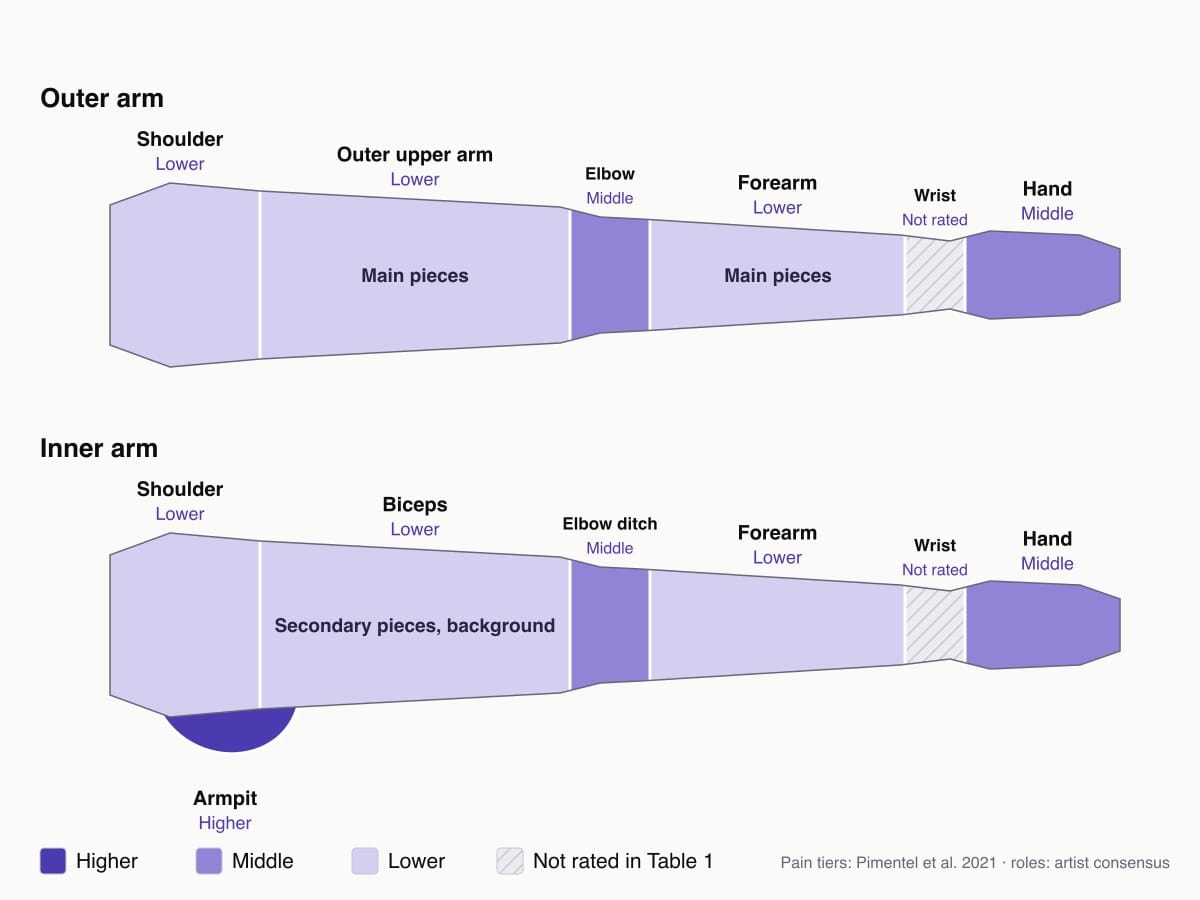
Zone is only part of the story. In a survey of 1,092 tattooed people, Witkoś and Hartman-Petrycka (2020) found that the body area was not a significant predictor of pain intensity once session length, stress and bleeding were counted, and that longer sessions came with more pain. They also found radiating pain more often for arm tattoos than leg tattoos (83% vs 72%). For a sleeve, shorter sittings and breaks may matter as much as where you start. Our tattoo pain chart covers the full body and the limits of these studies.
What styles work best for a sleeve?
Any style can fill a sleeve. What changes is the number of hours, how the background looks and how the pieces connect. Here is the same snake and rose drawn as a sleeve design in four styles.
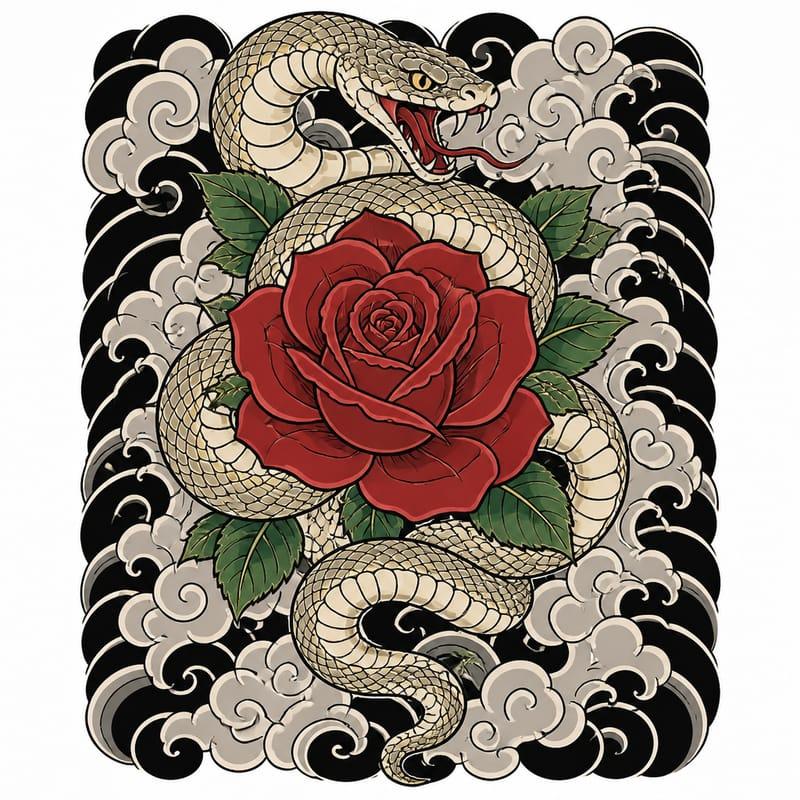 JapaneseComposed for the body as a whole, which is why the style is known for sleeves.
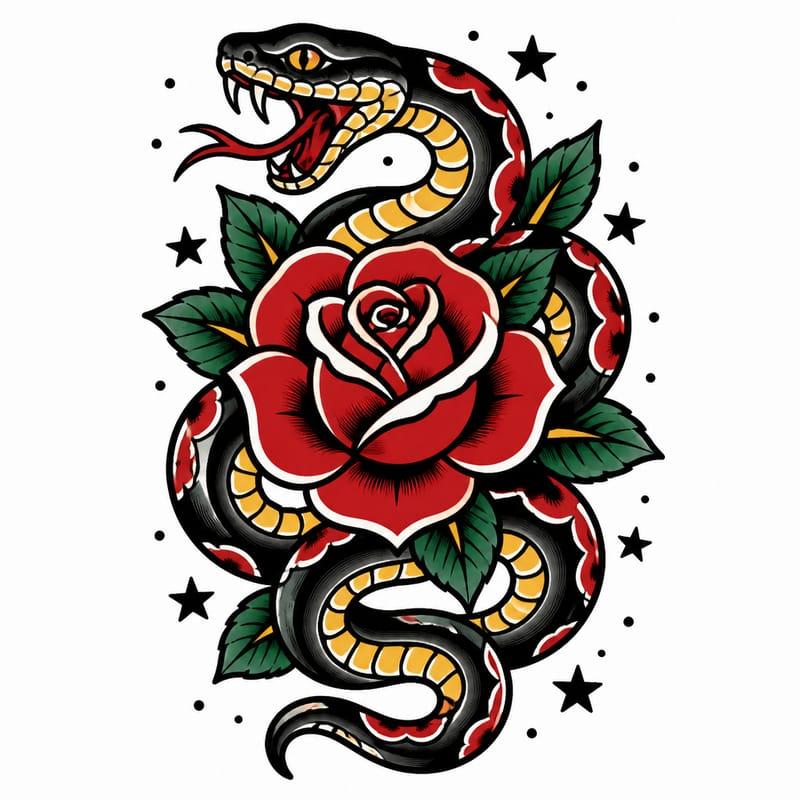 TraditionalBold and simple: as little as 10 to 15 hours for a sailor-style sleeve, per Bustle.
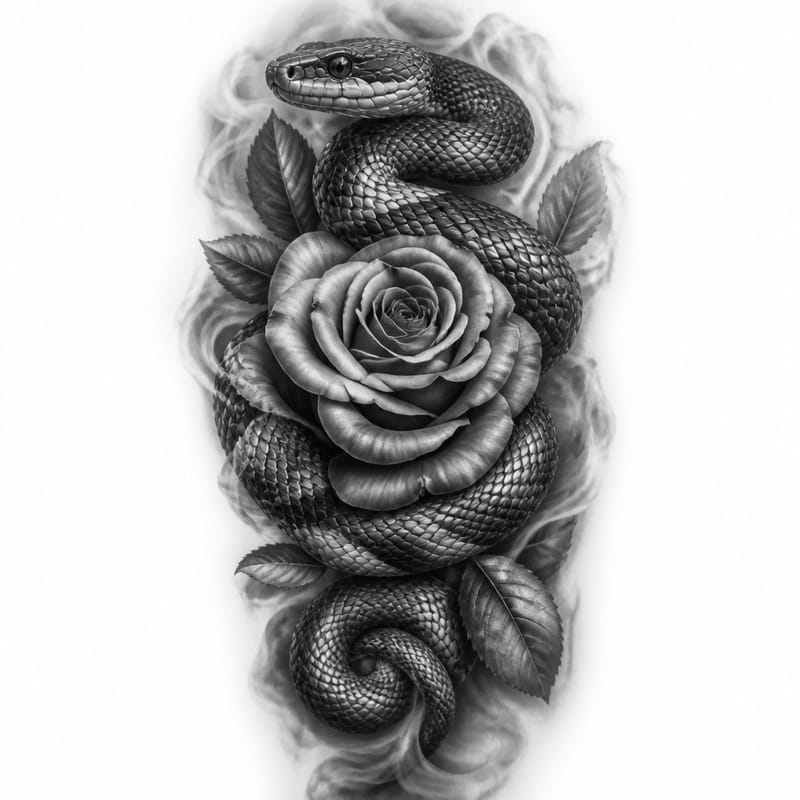 RealismSmooth gradients take longest: up to 80 hours or more, per Bustle and Chronic Ink.
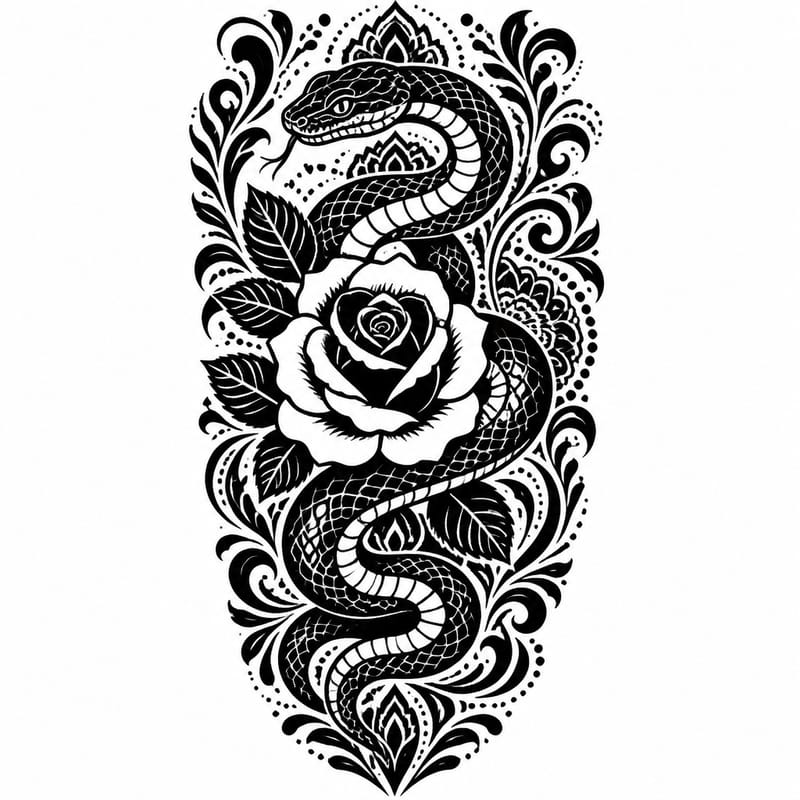 BlackworkSolid black and bare skin; bold, open designs are faster than smooth gradients.
Mixing styles is possible; the planning list above has the artists' tip for keeping it cohesive. The tattoo styles guide shows one rose in eight styles if you have not picked yours yet.
Japanese sleeve lengths: gobu, shichibu and nagasode
In Japanese tattooing you may hear these terms. Wikipedia's irezumi glossary, which is flagged as needing citations, lists gobu as a sleeve that stops above the elbow, shichibu as a three-quarter sleeve to mid-forearm and nagasode as an arm tattoo to the wrist. Chronic Ink also describes the hikae, a sleeve that continues over the shoulder onto the chest.
Sleeve tattoo ideas for men and women
No sleeve style belongs to one gender: Japanese sleeves, traditional flash, realism and blackwork are worn by people of every gender, and what should decide yours is the design, the size and the artist. The subjects on this page are starting points: koi, peonies and waves; a tiger with peonies; a snake and a rose; swallows, daggers and anchors for a patchwork. For single subjects that can anchor a sleeve, see the tiger, wolf, lion and samurai ideas, or generate a sleeve concept to bring to your consultation.
Can you hide a sleeve at work?
It depends on the length. Wikipedia notes that people choose a quarter sleeve so it can be covered by a short-sleeved shirt. Adrenaline Tattoo recommends an upper half sleeve to people who may need to hide it at work, and calls a quarter sleeve a good entry tattoo for those who want more later but must wait for time, budget or profession. A lower half (forearm) sleeve shows whenever your forearms do; with a T-shirt over the upper arm, Adrenaline notes, it can look like a full sleeve.
What about a leg sleeve?
The word is sometimes used for a large tattoo that covers a leg (Wikipedia). Using the same ANSUR II medians, a leg sleeve from the top of the thigh to the ankle is about 28.3 inches long for women (13.1 in of thigh plus 15.2 in of lower leg) and 30.4 inches for men (14.1 + 16.3 in), so expect more hours than an arm. The thigh placement guide covers the widest part of it.
Plan the rest of your sleeve
Tattoo Size Chart
How much room each body part has, in inches and cm.
Tattoo Cost Guide
Minimums and hourly rates from 25 US studios.
Tattoo Pain Chart
Which spots hurt most, and why session length matters more.
Tattoo Healing Stages
What healing looks like between sessions, week by week.
Tattoo Styles
One rose in eight styles, to pick the look of your sleeve.
First Tattoo Guide
What to settle with your artist before the first appointment.
Forearm Tattoos
If you start with a lower half sleeve.
Shoulder Tattoos
If you start with a quarter sleeve on the shoulder cap.
Sources
- ANSUR II: Anthropometric Survey of US Army Personnel (public data, OPEN Design Lab, Penn State) · checked November 6, 2026
- Wikipedia: Sleeve tattoo · checked November 6, 2026
- Wikipedia: Irezumi (glossary, flagged as needing citations) · checked November 6, 2026
- Chronic Ink Tattoo: Types of sleeve tattoos · checked November 6, 2026
- Bustle (Annie Crawford, September 3, 2015): How long does a full sleeve tattoo take, with Brett Baumgart of Premium Tattoo · checked November 6, 2026
- Allure (Marci Robin, January 19, 2021): How to curate a custom tattoo sleeve, with Erin Odea and Becca Genné-Bacon (via Yahoo) · checked November 6, 2026
- Adrenaline Tattoo: Where should a tattoo sleeve end (2020) · checked November 6, 2026
- Atlanta Ink: booking page with starting prices and sleeve consultations · checked November 6, 2026
- Pimentel et al. 2021, Frontiers in Virtual Reality, Table 1 (reported pain sensitivity by body location) · checked November 6, 2026
- Witkoś & Hartman-Petrycka 2020, International Journal of Environmental Research and Public Health (1,092 participants) · checked November 6, 2026
- InkFreakz: Planning a full sleeve (community guide) · checked November 6, 2026
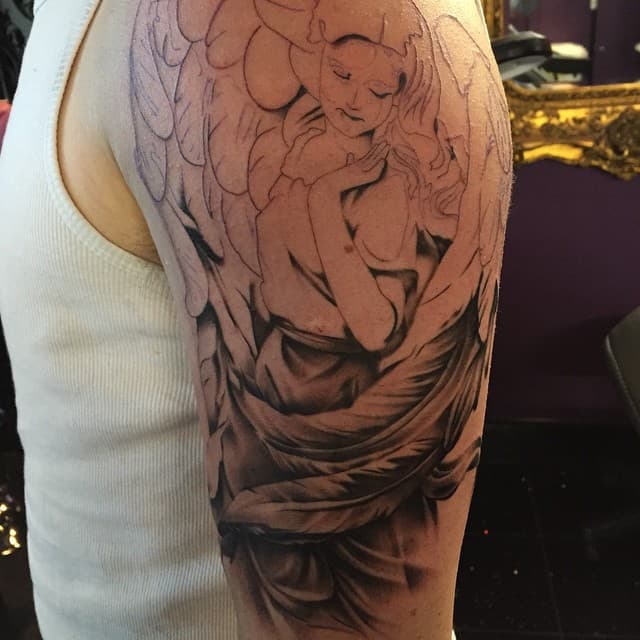
- Photo: Angel Half Sleeve Black and White Tattoo, Josh Morley, CC BY 2.0 (Wikimedia Commons) · checked November 6, 2026
Sleeve tattoo FAQ
How long is a full sleeve tattoo in inches?+
About 22 inches from shoulder to wrist for a median woman (21.7 in, 55 cm) and about 24 inches for a median man (23.7 in, 60 cm), based on ANSUR II arm measurements. Your own arm may be longer or shorter, so measure it.
What is the difference between a half sleeve and a quarter sleeve?+
A quarter sleeve runs from the shoulder to about halfway to the elbow, roughly 6 to 6.5 inches on a median arm. A half sleeve usually runs from the shoulder to the elbow, about 12 to 13 inches, though some studios also call an elbow-to-wrist forearm sleeve a half sleeve.
How many hours does a sleeve tattoo take?+
Chronic Ink Tattoo says most sleeves take around 15 hours, with some designs over 80. Bustle's 2015 interview with Brett Baumgart puts a traditional sailor-style sleeve at 10 to 15 hours and a photo-realistic one at up to 80 hours or more. Only your artist can estimate your design.
How many sessions does a full sleeve take?+
It depends on the hours and how long you sit. Chronic Ink says most people sit three to six hours per session, usually about two weeks apart, so a 15-hour sleeve is roughly three to five sessions by simple arithmetic, and a detailed sleeve many more.
How much does a sleeve tattoo cost?+
Atlanta Ink lists starting prices of $500 for a quarter sleeve, $900 for a half sleeve and $1,700 for a full sleeve. Studios that bill by the hour multiply time by their rate: at the $200 median of our 25-studio sample, 15 hours would come to $3,000. That is arithmetic, not a quote.
Can you get a sleeve in one session?+
Rarely. Chronic Ink mentions sessions of around 16 hours as the extreme, while most people sit three to six hours. Becca Genné-Bacon told Allure that finishing a whole sleeve in one appointment is usually not possible, because of time or pain.
Should one artist do the whole sleeve?+
For one large image with a background, the artists interviewed by Allure recommend one artist, which also keeps the sleeve cohesive. A patchwork sleeve of separate pieces can mix several artists whose work you like.
Tattoo planning tool
Preview a sleeve tattoo before booking
Describe your idea, generate it in any style, and preview it on your own skin before the needle.
Generate for freeFree to start
Compare more placements
- Forearm TattoosForearm tattoos are easy to preview, easy to photograph and usually manageable for a first tattoo.
- Wrist TattoosWrist tattoos are visible and personal, but the area is small and moves often.
- Chest TattoosChest tattoos can be powerful and balanced, but they need careful placement around the sternum, collarbone and natural body lines.
- Shoulder TattoosShoulder tattoos work well when the design follows the rounded body shape.