Tattoo Aftercare: How to Care for a New Tattoo Day by Day
Aftercare · By CustomTattoo AI Editorial Team · Updated
Tattoo aftercare comes down to a few habits: keep the covering on for as long as your artist says, then wash the tattoo gently with clean hands twice a day, pat it dry and apply a thin layer of the ointment or fragrance-free lotion your artist recommends, and keep it out of pools, baths, the sea and direct sun until it has healed. Do not pick or scratch it. Studios disagree on the details, such as how long a wrap stays on or ointment versus lotion, so the sheet your artist gives you comes first. Fever, redness that keeps spreading or pain that gets worse instead of better are reasons to see a doctor.
Tattoo aftercare day by day: the care routine
What to do, stage by stage
First hours
Leave the covering on
- Keep the wrap or film on for the time your artist gave
- Wash your hands before you touch it
- Remove it gently, then do the first wash
First days
Wash and apply a thin layer
- Wash gently about twice a day
- Pat dry with a clean paper towel
- Thin layer of the ointment or lotion your artist chose
Peeling weeks
Hands off, keep it clean
- Keep washing and moisturizing
- Do not pick flakes or scratch
- No soaking, no direct sun, loose clothes
Once healed
Protect it for life
- Back to pools and the sea
- Sunscreen SPF 30+ on exposed ink
- Moisturize if the skin gets dry
Each stage ends when the skin is ready, not on a set day. A small fine-line piece on an arm moves through it faster than a large, heavily shaded back piece, and Cleveland Clinic notes that the top layer of skin typically needs about two months to heal, with deeper layers taking longer. If you want to know whether what you see is normal (oozing, peeling, cloudy skin), the healing stages guide shows it day by day. This page is about what to do.
How long should you keep a new tattoo wrapped?
As long as your artist tells you, because the answer depends on what they put on it. There are two families of covering, and they are not used the same way:
- Plastic wrap, a pad or a regular bandage: meant to stay on for a few hours. The US studio sheets we read say 2 to 4 hours, and some ask you to wrap the tattoo again for the first nights.
- Clear adhesive film (often called second skin; Saniderm and Tegaderm are brand names): breathable and meant to stay on longer, from several hours to several days depending on the artist.
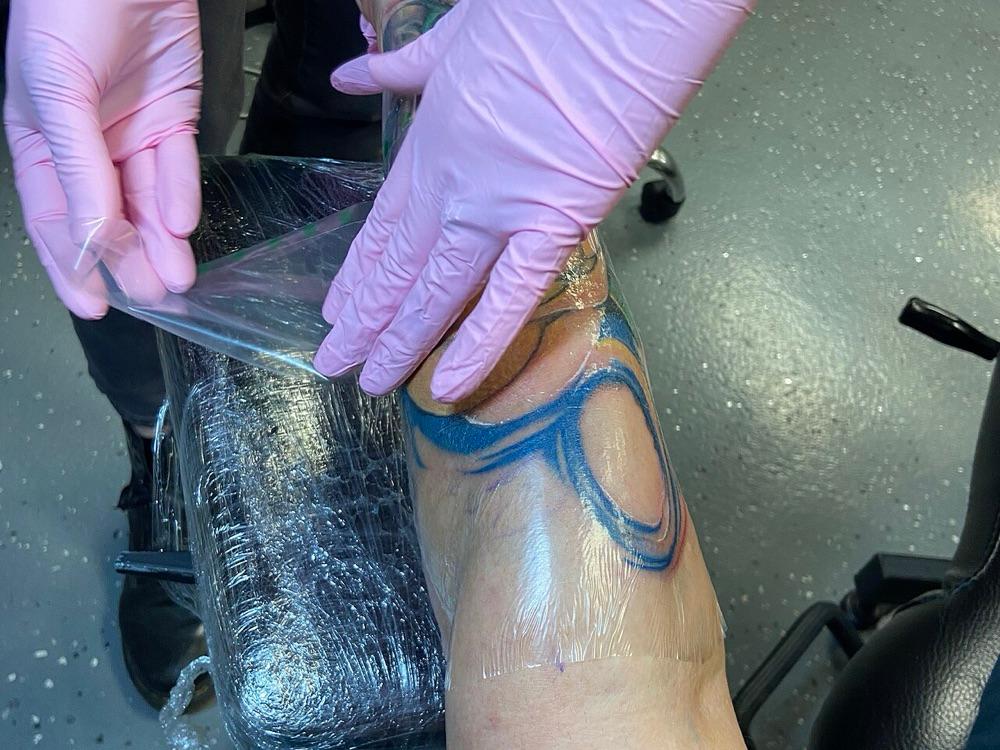
The numbers vary a lot. Cleveland Clinic says a clear bandage stays on for at least three hours or more depending on the size of the tattoo. Chapter House Tattoo in Baltimore says 2 to 3 hours for its bandage. Skin & Ink says 3 to 4 hours for a traditional bandage and typically up to 24 hours for an adhesive film. Club Tattoo has its clients wear a first Saniderm piece for 8 to 24 hours, and Healthline puts the whole range at a few hours to a few days. The European tattoo hygiene standard EN 17169 (2020), as summarized by Fauger and colleagues, lists a dressing for the first two to three days as one of several options.
None of these is wrong: they describe different dressings. What matters is that you know which one you have and how long it is meant to stay. If you left the studio unsure, message the artist the same day rather than guessing. And if a film leaks, lifts at the edges or the skin under it looks irritated, ask the artist whether to take it off early instead of leaving it in place.
How do you take off second skin?
Slowly, and with water. Cleveland Clinic advises washing your hands first, soaking the bandage in warm water to soften it, then peeling it off gently. Then wash the tattoo as described below.
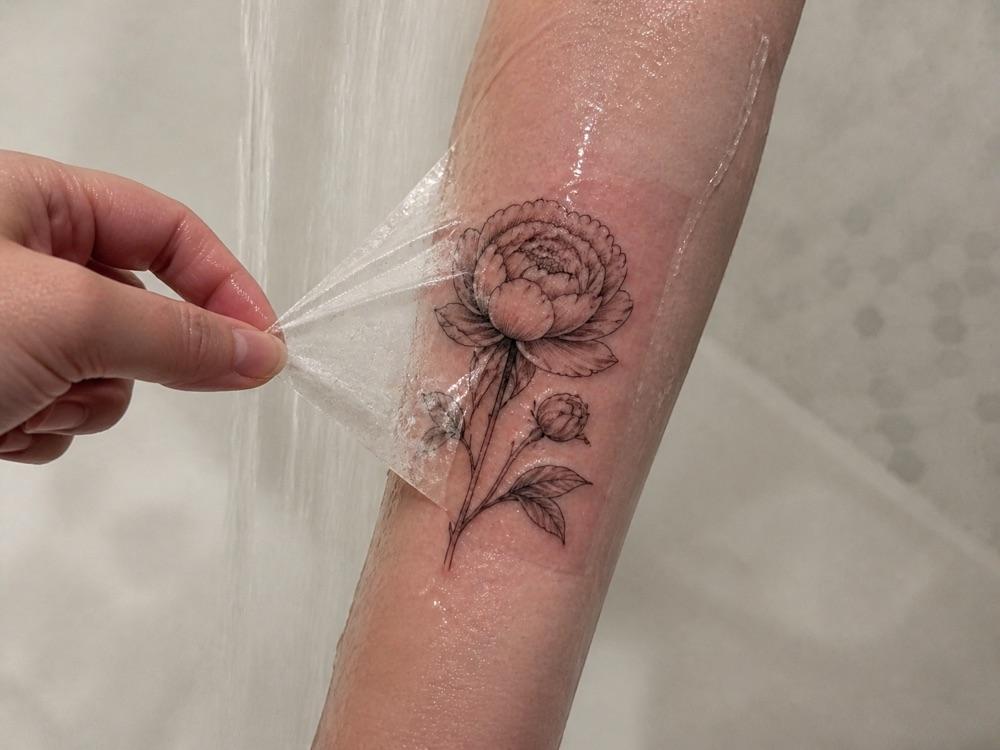
Under the film you will usually see fluid, ink and a little blood collect. That is the normal early oozing held in one place; the healing stages guide explains it. If you have a tattoo with no second skin, the same routine applies from the first wash: you simply start it a few hours earlier.
How to wash a new tattoo, step by step
- Wash your hands with soap first. A 2023 review of 700 US studio sheets found that few of them told clients to do this; Cleveland Clinic's advice starts with it.
- Wet the tattoo with lukewarm water, not hot, and keep the shower stream off it if it is strong.
- Lather a mild, fragrance-free soap with your fingertips and move it gently over the tattoo. No washcloth, loofah or sponge.
- Rinse until no soap is left on the skin.
- Pat dry with a clean paper towel. Press, do not rub. Studios prefer a fresh paper towel to a bath towel.
- Let it air for a few minutes, then apply a thin layer of what your artist recommended.
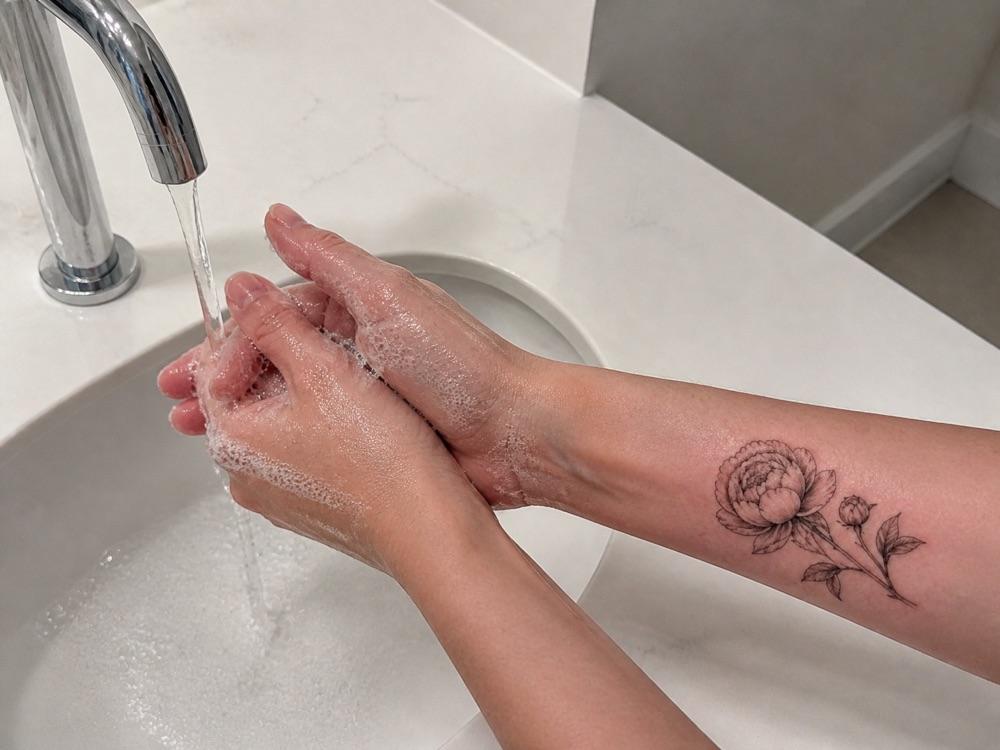 1Wash your hands before you touch the tattoo.
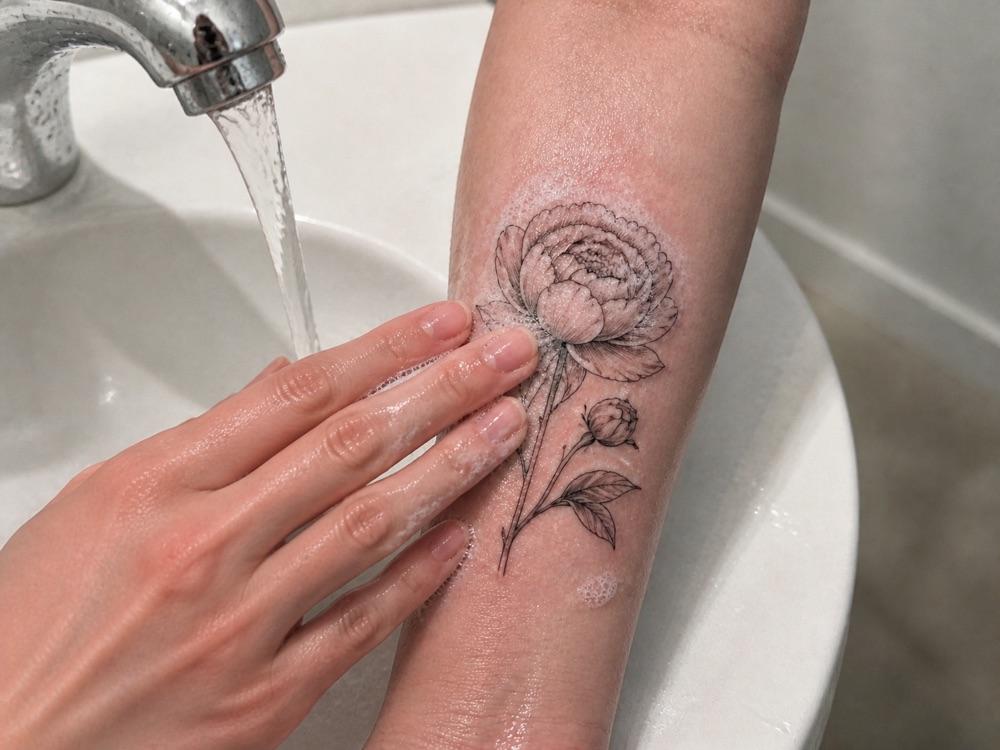 2Lather with fingertips only, lukewarm water.
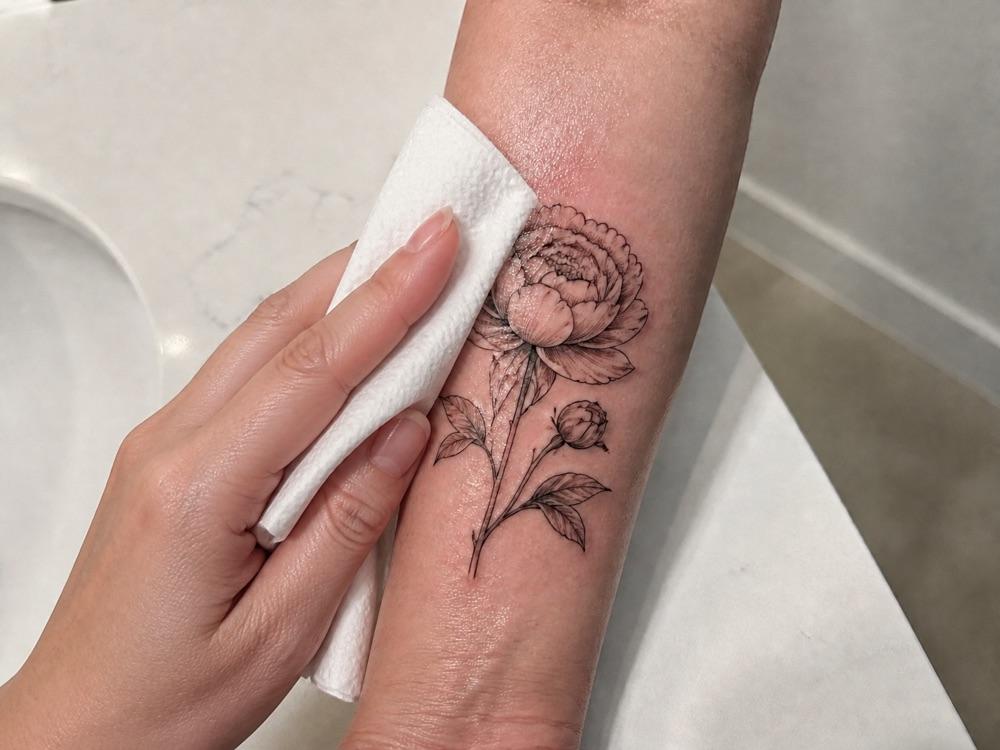 3Pat dry with a clean paper towel.
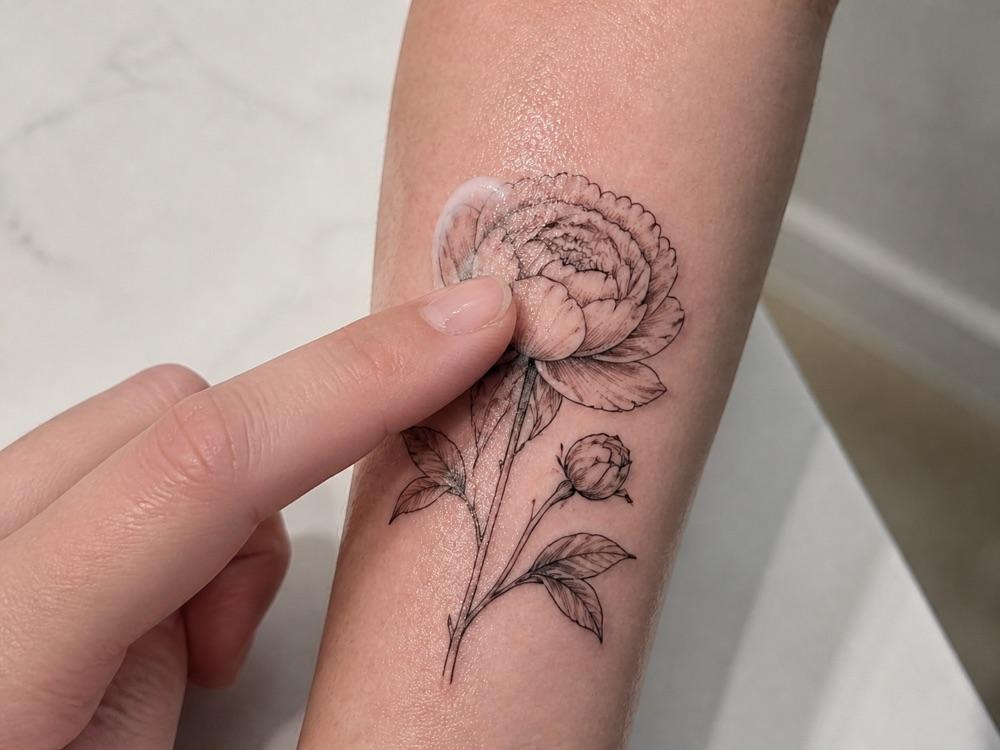 4A thin layer, rubbed in until it barely shows.
How often? Cleveland Clinic says twice a day, with warm water and a mild, fragrance-free antibacterial soap, never scrubbing. Studio sheets mostly say two to three times a day (Club Tattoo, Chapter House, Skin & Ink). The soap itself is a point of disagreement: most of the 700 US sheets reviewed by Liszewski and colleagues recommended antibiotic soaps, including chlorhexidine, while Club Tattoo tells clients to skip harsh antibacterial washes. Chapter House even asks for hot water, where Cleveland Clinic says warm, not hot. If your sheet and this page disagree, ask your artist; if your skin reacts to a soap, stop using it.
Ointment or lotion: what should you put on a new tattoo?
This is where aftercare advice disagrees the most, and no clinical trial settles it. Three positions come up again and again:
- Ointment first, lotion later. The European standard EN 17169, as summarized by Fauger and colleagues, describes a thin layer of a tattoo aftercare ointment two or three times a day for the first two to three days, then an unperfumed moisturizing lotion several times a day for two to three weeks. Chapter House Tattoo uses a very thin coat of Aquaphor for three days, then a light lotion.
- Lotion from the start. Club Tattoo asks for a thin layer of fragrance-free lotion two to three times a day, and its Saniderm sheet names water-based lotions.
- No petroleum. Cleveland Clinic lists petroleum jelly among things to avoid until the tattoo is healed, and the AAD says petroleum-based products can make tattoo ink fade and suggests a water-based lotion or cream. Healthline draws the line at 100% petroleum products such as original Vaseline, and treats Aquaphor, which is not pure petroleum jelly, as generally fine in a thin layer.
Two things almost everyone agrees on: the layer should be thin, and the product should be simple. Club Tattoo puts it well: a healing tattoo should look lightly moisturized, not glazed. A thick coat keeps the skin wet and stops air from reaching it. If you can still see product sitting on the skin a few minutes later, you used too much: blot it with a clean paper towel.
- US studio aftercare sheets reviewed
- 700
- US studio aftercare sheets reviewed
- all 50 states and Washington, D.C.
- different moisturizers recommended
- 70
- different moisturizers recommended
- 22 of them niche tattoo products
- of sheets encouraged topical antibiotics
- 14.9%
- of sheets encouraged topical antibiotics
- in the same 2023 review
- listed contact allergens per aftercare product, on average
- 7.9
- listed contact allergens per aftercare product, on average
- 84 products from 52 brands
That last figure is a good reason to keep it plain. A product sold for tattoos is not automatically gentler: in the 2021 product review, tattoo aftercare products listed an average of about eight ingredients on the American Contact Dermatitis Society's core allergen series. A fragrance-free product with a short ingredient list is a reasonable starting point. The AAD lists itch, bumps, blisters and a rash among signs of an allergic reaction; if a product stings or a rash appears where you applied it, stop and ask a health professional.
Prompt to try
“minimal fine line wildflower bouquet tattoo for the outer ankle, no shading”
Generate this designWhat 7 aftercare instruction sheets say about the same tattoo
We put seven sets of instructions side by side: a dermatologist's advice, a European standard, two medical publishers and three tattoo studios. Same new tattoo, same four questions. The disagreements are not mistakes on your sheet; they are the state of tattoo aftercare. Liszewski and colleagues reached the same conclusion from 700 US sheets: recommendations vary tremendously, and many sheets lack basic hygiene and medical-care guidance.
| Source | Covering | Washing | What to apply | Pools, baths, sea |
|---|---|---|---|---|
| Cleveland Clinic, dermatologist, 2026 | Clear bandage, at least 3 hours or more by size | Twice a day, mild fragrance-free antibacterial soap, warm water | Simple moisturizer or recommended ointment, twice a day; no petroleum jelly | No pools, hot tubs or baths until fully healed |
| EN 17169 standard, 2020, via Fauger 2022 | A dressing for 2 to 3 days is one option | Clean before each application | Aftercare ointment 2 to 3 times a day for 2 to 3 days, then unperfumed lotion for 2 to 3 weeks | Not in the summary |
| Healthline, medically reviewed, 2024 | A few hours to a few days, by dressing | Once or twice a day, fragrance-free soap | Ointment in the first days, lotion around week one; no 100% petroleum | No baths, hot tubs or pools until healed |
| Ohio State Wexner Medical Center, 2017 | Cover with a dressing | Daily, medicated or antimicrobial soap | Thin layer of antibiotic ointment until healed | Stay out of oceans and lakes while healing |
| Club Tattoo (Arizona, Nevada, Texas) | Saniderm: first piece 8 to 24 hours, several days in all, per artist | 2 to 3 times a day, mild fragrance-free soap, fingertips only | Thin fragrance-free lotion 2 to 3 times a day | No baths, pools, hot tubs, ocean or lakes for 14 days |
| Chapter House Tattoo (Baltimore) | Bandage 2 to 3 hours; plastic wrap at night for the first 3 nights | 2 to 3 times a day, soap and hot water | Very thin Aquaphor for 3 days, then light lotion | No swimming until fully healed |
| Skin & Ink (magazine and studio) | Bandage 3 to 4 hours; film typically up to 24 hours | 2 to 3 times a day, lukewarm water, mild fragrance-free soap | Very thin layer 2 to 3 times a day, ointment or unscented lotion | No pools or hot tubs for the first several weeks |
Compiled by CustomTattoo AI from the pages linked above, all opened on November 10, 2026. Studios update their sheets, so check the current version, and treat a studio's sheet as that studio's practice, not as medical guidance.
Where all seven agree: clean hands and gentle washing, a thin layer rather than a thick one, no soaking until healed, and no picking. Where they split: how long the covering stays on (two hours to several days), ointment or lotion, petroleum or not, antibacterial soap or mild soap, warm or hot water, and whether swimming waits 14 days or until the tattoo is fully healed. One recommendation stands apart: the 2017 Ohio State advice to use antibiotic ointment until healed. Among the 700 studio sheets in the 2023 review, only 14.9% encouraged topical antibiotics, so this is a minority position; ask your artist or a health professional before putting a medicated product on a tattoo.
Can you dry heal a tattoo?
Dry healing means washing the tattoo but skipping ointment and lotion. Healthline notes that it may lower the risk of irritation or an allergic reaction to a product, but that dry skin itches more, and that no research shows it works better or worse than standard aftercare. Some artists favor it, most sheets in the table above do not. If you try it, do it with your artist's agreement, and add a thin layer of plain moisturizer if the skin gets tight or starts to crack.
Can you shower with a new tattoo?
Yes. Showering is how most people wash a new tattoo. Keep it short, keep the water lukewarm, and let the water run over the tattoo rather than aiming a strong jet at it. What you avoid is soaking: Cleveland Clinic says not to submerge the tattoo, including in baths, until it is fully healed. If you have an adhesive film on, Club Tattoo says showering with it sealed is fine; if the film starts to lift, ask your artist whether to remove it. After the shower, pat the tattoo dry with a clean paper towel, not the bath towel.
When can you swim after getting a tattoo?
When the tattoo is fully healed, according to Cleveland Clinic: no pools, hot tubs or baths until then. Studios give shorter or longer rules: Club Tattoo says 14 days for baths, pools, hot tubs, oceans and lakes, while Skin & Ink says the first several weeks. The safer reading is the medical one: the skin has to be closed, with no scabs or peeling left, not just past a date.
If you have a beach trip or a pool holiday planned, the easiest fix is timing: book the tattoo after the trip, not before. When that is not possible, tell your artist at the appointment; they may suggest a smaller session or a different placement.
How to sleep with a new tattoo
No medical source we found gives sleeping rules, so this is studio practice. Club Tattoo says to sleep on freshly washed sheets and, if you can, off the tattoo, in loose clothing. Skin & Ink says to avoid pressure on tattoos on moving areas while you sleep. Chapter House Tattoo has clients wrap the tattoo in plastic wrap secured with paper tape for the first three nights; most other sheets do not ask for a night wrap. Expect some ink and fluid on the sheets the first nights, so use old ones.
If you wake up with the sheet or a T-shirt stuck to the tattoo, do not pull it off. Wet the fabric with warm water until it lets go on its own, as studio sheets advise, then wash the tattoo, rather than tearing fabric off healing skin.
Can you work out after getting a tattoo?
Lightly, after the first few days, and with care. In the Ohio State Wexner Medical Center advice, a wound-care physician says light exercise is fine, but to avoid excessive sweating for the first few days and gym environments where germs such as MRSA could reach the wound. Club Tattoo suggests taking a few days off or keeping it light, being extra careful with large tattoos and tattoos near a joint, and rinsing off sweat soon after training. Skin & Ink adds that movement stresses healing skin.
- Skip exercises that rub or strongly stretch the tattooed area while it is fresh.
- Wear loose, clean clothes over the tattoo; tight sleeves and leggings rub off scabs.
- Do not lay the tattoo on shared benches, mats or machines.
- Rinse off sweat and pat dry as soon as you finish, then apply your usual thin layer.
Sun and sunscreen: how to protect a new tattoo
While it heals, keep the tattoo out of direct sun and covered with loose clothing. Cleveland Clinic warns that UV exposure can make the ink look faded and lists sunscreen on the area among the things to avoid until it is fully healed, so cover it rather than putting sunscreen on open skin. Tanning beds wait too: the AAD advises avoiding tanning beds and sunlamps, which can fade ink.
Once healed, sunscreen becomes the main long-term care. The AAD recommends a broad-spectrum, water-resistant sunscreen with SPF 30 or higher, applied 15 minutes before going outside and reapplied at least every two hours. A simple clothing test from the AAD: hold the fabric up to the light, and if no light comes through, it covers the tattoo well. A 2020 commentary by Gonzalez and colleagues notes that most tattoo artists already tell clients to protect new tattoos from the sun, but that few are well informed on the full set of sun-safety steps.
Prompt to try
“bold black outline swallow tattoo for the outer forearm, classic style”
Generate this designWhat to avoid after getting a tattoo
| Avoid | Why | Until |
|---|---|---|
| Picking flakes, scratching scabs | Can damage the design and let germs in | Fully healed |
| Touching it with unwashed hands | It is an open wound | Fully healed |
| Baths, pools, hot tubs, sea, lakes | An open wound should not be submerged | Fully healed |
| Direct sun, tanning beds | UV fades ink; sunscreen is not for open skin | Healed, then sunscreen |
| Tight clothes, straps, rough fabric | Friction rubs off scabs | Peeling has stopped |
| Exfoliating, scrubs, loofahs | Scrapes the healing surface | Fully healed |
| Thick coats of ointment | Keeps the skin wet | Always |
| Fragranced or new skin products | Fragrances are common allergens | Healed, and test first |
Avoid list compiled from Cleveland Clinic, the AAD, the CDC and the studio sheets above. Itching is normal while a tattoo heals; tapping lightly around it, as Club Tattoo suggests, or applying your usual thin layer is better than scratching.
When to see a doctor about a new tattoo
To tell normal healing from an infection or an allergic reaction, sign by sign, read infected tattoo signs.
Some redness, swelling, warmth, oozing, itching and flaking are expected early on, and should ease over time. Get medical care if things get worse instead of better. Cleveland Clinic lists fever, skin that feels hot, odor or significant drainage, pain that increases instead of improving, and red streaks or redness that keeps spreading. The AAD adds chills, pus, open sores and itchy, painful bumps in the tattoo, and says to see a doctor or a board-certified dermatologist right away for signs of infection.
- Get immediate medical care for trouble breathing, a racing heart, chest tightness, dizziness, intense swelling or hives: the AAD lists these as signs of a serious allergic reaction that needs immediate care.
- See a doctor promptly for fever, chills or sweats, redness that spreads, red streaks, pus, worsening pain, or a tattoo that is not healing. The FDA notes that a serious infection may need antibiotics, hospital care or surgery.
- Have a rash checked: the FDA says to seek care for a rash, and the AAD notes that ink allergies often affect a single color, red most often. Tell your artist too, and see a board-certified dermatologist if a mild reaction lasts more than one to two weeks.
Not sure whether what you see is normal healing? The tattoo healing stages guide has a side-by-side table of usual healing signs and signs that need a doctor. When in doubt, ask a health professional rather than a forum.
How to care for a healed tattoo
After healing, care is mostly about sun and skin. Use sunscreen on exposed tattoos (SPF 30 or higher, per the AAD), moisturize when the skin feels dry, preferably with a water-based lotion or cream, and skip tanning beds. The AAD also recommends seeing a board-certified dermatologist for any reaction or change in tattooed skin, even years later, and telling the technician about your tattoos before an MRI. If some lines or shading look patchy once the skin has fully settled, ask your artist whether a touch-up makes sense.
This guide summarizes published dermatology and public-health sources and the instructions of named tattoo studios. It has not been reviewed by a clinician and is not medical advice. Your artist's instructions and your doctor's advice come first.
Plan the rest of your tattoo
Tattoo Healing Stages
What a healing tattoo looks like day by day, and how long each stage lasts.
Tattoo Pain Chart
Which spots hurt most, and why session length matters more.
First Tattoo Guide
What to settle with your artist before the appointment, aftercare sheet included.
Tattoo Placement
Choose a body area by pain, visibility, size and how it fits your routine while it heals.
How long should I keep my new tattoo wrapped?+
As long as your artist says, because it depends on the covering. Regular bandages and plastic wrap usually come off after a few hours (Cleveland Clinic says at least three hours or more, depending on size); clear adhesive films can stay on from several hours to several days.
How often should I wash a new tattoo?+
Cleveland Clinic says twice a day; most studio sheets say two to three times a day. Use clean hands, lukewarm water and a mild fragrance-free soap, never a washcloth, then pat dry with a clean paper towel.
Can I put Aquaphor or Vaseline on a new tattoo?+
Sources disagree. Some studios use a very thin layer of Aquaphor for the first days; Cleveland Clinic says to avoid petroleum jelly until healed, and the AAD says petroleum-based products can make ink fade. Follow your artist's sheet, keep any layer thin, and stop if a rash appears.
Can I shower after getting a tattoo?+
Yes, short lukewarm showers are how most people wash a new tattoo. Avoid soaking it: no baths, pools or hot tubs until it is fully healed.
When can I swim after a tattoo?+
Cleveland Clinic says once the tattoo is fully healed; some studios say 14 days, others several weeks. The skin should be closed with no scabs or peeling left. The CDC counts recent tattoos as open wounds and advises staying out of salt and brackish water with one.
How should I sleep with a new tattoo?+
Studio sheets suggest clean sheets, loose clothes and sleeping off the tattoo where possible. If fabric sticks to it, wet it with warm water until it releases instead of pulling.
Sources
- Cleveland Clinic: Tattoo Aftercare Tips From a Dermatologist, with Shilpi Khetarpal, MD (March 20, 2026) · checked November 10, 2026
- American Academy of Dermatology: Caring for tattooed skin · checked November 10, 2026
- American Academy of Dermatology: Tattoos: 7 unexpected skin reactions and what to do about them · checked November 10, 2026
- FDA: Think Before You Ink: Tattoo Safety (content current as of December 17, 2024) · checked November 10, 2026
- CDC: Preventing Vibrio Infection (July 7, 2025) · checked November 10, 2026
- Liszewski W et al. An Analysis of the Content and Recommendations of 700 American Tattoo Aftercare Instructions. Dermatology, 2023 (abstract) · checked November 10, 2026
- Liou YL et al. Characterization of Tattoo Aftercare Products: Allergenic Ingredients and Marketing Claims. Dermatitis, 2021 (abstract) · checked November 10, 2026
- Fauger A et al. Tattoo aftercare management with a dermo-cosmetic product. J Cosmet Dermatol, 2022 (summary of EN 17169) · checked November 10, 2026
- Gonzalez CD et al. Aftercare Instructions in the Tattoo Community: An Opportunity to Educate on Sun Protection. J Clin Aesthet Dermatol, 2020 · checked November 10, 2026
- Healthline: Tattoo Aftercare: Tips, Daily Routine, Products, and More (medically reviewed, January 8, 2024) · checked November 10, 2026
- Ohio State Wexner Medical Center: How to care for a new tattoo (2017) · checked November 10, 2026
- Club Tattoo: Tattoo Aftercare (studio instructions) · checked November 10, 2026
- Club Tattoo: Saniderm Aftercare (studio instructions) · checked November 10, 2026
- Chapter House Tattoo, Baltimore: Tattoo Aftercare (studio instructions) · checked November 10, 2026
- Skin & Ink: Tattoo Aftercare Guide (studio instructions) · checked November 10, 2026
- Photo: applying transparent dressing to protect tattoo, by Myotus, CC BY-SA 4.0, Wikimedia Commons · checked November 10, 2026
Pain, healing and aftercare
- Tattoo pain chart
Which body areas hurt most, from artist reports and a 1,092-person survey.
- Tattoo healing stages
What is normal at day 1, week 2 and week 4.
- Infected tattoo signs
Normal healing versus signs that need a doctor.
- Spine tattoo pain
How much it hurts, how long it takes and designs to scale.
- Do finger tattoos fade?
Why finger tattoos blur and how to make them last.
- Tattoo size chart
How much room each body part has, in inches and cm.