
Realism Tattoos
A realism tattoo reproduces a subject the way a photograph shows it: built from light and shadow, with few or no outlines. It comes in two main palettes, black and grey (diluted black ink) and full color, and it needs room, because every eyelash and feather has to survive years in the skin. Below: the same owl in four kinds of realism, what size does to detail, portrait photo tips, time, cost and pain.
What are the types of realism tattoos?
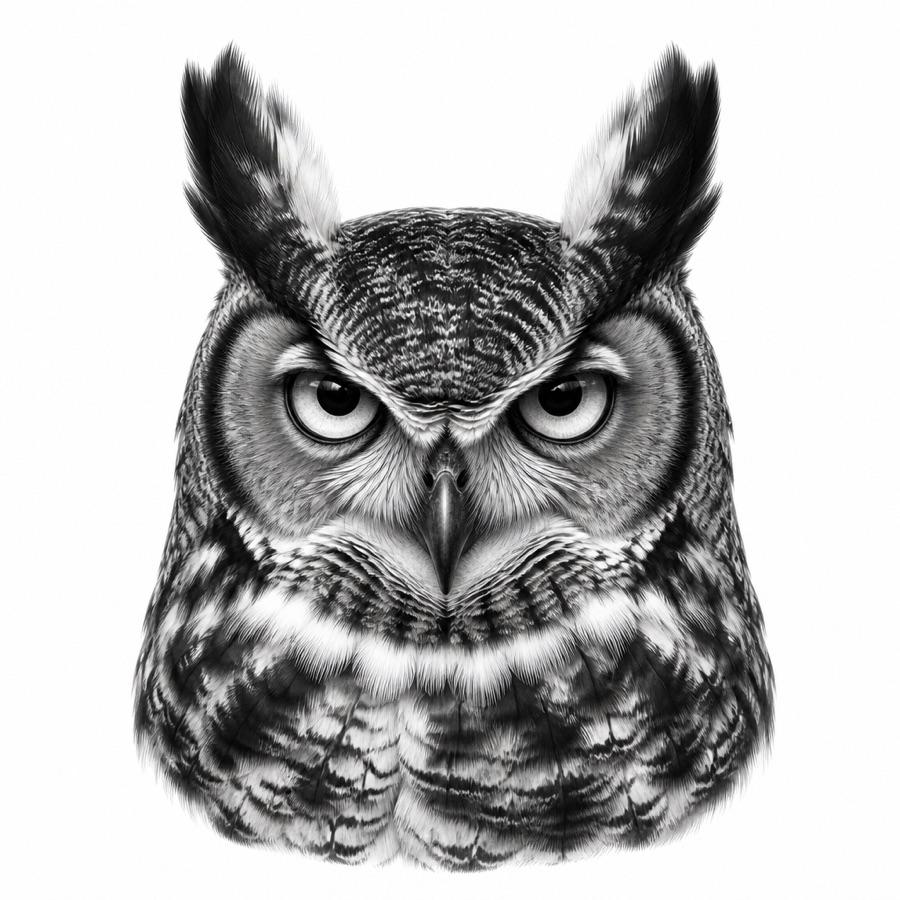
To see the difference, keep the subject fixed. We generated the same great horned owl in four kinds of realism with an AI image model, so only the treatment changes: the palette, and whether the image stays believable or bends into something impossible.
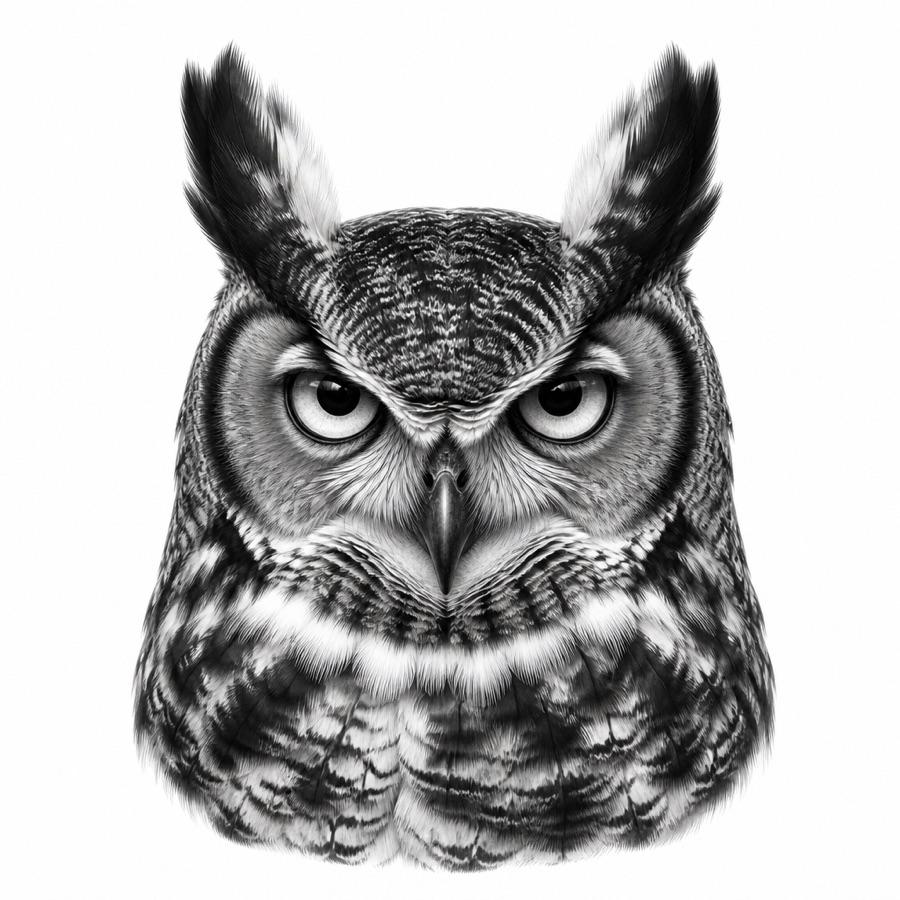 Black and grey
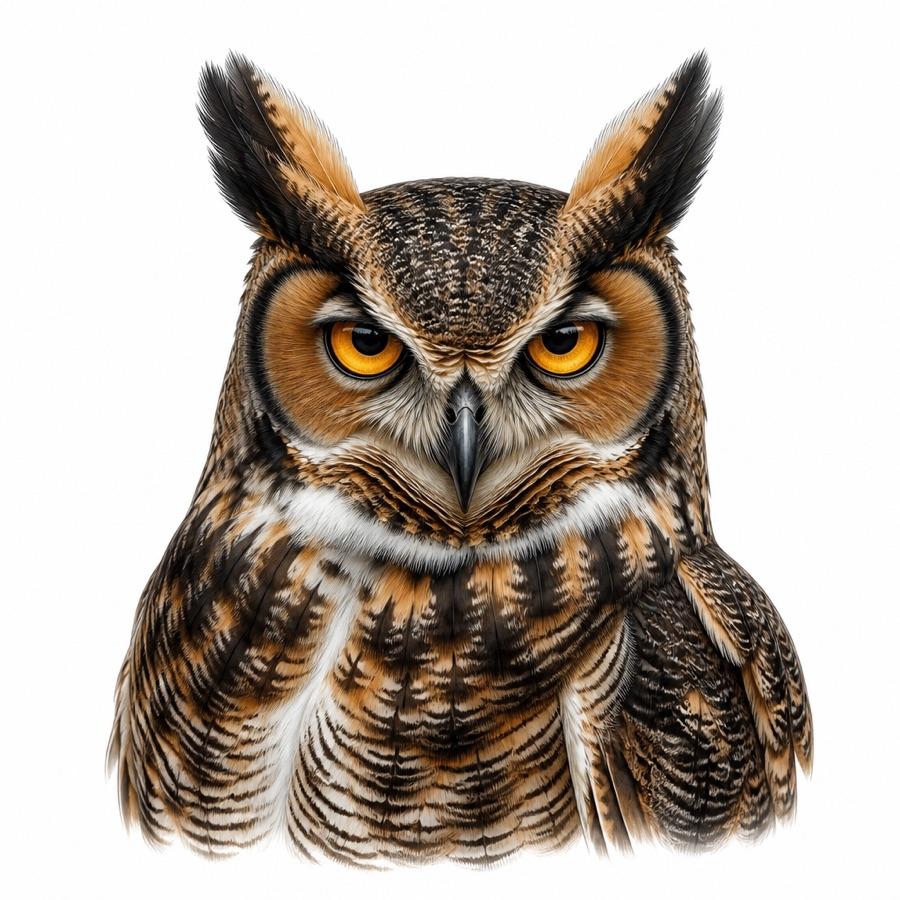 Color realism
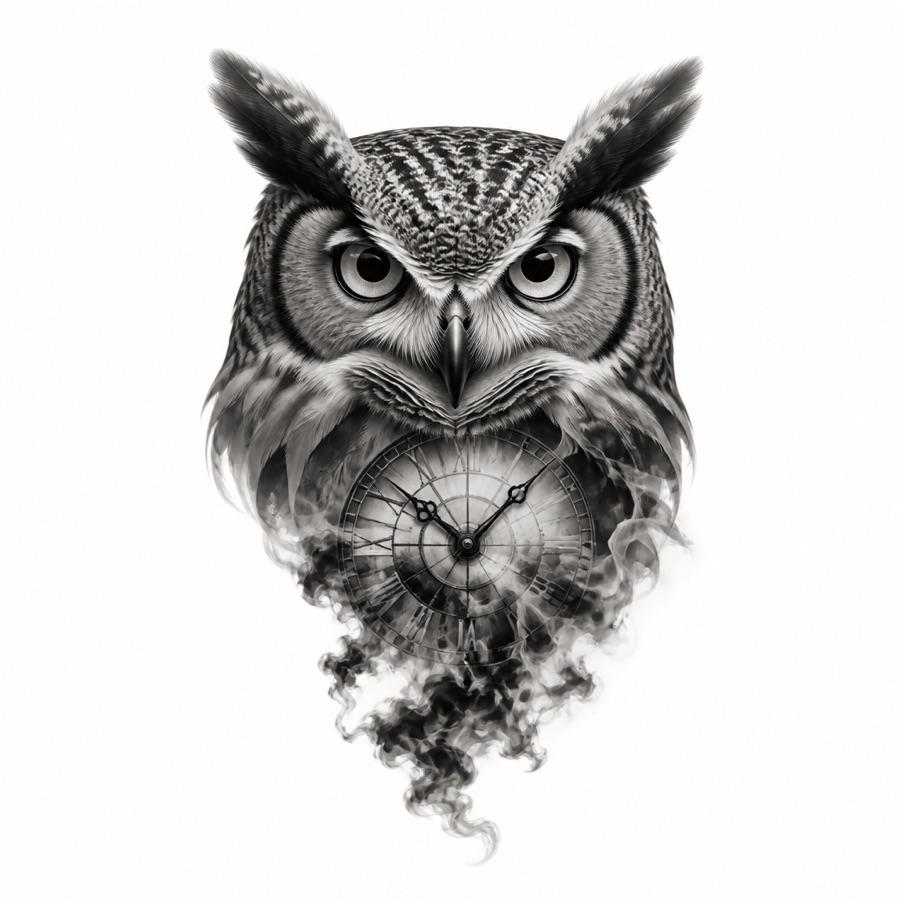 Surrealism
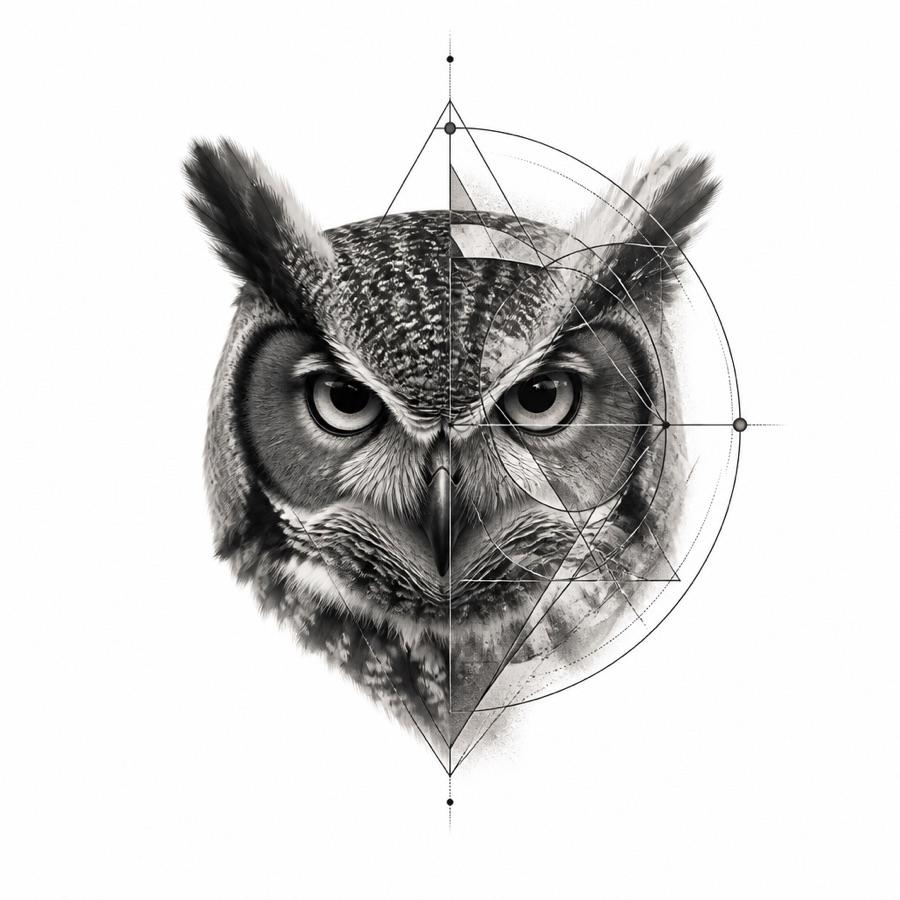 Realism + geometric
- Black and grey realism: only black ink, diluted with water into a range of greys, with bare skin left for the brightest highlights. The usual choice for animals, portraits, statues and religious pieces.
- Color realism: the same photographic approach in full color, built up in layers. Common for flowers, birds, fruit and wildlife where the real color is part of the subject.
- Micro realism: realistic shading shrunk to an inch or two. It looks striking fresh, but it has the least room for detail to soften; the aging section below shows why.
- Surrealism: realistic rendering of something impossible, such as an owl turning into a clock. The technique is realism; the idea is a dream.
- Realism mixed with other styles: realistic subjects cut by geometric lines, framed by ornament or set in a Japanese background. Ask the artist to plan it as one design.
Tattoodo's realism guide describes the same families, with surrealism, micro-realism and mixed work as sub-styles of realism. Some studios also list "hyper realism" as its own type; it describes the most photographic end of the same approach. To see your own subject in realism, the generator behind the button below drafts a reference you can bring to an artist.
Black and grey vs color realism: which should you choose?
Both use the same approach, smooth transitions and no hard outlines, so the choice is about palette, subject and how much contrast the design keeps over time.
| Black and grey realism | Color realism | |
|---|---|---|
| Ink | Black, diluted into greys (grey wash) | Full palette, often with black for the darkest shadows |
| Highlights | Bare skin | Bare skin or light colors |
| Typical subjects | Portraits, animals, statues, religious and memorial pieces | Flowers, birds, fruit, wildlife, anything where color is the point |
| Sun | UV light can fade some tattoo inks (AAD); pale greys go first (Tattoodo, industry view) | Same; color goes first (Tattoodo, industry view) |
| Ink reactions | Reactions are reported to tattoo inks in general (FDA) | Same; more pigments in the design |
| What to check in a portfolio | Deep blacks next to clean skin highlights | Color that still reads in healed photos |
There is no study that compares how the two palettes age. What the evidence supports: the American Academy of Dermatology says ultraviolet light can fade some tattoo inks and advises a broad-spectrum, water-resistant SPF 30+ sunscreen on tattooed skin in the sun. Tattoodo adds, as an industry view, that UV fades color and pale greys first. The belief that black and grey "ages better" is common among clients and artists; a client interviewed by NPR chose black and grey because, in his words, color does not age well. Treat that as artist and client consensus, not a measured result.
Black and grey realism is also not the same as blackwork. Blackwork builds tone from solid black, dots and hatching with little or no grey; black and grey realism depends on the smooth grey wash.
Where does black and grey realism come from?
The style has a documented origin in Chicano culture in Los Angeles. This timeline uses only what the two NPR Code Switch pieces from April 2018 report.
| When | What happened | Source |
|---|---|---|
| Before the mid-1970s | In California youth and adult prisons, inmates build tattoo machines from pen parts, needles and tape-player motors. With no color available, ink is black; watered down, it turns grey. The homemade machines have one needle, which gives finer lines. | NPR, April 12, 2018 |
| Same period | Clients ask for Catholic imagery, Aztec and Mayan symbols, Mexican revolutionaries, lettering and portraits of loved ones who have died. | NPR, April 12, 2018 |
| Mid-1970s | Good Time Charlie's Tattooland opens in East Los Angeles. Its mostly Mexican-American clients want prison-style work with fine lines and black and grey shading, and the shop switches its machines to a single needle. | NPR Code Switch, April 15, 2018 |
| 1977 | Freddy Negrete, who learned to tattoo while incarcerated, is hired at Good Time Charlie's; he describes himself as one of the first Chicano professional tattoo artists. | NPR Code Switch, April 15, 2018 |
| 2018 | Black and grey work by Negrete and Chuey Quintanar features in the "Tattoo" exhibition at the Natural History Museum of Los Angeles. | NPR Code Switch, April 15, 2018 |
NPR describes the style moving "from penal institutions, to the barrios, to high-end tattoo shops around the world". Two classics from that tradition have their own pages: Laugh Now Cry Later masks and religious pieces such as guardian angels. We found no dated source for when color realism began, so we do not give one.
Do realism tattoos age well?
They can, if the design has enough size and contrast for the ink to soften. Tattoo ink does not stay perfectly still: in a 2018 mouse study, Baranska and colleagues showed that the skin cells holding tattoo pigment die and release it, and new cells capture it again, over and over. Artists describe the visible result as lines and edges softening over the years. There is no published measurement of how fast this happens in people, so the images below use an assumption, stated in the caption.
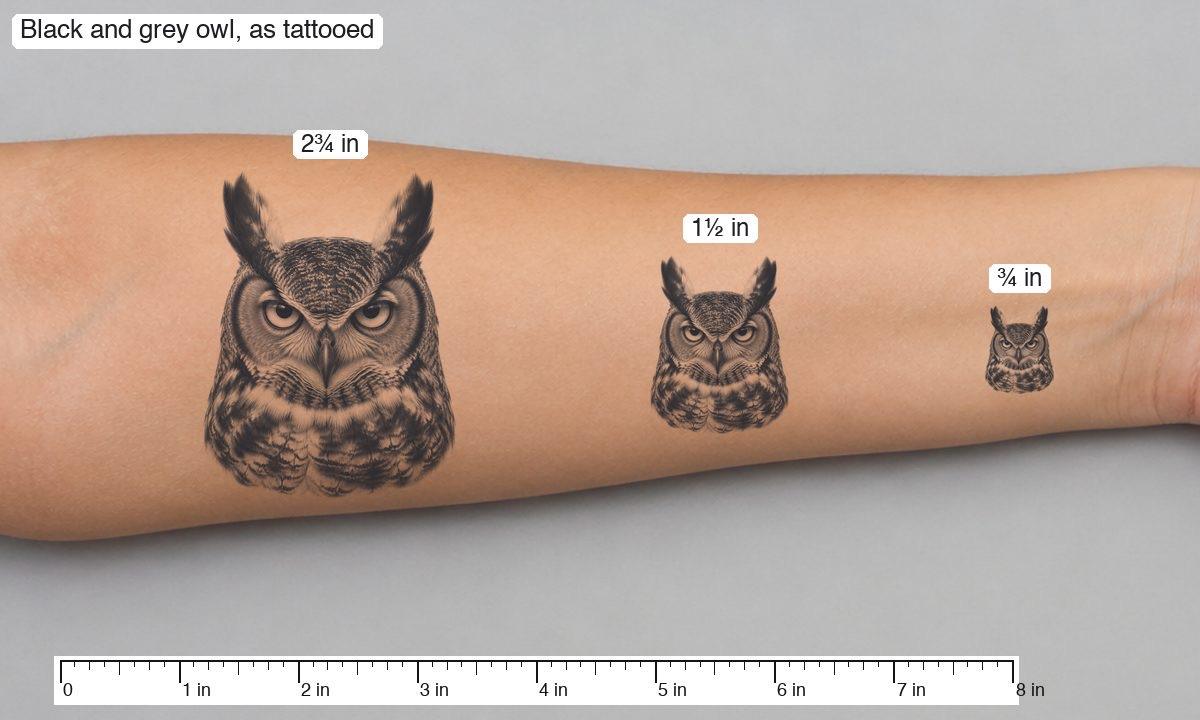 As tattooedThe same owl at 2¾ in, 1½ in and ¾ in, at true scale.
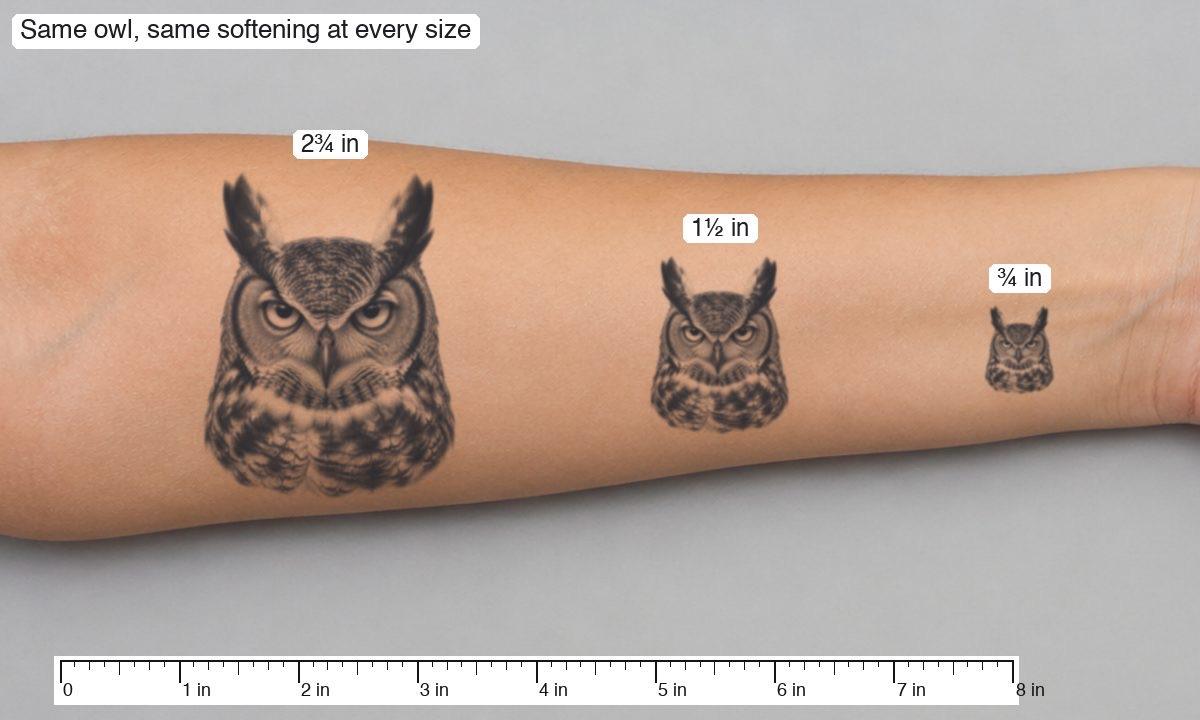 Same softeningOne identical blur at every size. The big owl keeps its eyes; the small one does not.
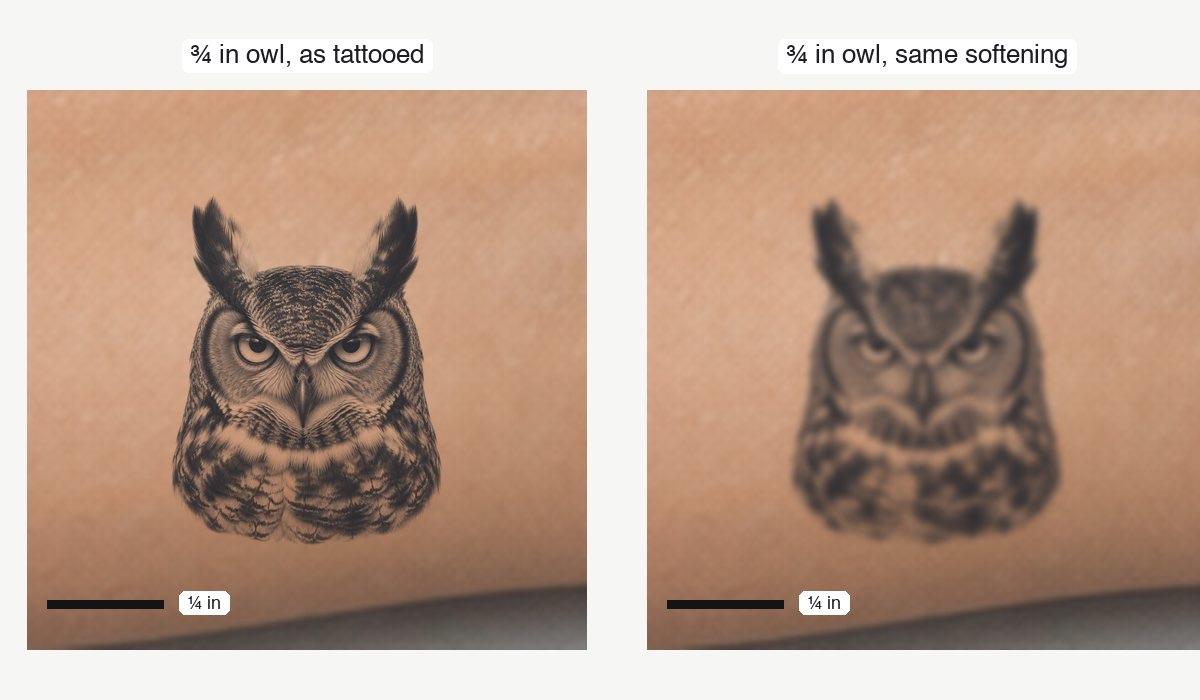
The blur is the same in every image. What changes is how big the details are compared with it. On the 2¾ in owl, an eye is several millimeters wide, so a fraction of a millimeter of softening barely shows. On the ¾ in owl, the whole eye is about the size of the blur, so it merges with the feathers around it. That is the honest answer to "micro realism tattoo after 10 years": the small version has the least margin.
Contrast matters as much as size
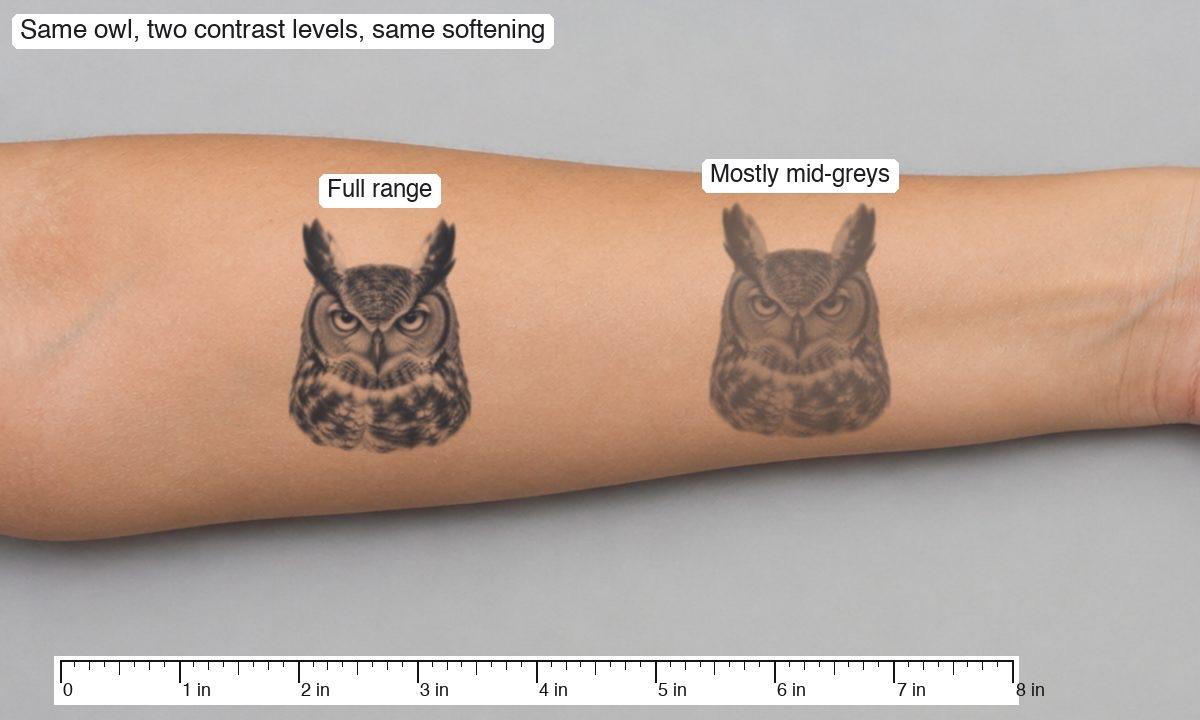
The right-hand owl has the same detail, but its darkest and lightest areas sit close together, so once it softens there is little left to separate the eye from the feathers. Tattoodo puts it bluntly, as an industry view: a piece built mostly from mid-greys can turn into a grey smudge within a few years. Realism artists build in deep blacks and leave real bare-skin highlights for this reason. Those are artist consensus, not measured results, but they match what the images show.
- Go bigger than you think. The smallest detail you care about (an eye, a lettering line, a fingernail) should stay several millimeters wide.
- Ask for contrast. Deep blacks and true skin highlights read for longer than a soft, all-grey image.
- Protect it from the sun. The AAD advises SPF 30+ on tattooed skin and keeping away from tanning beds, which can also fade ink.
- Plan for a touch-up. Ask before booking whether one is included after healing.
How small can a realism tattoo be? Micro realism and size
There is no medical or industry minimum; artists set their own. What limits realism is the smallest detail, as the owl shows. Many artists set a minimum size for portraits (Tattoodo); that is artist practice, not a standard, and it varies by artist. Micro realism is possible, but it is a trade: less detail, kept simple, from an artist who can show healed micro pieces.
To know what fits, look at the room each body part offers. These are medians from ANSUR II, the US Army body measurement survey of 1,986 women and 4,082 men, as computed in our tattoo size guide.
Room on one side of each body part, drawn to scale
- Women (median)
- Men (median)
- 1 square = 1 inch
9.5 × 5.2 in · 10.5 × 6.1 in
12.2 × 6 in · 13.2 × 7 in
15.2 × 7.3 in · 16.3 × 7.7 in
13.1 × 12.1 in · 14.1 × 12.3 in
14.4 × 16.7 in · 16.3 × 18.8 in
1 in · 3 in · 6 in
- Forearm: about 9.5 to 10.5 in long and 5 to 6 in across one side: room for a single animal or object at palm size or larger. See the forearm guide.
- Upper arm and shoulder: a rounder surface that suits a portrait or animal head. See the shoulder guide.
- Thigh: about 12 in across one side, enough for a full scene or a large portrait. See the thigh guide.
- Chest: wide but curved over the ribs and chest muscles; ask how a face will bend. See the chest guide.
- Realism sleeve: several realistic elements joined by a background (smoke, clouds, architecture) running the whole arm. See the sleeve guide.
For a planning estimate on your own measurements, use the tattoo size calculator. For why small, detailed tattoos blur, the small tattoo guide runs the same test on line work.
Prompt to try
“micro realism hummingbird in black and grey, simple silhouette, high contrast, for the inner wrist”
Generate this designPortrait tattoos: how to choose the reference photo
A realism tattoo is only as good as the photo it starts from. The artist can adjust lighting and remove a background, but cannot invent detail that the photo never had. Here is a real pet portrait next to its reference:
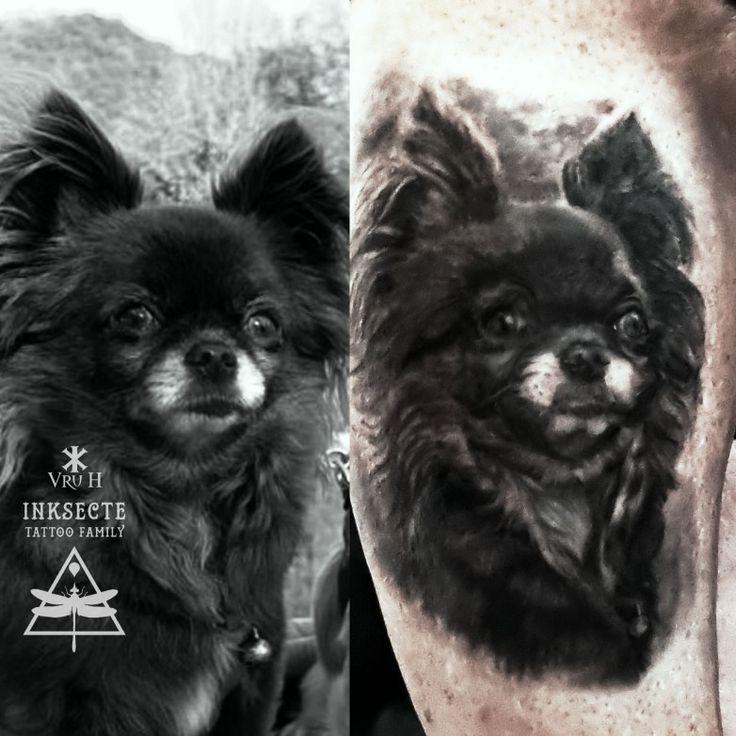
Notice what carries over: the dark eyes with their small highlights, the white muzzle against black fur, the soft background. Those are the strongest contrasts in the photo, and they are what the tattoo keeps. A blurry, flat or filtered photo gives the artist nothing to keep.
| Good reference | Weak reference |
|---|---|
| Sharp focus on the eyes | Soft or motion-blurred eyes |
| Side or window light that models the face | Direct flash that flattens it |
| The original high-resolution file | A screenshot or a photo of a printed photo |
| No filters or beauty smoothing | Filters that erase skin, fur or hair texture |
| The face fills the frame | A tiny face in a group shot |
| Clear contrast between light and dark areas | Flat, evenly grey light |
These checks follow the advice in Tattoodo's realism guide and common artist practice. Two more: if the portrait is of a person, ask for their consent, or a family member's if they have died; and send the artist several photos so they can pick one, or combine the eyes from one and the angle from another. Tattoodo also warns that hands and feet are poor placements for portraits because likeness fades there quickly, which matches artists' wider view that hands and feet fade faster.
How long does a realism tattoo take?
There is no fixed number of hours; it depends on size, detail and the artist. One studio's figures give a sense of scale: Chronic Ink says a typical session is 4 to 6 hours, that realistic work may take multiple sessions, and that clients usually wait about 3 weeks between sessions for the skin to heal. A first-timer, it suggests, should not go past 3 to 5 hours. The project below is a typical outline built from those figures, not a schedule for your piece.
A typical realism project, from idea to healed
Before
Consultation and reference
- Choose the photo or photos
- Agree size and placement
- Get a time and price estimate
Day 1
First session
- Stencil, then the main shapes and darkest areas
- Often 4 to 6 hours
About 3 weeks later
Next session
- Depth, texture, background
- Repeated until the piece is done
After healing
Touch-up
- Fixes patchy spots and adds final contrast
- Ask whether it is included
A small realistic animal can fit in one sitting; a realism half sleeve or full sleeve is usually spread over several sessions and months. Ask your artist for an estimate of hours, not only sessions, so you can compare quotes.
How much does a realism tattoo cost?
We found no price survey specific to realism. Most studios charge by the hour for anything above a small piece, so what drives the price is how many hours the detail takes. In the sample from our tattoo cost guide (25 US studios whose own websites list prices, checked November 4, 2026), hourly rates ran from $100 to $300.
- Median hourly rate
- $200
- Median hourly rate
- 18 studios that publish one
- Range of hourly rates
- $100 to $300
- Range of hourly rates
- Checked November 4, 2026
- Median shop minimum
- $120
- Median shop minimum
- 23 studios that publish one
| Example (hours are hypothetical) | Hours | At the sample median of $200/h |
|---|---|---|
| Palm-size black and grey animal on the forearm | 3 | $600 |
| Pet or family portrait on the upper arm, two sessions | 10 | $2,000 |
| Realism half sleeve, several sessions | 20 | $4,000 |
The hours are made up to show the arithmetic; they are not quotes. Your artist's estimate of hours, times their rate, is the number that counts. For a planning range from a size and placement, use the tattoo price calculator.
Do realism tattoos hurt more?
No study compares pain by tattoo style. What predicts pain is mostly time and stress: in a survey of 1,092 tattooed people (Witkoś and Hartman-Petrycka, 2020), longer tattooing time and higher stress predicted more pain during tattooing. Realism tends to mean long sessions with many passes over the same skin, so plan breaks, eat beforehand and split big pieces into several sittings.
Placement matters too. The artists and customers interviewed in a 2021 pilot study rated the chest among the more painful spots and the forearms, biceps and triceps and outer thighs among the easier ones, which happen to be common realism placements. That is reported experience, not measurement. Our tattoo pain chart covers every spot.
How does a realism tattoo heal?
The stages are the same as for any tattoo. Cleveland Clinic says redness, flaking and scabbing are normal while it heals and advises keeping the new tattoo moisturized and out of the sun. Soft grey shading can look patchy or slightly cloudy while the skin peels; judge the result once it has healed, and use the touch-up for anything that did not settle. Our tattoo healing stages guide shows what normal looks like week by week.
Realism tattoo ideas that suit the style
Realism suits subjects with texture and strong light: fur, feathers, skin, metal, stone, petals. These are AI drafts in black and grey, the kind of reference you could bring to a consultation.
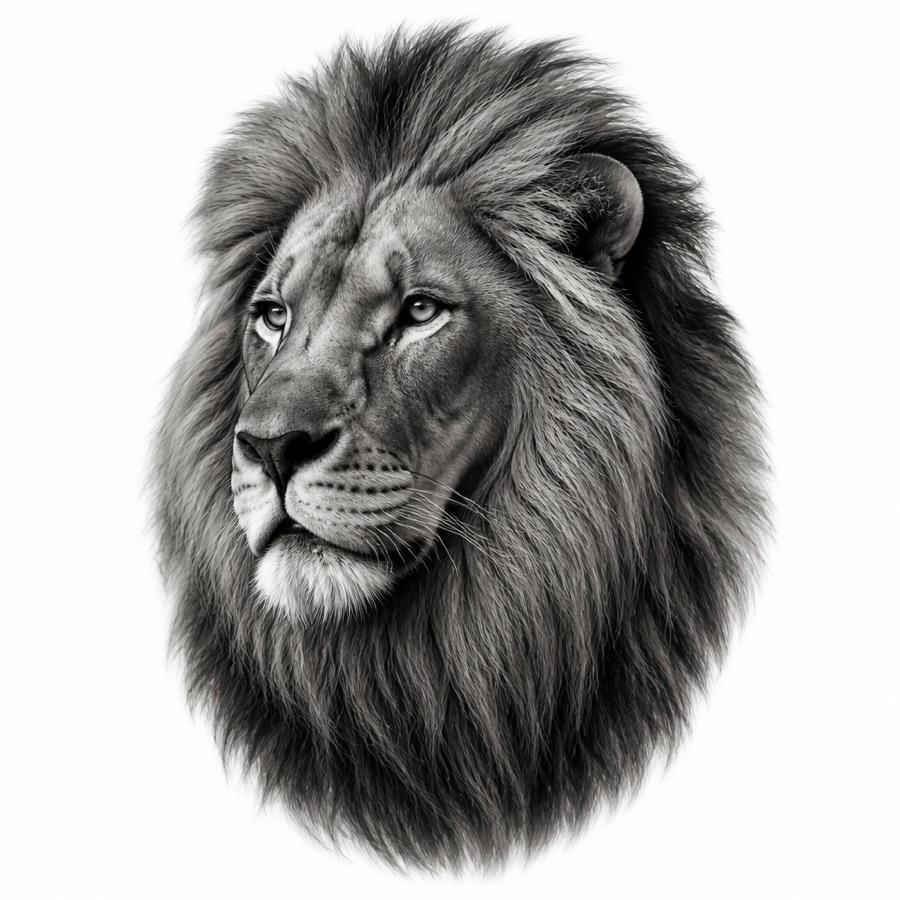 Fur and eyesAnimal portrait
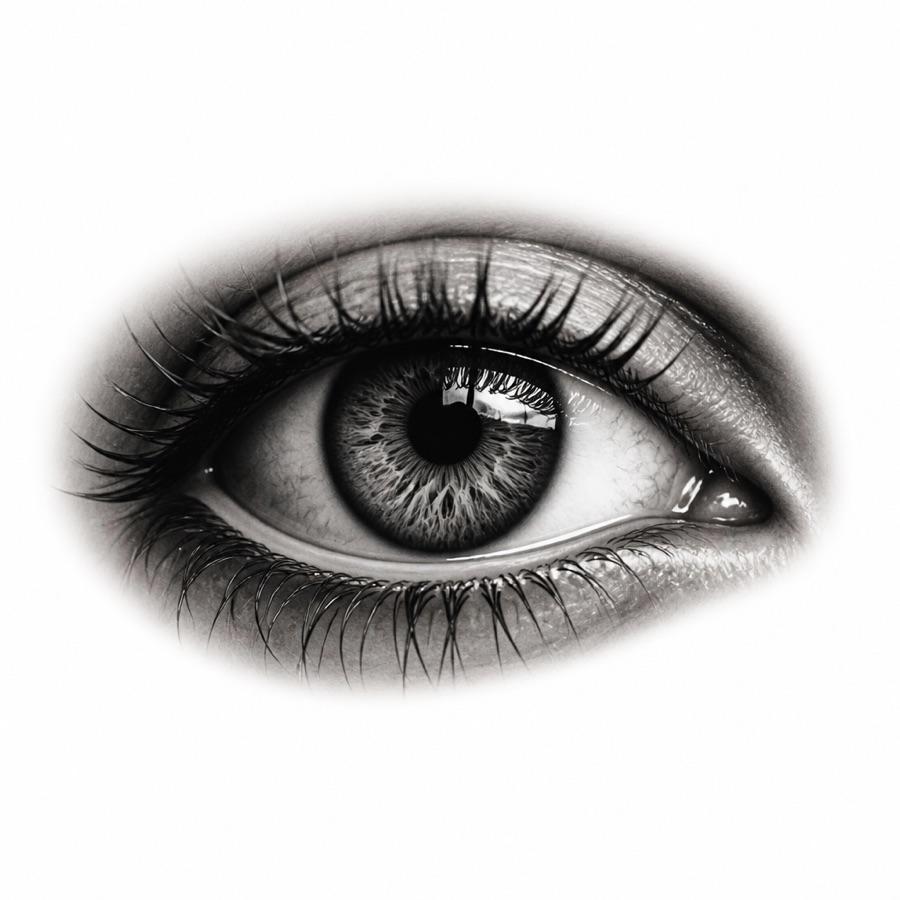 Glossy highlightEye
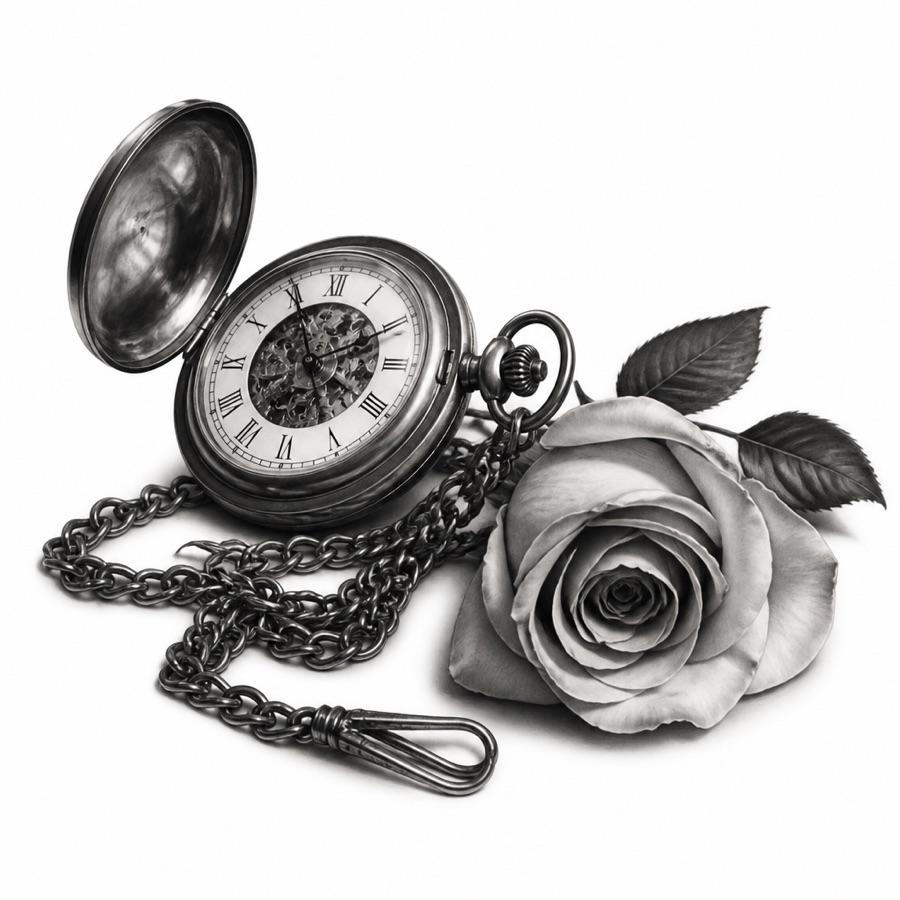 Metal and petalsPocket watch and rose
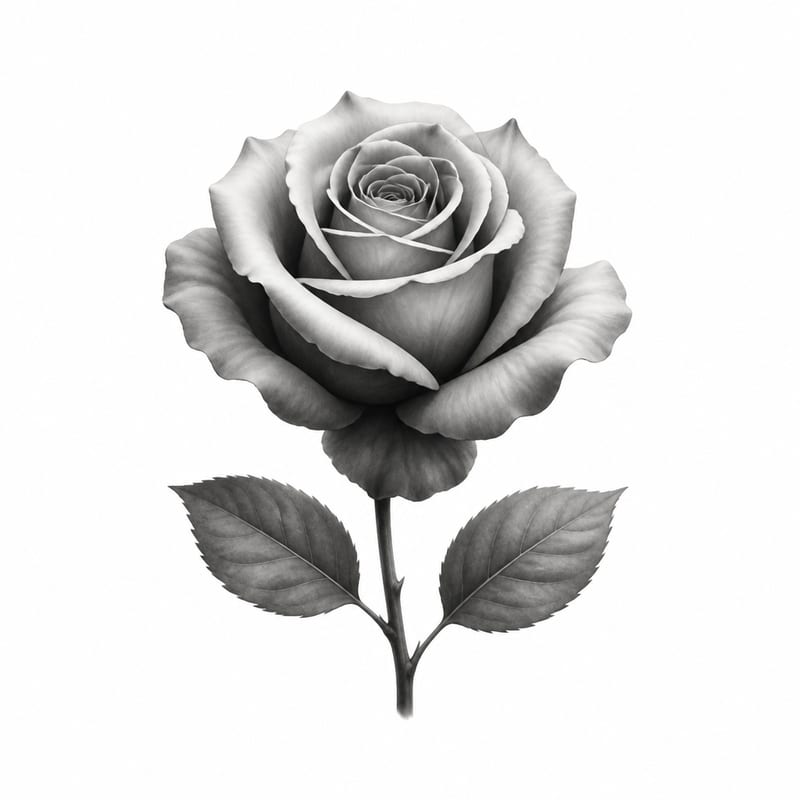 Soft petalsRose
Prompt to try
“black and grey realism lion head, three-quarter view, deep shadows in the mane, for the upper arm”
Generate this designWolf Tattoo Ideas
Fur, eyes and a strong profile, a classic realism animal.
Samurai Tattoo Ideas
Armor, fabric and a mask, rich textures for black and grey.
Memento Mori Tattoo Ideas
Skulls, clocks and hourglasses, the still-life side of realism.
Laugh Now Cry Later Tattoo Ideas
The two masks from the Chicano black and grey tradition.
Archangel Michael Tattoo Ideas
Wings, armor and a sword, a large religious realism piece.
Jesus Tattoo Ideas
Religious portraits, one of the oldest black and grey subjects.
Zeus Tattoo Ideas
A statue-like face, lightning and clouds for a sleeve.
Prompt to try
“color realism hummingbird and hibiscus flower, soft background, for the shoulder blade”
Generate this designHow do I choose a realism tattoo artist?
- Ask for healed photos, at least a year old, not only fresh ones. Fresh realism always looks sharper than it will end up.
- Look for deep blacks next to clean, unshaded skin. A portfolio of soft, all-grey pieces is a warning sign for aging.
- Match the specialty: black and grey, color, portraits and micro realism are different skills. Someone great at animals may not do faces.
- For a portrait, check portraits of people you can compare with the photo, ideally shown side by side like the dog above.
- Ask how many hours they expect, how many sessions, and whether a touch-up is included.
- Ask what minimum size they would accept for your subject. If an artist tells you to go bigger, that is advice, not upselling.
These checks are common advice from artists rather than research. If you are searching for a realism tattoo artist near you, the same list applies to every portfolio you look at.
Can AI help plan a realism tattoo?
Yes, for the planning part. An AI draft is a quick way to test a subject, a composition, black and grey against color, or how a design sits on your arm before you book. It is not a stencil: the artist redraws it for your skin, size and placement, and decides where the blacks and highlights go. You can draft a reference with the AI tattoo generator, preview it on a photo of your body with the tattoo visualizer, and turn a design into linework with the stencil maker. Do not use AI to put a real person's face on a design; for a portrait, work from your own photo with the artist.
Prompt to try
“surrealism tattoo, an owl whose feathers dissolve into smoke and an antique clock, black and grey, for the forearm”
Generate this designPlan the rest of your realism tattoo
Tattoo Styles Explained
One rose drawn in eight styles, to compare realism with the rest.
Blackwork Tattoos
Solid black and bare skin, the opposite approach to grey wash.
Japanese Tattoos
Large compositions that often mix with realistic animals.
Tattoo Size Chart
How much room each body part has, in inches and cm.
Tattoo Pain Chart
Which spots hurt most, and why session length matters.
Tattoo Healing Stages
What normal healing looks like, week by week.
Tattoo Cost Guide
Prices and minimums from US studios, with how quotes work.
Sleeve Tattoos
How a half or full sleeve is planned around the arm.
Sources
- NPR (Shereen Marisol Meraji): The roots of black and gray realism tattoos, Morning Edition, April 12, 2018 · checked November 11, 2026
- NPR Code Switch (Shereen Marisol Meraji): Black and Gray ... and Brown, a tattoo style's Chicano roots, April 15, 2018 · checked November 11, 2026
- Tattoodo: Realism Tattoos, Styles, Portraits and How They Age (industry style guide) · checked November 11, 2026
- Chronic Ink Tattoo: How long will it take to get my new tattoo? (studio blog) · checked November 11, 2026
- American Academy of Dermatology: Caring for tattooed skin · checked November 11, 2026
- US FDA: Think Before You Ink, Tattoo Safety · checked November 11, 2026
- Cleveland Clinic: Tattoo aftercare tips from a dermatologist (Shilpi Khetarpal, MD), March 20, 2026 · checked November 11, 2026
- Skin Cancer Foundation: Ask the Expert, Can a tattoo increase skin cancer risk? · checked November 11, 2026
- Baranska A et al. Unveiling skin macrophage dynamics explains both tattoo persistence and strenuous removal. J Exp Med, 2018 (mouse study) · checked November 11, 2026
- Witkoś J, Hartman-Petrycka M. Gender differences in subjective pain perception during and after tattooing. IJERPH, 2020 · checked November 11, 2026
- Pimentel et al. The effects of VR use on pain experienced during a tattoo procedure: a pilot study. Frontiers in Virtual Reality, 2021 · checked November 11, 2026
- ANSUR II: Anthropometric Survey of US Army Personnel (public data, OPEN Design Lab, Penn State) · checked November 11, 2026
- Wikimedia Commons: Realistic tattoo, Bruno Antonio Menei - Belgium (Brunomenei, CC BY 4.0) · checked November 11, 2026
Realism tattoo FAQ
What is a realism tattoo?+
A tattoo that reproduces a subject the way a photograph shows it, built from shading and contrast with few or no outlines. It is done either in black and grey (black ink diluted into greys) or in full color.
Do realism tattoos age well?+
They can, if they are big enough and have strong contrast. Tattoo ink softens slowly over the years, and fine details such as eyes and fur merge first on small, mostly grey pieces. Artists advise going larger, keeping deep blacks and real skin highlights, and protecting the tattoo from the sun. No study measures this, so treat it as artist consensus.
Is micro realism a good idea?+
It can look striking when fresh, but a design an inch or two tall has the least room for detail to soften. Keep the subject simple and high-contrast, and choose an artist who can show healed micro realism, not only fresh photos.
Is black and grey or color realism better?+
Neither is better in general. Black and grey suits portraits, animals and religious pieces; color suits subjects where color is the point, such as flowers and birds. Many clients and artists believe black and grey ages better, and UV light can fade some inks, but no study compares the two directly.
How long does a realism tattoo take?+
It depends on size and detail. One studio puts a typical session at 4 to 6 hours, with about 3 weeks between sessions for healing; a small piece may take one sitting, while a realism sleeve usually takes several sessions over months.
How much does a realism tattoo cost?+
Most studios charge realism by the hour. In our sample of US studios that publish prices, hourly rates ranged from $100 to $300; the total is the artist's estimate of hours times their rate, so ask for hours in the quote.
Tattoo planning tool
Generate a realism tattoo reference
Describe your idea, generate it in any style, and preview it on your own skin before the needle.
Generate for freeFree to start