
Geometric Tattoos: Ideas, Meanings and How They Fit the Body
A geometric tattoo is built from measured lines, circles, polygons and repeated patterns, usually in black ink and often symmetrical: sacred geometry, mandalas, faceted animals, optical illusions and bands. The shapes have no fixed meaning, but named figures such as the Flower of Life or a mandala come with a history and a common interpretation. The other thing to know before you book: skin is not flat, so a perfect circle on paper turns into an oval on a curved arm unless the design is sized and drawn for it.
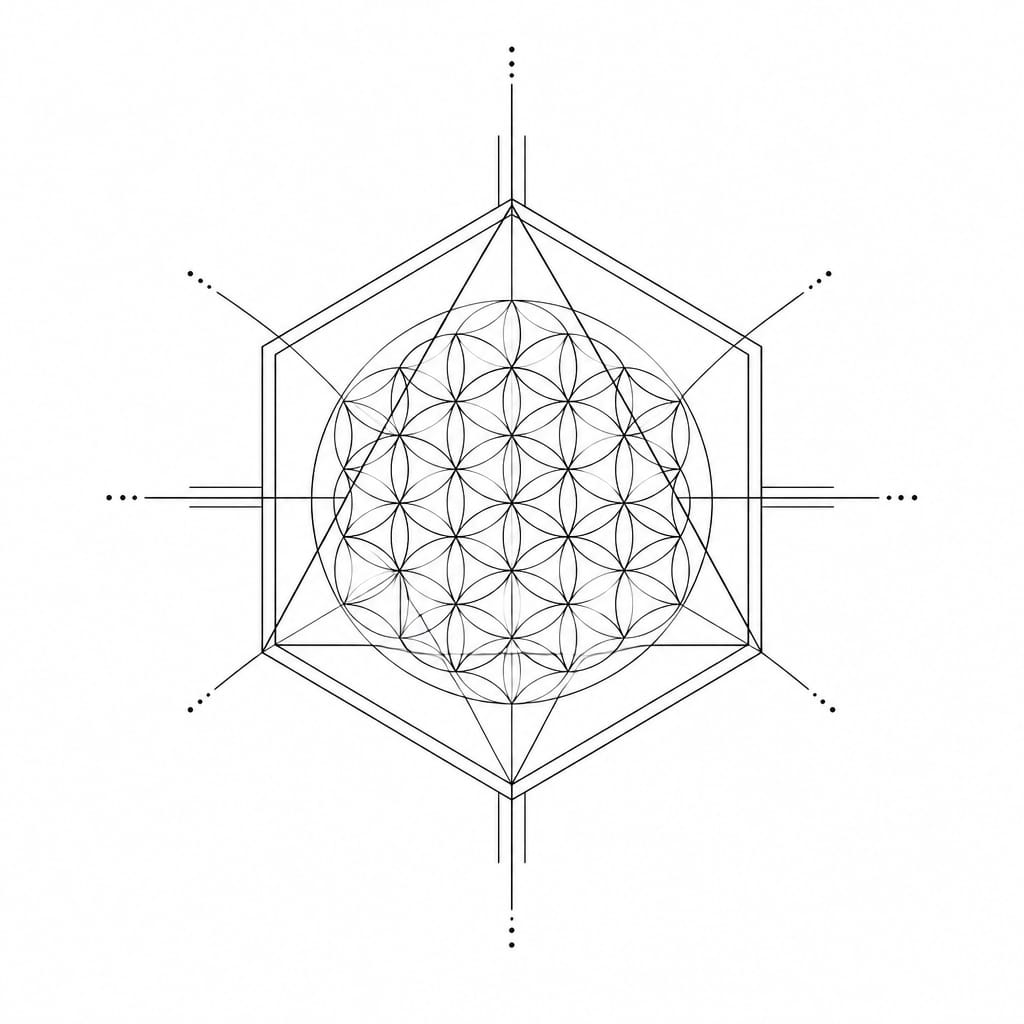
What are the types of geometric tattoos?
Geometric is less one look than a family of them. What they share is construction: straight lines drawn to a ruler, true circles, repeated units and symmetry. What changes is how the black is used. We generated six typical designs with an AI image model so you can compare them side by side.
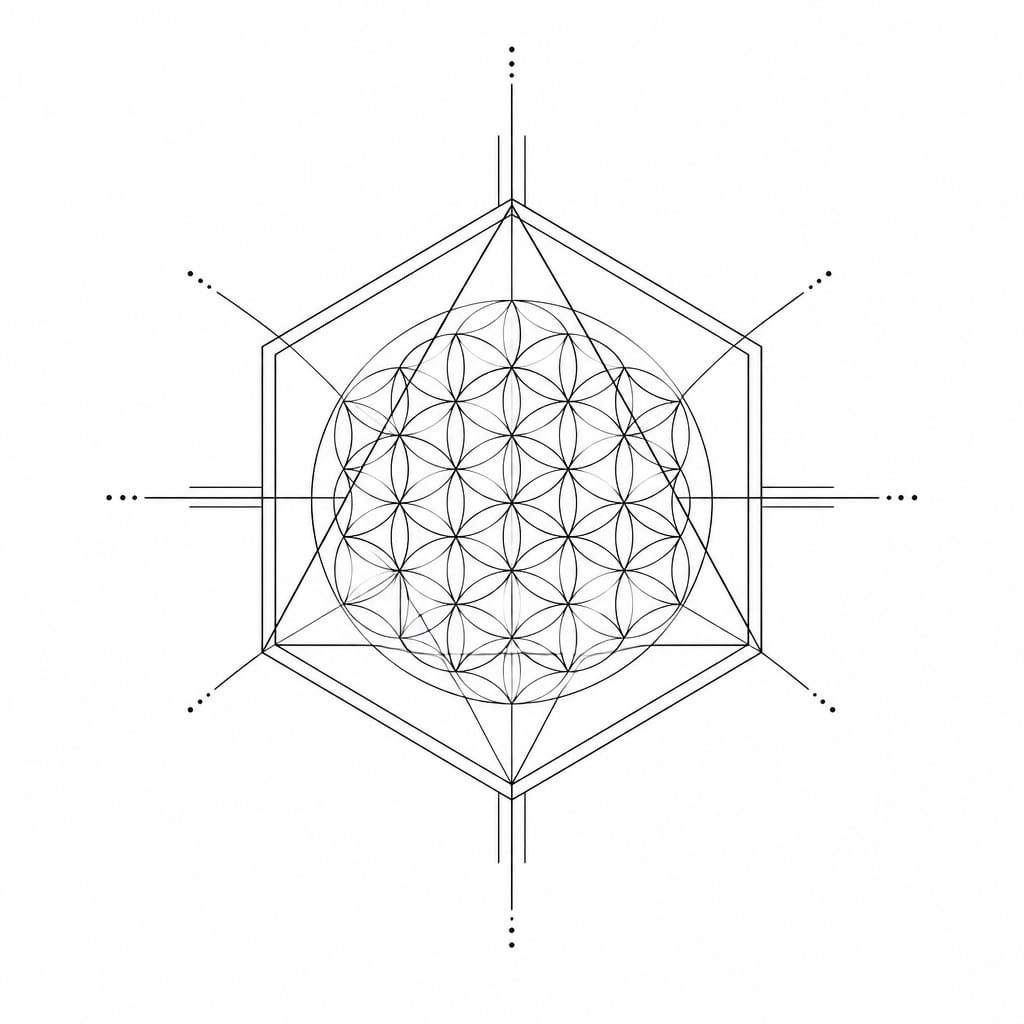 Sacred geometry linework
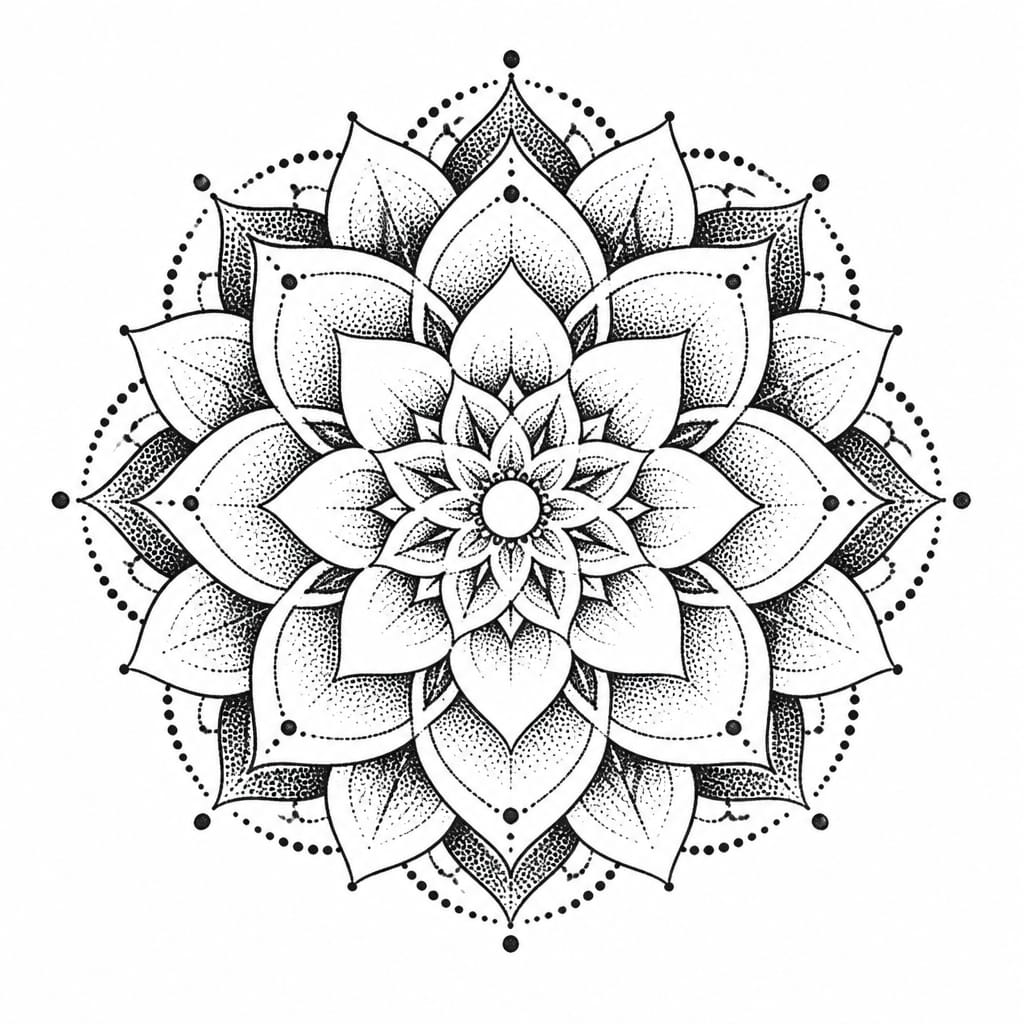 Dotwork mandala
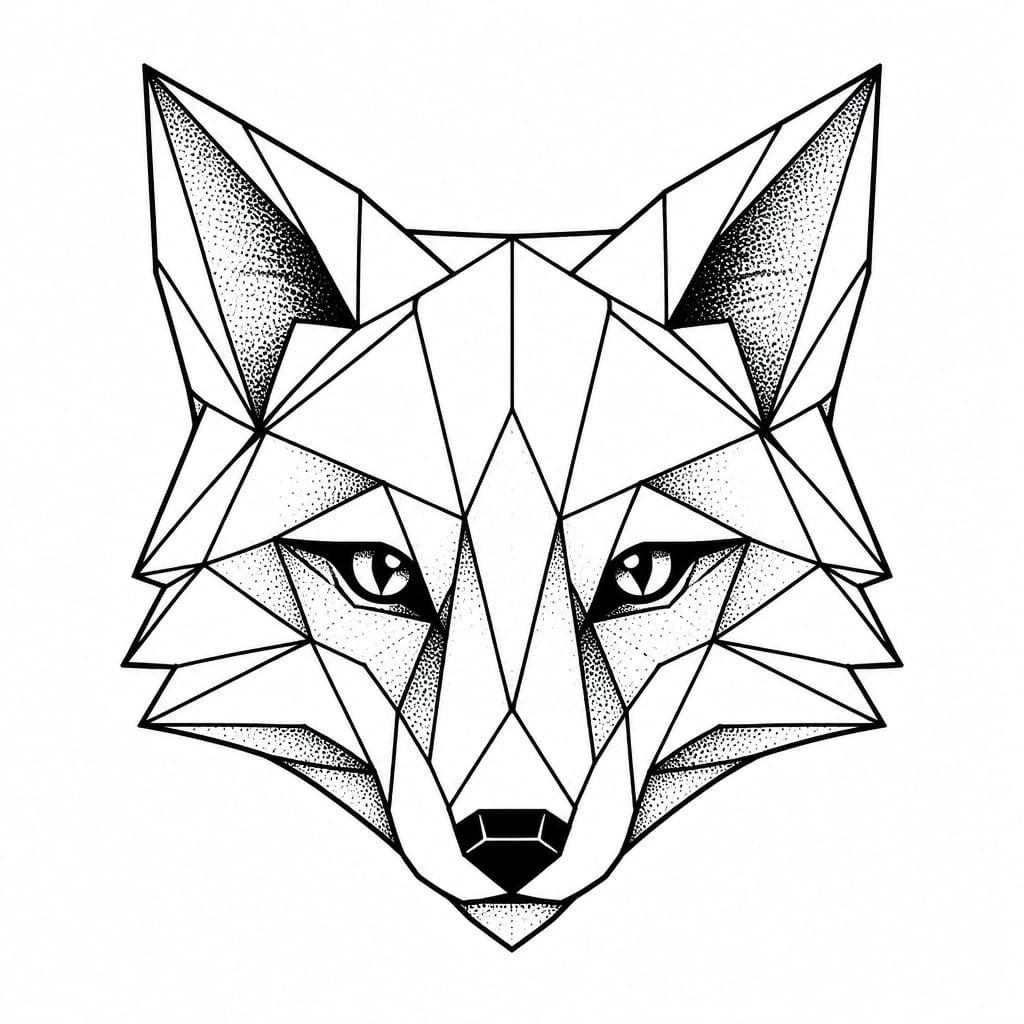 Geometric animal
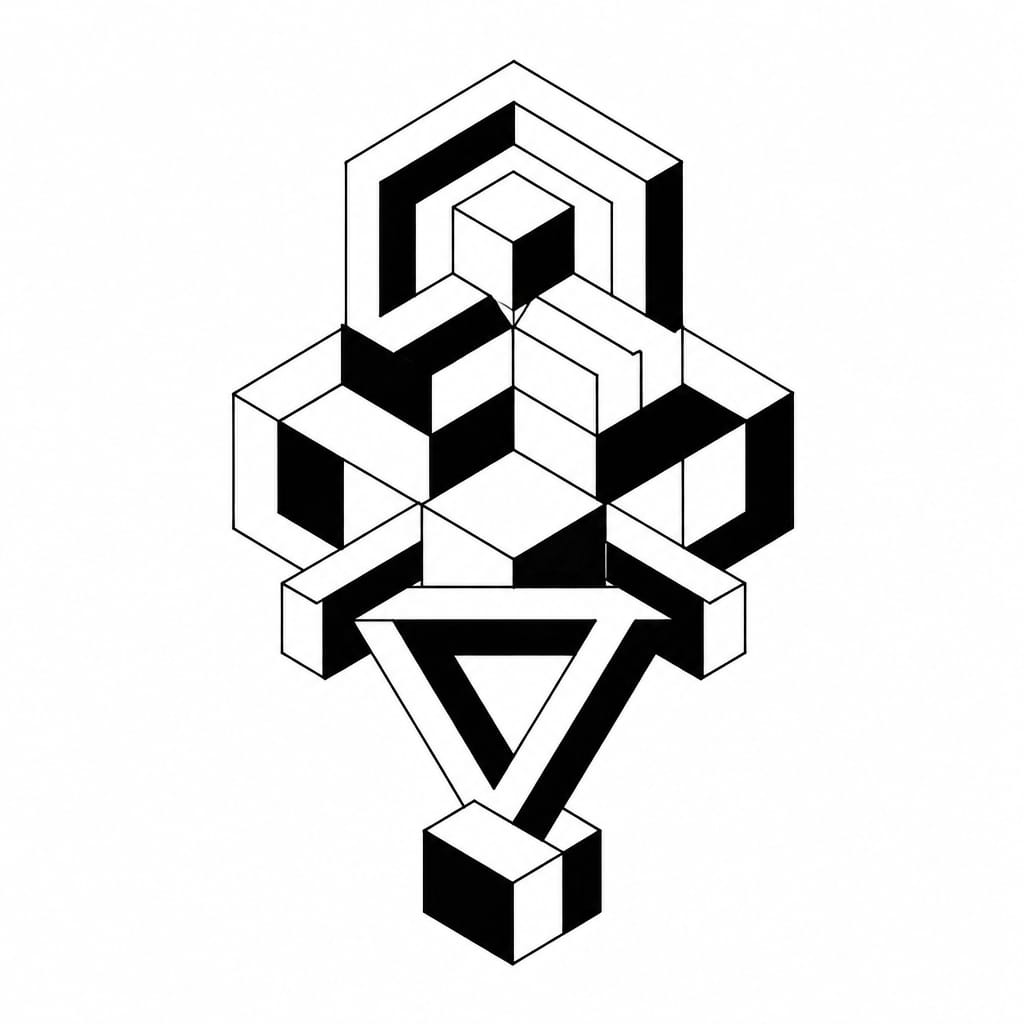 Optical illusion / 3D
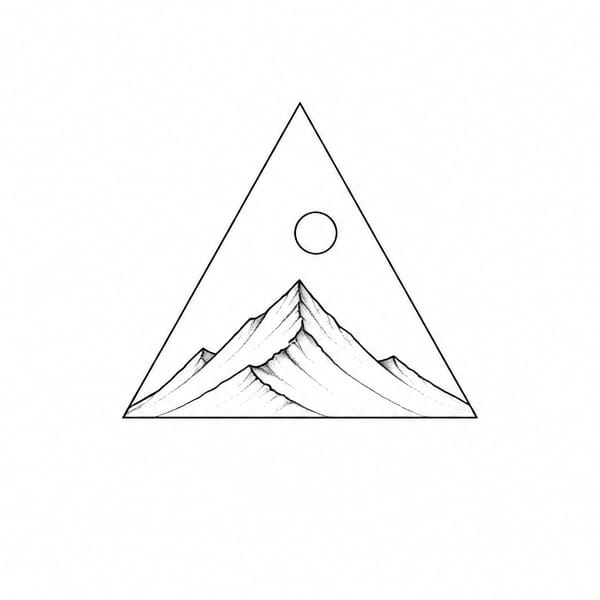 Minimal geometric
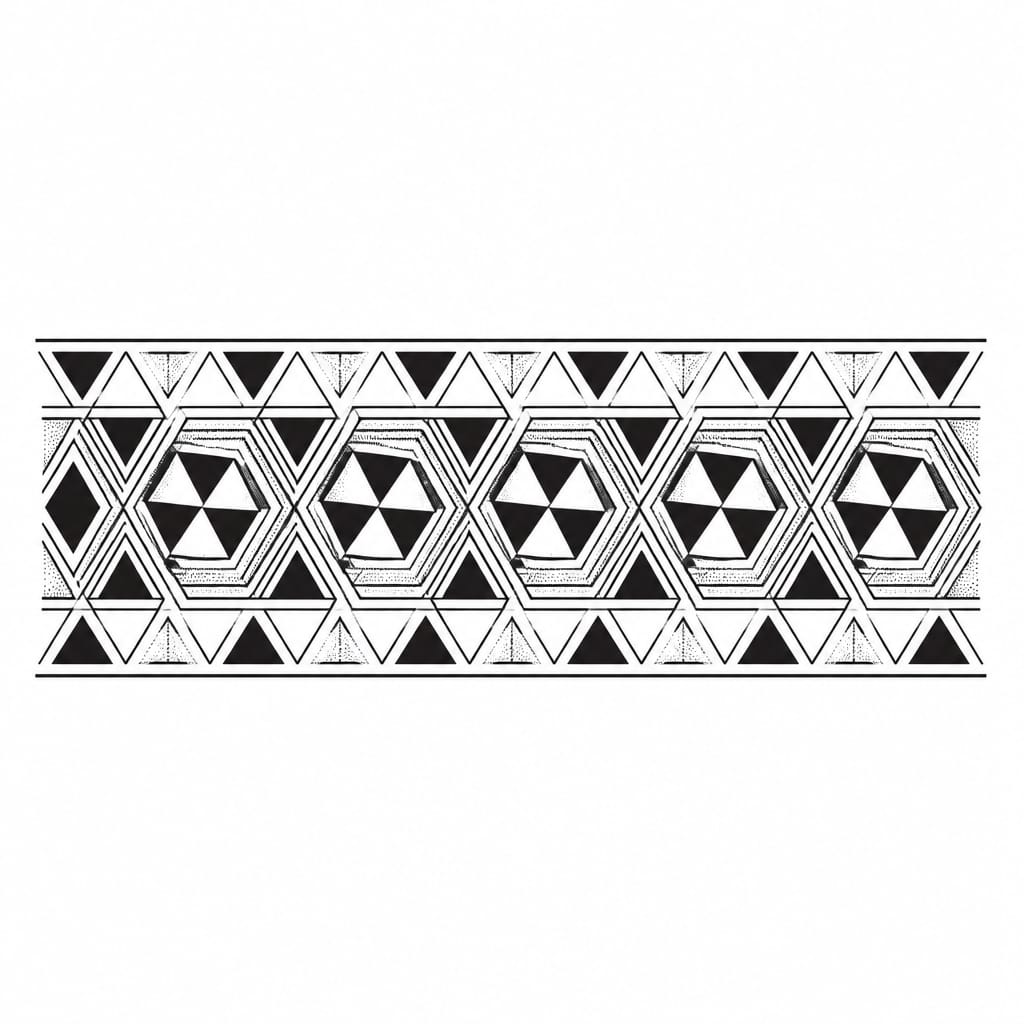 Pattern band
- Sacred geometry linework: named figures such as the Flower of Life or Metatron's Cube, drawn with thin, even lines. The precision is the whole point, so wobbles show.
- Dotwork mandala: a radial design whose shading is made only of dots, packed tightly for dark areas and spread out for light ones.
- Geometric animal: an animal head or body broken into triangular facets, or drawn half realistic and half geometric.
- Optical illusion or 3D: isometric cubes, impossible triangles and solid faces that make flat skin look like it has depth.
- Minimal geometric: one or two thin shapes, a triangle, a circle, a line, often framing a small motif.
- Pattern band: a repeating strip of triangles, hexagons or chevrons, made to close around an arm or a leg.
Most real pieces mix two of these: a linework figure with a dotwork gradient, or a faceted animal inside a circle. Geometric is also one of the sub-styles of blackwork, which covers every all-black approach from ornament to blackout.
Sacred geometry tattoo symbols and what they mean
"Sacred geometry" is a modern umbrella term for a handful of figures built from circles and straight lines. Below, each one is drawn exactly, by us, in code. For each figure we separate what is documented (how it is built, where it has been found) from what it is commonly said to mean, because the meanings come from spiritual and New Age writing rather than from history.
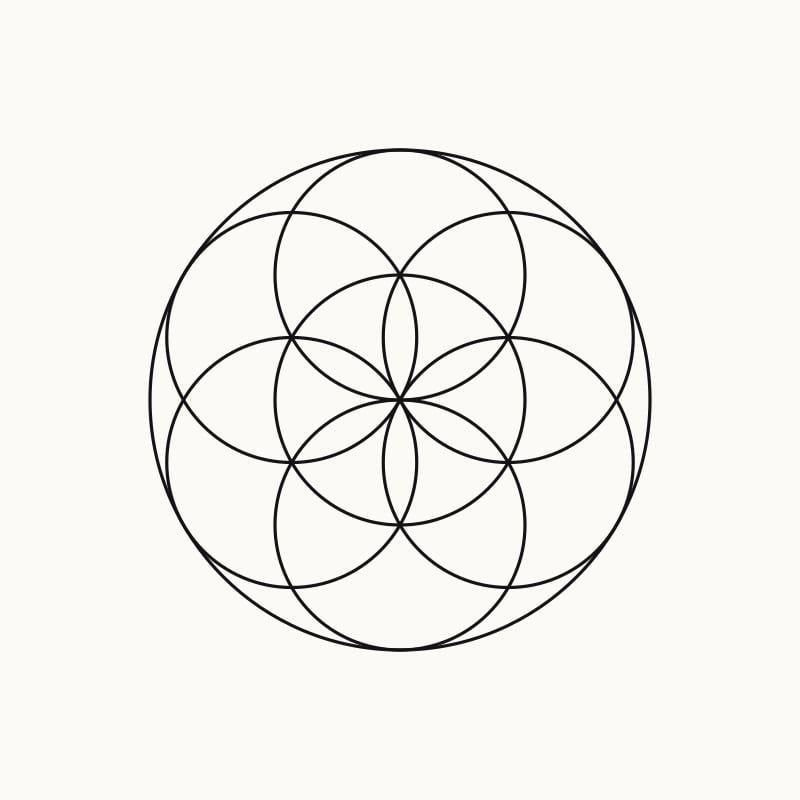 7 circlesSeed of Life
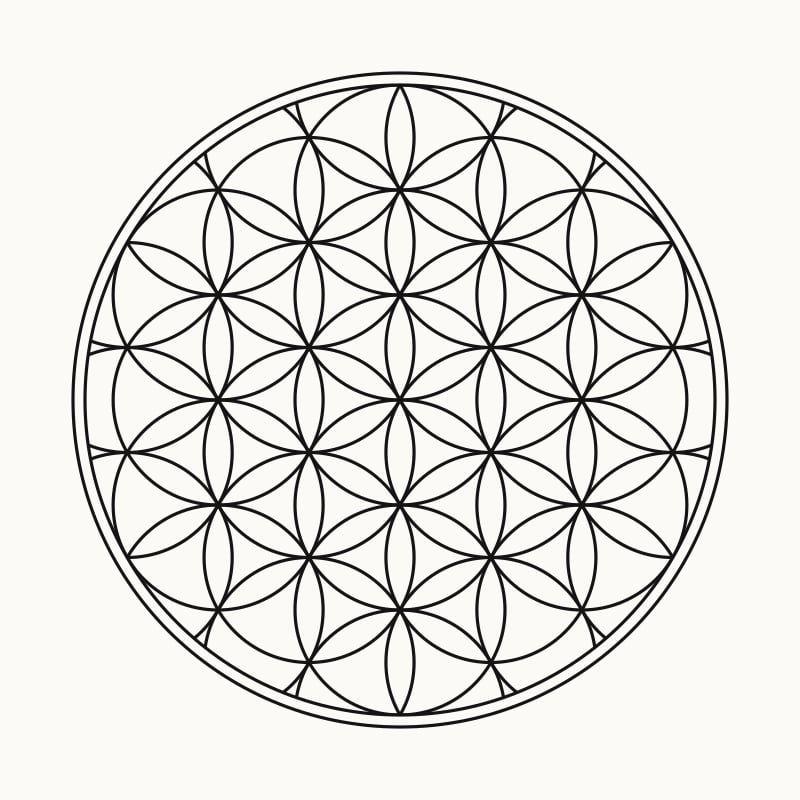 19 circlesFlower of Life
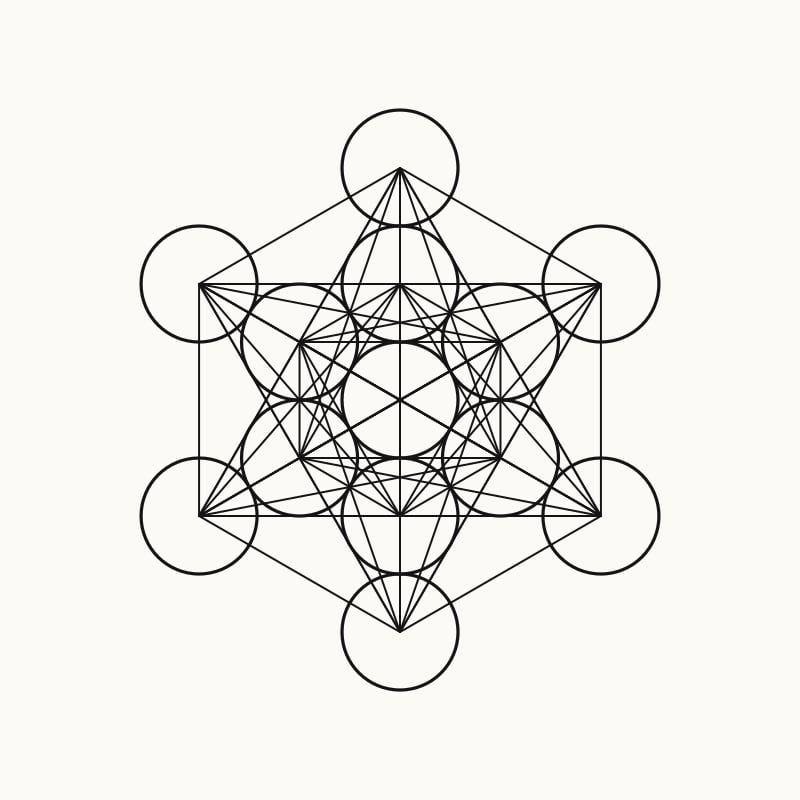 13 circles, 78 linesMetatron's Cube
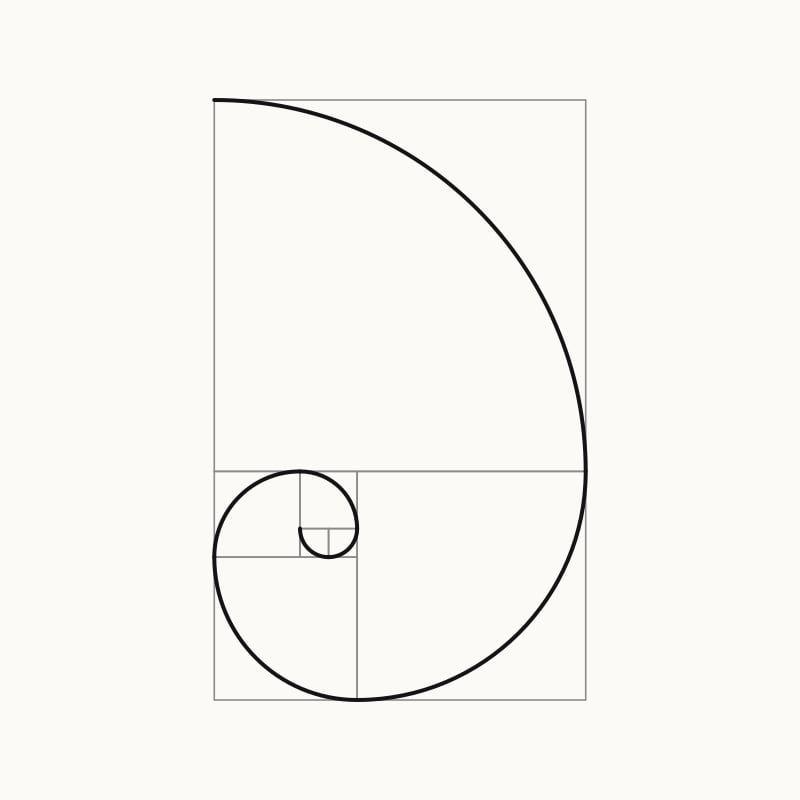 1, 1, 2, 3, 5, 8, 13Fibonacci spiral
| Figure | How it is built | What is documented | Common interpretation |
|---|---|---|---|
| Seed of Life | Six circles around a seventh, each passing through the center of the one in the middle | Seven-circle patterns appear in Roman mosaics at Herod's Palace, 1st century BCE (Wikipedia) | Creation, beginnings |
| Flower of Life | The same grid grown to 19 circles, usually inside a ring | Patterns of 19 circles drawn in red ochre at the Temple of Osiris, Abydos; Leonardo da Vinci studied the proportions. The name is modern, tied to New Age writing (Wikipedia) | Interconnection of all life |
| Metatron's Cube | 13 circles, with a straight line joining every center to every other (78 lines); a cube outline appears inside | Named after Metatron, an angel of Jewish apocrypha and early Kabbalah (Wikipedia); we found no reliable source dating the figure itself | Balance, protection |
| Platonic solids | The five solids whose faces are identical regular polygons | In the Timaeus (about 360 BCE), Plato links the tetrahedron to fire, octahedron to air, icosahedron to water and cube to earth; the dodecahedron is used for the heavens (Wikipedia) | The elements, the universe |
| Fibonacci or golden spiral | Quarter circles through squares whose sides follow 1, 1, 2, 3, 5, 8, 13 | Approximates the golden spiral. The common claim that a nautilus shell follows it is not supported by measurements (Wikipedia, citing Peterson, 2005) | Growth, natural harmony |
| Sri Yantra | Nine interlocking triangles, four pointing up and five down, around a central point (bindu) | An object of worship in the Shri Vidya school of Hindu tantra (Wikipedia) | Religious: the goddess Tripurasundari, the union of Shiva and Shakti |
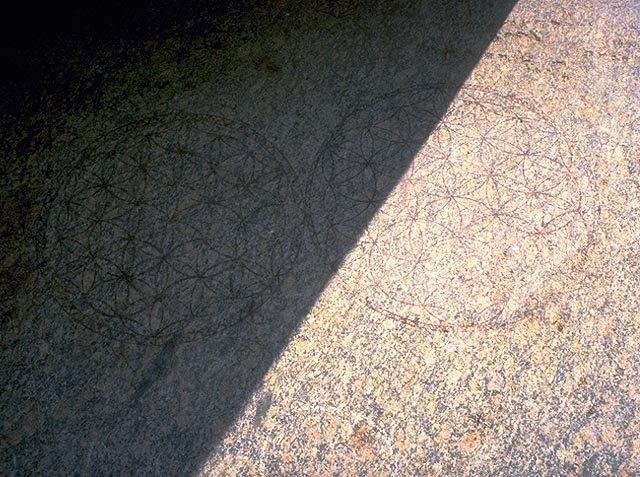
The Abydos patterns are often presented as thousands of years old. The evidence is more modest: according to the Wikipedia article on overlapping circle grids, they are graffiti rather than original temple decoration, mostly dated to the early centuries CE and no earlier than 535 BCE, and a much later origin cannot be ruled out. The name "Flower of Life" itself is commonly traced to Drunvalo Melchizedek's 1999 book. Overlapping-circle designs are genuinely old and widespread, from Assyrian palace floors to medieval pavements; the specific spiritual meanings attached to them are recent.
Prompt to try
“Metatron's cube tattoo, fine black linework, thin even lines, dotwork gradient fading from the center”
Generate this designDo geometric tattoos have meaning?
Only as much as you give them. A triangle, a hexagon or a band of chevrons carries no agreed meaning; people choose plain geometry for how it looks, for balance and order, or as a frame for something personal such as a birth date hidden in the spacing. Searches like "geometric tattoo meaning strength" or "meaning family" have no single answer: the meaning comes from the subject inside the geometry and from what you decide it stands for.
Named figures are different. They come with the interpretations in the table above, and you will hear them from artists and clients. Treat those as tradition and belief, not as properties of the shape. If a figure matters to you for a specific reason, tell your artist; it changes how they will compose the piece.
Are geometric tattoos cultural appropriation?
Simple shapes such as triangles, circles and hexagons belong to no single culture. Two kinds of design deserve more thought. First, religious diagrams: a mandala is a ritual object in Hinduism, Buddhism and Jainism (Wikipedia), and the Sri Yantra is an object of worship. Second, patterns taken from living tattoo traditions such as Polynesian work, where motifs can carry specific meanings. The Grand Rapids Art Museum reports that tribal tattoo pioneer Leo Zulueta considers it disrespectful to copy traditional designs exactly without a personal relationship to those cultures, and draws an original design for every client. The common advice follows from that: ask for an original design inspired by a tradition rather than a copy, and learn what a religious figure is before wearing it.
Mandala tattoos: meaning and the best places for them
The word mandala comes from Sanskrit for "circle". In Hindu, Buddhist and Jain practice it is a diagram of the cosmos or of a deity's dwelling, used to focus attention in meditation and to mark a sacred space; Tibetan sand mandalas are destroyed once finished, to symbolize impermanence (Wikipedia). In tattooing, "mandala" usually means any radial, flower-like design that repeats around a center, whether or not it follows a religious model.
Because a mandala is round and radial, it suits round places. Kreafolk's design guide suggests radial patterns for shoulders, elbows and kneecaps, where the design can center on the joint. Those spots come with a trade-off: in the 2021 pilot study that grouped body areas by reported pain, the elbow and the knee were in the middle tier, the forearm and the outer thigh in the lowest. A mandala on the back of the shoulder or the outer thigh is gentler than one on the elbow.
Prompt to try
“dotwork mandala tattoo for the elbow, radial symmetry, open circle in the center, fine linework petals”
Generate this designHow do geometric tattoos look on curved body parts?
This is the question none of the design galleries answer with a picture. A limb is roughly a cylinder, so a design drawn flat bends away from you on both sides. Lines along the arm stay straight; anything that runs around the arm gets squeezed as it turns away. Figurative tattoos hide this well. Geometric tattoos do not, because everyone can tell when a circle is not round. To show how much, we drew one exact Flower of Life and wrapped it, by calculation, around a forearm of median size.
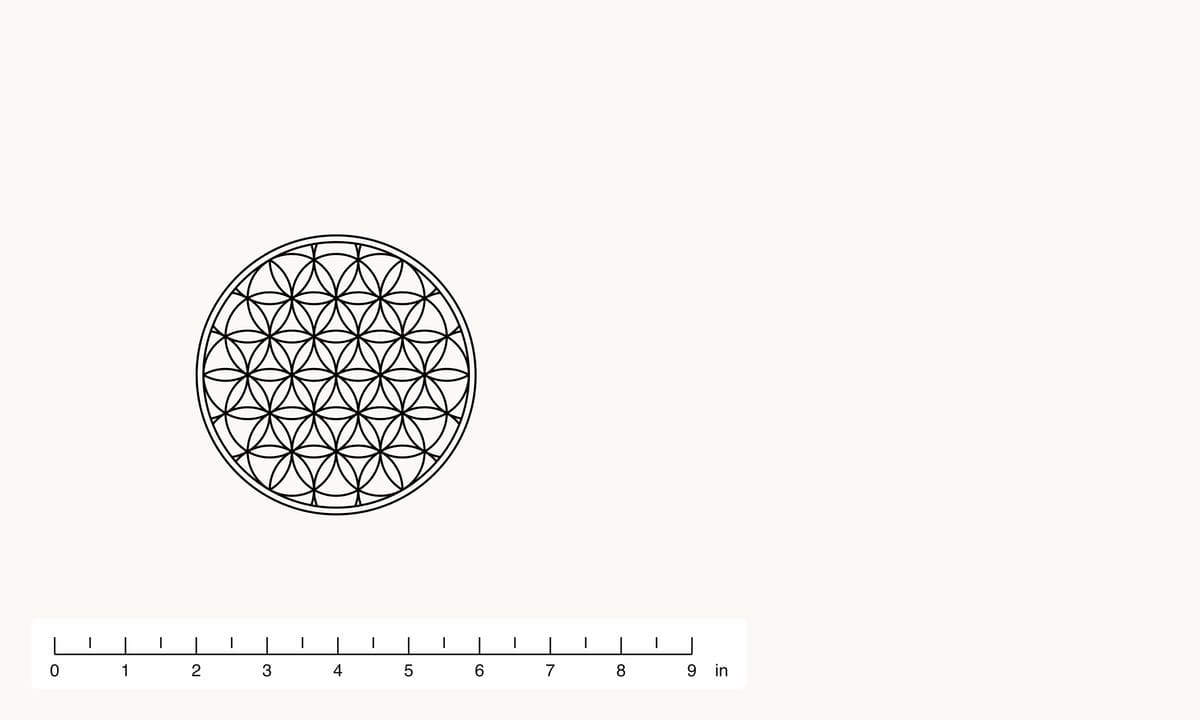 On paper4 in wide, a perfect circle.
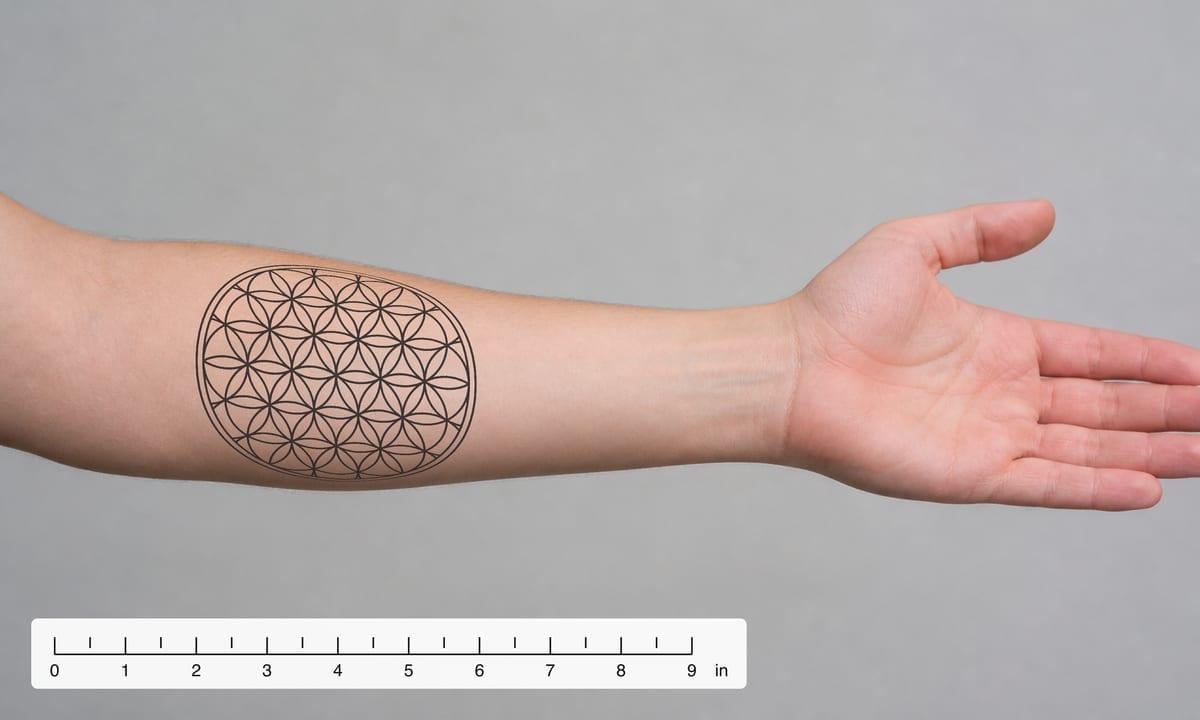 4 in on the forearmFrom the front it reads as an oval about 3.1 in tall.
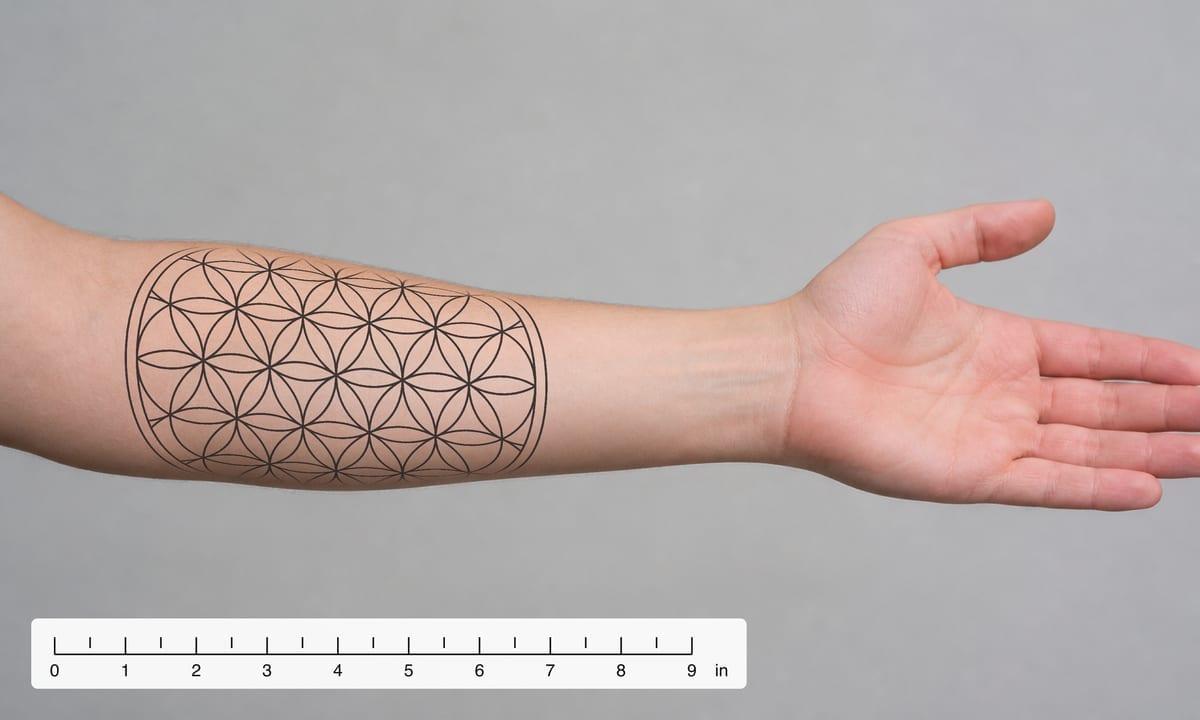 6 in on the forearmWider than the visible half of the arm: the edges go out of sight.
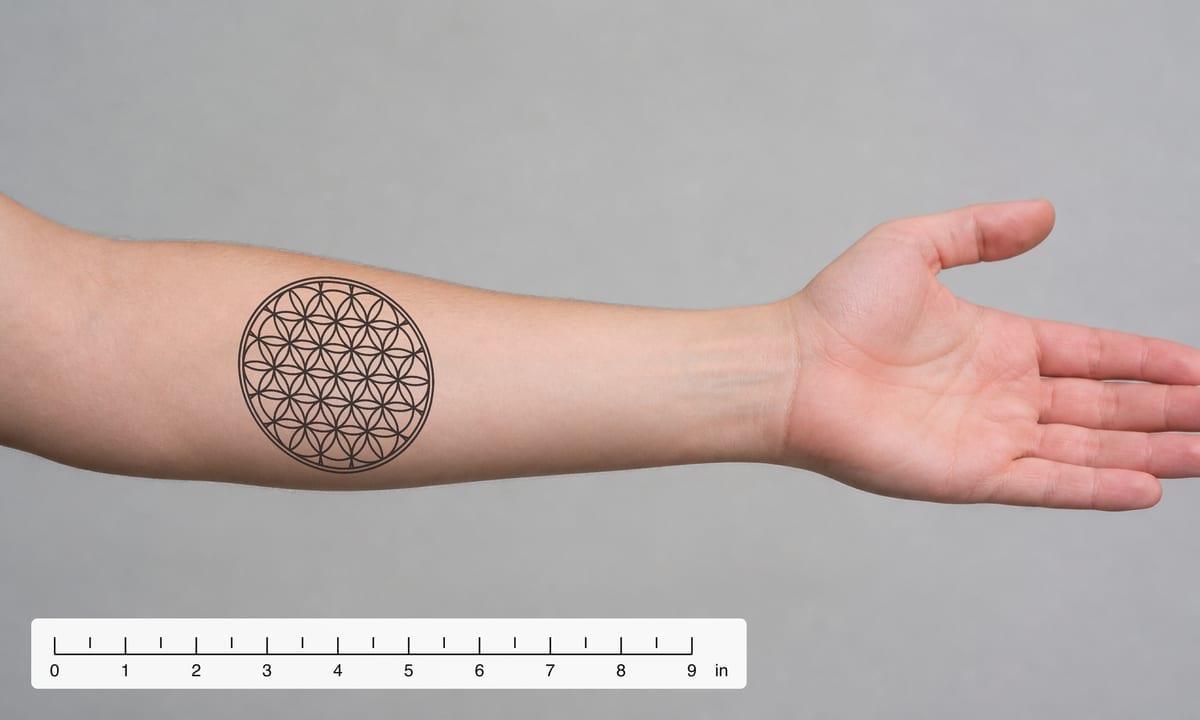 Pre-stretched stencil2.8 in along the arm, about 3.3 in around it: round from the front only.
- Around a median women's forearm
- 10.4 in
- Around a median women's forearm
- 12.2 in for men (ANSUR II)
- The half you see from the front
- 5.2 in
- The half you see from the front
- 6.1 in for men
- How tall a 4 in circle looks there
- 3.1 in
- How tall a 4 in circle looks there
- Its edges are squeezed to 35%
The narrower the limb, the stronger the effect. The chart applies the same calculation to each body part: how wide a small circle near the edge of a 4-inch design still looks from the front, compared with its real width. On a median women's forearm it keeps only about a third of its width; on the thigh it barely changes. Flat areas such as the upper back and the chest between the collarbones are not cylinders, so this calculation does not apply to them, but muscles and breathing move them in other ways.
How round a circle at the edge of a 4 in design still looks from the front
- Women (median)
- Men (median)
- Forearm · 10.4 in around35%
- Forearm · 12.2 in around51%
- Upper arm · 12.0 in around50%
- Upper arm · 14.0 in around62%
- Calf · 14.6 in around65%
- Calf · 15.4 in around69%
- Thigh · 24.2 in around87%
- Thigh · 24.6 in around87%
Artists know this, and the fix is in the stencil. Tattoofilter's style guide notes that geometric stencils often need adjusting, because lines that are straight and circles that are round on paper can look curved or oval on skin, and skilled artists compensate so the shape still reads true. Kreafolk makes the same point about rounded muscles and joints. The last picture above shows the catch: a stencil pre-stretched around the arm looks round from the front, but turn the arm and you see the stretch. No drawing is round from every angle, so decide with your artist which view matters most, usually the one in the mirror with the arm relaxed.
- Keep round figures well inside the visible half. On a median forearm you see 5.2 to 6.1 inches across, but a circle looks clearly oval long before it reaches that width, and the arm narrows toward the wrist.
- Run long designs along the limb. Lines that follow the arm stay straight; tall, narrow compositions suffer least.
- Put radial designs on round places. A mandala centered on a shoulder, elbow or knee uses the curve instead of fighting it.
- Check the stencil standing, with the arm relaxed and then turned. Ask for it to be redone if the center line drifts.
Geometric sleeve and band tattoos
A sleeve is where geometric work meets the body head on, because every line eventually has to go all the way around. Using ANSUR II medians, a full sleeve runs about 21.7 inches from shoulder to wrist on women and 23.7 inches on men (upper arm plus forearm), and the forearm alone is about 10.4 or 12.2 inches around. Our sleeve placement guide shows those lengths drawn on one arm.
How a geometric sleeve is usually planned
Step 1
Pick the structure
- One large figure on the outer arm, or a pattern that covers everything
- Decide where the pattern changes scale: elbow, wrist, shoulder
Step 2
Measure the arm
- Length and circumference at the shoulder, elbow, forearm and wrist
- A repeating unit must divide the circumference evenly or the band will not close
Step 3
Draw on the arm
- Ask whether guide lines will be drawn on the skin or transferred by stencil
- Agree where the seams go, usually where you see them least
Step 4
Tattoo in sessions
- Large pieces are split into several sittings
- Ask your artist how long to heal between them
The arm also tapers: a pattern of equal hexagons that fits the upper arm will not fit the wrist. Good geometric sleeves either scale the units down toward the wrist or switch to a different pattern at the elbow. Bands, popular as forearm or calf pieces and as "geometric filler" between other tattoos, follow the same rule on a smaller scale: measure the circumference where the band will sit, and design the repeat to that number.
Prompt to try
“geometric band tattoo of triangles and hexagons that wraps around the forearm, solid black and linework, repeating units”
Generate this designGeometric animal tattoo ideas
Animals are the most common subject in geometric work after sacred geometry itself. There are two usual treatments: the whole animal faceted into triangles, like a low-poly model, or the animal split down the middle, half realistic and half geometric. Faceted designs need size to keep each facet readable; a half-and-half design needs an artist who is good at both realism and clean linework.
- Faceted fox, with dotwork in the ears
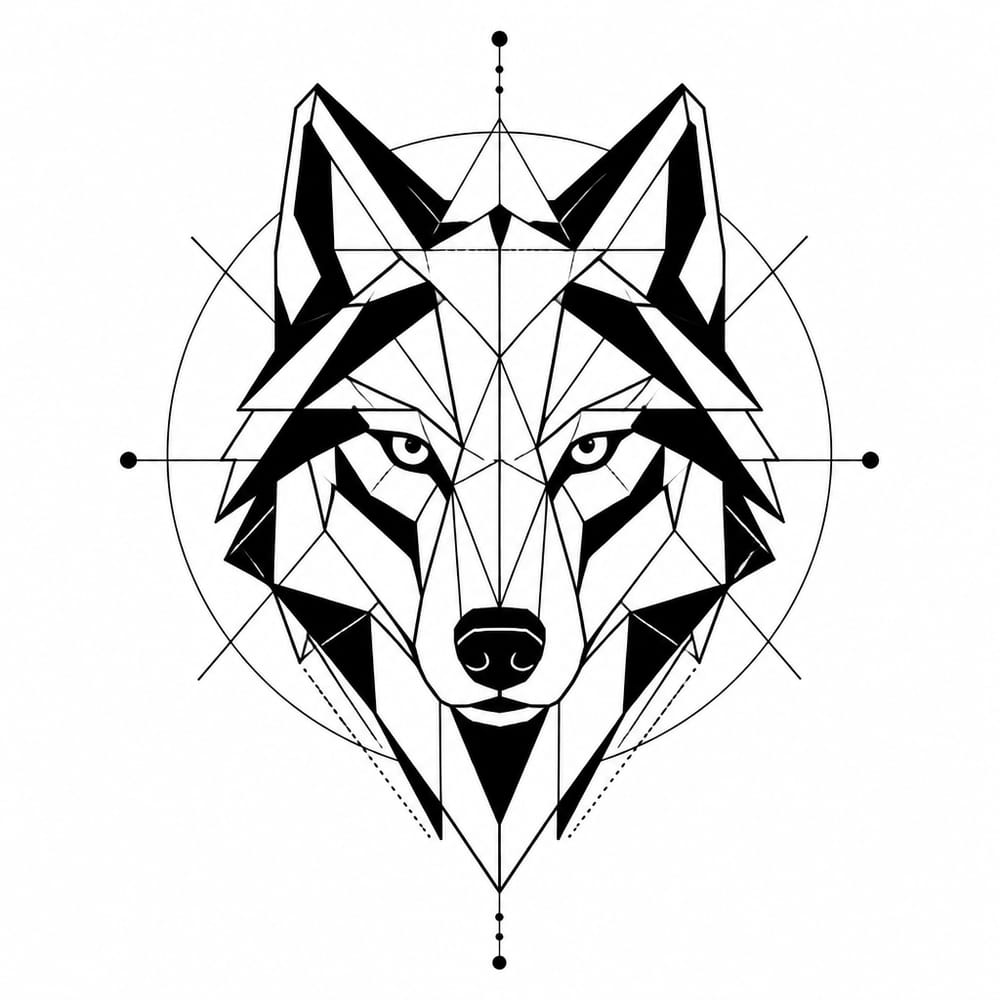 Geometric wolf from our blackwork comparison
Wolf Tattoo Ideas
The animal most often drawn in facets, alone or with a moon.
Fenrir Tattoo Ideas
The bound wolf of Norse myth, a strong subject for a geometric frame.
Spider Tattoo Ideas
A body and eight legs that turn naturally into straight lines.
Honeycomb Tattoo Ideas
Hexagons, the simplest repeating pattern, with or without bees.
Vegvisir Tattoo Ideas
A radial Icelandic stave that sits well inside a circle.
Prompt to try
“half realistic half geometric wolf head tattoo, triangular facets on one side, black and grey fur on the other”
Generate this designGeometric vs dotwork vs blackwork vs fine line
These four overlap so much that the names get used interchangeably. The difference is what defines each one: geometric is defined by construction, dotwork by a shading technique, blackwork by the ink, and fine line by the needle.
| Geometric | Dotwork | Blackwork | Fine line | |
|---|---|---|---|---|
| Defined by | Measured shapes, symmetry | Shading made of dots | Solid black and bare skin | Very thin needle |
| Lines | Ruler-straight, true circles | Often paired with linework | Bold or fine | Single thin lines |
| Shading | None, dots or solid fills | Dots only | Fills, dots, hatching | Little or none |
| Typical subjects | Sacred geometry, mandalas, animals, bands | Mandalas, gradients, ornament | Ornament, animals, cover-ups | Script, florals, small symbols |
| Our page | This page | Covered on this page | Blackwork | Fine line |
"Dotwork geometric" is the most common mix: linework for the structure, dots for depth. For more styles side by side, our tattoo styles guide draws the same rose in eight of them.
Do geometric tattoos age well?
No study compares how tattoo styles age, so anything you read on this is artist experience. The consensus is that geometric work ages well when it is drawn with space in it and less well when it is dense and small. Kreafolk's guide recommends simpler, bolder elements for longevity, notes that highly detailed elements may lose sharpness as the skin changes, that small areas like wrists and ankles need bolder lines to stay legible, and that negative space helps complex patterns hold.
In practice that means three things. Parallel lines drawn very close together are the first to merge, so a tiny Flower of Life on a wrist is a riskier choice than the same figure at 4 inches. Dotwork gradients soften over time, which often suits them. And because a geometric design depends on symmetry, any blowout or uneven line is more visible than it would be in a loose floral; choose an artist with healed geometric work to show you.
Do geometric tattoos hurt more or take longer?
No study measures pain by style. What the evidence points to is time. In a survey of 1,092 tattooed people (Witkoś and Hartman-Petrycka, 2020), longer tattooing time, bleeding and higher stress predicted more pain during tattooing, while body area was not a significant predictor; tattoo size was not recorded. Precise linework is slow to do well, and solid fills or dense dotwork add hours, so a large geometric piece is usually split into several sessions.
Placement matters to how it feels. The artists and clients interviewed in a 2021 pilot study put the chest and ribs in the highest pain tier, the elbow, knee and calf in the middle, and the forearm, biceps and triceps and outer thigh in the lowest. That is reported experience, not measurement. Our tattoo pain chart maps every area. How long a geometric tattoo takes depends on size and density; we found no reliable figures specific to the style, so ask your artist for an estimate from your stencil.
How much does a geometric tattoo cost?
We found no price survey for geometric work. Most studios charge by the hour or by the piece, so price follows size, density and placement. For real numbers, our tattoo cost guide compares the published minimums and hourly rates of 25 US studios, and the tattoo price calculator turns a size and placement into a planning range.
How to choose a geometric tattoo artist and prepare the stencil
- Look for healed geometric work, not only fresh photos: straight lines that are still straight and circles that are still round a year later.
- Check symmetry in the portfolio. Fold a photo in half in your head; both sides should match.
- Ask how the artist adapts a flat design to the body part you want, and whether they draw on the skin for wraparound work.
- Bring a clean reference at the size you want. A precise drawing saves time in the chair, and an artist will still redraw it for skin.
- Look at the stencil standing in a mirror before the first line, relaxed and turned. It is the last moment to move it.
These checks are common advice from artists rather than research. If you are searching for a geometric tattoo artist near you, the same list applies to every portfolio. To turn a design into clean line art you can print and discuss, the tattoo stencil maker converts an image into a stencil.
Healing a geometric tattoo
A geometric tattoo heals like any other. Cleveland Clinic says the top layer of skin is typically healed by about two months and the deeper layers take several more months; larger tattoos can take a few months, with redness and swelling lasting longer. Keep the tattoo out of direct sun while it heals. If a line still has a gap once the skin has healed, ask your artist about a touch-up. Our tattoo healing stages guide shows what normal looks like week by week.
Plan the rest of your geometric tattoo
Forearm Tattoos
The most common spot for geometric work, and the most curved.
Shoulder Tattoos
A round surface made for mandalas and radial designs.
Thigh Tattoos
The flattest limb surface, room for wide symmetrical pieces.
Chest Tattoos
Symmetry around the sternum, with the ribs' pain to plan for.
Sleeve Tattoos
How a half or full sleeve is planned around the arm.
Blackwork Tattoos
The all-black family that geometric belongs to.
Tattoo Size Chart
How much room each body part has, in inches and cm.
Tattoo Pain Chart
Which spots hurt most, and why session length matters more.
Sources
- Wikipedia: Overlapping circles grid (Flower of Life, Abydos dating, Leonardo da Vinci, Herod's Palace) · checked 2026-11-10
- Wikimedia Commons: Temple-of-Osiris Flower-of-Life 02.jpg, photo by Ray Flowers, CC BY-SA 3.0 · checked 2026-11-10
- Wikipedia: Metatron · checked 2026-11-10
- Wikipedia: Platonic solid (Plato's Timaeus) · checked 2026-11-10
- Wikipedia: Golden ratio (nautilus shell, citing Peterson, Science News, 2005) · checked 2026-11-10
- Wikipedia: Mandala · checked 2026-11-10
- Wikipedia: Sri Yantra · checked 2026-11-10
- Grand Rapids Art Museum: Black Waves, The Tattoo Art of Leo Zulueta (exhibition, 2017) · checked 2026-11-10
- Tattoofilter: Tattoo Styles, Geometric Tattoos (style guide, 2018) · checked 2026-11-10
- Kreafolk: Sacred Tips to Create A Geometry Tattoo Design (design guide) · checked 2026-11-10
- ANSUR II: Anthropometric Survey of US Army Personnel (public data, OPEN Design Lab, Penn State) · checked 2026-11-10
- Witkoś J, Hartman-Petrycka M. Gender differences in subjective pain perception during and after tattooing. IJERPH, 2020 · checked 2026-11-10
- Pimentel et al. The effects of VR use on pain experienced during a tattoo procedure: a pilot study. Frontiers in Virtual Reality, 2021 · checked 2026-11-10
- Cleveland Clinic: Tattoo aftercare tips from a dermatologist · checked 2026-11-10
Geometric tattoo FAQ
Do geometric tattoos have meaning?+
Plain shapes have no fixed meaning; the meaning is what you give them. Named figures come with common interpretations: the Flower of Life is said to stand for the interconnection of life, Metatron's Cube for balance, a mandala for the cosmos. Those come from spiritual and New Age writing, not from history.
Do geometric tattoos age well?+
No study compares styles. Artists generally find that geometric work with open space and bolder lines holds up well, while small, dense designs with lines close together are the first to blur. Size intricate sacred geometry up rather than down.
Why does my geometric tattoo look distorted?+
Limbs are curved, so a circle drawn flat looks like an oval from the front. On a median women's forearm, a circle at the edge of a 4-inch design keeps only about a third of its width, by our calculation. Artists often adjust the stencil so the design reads true from the main viewing angle.
Where is the best place for a geometric tattoo?+
Flatter or wider areas distort least: the upper back, the outer thigh, the chest. Long designs suit the forearm and calf if they run along the limb. Round designs like mandalas suit the shoulder, elbow and knee, where they can center on the joint.
Are geometric tattoos cultural appropriation?+
Simple shapes such as triangles and hexagons belong to no single culture. Religious diagrams such as mandalas and the Sri Yantra, and patterns from living traditions such as Polynesian tattooing, deserve care: learn what they are, and ask for an original design inspired by a tradition rather than a copy.
What is the difference between geometric and dotwork tattoos?+
Geometric is defined by construction (measured shapes and symmetry); dotwork is a shading technique made only of dots. They are often combined: linework for the structure, dots for depth.
Tattoo planning tool
Generate a geometric tattoo reference
Describe your idea, generate it in any style, and preview it on your own skin before the needle.
Generate for freeFree to start