
Anubis Tattoo: Meaning, Symbols and Designs to Scale
An Anubis tattoo shows the jackal-headed Egyptian god of embalming and the dead, who was also drawn as a black jackal resting on a shrine. In Egypt he protected the dead, oversaw mummification and led them to the weighing of the heart. Today wearers commonly read it as protection, a memorial for someone who died or a reminder of mortality: modern interpretations, not Egyptian doctrine.
11+ Anubis tattoo designs
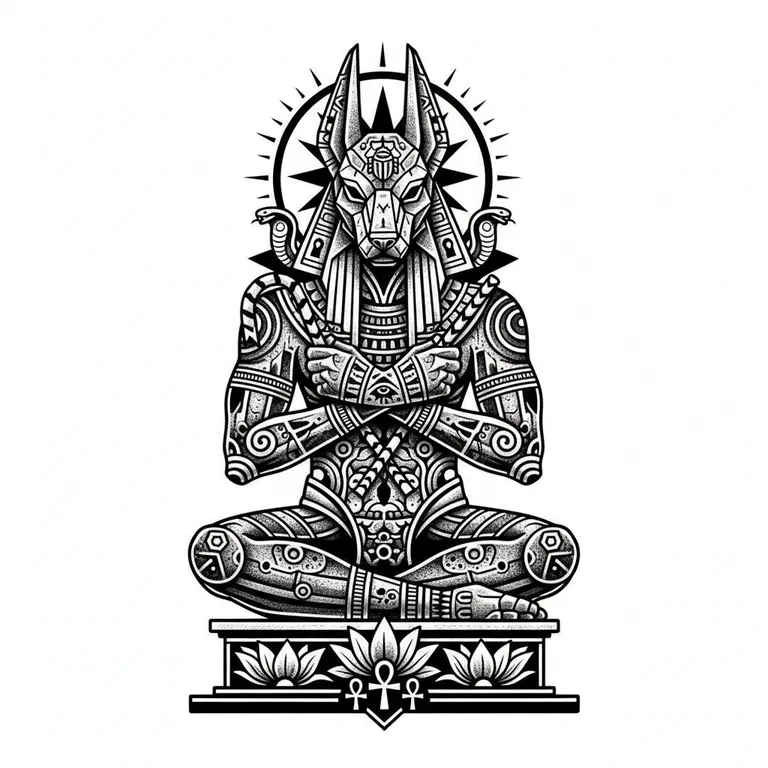
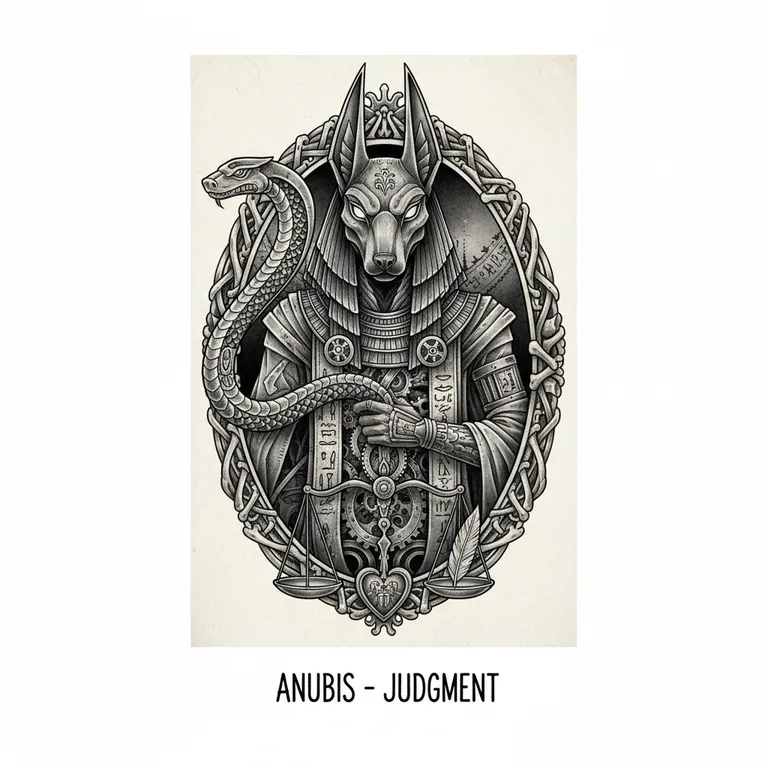
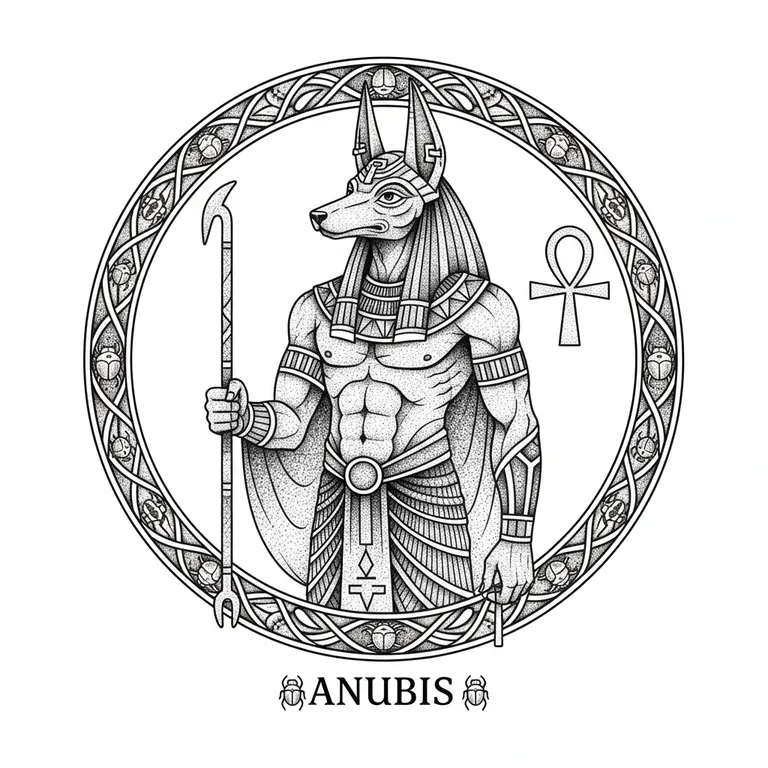
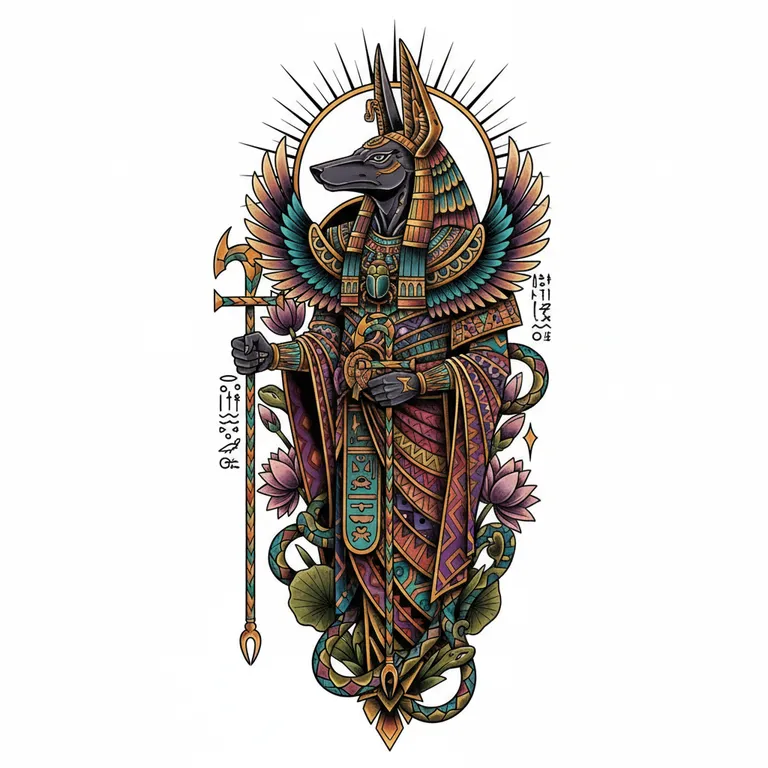
AI-generated anubis tattoo designs across popular styles. Tap any one to generate your own version and preview it on your skin.
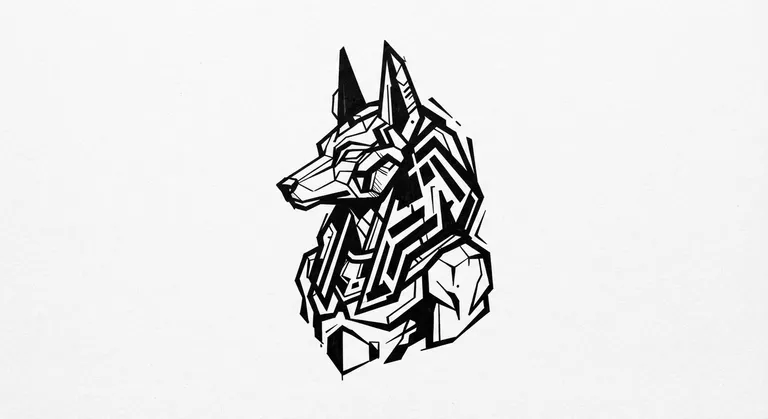
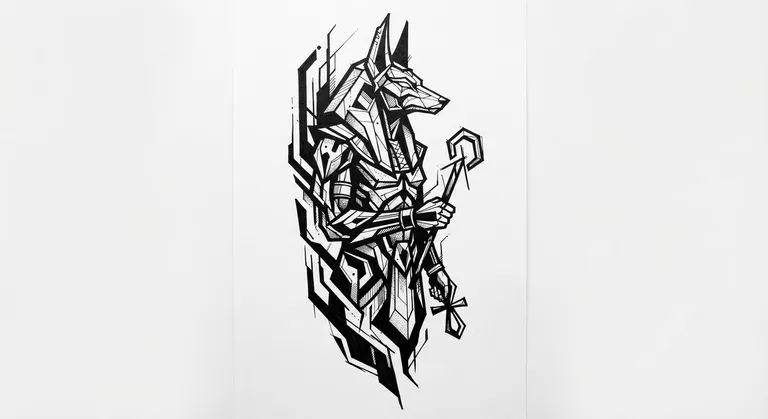
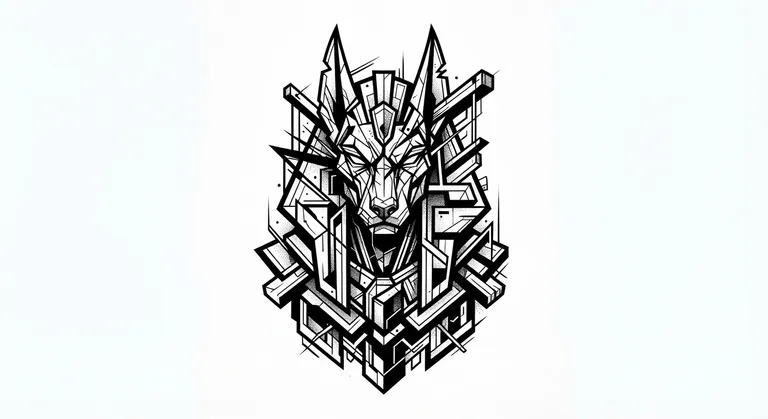
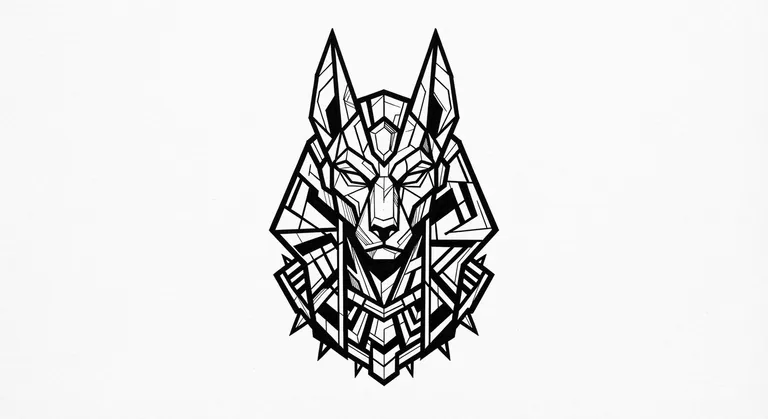
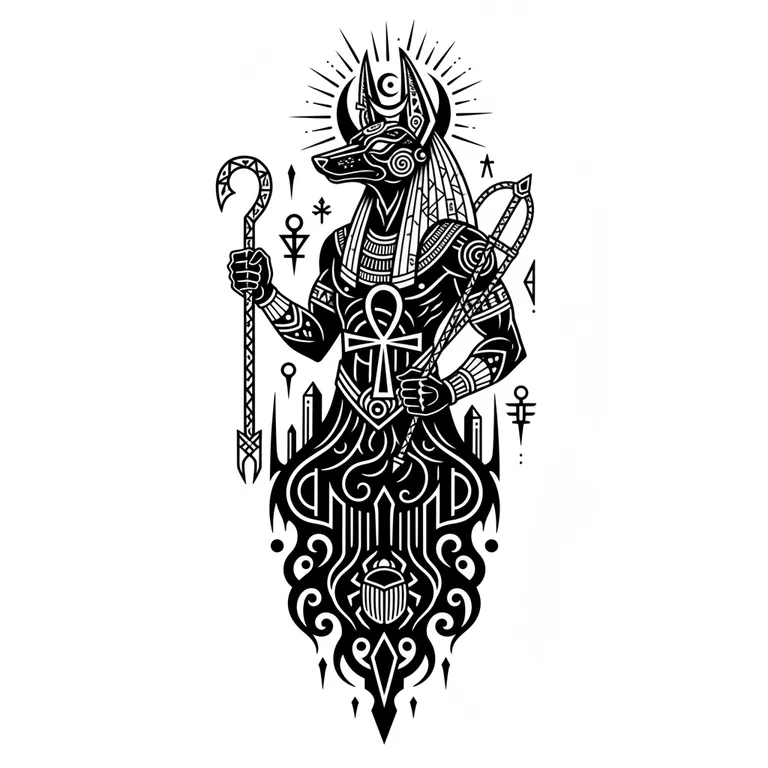
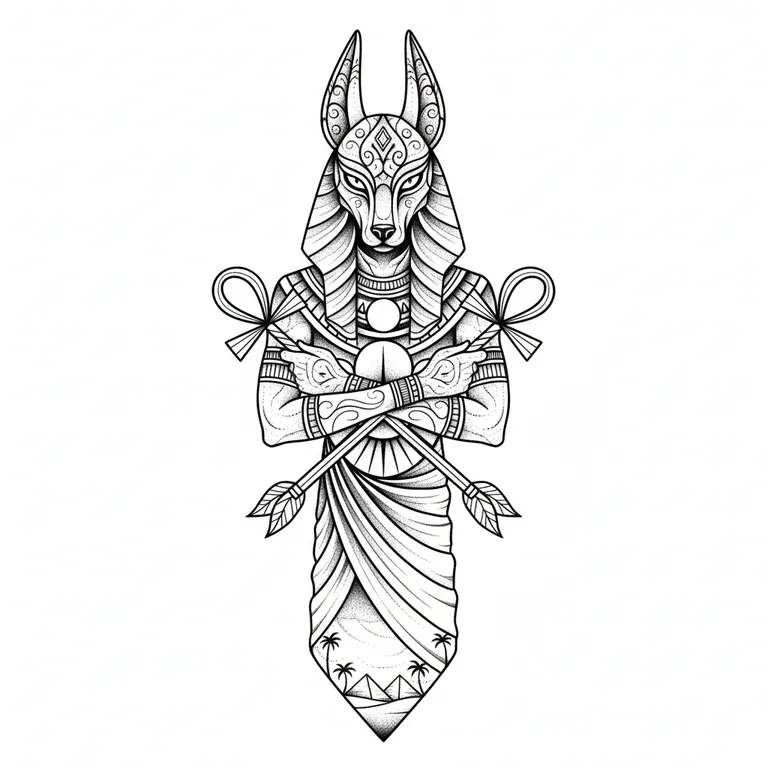
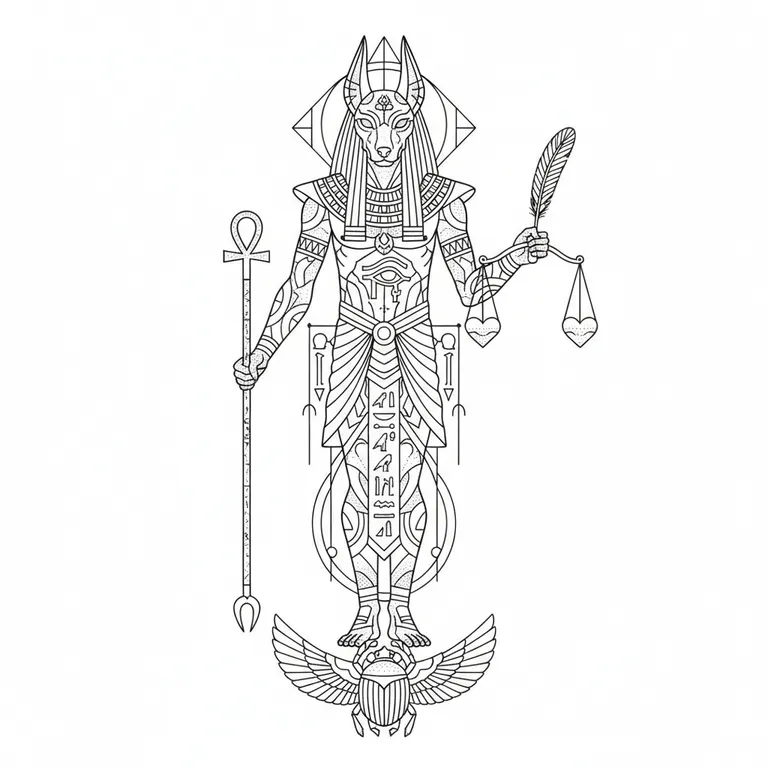
What does an Anubis tattoo mean?
Historically, Anubis is about the care of the dead. World History Encyclopedia calls him the god of mummification and funerary rites, guardian of tombs and guide to the afterlife, "He Who is in the Place of Embalming"; his image appears on royal tombs from the First Dynasty (c. 3150 to 2890 BCE). The Western Australian Museum lists what he does in Egyptian sources:
- Embalming. As the god "who is in the embalming tent" he oversees mummification; in some versions of the myth he helped mummify Osiris.
- Guarding the tomb. Book of the Dead spell 151 puts a magic brick with an Anubis amulet on the west wall of the burial chamber, protecting the dead "from any aggressor".
- Opening of the Mouth. He supports the upright mummy during the ritual meant to let the dead breathe, speak and see again.
- The judgement. He can lead the dead to the Hall of Judgement and make sure the scales work correctly when the heart is weighed.
Today, wearers commonly describe the tattoo as protection for themselves or someone they love, a memorial for a person or a pet who died, a reminder that life ends, or simply a love of Egyptian mythology. Those are modern interpretations, and they are yours to choose; just keep them apart from the history, which is about embalming, guarding and judgement.
Anatomy of an Anubis tattoo
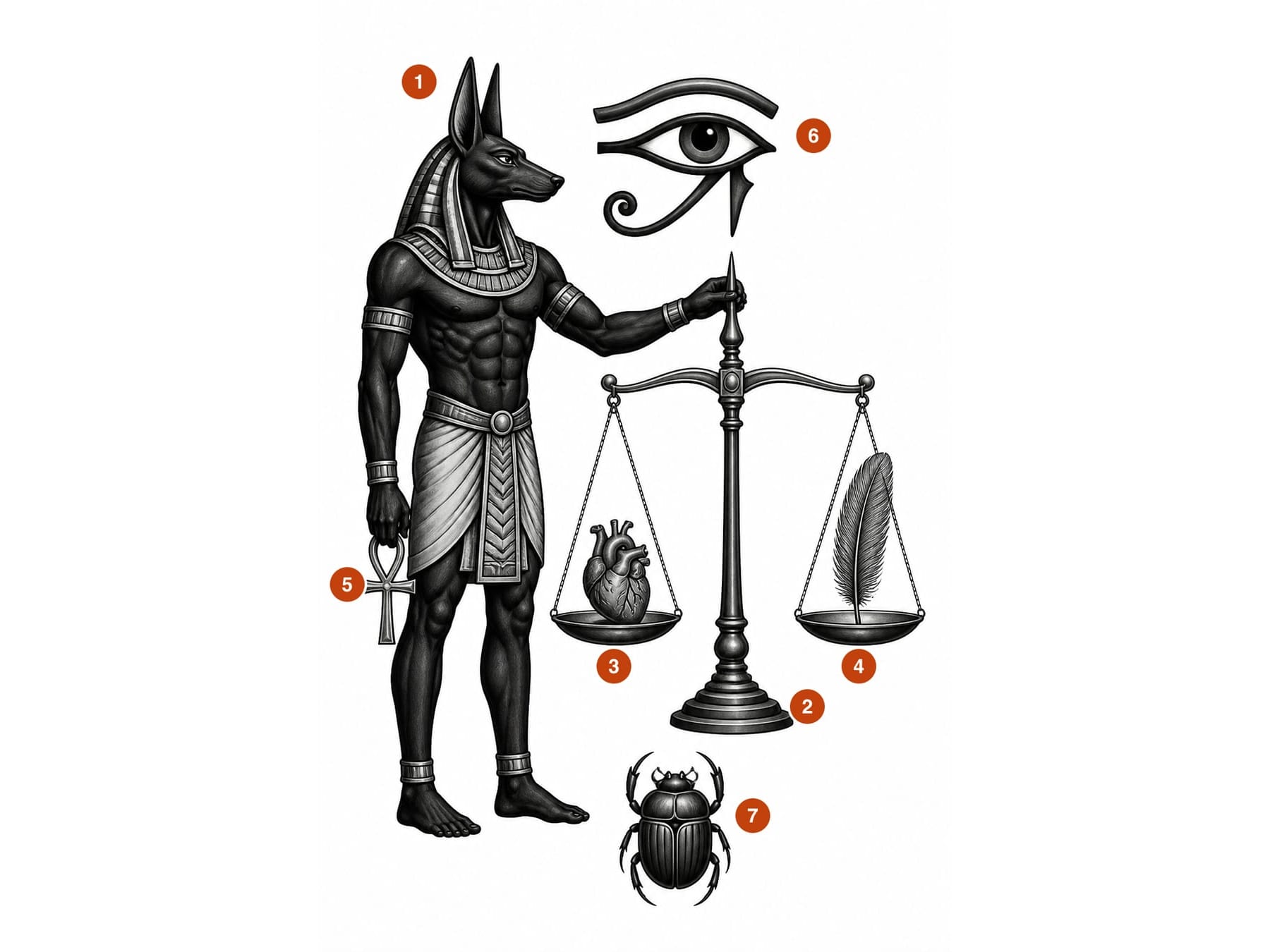
| # | Element | What it meant in ancient Egypt | Source |
|---|---|---|---|
| 1 | Black jackal head | Black stood for decay and the fertile Nile soil, so regeneration; Egyptian jackals were not black | World History Encyclopedia |
| 2 | Balance | Anubis makes sure the scales work; in the Hunefer papyrus he adjusts the plumb-weight | WA Museum, DailyArt |
| 3 | Heart | Seat of thought and personality, kept in the mummy to be weighed | Global Egyptian Museum |
| 4 | Feather | Ma'at: truth and cosmic order, weighed against the heart | Global Egyptian Museum, DailyArt |
| 5 | Ankh | The Egyptian word for "life", often shown given by a god to the king | Global Egyptian Museum |
| 6 | Eye of Horus (wedjat) | Horus's eye, injured by Seth and healed: protection and wholeness | V&A |
| 7 | Scarab | A heart scarab carried a spell asking the heart not to betray its owner at the weighing | Global Egyptian Museum |
Why is Anubis black, and is he a jackal or a dog?
World History Encyclopedia describes three forms: a black canine, a jackal-dog hybrid with pointed ears, or a muscular man with a jackal's head. The black is symbolic, standing for decay and the black soil of the Nile valley, not the color of Egyptian jackals. The article quotes the Egyptologist Salima Ikram, who thinks Anubis is probably a "super-canid" combining several canids rather than just a jackal or a dog, so your artist can lean either way. One caution if you copy museum pictures: the WA Museum notes that the god Wepwawet and one of the four sons of Horus also have jackal heads, so check the label first.
The African "golden jackal" was reclassified in 2015 as a separate species, the African golden wolf (ScienceDaily, on Koepfli and colleagues). That study does not mention Anubis, and we found no reliable source saying Egyptians modeled him on it.
What happens in the weighing of the heart?
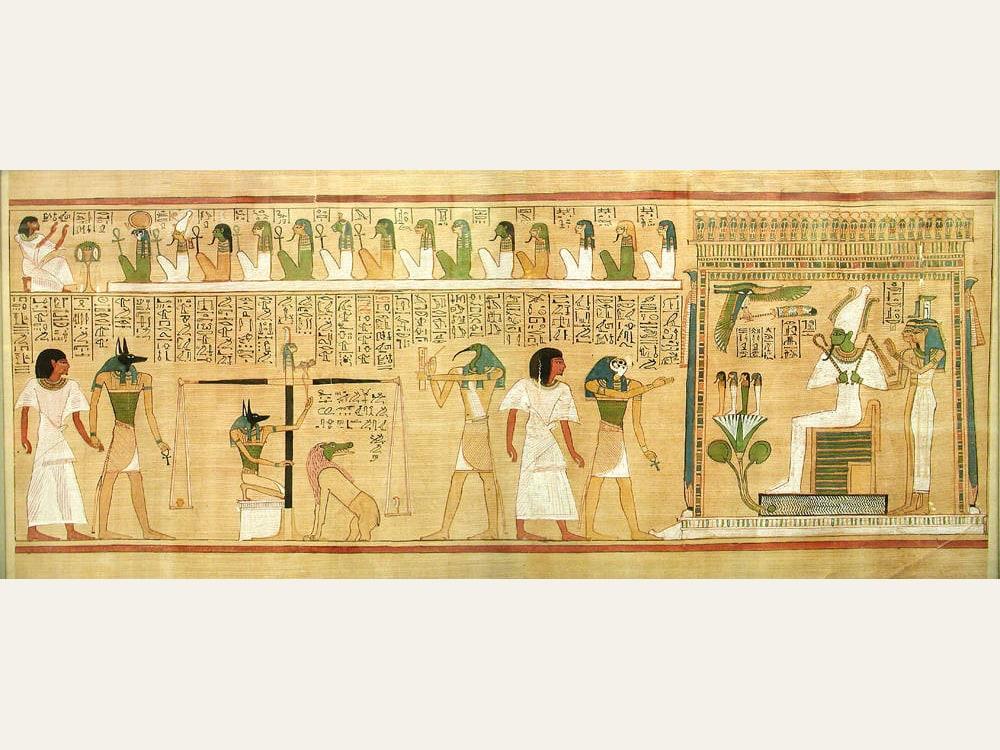
Scale-and-feather Anubis tattoos borrow from scenes like this one, from the Book of the Dead of the royal scribe Hunefer, 19th Dynasty (DailyArt; Wikimedia Commons). Read it left to right: Anubis leads Hunefer by the hand to the balance, where his heart is weighed against the feather of Ma'at, truth, and Anubis adjusts the plumb-weight. Ammit, part crocodile, lion and hippopotamus, waits to devour a heart that fails. Ibis-headed Thoth records the result. Hunefer passes, and falcon-headed Horus presents him to Osiris, enthroned with Isis and Nephthys. So in the original, Anubis guides and tends the balance while Thoth writes and Osiris presides; a design with Anubis holding the feather himself is a modern simplification.
Anubis and Osiris: who was god of the dead first?
Anubis. In the Early Dynastic Period and the Old Kingdom (c. 3150 to 2181 BCE) he was the sole lord of the dead, called "First of the Westerners", according to World History Encyclopedia. As the cult of Osiris grew in the Middle Kingdom (2040 to 1782 BCE), Osiris took over that role. Anubis was folded into his myth: once a son of Ra and Hesat, he became the son of Osiris and Nephthys, adopted by Isis, and Osiris's protector. His main cult center was Cynopolis, "the city of the dog". An Anubis and Osiris tattoo therefore reads as guide and king, not rivals.
What symbols go with an Anubis tattoo?
| Symbol | What it meant in Egypt | How it reads in a design |
|---|---|---|
| Scales and feather | The judgement of the heart against Ma'at (WA Museum) | The most narrative pairing; needs width |
| Ankh | "Life" (Global Egyptian Museum) | A simple shape that fits under a head profile |
| Eye of Horus | Protection and wholeness (V&A) | Reads as Anubis plus Horus; works small |
| Heart scarab | A spell so the heart would not testify against its owner (Global Egyptian Museum) | Points to the judgement without the whole scene |
| Red sash on a seated jackal | A form of the sa sign, protection (WA Museum) | The one touch of color in a black design |
| Hieroglyphs | Real writing | Must be spelled correctly; see the callout below |
A pyramid backdrop is scenery: none of the sources we used ties pyramids to Anubis. Artists commonly advise one partner symbol rather than several, so each stays readable.
Anubis and Horus tattoo: what is the difference?
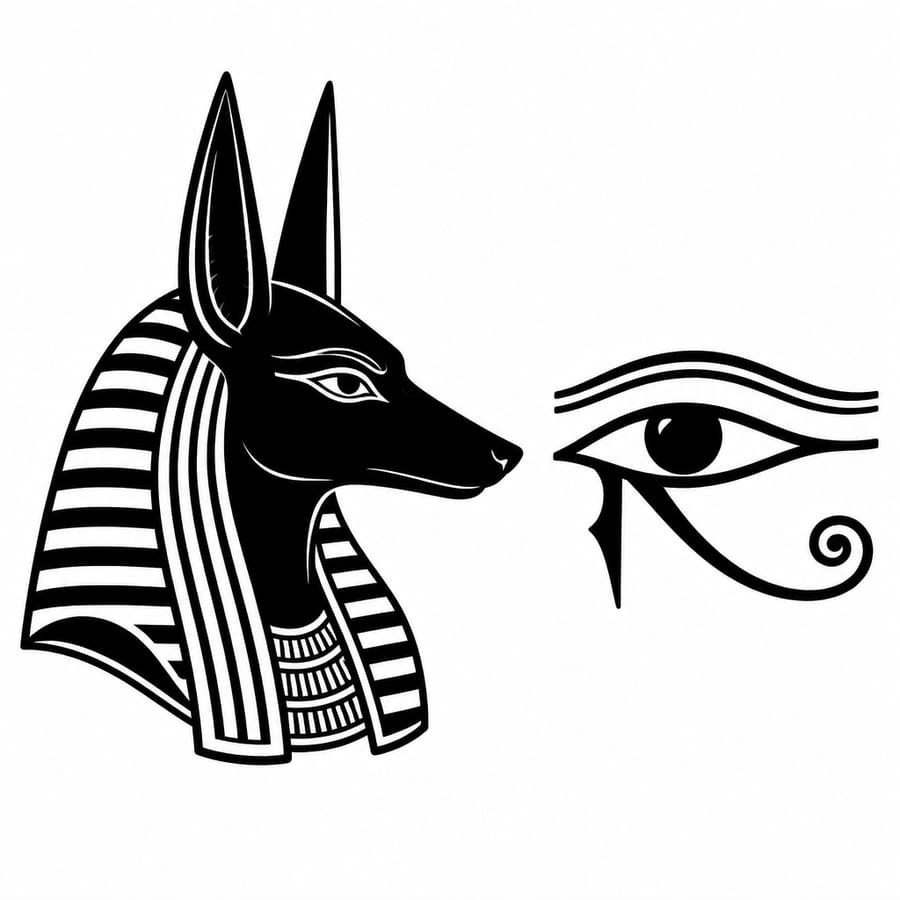
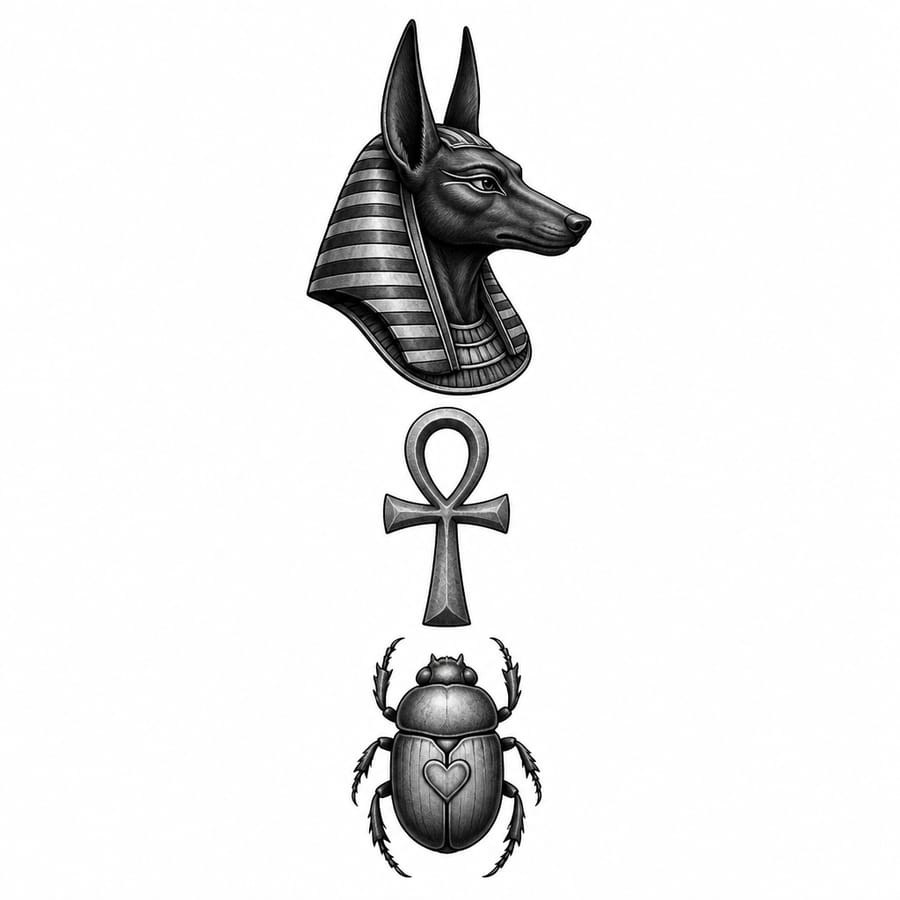


Anubis is the jackal; Horus, the falcon, is the god of kingship and the sky (DailyArt). In the Hunefer scene Horus presents the dead man to Osiris after Anubis's part at the balance, so "Anubis vs Horus" is not a rivalry: they are two gods with different jobs in the same scene. The wedjat eye carries a falcon's markings (V&A). Wearers usually read the pairing as judgement plus protection, which is a design reading, not an ancient formula.
Two ways to draw Anubis: jackal-headed figure or jackal on a shrine
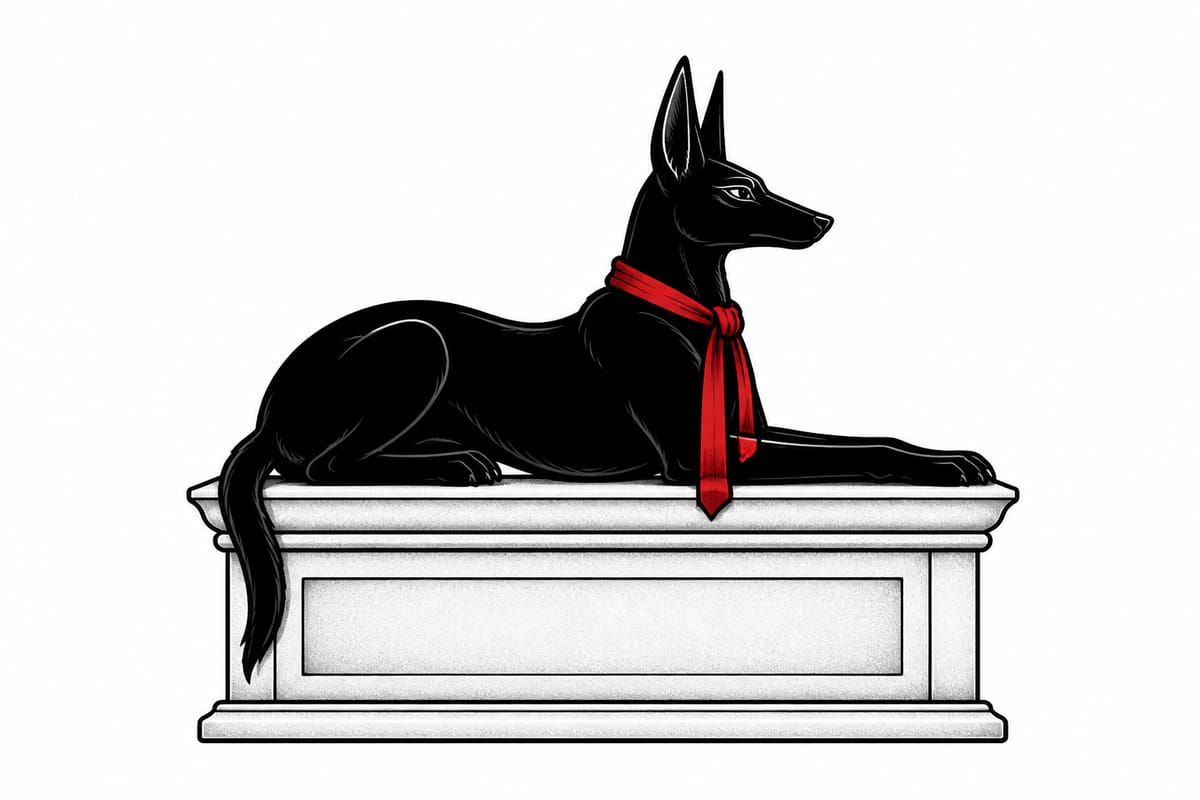
The WA Museum names two ways Egyptians showed him: a human body with a jackal's head, or a jackal or dog, often on top of a shrine, wearing a looped red sash, the sa sign of protection. Larger figures of the jackal on a shrine had the same protective power as the spell 151 amulet. As artist consensus rather than rule: a head profile is the compact option, a standing figure is tall and narrow for a forearm or calf, and the jackal on a shrine is long and low for an outer forearm, a collarbone or across the upper back.
Which style suits an Anubis tattoo?
- Blackwork: solid black on the jackal head, close to the black of the Egyptian images.
- Black and grey realism: shaded muscles, collars and fur; needs size.
- Dotwork: shading built from dots, a grainy texture on headdress stripes and stone.
- Fine line: thin single lines; artists generally want extra room for the headdress and face.
- Traditional and neo-traditional: bold outlines, where a red sash or gold collar carries the color.
- Geometric: Anubis rebuilt from straight lines and flat shapes.
The AI-generated gallery at the top of this page shows several of these on the same subject. For a side-by-side of one design in eight styles, see tattoo styles explained.
How big should an Anubis tattoo be?
Size follows the composition: a head profile fits almost anywhere, a standing figure needs length, the judgement scene needs a wide area. Room per body part is the ANSUR II median, as in our tattoo size guide. That also answers "for men" and "for women": men's medians are wider, so the same design takes up less of the limb.
| Placement | Room, women / men | Design that fits | Pain tier |
|---|---|---|---|
| Wrist, one side | 3.0 / 3.5 in across | Head profile, about 2.5 in | Not tiered (called tender) |
| Hand | 7.1 × 3.1 / 7.6 × 3.5 in | Head profile or ankh pairing | Middle |
| Forearm | 9.5 × 5.2 / 10.5 × 6.1 in | Standing figure, about 7 in | Lower |
| Upper arm | 12.2 × 6.0 / 13.2 × 7.0 in | Standing figure or jackal on a shrine | Lower |
| Lower leg (calf) | 15.2 × 7.3 / 16.3 × 7.7 in | Standing figure, about 11 in | Middle |
| Thigh | 13.1 × 12.1 / 14.1 × 12.3 in | Figure at the balance | Lower outer, higher inner |
| Back | 14.4 × 16.7 / 16.3 × 18.8 in | The whole judgement scene | Not rated |
| Full arm (sleeve) | about 21.7 / 23.7 in long | The scene as a sequence | Varies along the arm |
Room is length times half the circumference (width × height for the back), our calculation from survey medians of US Army personnel aged 17 to 58, not the general population, so measure yourself or try the tattoo size calculator. Pain tiers come from the tattoo pain chart, based on what artists and customers reported in Pimentel et al. (2021), not measurements; the back was not rated, and one artist called the wrist tender. In a survey of 1,092 tattooed people, body area stopped predicting pain once session length, stress and bleeding were counted.
Small Anubis tattoo on the wrist or hand
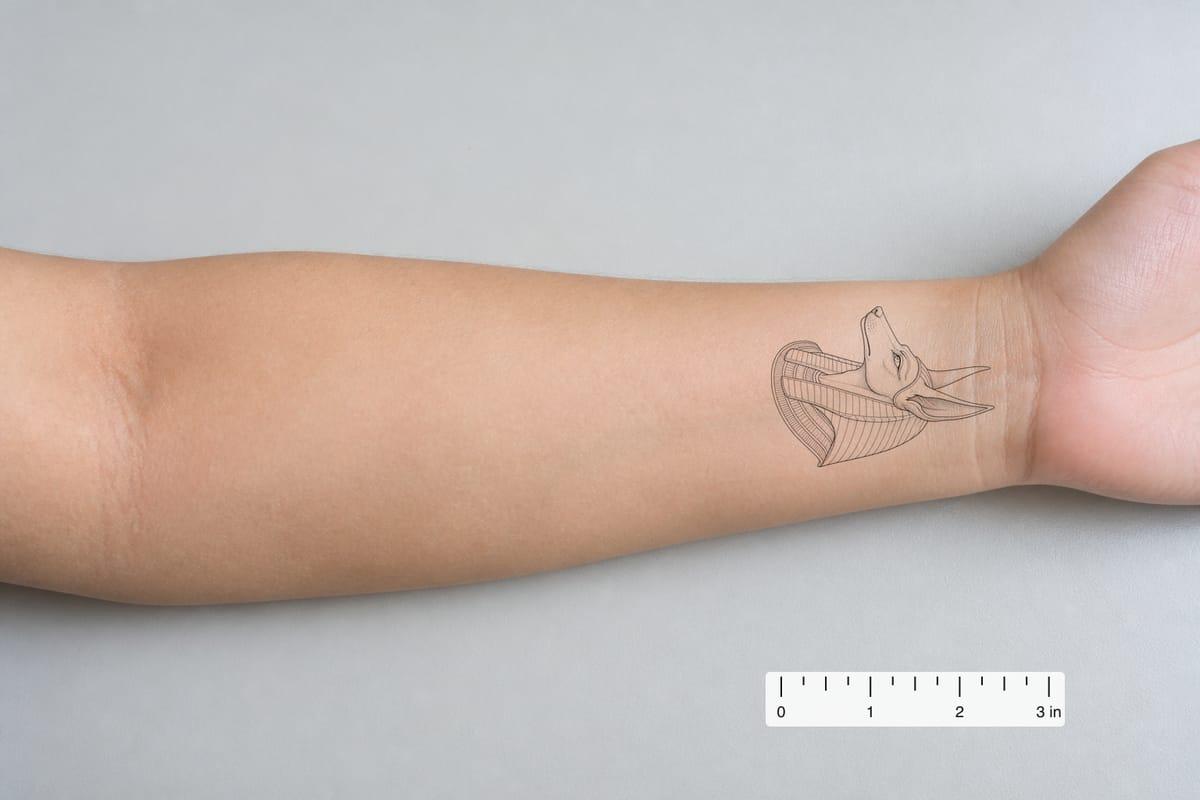
The head profile is the "small and simple" Anubis: ears, snout and headdress stay recognizable at about 2.5 inches, with a margin on a 3.0 to 3.5 inch wrist. Going smaller usually means simplifying, dropping headdress stripes and fine shading first. The back of the hand, about 3.1 to 3.5 inches wide, takes the same head; see the hand placement guide.
Anubis tattoo on the forearm
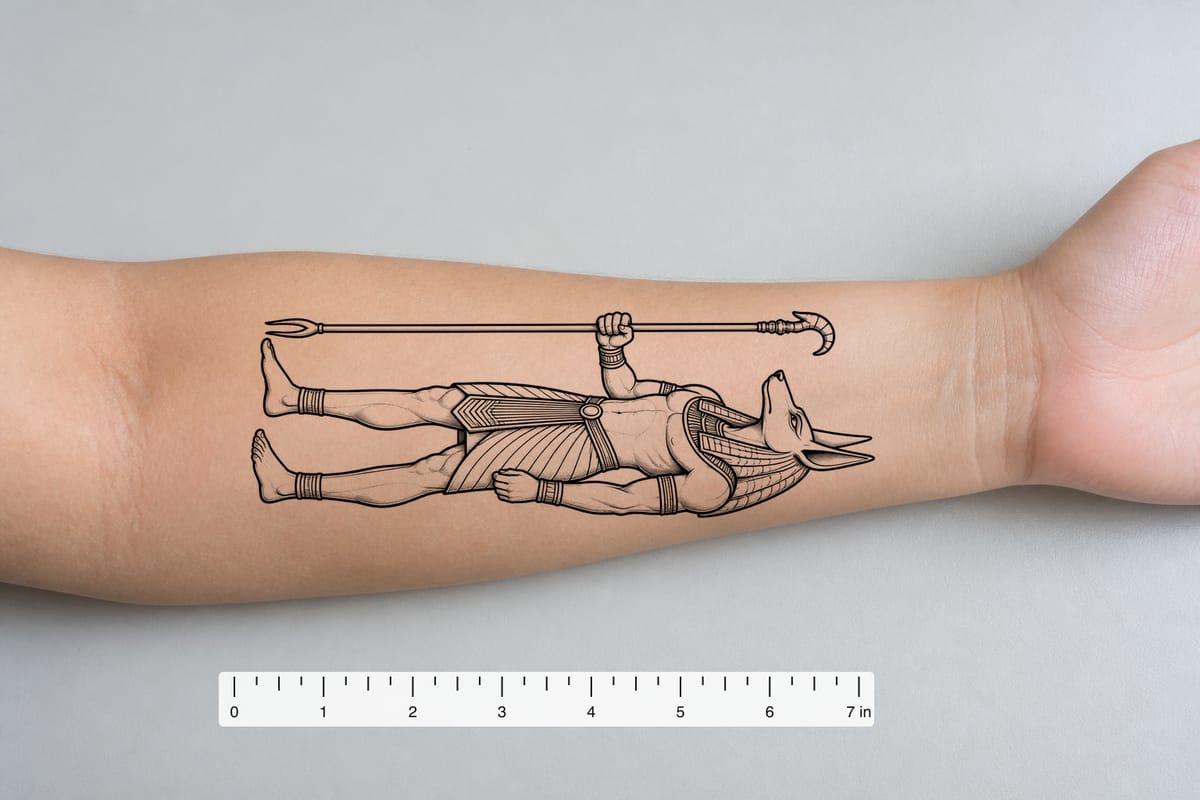
Our standing design is about a third as wide as it is tall, so at 7 inches it is about 2.3 inches wide and sits on the flat inner or outer forearm with room to spare. The outer forearm also takes a horizontal jackal on a shrine. More in the forearm placement guide.
Anubis tattoo on the leg or calf
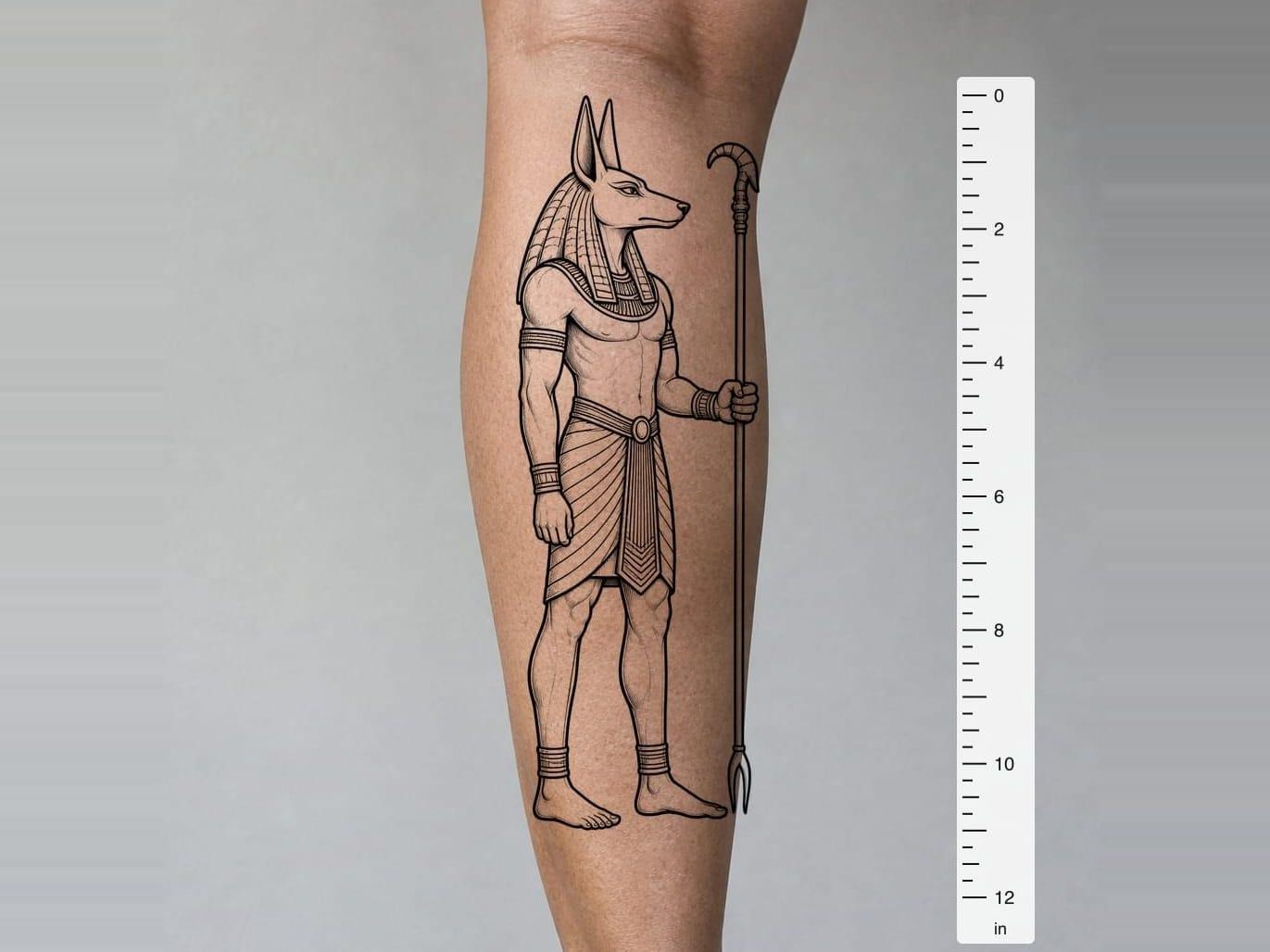
The calf takes the tallest standing figure, about 11 inches between knee and ankle. The full scene with the balance is a different shape: our anatomy design is about two-thirds as wide as it is tall, so at 11 inches it would be about 7.4 inches wide, the whole half-circumference of a median calf (7.3 to 7.7 inches), and would wrap around the leg. The thigh, about 12 inches across one side, or the back suits it better.
Anubis sleeve and back piece ideas
The Hunefer papyrus is itself a long strip, about 5.5 meters long and 40 cm high (Wikimedia Commons), and the judgement reads as a sequence. That gives a ready-made plan: Anubis leading the dead at the top of the arm or the left of the back, the balance with Ammit in the middle, Thoth recording, and Osiris enthroned at the end. On a back it can run as one horizontal band; on a sleeve it spirals down the arm. Ask your artist how many sessions they would split it into, and see how much a tattoo costs and the sleeve placement guide.
Is an Anubis tattoo bad luck?
No source we checked supports a bad-luck tradition. In Egyptian funerary religion Anubis was a protector: his amulet was placed in the burial chamber to guard the dead "from any aggressor" (WA Museum) and called upon for protection (World History Encyclopedia). Being linked to death is not the same as being evil; the curse idea is modern superstition.
Did ancient Egyptians have tattoos?
Yes. Two naturally preserved mummies from Gebelein at the British Museum, about 5,000 years old, carry the oldest known figurative tattoos (Phys.org, on Friedman and colleagues, Journal of Archaeological Science, 2018). Infrared imaging revealed a wild bull and a Barbary sheep on the man's upper arm and S-shaped designs on the woman's shoulder, probably made with soot. None of the sources we opened says ancient Egyptians tattooed Anubis.
How to get a stencil-ready Anubis design
Reduce the design to what a stencil carries: the outline of the head and ears, the headdress and the main lines of the balance; the artist adds shading. The tattoo stencil maker turns a drawing or design into transfer linework, with one free generation before signup; exact-size printing across several sheets with cut marks is in the Stencil studio after sign-in. Your artist will still redraw it for your skin.
Related tattoo ideas and guides
Memento Mori Tattoo Ideas
Skulls, hourglasses and other reminders of mortality.
Cerberus Tattoo Ideas
The Greek hound that guards the underworld, another dog of the dead.
Zeus Tattoo Ideas
A Greek god figure, for comparison with Egyptian designs.
Evil Eye Tattoo Ideas
A different eye symbol from the Eye of Horus, also worn for protection.
Wolf Tattoo Ideas
Another canine, for a natural rather than mythological design.
Forearm Tattoo Placement
Room, pain and visibility for a standing Anubis.
Tattoo Styles Explained
One rose drawn in eight styles to help you choose yours.
First Tattoo Guide
What to plan, ask and expect before your first appointment.
Sources
- Joshua J. Mark, "Anubis", World History Encyclopedia (2016) · checked November 6, 2026
- Moya Smith, "Anubis", Secrets of the Afterlife curator's introduction, Western Australian Museum · checked November 6, 2026
- James W. Singer, "Judgement Scene from the Book of the Dead of Hunefer", DailyArt Magazine · checked November 6, 2026
- Wikimedia Commons, File:BD Hunefer.jpg (British Museum EA 9901, photo Jon Bodsworth, public domain) · checked November 6, 2026
- Victoria and Albert Museum, Wedjat eye amulet, carnelian, c. 664 to 30 BC (CIRC.28Y-1935) · checked November 6, 2026
- Global Egyptian Museum, glossary: "Ankh" · checked November 6, 2026
- Global Egyptian Museum, heart scarab of Ramose (Liverpool, Mayer collection) · checked November 6, 2026
- Bob Yirka, "Egyptian mummies found to have oldest figurative tattoos", Phys.org (2018), on Friedman et al., Journal of Archaeological Science · checked November 6, 2026
- ScienceDaily (July 30, 2015), "'Golden jackals' of East Africa are actually 'golden wolves'", on Koepfli et al., Current Biology · checked November 6, 2026
- ANSUR II: Anthropometric Survey of US Army Personnel (public data, OPEN Design Lab, Penn State) · checked November 6, 2026
- Pimentel D et al. The Effects of VR Use on Pain Experienced During a Tattoo Procedure: A Pilot Study. Frontiers in Virtual Reality, 2021 · checked November 6, 2026
- Witkoś J, Hartman-Petrycka M. Gender Differences in Subjective Pain Perception during and after Tattooing. IJERPH, 2020 · checked November 6, 2026
Anubis tattoo FAQ
Is an Anubis tattoo bad luck?+
No source we checked supports a bad-luck tradition. In Egyptian funerary religion Anubis protected the dead: a Book of the Dead spell placed his amulet in the burial chamber to guard them from any aggressor. The bad-luck idea is modern superstition.
Is Anubis good or evil?+
The Egyptian sources present him as a protector, not a villain. He oversaw embalming, guarded tombs and led the dead to the weighing of the heart. Being a god of the dead made him a guardian of the dead, not a figure of evil.
Is Anubis a jackal or a dog?+
Both appear. World History Encyclopedia describes him as a black canine, a jackal-dog hybrid or a man with a jackal's head, and quotes the Egyptologist Salima Ikram calling him a "super-canid" that combines several canids. His black color is symbolic, not the animal's real color.
What is the difference between Anubis and Horus?+
Anubis is the jackal-headed god of embalming and the dead; Horus is the falcon-headed god of kingship and the sky. In the Hunefer papyrus Anubis tends the balance and Horus then presents the dead man to Osiris. The Eye of Horus stands for protection and wholeness.
How big should an Anubis tattoo be?+
It depends on the composition. A head profile works at about 2.5 inches on a wrist, a standing figure at about 7 inches on a forearm or 11 inches on a calf, and the full judgement scene needs a thigh, back or sleeve. Median forearm room is 9.5 × 5.2 inches for women and 10.5 × 6.1 for men (ANSUR II).
Does an Anubis tattoo hurt?+
It depends on placement and session length. In artists' reports summarized in our tattoo pain chart, the forearm and upper arm are in the Lower tier and the hand and calf in the Middle tier. A survey of 1,092 people found session length, stress and bleeding mattered more than the body area.
How long does an Anubis tattoo take to heal?+
Healing depends on the tattoo, not the subject. A detailed sleeve or back piece done over several sessions means several healing periods. Our tattoo healing stages guide explains what is normal at each stage and when to see a doctor.
Tattoo planning tool
Design your own Anubis tattoo
Describe your idea, generate it in any style, and preview it on your own skin before the needle.
Generate for freeFree to start
Explore more tattoo ideas
- Kraken Tattoo IdeasA kraken tattoo depicts the giant sea monster of Nordic legend, all tentacles and dread from the deep.
- Fenrir Tattoo IdeasA fenrir tattoo features the giant wolf of Norse mythology destined to break free at Ragnarök.
- Yggdrasil Tattoo IdeasAn yggdrasil tattoo depicts the Norse tree of life that connects the nine worlds.
- Samurai Tattoo IdeasA samurai tattoo represents the legendary Japanese warriors and their code of honour, bushido.