
Kraken Tattoo Ideas: Meaning, Legend and Placement
A kraken tattoo shows the giant many-armed sea creature of Norwegian fishermen's lore, drawn today as a huge octopus or squid rising from the waves. It is commonly read as strength, the unknown and facing something bigger than you; the oldest written accounts also tie it to hidden depths and plentiful fish. Its arms can follow the shape of a limb, so it suits a sleeve, a calf or a full back.
11+ Kraken tattoo designs
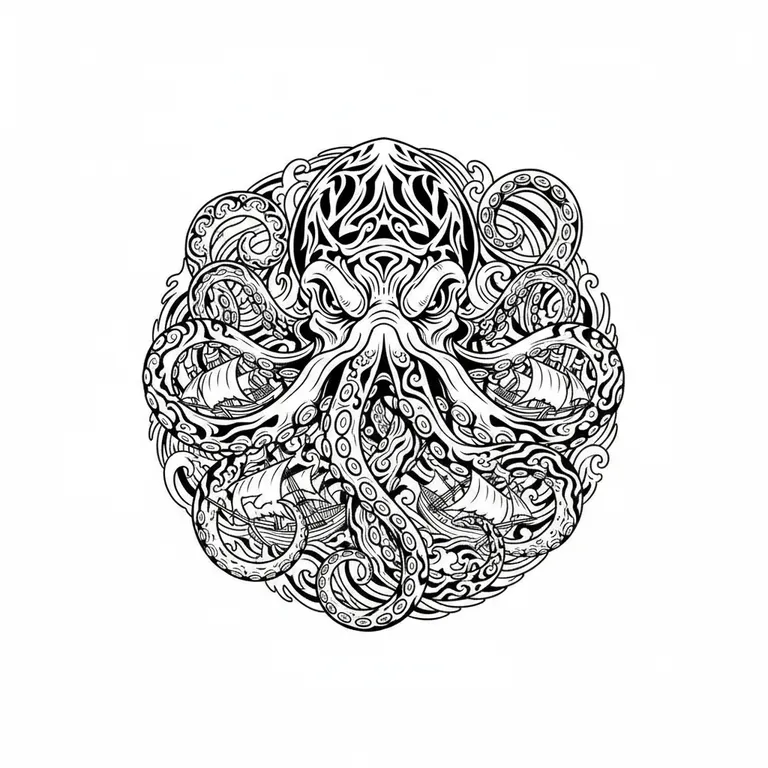
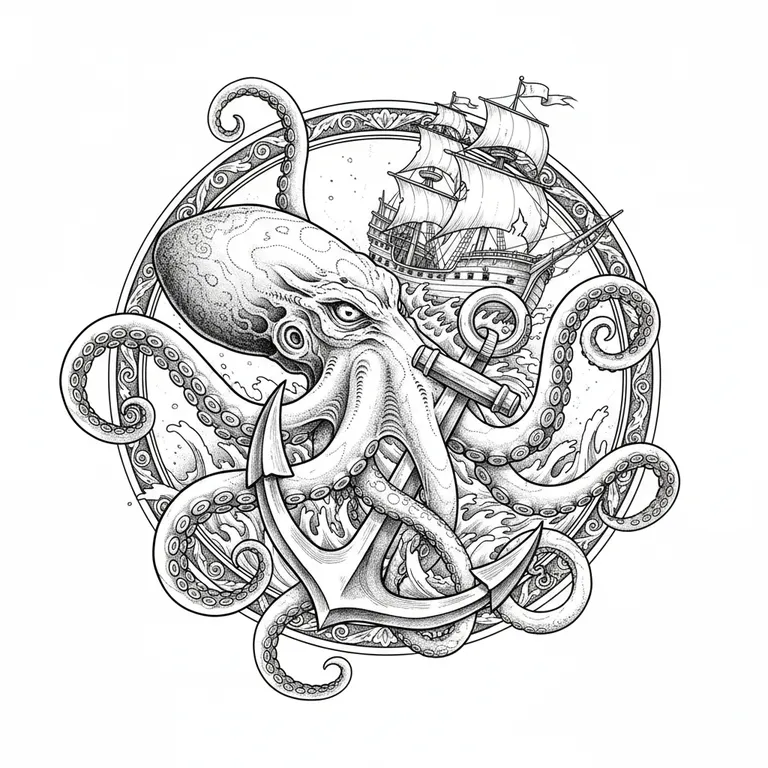
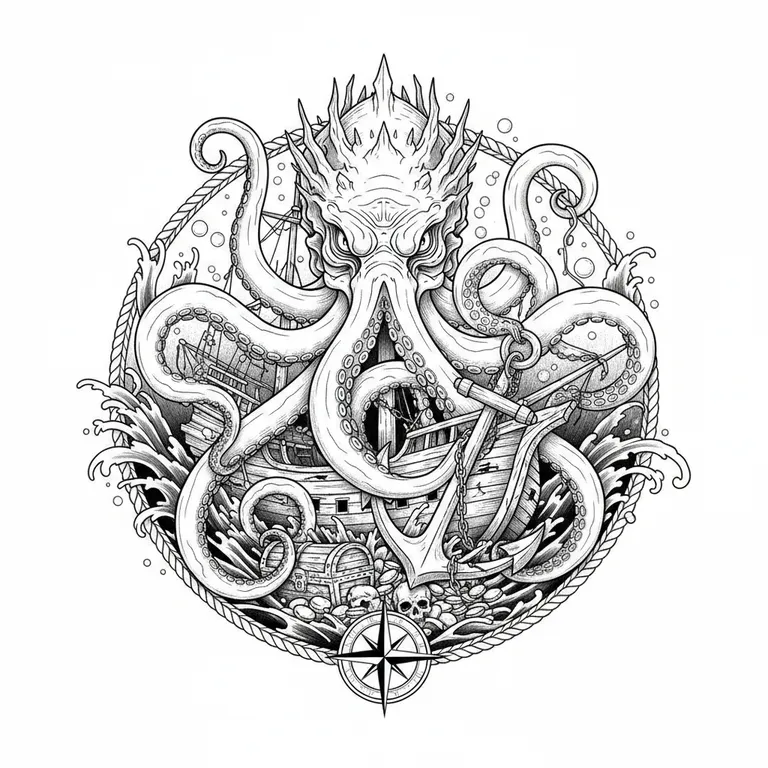
AI-generated kraken tattoo designs across popular styles. Tap any one to generate your own version and preview it on your skin.
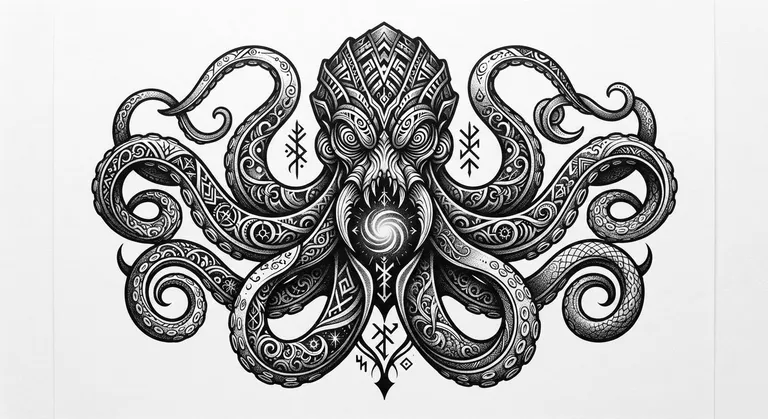
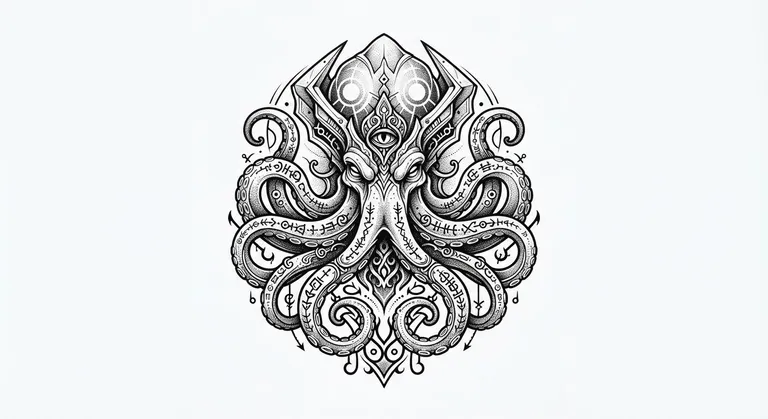
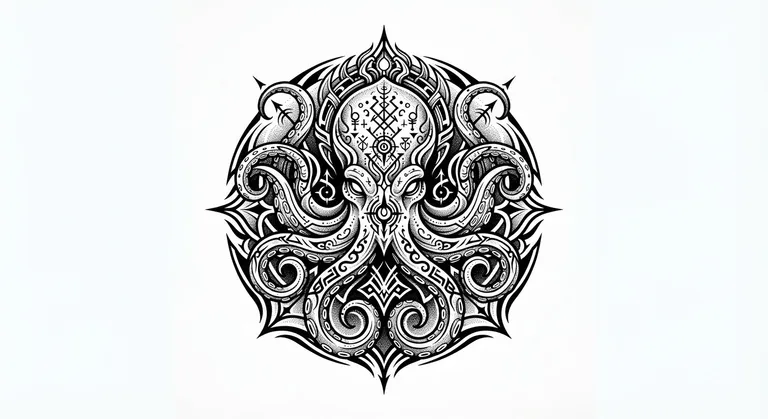
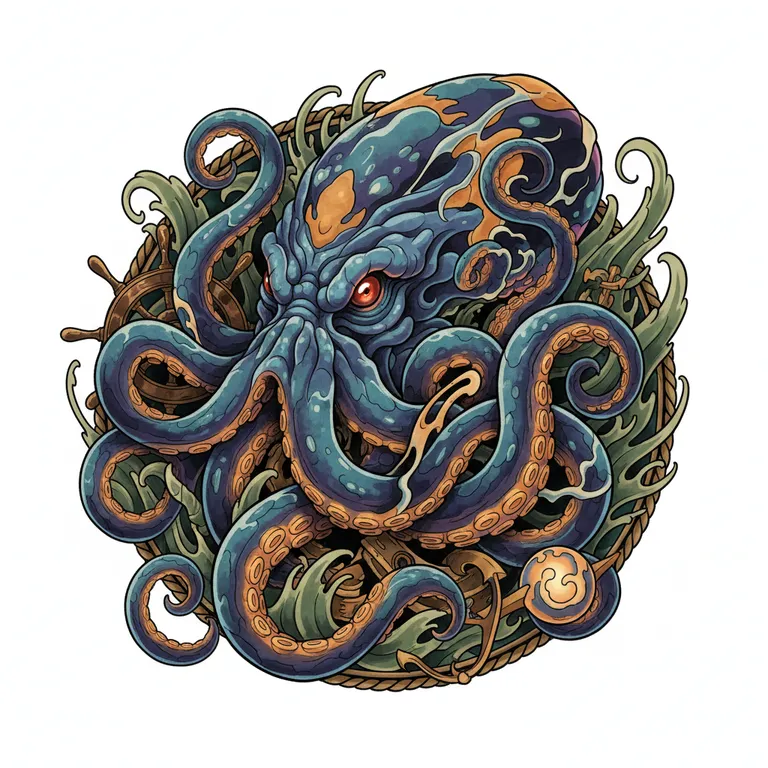
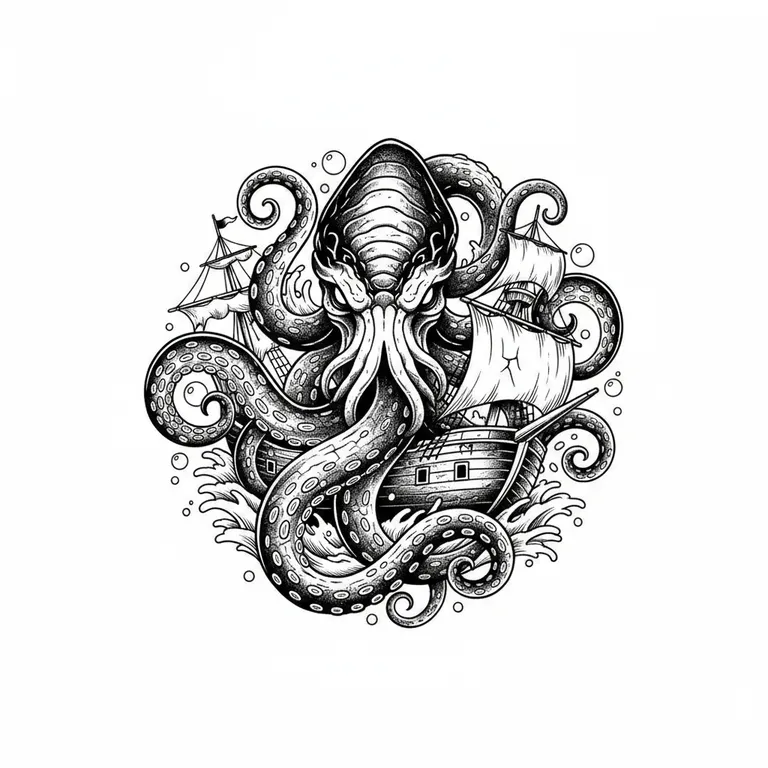
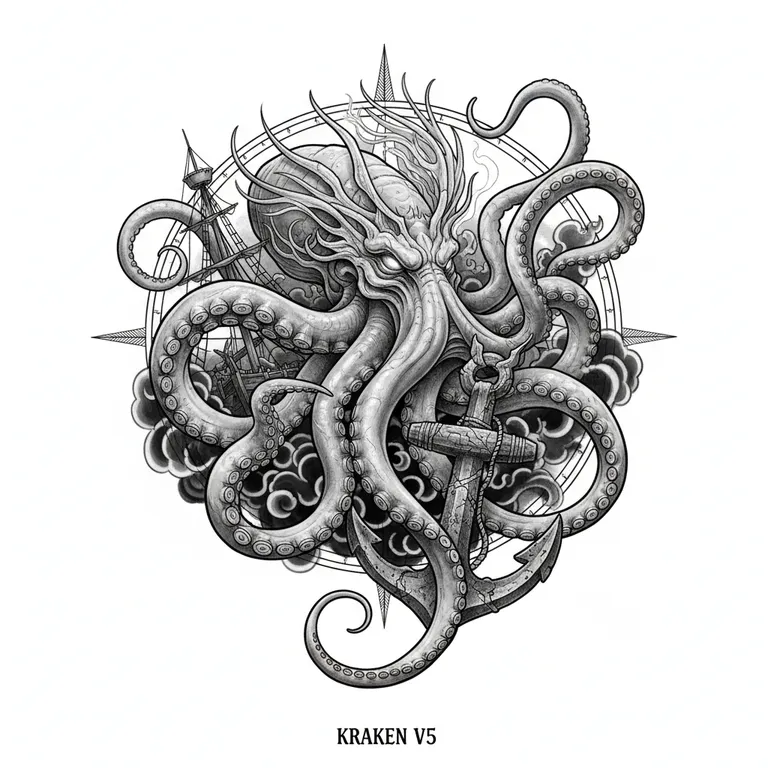
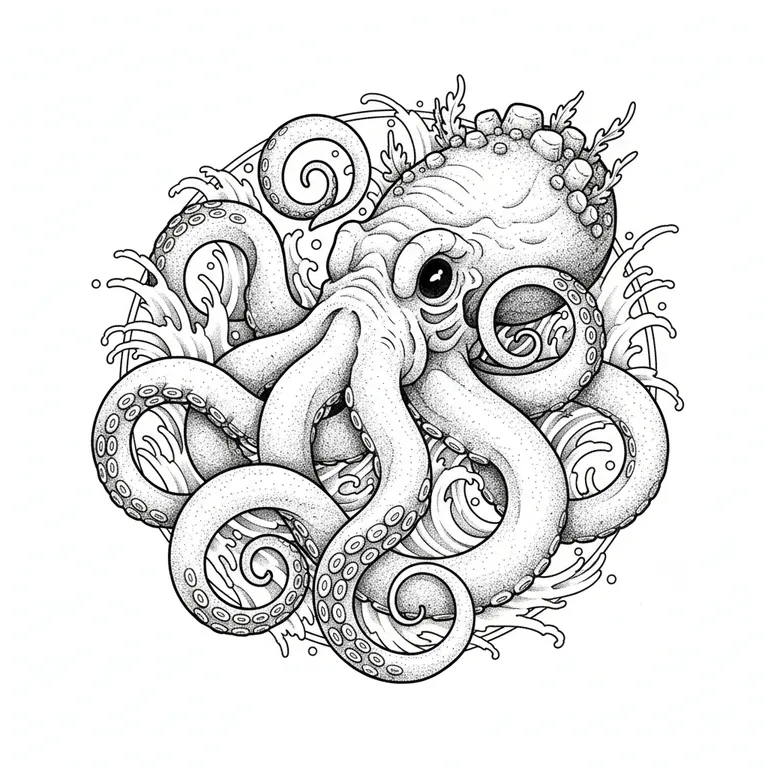
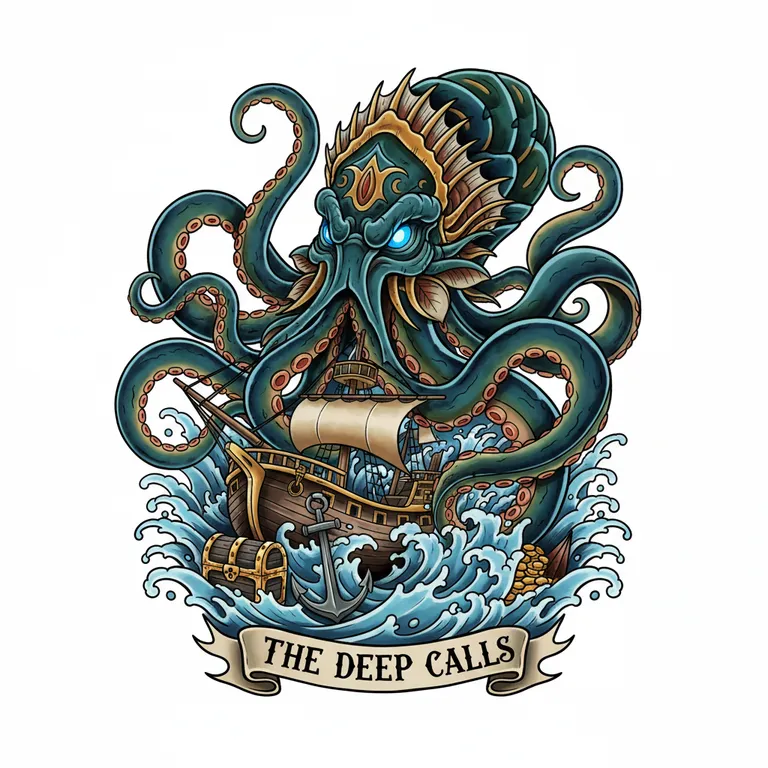


What does a kraken tattoo mean?
There is no official meaning, so it helps to separate two things: what people read into the design today, and what the old sources actually say about the creature.
- Common modern interpretations: strength and power, the unknown and what lies beneath the surface, facing something bigger than yourself, and a love of the sea or a life spent on it. These are readings people give the tattoo, not historical meanings.
- What the legend says: in the best-known account, Erik Pontoppidan's Natural History of Norway (English edition, London 1755), fishermen recognized the kraken because the sea was suddenly 20 to 30 fathoms deep where they expected 80 to 100, and they found "the greatest plenty of fish, especially cod and ling." Its back looked "like a number of small islands." The danger came when it rose and sank again, so the boats rowed away as soon as the water grew shallower.
- Same meaning for anyone: searches ask about kraken tattoos for guys and for women, but nothing in the legend ties the creature to a gender. The meaning is whatever you bring to it.
That older reading is easy to miss: for Pontoppidan's fishermen, the kraken was a sign of abundance sitting on top of a real risk, a huge thing hidden under calm water. If you want a kraken that means more than "monster," that is a meaning with a source behind it. The name itself comes from Norwegian krake, which a Norwegian dictionary cited by Wikipedia glosses as a crooked, overgrown tree: a fair description of a tangle of arms.
Where does the kraken legend come from?
The kraken is not a figure from the Norse myths of gods and giants. It comes from Norwegian sea lore and early natural history, written down by clerics and scholars who collected what fishermen told them. Here is how the story built up, with the source for each step.
| When | What happened | Source |
|---|---|---|
| Around 1247 | The Norwegian King's Mirror describes a rarely seen sea creature that "appeared more like an island than a fish," with a mouth "about as wide as a sound or fjord" that it opens to swallow the fish it lures in. Larson's 1917 English translation calls it the "kraken"; the Old Norse name is hafgufa, and some scholars read it as a whale. | Larson 1917, p. 125; Wikipedia for hafgufa |
| 1752 to 1755 | Bishop Erik Pontoppidan's Natural History of Norway (Danish edition 1752 and 1753, English 1755) gives the kraken its fullest description: "round, flat, and full of arms," also called Krabben, Horven or Anker-trold, with arms as tall as the masts of mid-sized ships. | Pontoppidan, part II, pp. 210 to 213 |
| 1801 | French naturalist Pierre Denys de Montfort publishes Le Poulpe colossal, an engraving of a giant octopus wrapping its arms around a three-masted ship. Later books reprinted it as the kraken. | Wikimedia Commons; Wikipedia |
| 1830 | Alfred Tennyson's sonnet "The Kraken" appears in Poems, Chiefly Lyrical: a creature asleep "far, far beneath in the abysmal sea." | Project Gutenberg |
| 2005 | Tsunemi Kubodera and Kyoichi Mori publish the first images of a live giant squid in the wild, photographed attacking bait 900 m deep off the Ogasawara Islands, Japan. | Kubodera and Mori, Proc. R. Soc. B, 2005 |
| 2012 | Edie Widder's Medusa camera system records a giant squid off the coast of Japan, footage USF St. Petersburg describes as the first of a giant squid. | USF St. Petersburg, 2019 |
| June 2019 | A giant squid is filmed about 100 miles south of Louisiana, more than 750 m deep: the first filmed in US waters and only the third live giant squid ever filmed. | USF St. Petersburg, 2019 |
Pontoppidan himself was careful. He reports the ship-sinking claim as something "it is said," and writes that the kraken "has never been known to do any great harm," adding dryly that the only exceptions would be people who did not survive to tell the tale. The one incident he relates, near Fridrichstad (today's Fredrikstad), ends with two fishermen surviving on their crushed boat (p. 213). He also records a young kraken that drifted into a narrow channel at Alstahoug in 1680, got stuck in the rocks and died there, "perhaps a young and careless one."
Is a kraken a giant squid or an octopus?
Both answers have a source. Pontoppidan thought the kraken was "of the Polype, or of the Star-fish kind," and by polype he meant an octopus-like animal. Modern scholars point to the giant squid instead: a 2014 article in História, Ciências, Saúde-Manguinhos concludes that kraken legends were based on sightings of giant squid, genus Architeuthis (Salvador and Tomotani, 2014). For a tattoo, the difference changes the silhouette.
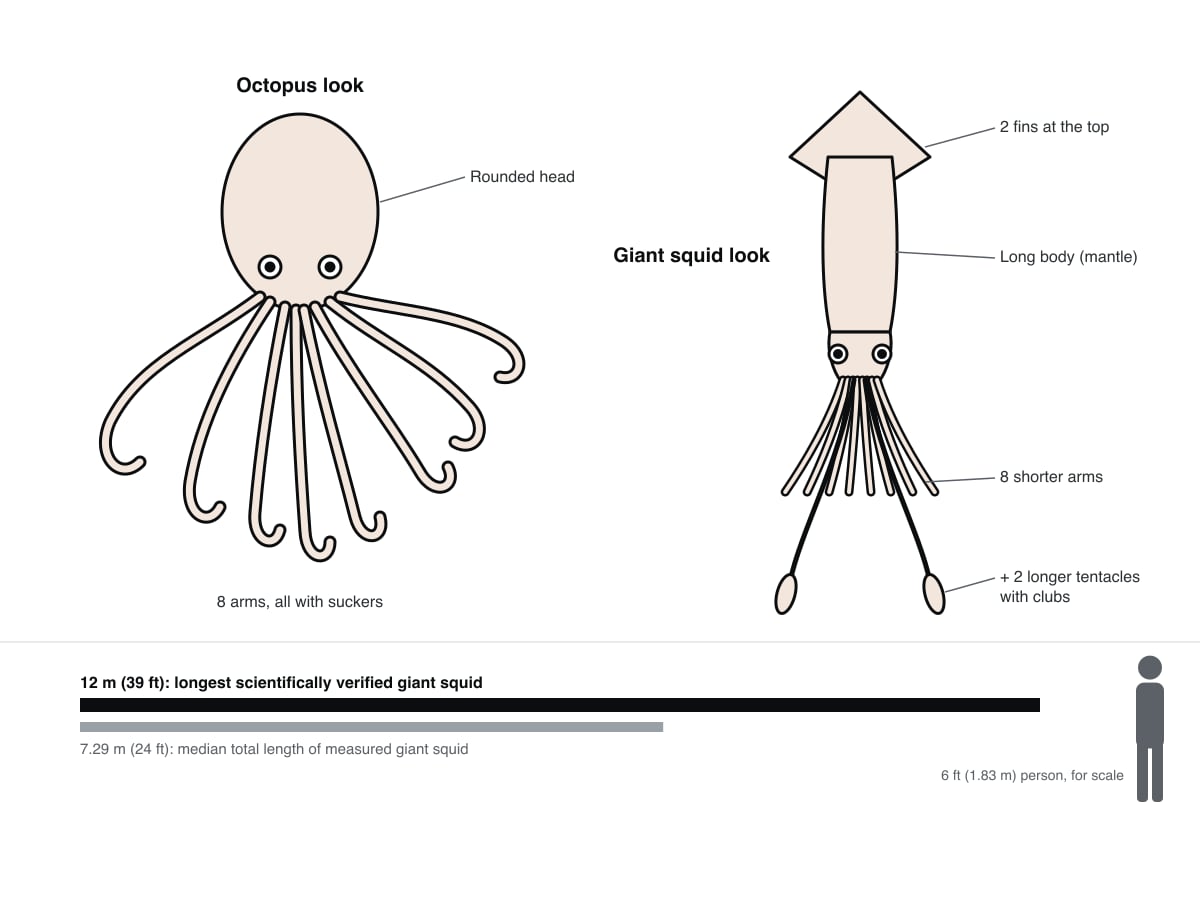
| Octopus look | Giant squid look | |
|---|---|---|
| Limbs | 8 arms, covered in suckers | 8 arms plus 2 longer tentacles used to catch prey |
| Head and body | Rounded head | Two fins at the top of the mantle, triangular head |
| What it does to the design | Arms fan out evenly; reads well round a calf or shoulder | Long body plus two reaching tentacles; suits a long, narrow area like a forearm or a sleeve |
Anatomy from the National Marine Sanctuary Foundation, which also notes that octopus arms are more flexible than a squid's. On size, McClain and colleagues (2015) reviewed giant squid records and found the longest scientifically verified specimen measured 12 m (about 39 ft), with a median total length of 7.29 m; longer figures, up to 17.37 m in an 1879 report, were not first-hand measurements. The largest octopus, the giant Pacific octopus, had a measured arm spread of 8.5 m in a 1956 specimen. Either look is a valid kraken. Tell your artist whether you want eight arms or eight arms plus two long tentacles, because it decides how the design flows.
What does a kraken and ship tattoo mean?
The ship scene goes back to two sources. Pontoppidan wrote that, it is said, if the kraken's arms "were to lay hold of the largest man of war, they would pull it down to the bottom" (p. 212). Half a century later, Montfort's engraving turned that line into the picture most kraken and ship tattoos still echo.
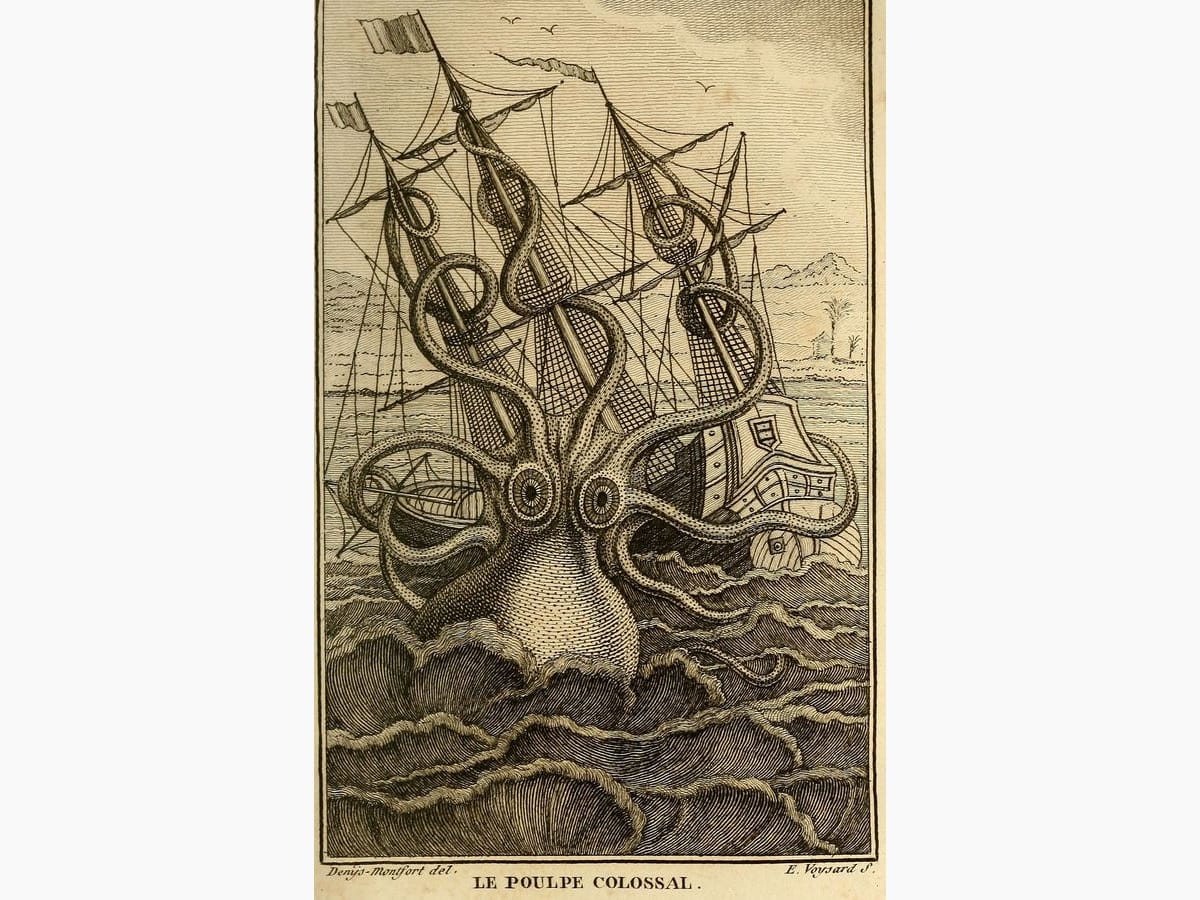
Read today, a kraken and ship tattoo is commonly taken as a struggle against forces bigger than you, a storm in your life, or a love of seafaring stories. Given Pontoppidan's own caveat that the kraken was not known to sink ships, you can also read it as a fear that is larger in the telling than in reality.
- Keep the ship small and high in the design so the kraken's arms lead the eye up toward it, as in Montfort's plate.
- Let the arms do the composition: one arm wrapping the hull, the others running down or around the limb.
- Give it room: rigging and sails are fine detail. The back, the chest and a long calf have the space; a forearm needs a simpler ship.
Which tattoo style suits a kraken?
Any style can carry a kraken; the style changes line weight, color and how much detail survives at your size. Here is the same composition (a kraken holding a ship) in the four styles people search for most with this design. All four are AI-generated by us, not photos of real tattoos. The descriptions follow our tattoo styles guide.
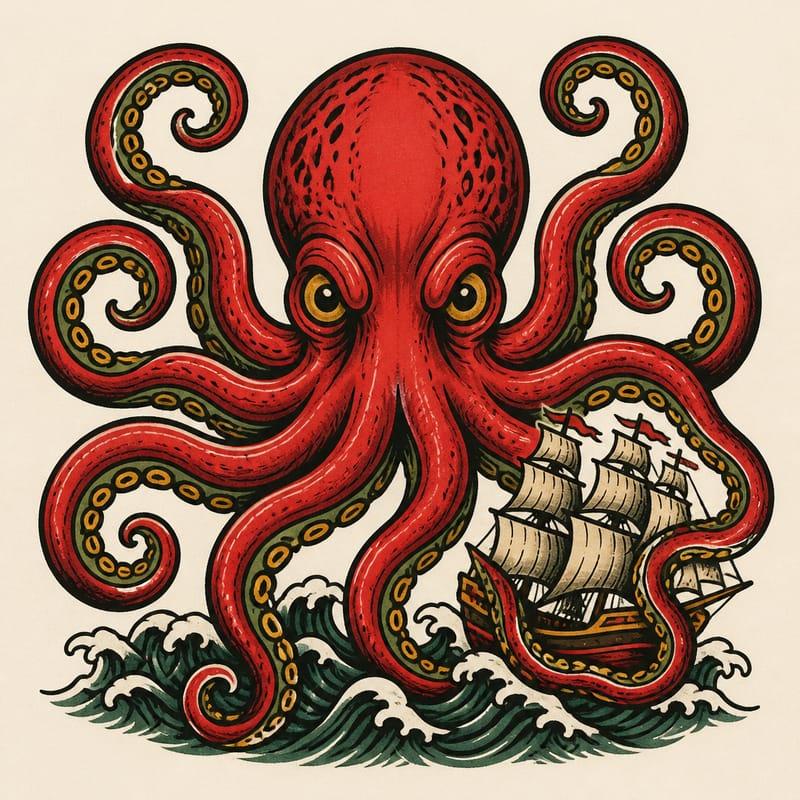 American traditional: heavy outlines, flat red, green, yellow and black; ships are a classic motif of the style.
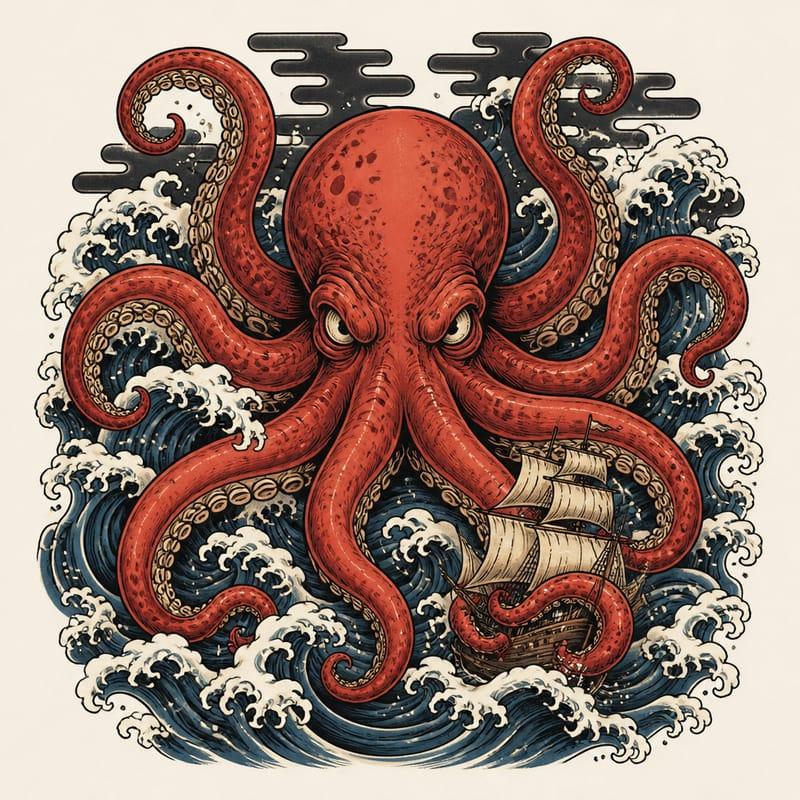 Japanese-inspired: bold outlines, flat color, waves and wind bars; it needs room to flow.
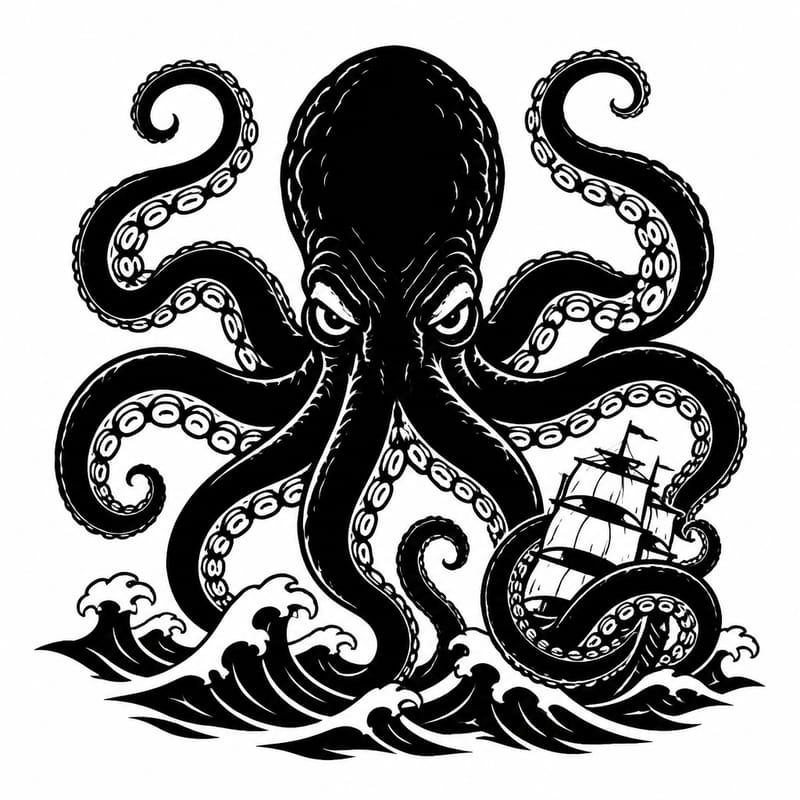 Blackwork: solid black with bare skin as contrast, no grey shading.
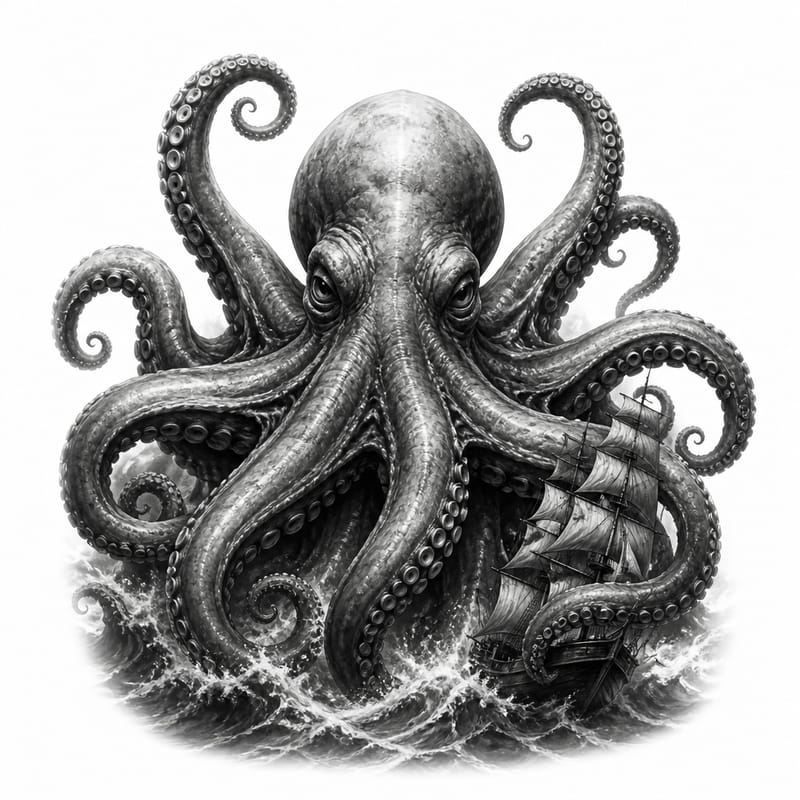 Black and grey realism: black diluted into greys, few or no outlines, needs room for detail.
Two notes. We label the second design "Japanese-inspired" on purpose: our styles guide lists the fixed subjects of Japanese tattooing (koi, dragons, tigers, peonies, cherry blossoms, waves and wind bars), and we found no source showing the kraken among them, so a kraken with waves and wind bars borrows the look rather than the tradition. And realism needs room for its detail and is a specialty, so look for an artist whose healed realism work you can see before you shrink a realistic kraken onto a forearm.
Where should a kraken tattoo go?
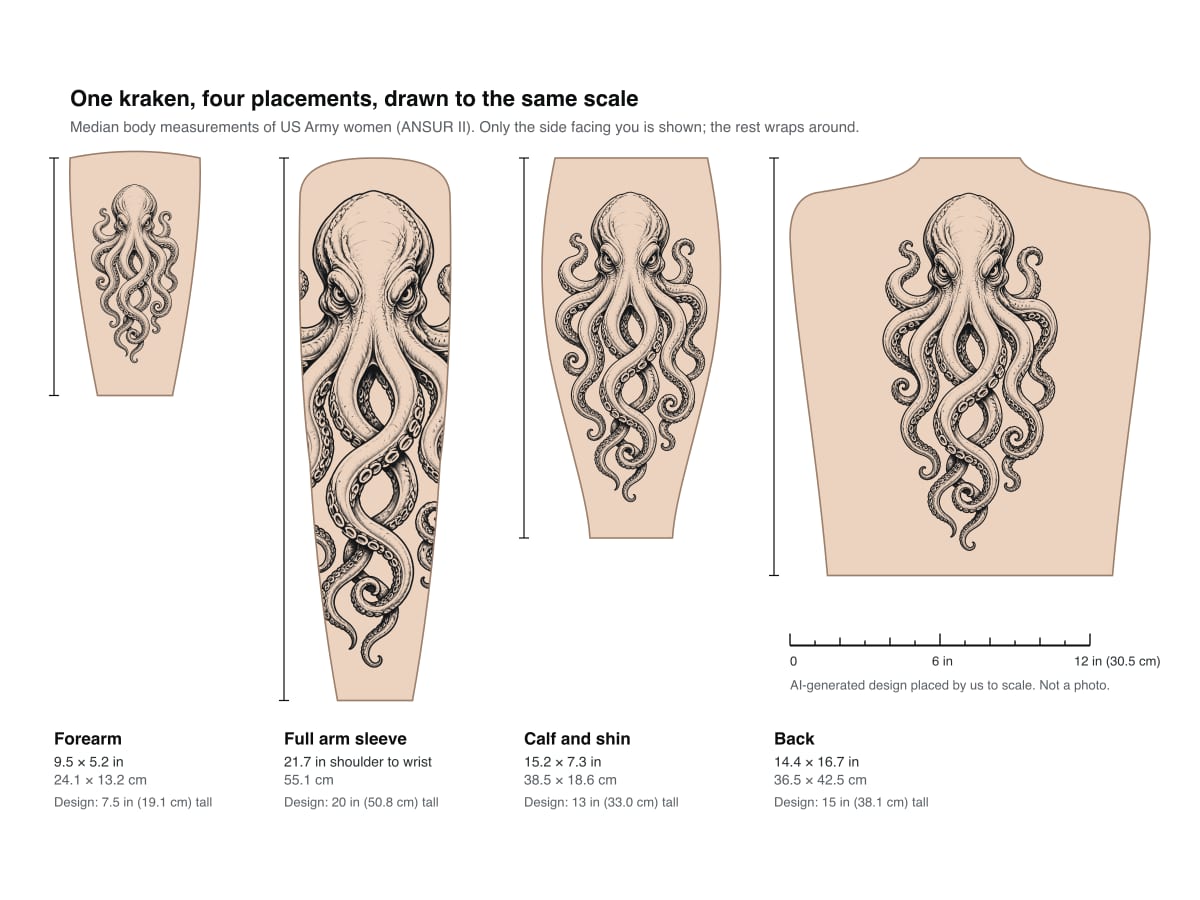
A kraken has to fit the room on the body part, and that room is smaller than most people think. We took median body measurements from ANSUR II, the US Army's survey of 1,986 women and 4,082 men (published in 2012, public since 2017), and placed one AI-generated kraken at exact scale on four placements. The width shown is about half the limb's circumference, the part you see from one side.
| Placement | Room on one side, women | Room on one side, men | Pain tier reported by artists |
|---|---|---|---|
| Forearm | 9.5 × 5.2 in 24.1 × 13.2 cm | 10.5 × 6.1 in 26.7 × 15.5 cm | Lower |
| Upper arm and shoulder | 12.2 × 6.0 in 31.1 × 15.2 cm | 13.2 × 7.0 in 33.5 × 17.9 cm | Lower |
| Full arm sleeve (length) | 21.7 in 55.1 cm | 23.7 in 60.2 cm | Mixed: the elbow sits in the middle tier |
| Thigh | 13.1 × 12.1 in 33.3 × 30.6 cm | 14.1 × 12.3 in 35.7 × 31.2 cm | Outer thigh lower, inner thigh higher |
| Calf and shin | 15.2 × 7.3 in 38.5 × 18.6 cm | 16.3 × 7.7 in 41.5 × 19.6 cm | Middle (knee, shin and calf) |
| Back | 14.4 × 16.7 in 36.5 × 42.5 cm | 16.3 × 18.8 in 41.5 × 47.7 cm | Not rated |
| Hand | 7.1 × 3.1 in 18 × 7.8 cm | 7.6 × 3.5 in 19.3 × 8.8 cm | Middle |
| Chest | Not measured here | Not measured here | Higher |
Sizes: our calculation from ANSUR II medians, the same figures as our tattoo size guide; the sample is military personnel aged 17 to 58, not the general population. Pain tiers: Table 1 of Pimentel et al., 2021, based on interviews with six artists and two customers at one Florida shop, so it is reported experience, not measured pain. In a survey of 1,092 tattooed people, the factors that raised pain most were session length, bleeding and stress (Witkoś and Hartman-Petrycka, 2020); our tattoo pain chart explains both studies.
Kraken sleeve tattoo
A full sleeve gives the kraken about 22 inches of length on a median woman's arm and about 24 on a man's. A common layout puts the head and eyes on the shoulder cap and spirals the arms down toward the wrist, so the design reads from every side of the arm. That is a multi-session project; the sleeve tattoo guide covers lengths, hours and planning, and the size guide explains half sleeves. For a Greek-myth sleeve with a sea god and a kraken, see the god designs on our Zeus tattoo ideas page for composition ideas.
Kraken leg tattoo: thigh, calf and leg sleeve
The thigh is the widest area on the limbs, about 12 inches across one side, enough for a kraken with a whole ship scene. The calf and shin are long and narrow, 15 to 16 inches by 7 to 8, which suits a vertical kraken with its head below the knee and arms curling round toward the shin. A leg sleeve joins the two, with the knee in the middle; artists put the knee, shin and calf in the middle pain tier and the outer thigh in the lower one. See the thigh placement guide for how that area moves and shows.
Kraken forearm tattoo
A forearm offers about 9.5 to 10.5 inches of length but only 5 to 6 inches across one side, less near the wrist. In the to-scale preview above, a 7.5-inch kraken already fills that side. The usual fix is to place the head on the outer forearm and let one or two arms wrap to the inner side, or to choose the squid look, whose long body fits the narrow shape. The forearm placement guide covers inner versus outer forearm.
Kraken back and chest tattoo
The back is the biggest flat canvas, about 14 to 16 inches wide at the shoulders and 17 to 19 inches from neck to waist, so it is where a full Montfort-style ship scene fits without shrinking the rigging. On the chest, the head usually sits in the center with the arms reaching toward the shoulders; the chest is in the higher pain tier artists report. The chest placement guide covers how the design bends over the rib cage.
Small kraken tattoo ideas
Small kraken designs work when you cut the subject down, not just the size: a single tentacle curling round a finger or the wrist, one eye with two arms, or a kraken silhouette without suckers. The back of a hand is about 3 inches wide and one side of the wrist about 3 to 3.5. What limits a small tattoo is its smallest detail, as our size guide explains: tightly packed suckers can blur into one dark shape, so ask your artist to open up the spacing. See the hand and wrist placement guides, or check a size with the tattoo size calculator.
Kraken tattoo ideas to bring to your artist
- Kraken and ship: the scene from Montfort's engraving, with room to work on a back, chest or calf.
- Kraken with an anchor, compass or lighthouse: a nautical object for the arms to wrap, smaller and simpler than a full ship.
- Kraken wrapped around a skull: a darker variant that keeps the composition compact.
- Single tentacle: one arm with suckers, for a finger, wrist, ankle or behind the ear.
- Kraken eye: one large eye with arms around it, a small design that still reads as a kraken.
- Kraken with a line of Tennyson: the 1830 poem is in the public domain, so a line like "Below the thunders of the upper deep" (full text) can run along the arms. Preview the lettering with our name tattoo generator.
- Ready to take it to the studio? Turn your design into a clean outline with the tattoo stencil maker.
How much does a kraken tattoo cost and how long does it take?
We do not quote a kraken price, because no source prices a subject: studios price by size, time and detail. A small single tentacle takes far less time than a full sleeve or back piece, which is spread over several sessions. Our tattoo cost guide compares minimums and hourly rates from US studios, and the tattoo price calculator gives a planning estimate for your size and placement.
Large wraparound pieces also take healing time between sessions, and your artist decides when the next area is ready. The tattoo healing stages guide explains what to expect after each session; anything that looks infected is a question for a doctor.
More designs and guides
Fenrir Tattoo Ideas
The giant wolf of Norse myth, for a Scandinavian theme.
Yggdrasil Tattoo Ideas
The world tree of Norse myth, with designs and meanings.
Vegvisir Tattoo Ideas
Icelandic stave designs and what the symbol is said to mean.
Sleeve Tattoos
Quarter, half and full sleeve sizes, hours and planning.
Blackwork Tattoos
Solid black designs that stay bold at a distance.
Tattoo Size Chart
How much room each body part really has, in inches and cm.
Tattoo Pain Chart
Which spots artists rate most painful, and what matters more.
Sources
- Erik Pontoppidan, The Natural History of Norway, part II, English translation, London 1755, pp. 210 to 213 (Internet Archive full text) · checked November 6, 2026
- The King's Mirror (Speculum regale, Konungs skuggsjá), translated by Laurence M. Larson, 1917, p. 125 (Internet Archive) · checked November 6, 2026
- Alfred Tennyson, "The Kraken" (1830), in The Early Poems of Alfred, Lord Tennyson, ed. J. Churton Collins (Project Gutenberg) · checked November 6, 2026
- Pierre Denys de Montfort, Le Poulpe colossal (1801), public domain scan, Wikimedia Commons · checked November 6, 2026
- Salvador R.B. and Tomotani B.M., The Kraken: when myth encounters science, História, Ciências, Saúde-Manguinhos, 2014 (PubMed) · checked November 6, 2026
- McClain C.R. et al., Sizing ocean giants, PeerJ, 2015 · checked November 6, 2026
- Kubodera T. and Mori K., First-ever observations of a live giant squid in the wild, Proceedings of the Royal Society B, 2005 · checked November 6, 2026
- USF St. Petersburg, First research team to film elusive giant squid in U.S. waters, June 24, 2019 · checked November 6, 2026
- National Marine Sanctuary Foundation, What's the Difference? Octopus vs. Squid, January 22, 2020 · checked November 6, 2026
- Wikipedia, Kraken (secondary source: etymology, hafgufa, later reuse of Montfort's engraving) · checked November 6, 2026
- ANSUR II: Anthropometric Survey of US Army Personnel (public data, OPEN Design Lab, Penn State) · checked November 6, 2026
- Pimentel D. et al., The Effects of VR Use on Pain Experienced During a Tattoo Procedure, Frontiers in Virtual Reality, 2021, Table 1 · checked November 6, 2026
- Witkoś J. and Hartman-Petrycka M., Gender Differences in Subjective Pain Perception during and after Tattooing, IJERPH, 2020 · checked November 6, 2026
Kraken tattoo FAQ
What does a kraken tattoo mean?+
There is no fixed meaning. People commonly read it as strength, the unknown and facing something bigger than yourself. In Pontoppidan's 1755 Natural History of Norway, fishermen also linked the kraken to unusually rich catches of cod and ling, with danger only when it rose, so abundance and hidden depth is an older reading. The meaning is the same for anyone who wears it.
Is the kraken from Norse mythology?+
Not from the myths of the Norse gods. It comes from Norwegian sea lore: the 13th-century King's Mirror describes a huge island-like sea creature (Old Norse hafgufa, translated as kraken in 1917), and Bishop Erik Pontoppidan described the kraken in detail in his Natural History of Norway in the 1750s.
Is a kraken an octopus or a squid?+
Pontoppidan thought it was of the octopus or starfish kind, while modern scholars link the legend to sightings of giant squid. For a tattoo, an octopus kraken has eight arms and a rounded head; a squid kraken has eight arms plus two longer tentacles, fins and a long body.
What does a kraken and ship tattoo mean?+
It draws on Pontoppidan's line that the kraken's arms could pull down the largest man of war, and on Montfort's 1801 engraving of a giant octopus attacking a ship. It is commonly read as a struggle against forces bigger than you. Pontoppidan himself noted the kraken was not known to do any great harm.
How big is a kraken sleeve tattoo?+
A full sleeve runs about 21.7 inches from shoulder to wrist on a median woman's arm and about 23.7 inches on a man's, based on US Army body measurement data (ANSUR II). It wraps all the way around the arm and is usually done over several sessions.
Does a kraken leg tattoo hurt?+
Tattoo artists interviewed in a 2021 study rated the outer thigh in the lower pain tier, the knee, shin and calf in the middle, and the inner thigh in the higher tier. In a survey of 1,092 tattooed people, session length, bleeding and stress mattered most, so ask your artist how to split a large leg piece into sessions.
Tattoo planning tool
Design your own Kraken tattoo
Describe your idea, generate it in any style, and preview it on your own skin before the needle.
Generate for freeFree to start
Explore more tattoo ideas
- Fenrir Tattoo IdeasA fenrir tattoo features the giant wolf of Norse mythology destined to break free at Ragnarök.
- Yggdrasil Tattoo IdeasAn yggdrasil tattoo depicts the Norse tree of life that connects the nine worlds.
- Samurai Tattoo IdeasA samurai tattoo represents the legendary Japanese warriors and their code of honour, bushido.
- Wolf Tattoo IdeasA wolf tattoo is a symbol of loyalty, family and untamed instinct.