
Traditional Tattoos: The American Old School Style
A traditional tattoo, also called American traditional or old school, is drawn with heavy, even black outlines, a few flat colors (red, green, yellow and black), black shading and simple subjects that read from across a room: swallows, anchors, roses, daggers, panthers, eagles and ships. The style grew out of the flash that sailors picked from shop walls. Below: what each classic motif meant and who says so, how traditional differs from neo-traditional, where it comes from, and how big it needs to be.
What is a traditional tattoo?
"Traditional" in tattooing usually means American traditional: the Western sailor style of the first half of the 20th century, also called old school, classic or simply "trad". (Japanese tattooing has its own traditional style, irezumi, which is a different job.) Industry guides describe it with the same handful of traits: heavy black outlines, a short palette, solid color, black-only shading and simple drawing (Tattoodo).
| Trait | What it looks like | Why it matters |
|---|---|---|
| Outline | One heavy, even black line around every shape | Keeps the design readable from a distance |
| Palette | Red, green, yellow and black, sometimes blue or brown | Few colors, each in its own area |
| Fills | Flat, packed color with no blending | The image reads as clear blocks |
| Shading | Black only, often whip shading that fades out in strokes | Adds depth without grey gradients |
| Subjects | Swallows, anchors, roses, daggers, hearts, panthers, eagles, ships, skulls, pin-ups | Most come from sailor and military flash |
| Lettering | Short words in banners: names, mottos | Part of the design, not a separate tattoo |
Tattoodo's guide describes the classic order of work as outline first, then whip shading, then packed color. The result is a design with very few decisions in it: a shape, a line around it, one color inside. That simplicity is the point. It is also why traditional flash looks alike across decades and shops: designs were drawn to be repeated, copied and tattooed quickly.
Traditional vs neo-traditional, black and grey and new school: one swallow, four ways
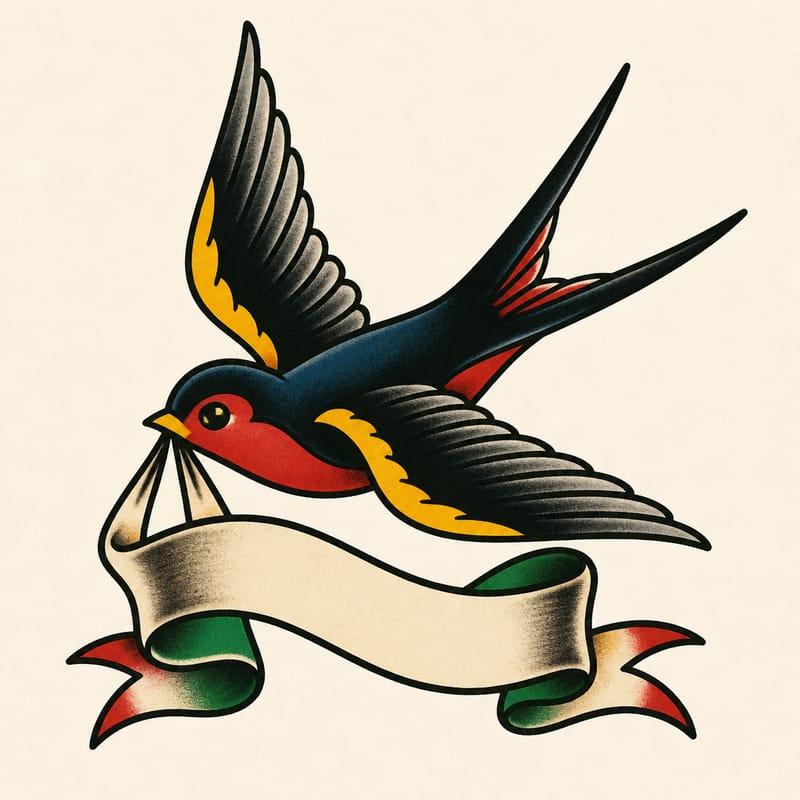
The clearest way to see what makes a tattoo traditional is to keep the subject fixed and change only the style. We generated the same swallow four times with an AI image model. These are AI illustrations made for comparison, not real tattoos or an artist's flash.
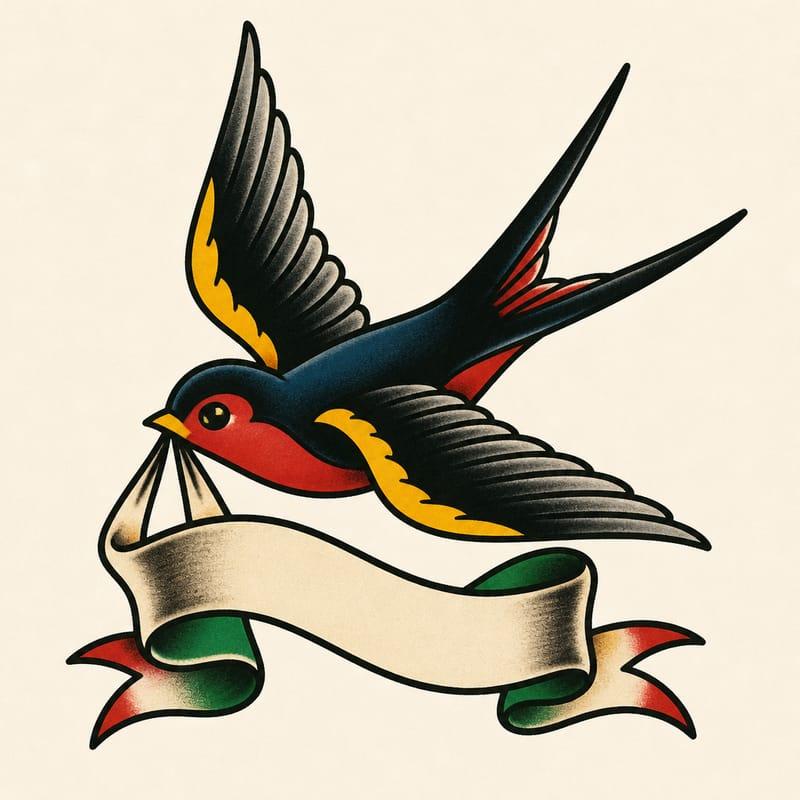 Even heavy line, 4 flat colors, black shadingAmerican traditional
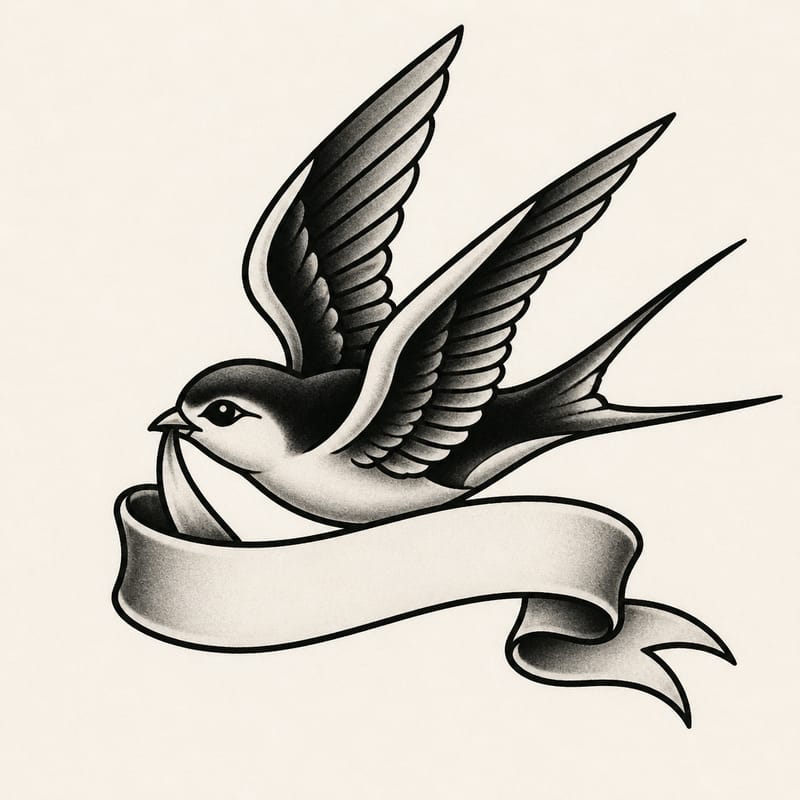 Same line, no color, grey shadingBlack and grey traditional
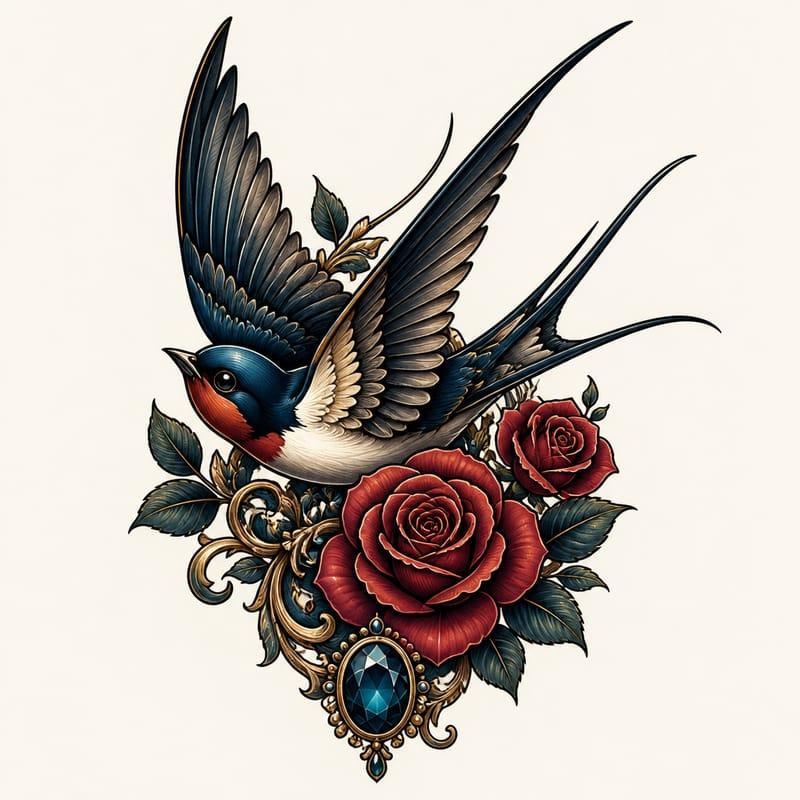 Varied line, wide palette, gradients, ornamentNeo-traditional
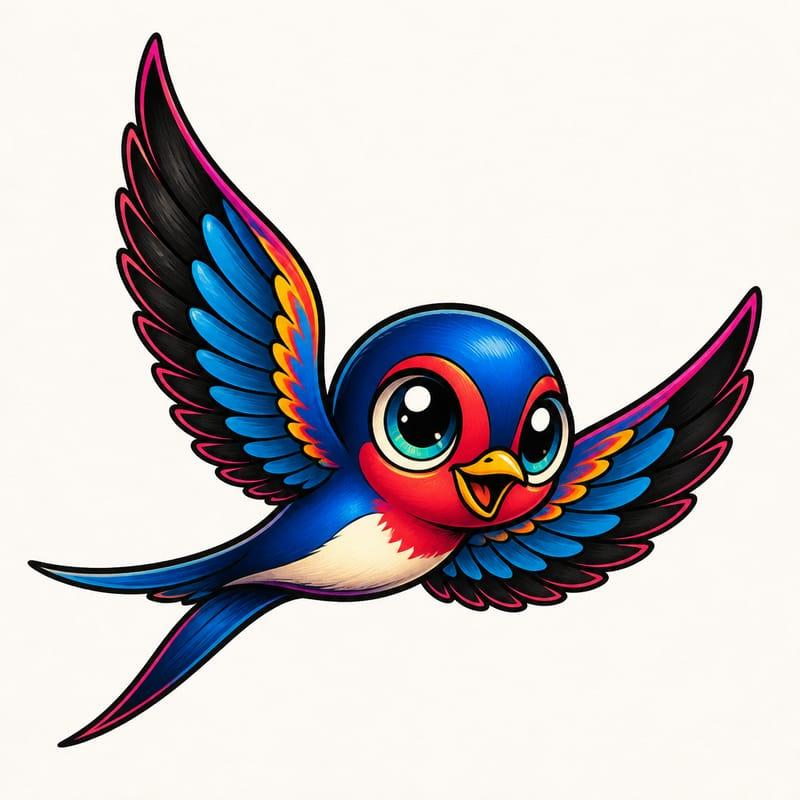 Thick line, cartoon proportions, bright colorsNew school
| American traditional | Neo-traditional | New school | |
|---|---|---|---|
| Line | Heavy and even | Heavy outer line, thinner inner lines | Thick, cartoon outline |
| Color | Red, green, yellow, black | Wide palette, jewel tones, muted tones | Bright, saturated, often neon |
| Shading | Black, whip strokes, mostly flat fills | Smooth gradients and volume | Gradients and highlights |
| Detail | As little as possible | Feathers, petals, jewels, frames | Exaggerated, playful |
| Typical subjects | Sailor flash: swallows, anchors, daggers | Animals, portraits of women, florals | Caricatures, pop culture |
Neo-traditional vs traditional is the comparison people search for most. Neo-traditional keeps the bold outline and the readability but varies the line weight and opens the palette to jewel tones, muted pastels and earthy neutrals, with sculpted shading (Club Tattoo, a studio guide). If a design has gradients, lots of fine detail inside the outline, or colors beyond the classic four, it has moved toward neo-traditional. There is no hard border: artists themselves place some pieces on either side of it.
Black and grey traditional is the same style without color: the same heavy outline and flash subjects, with grey shading where the color would be. It is a common request for people who want the old school look but wear only black ink, and it is a variant of traditional, not a separate style. New school shares the thick outline but little else: cartoon proportions, bright saturated color and an exaggerated, playful tone.
Prompt to try
“black and grey american traditional swallow with a blank banner, heavy outlines, whip shading, no color”
Generate this designTraditional tattoo meanings: what the classic flash motifs stood for
These seven designs are AI illustrations we generated in a classic flash look to show the motifs people ask about most. They are references, not historical flash or copies of any artist's sheet.
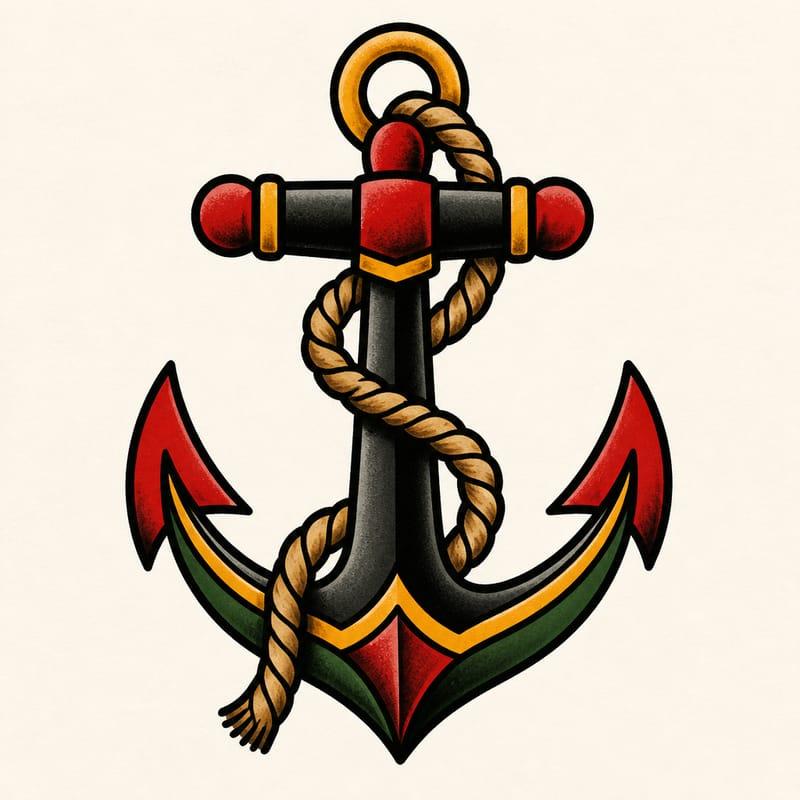 Anchor
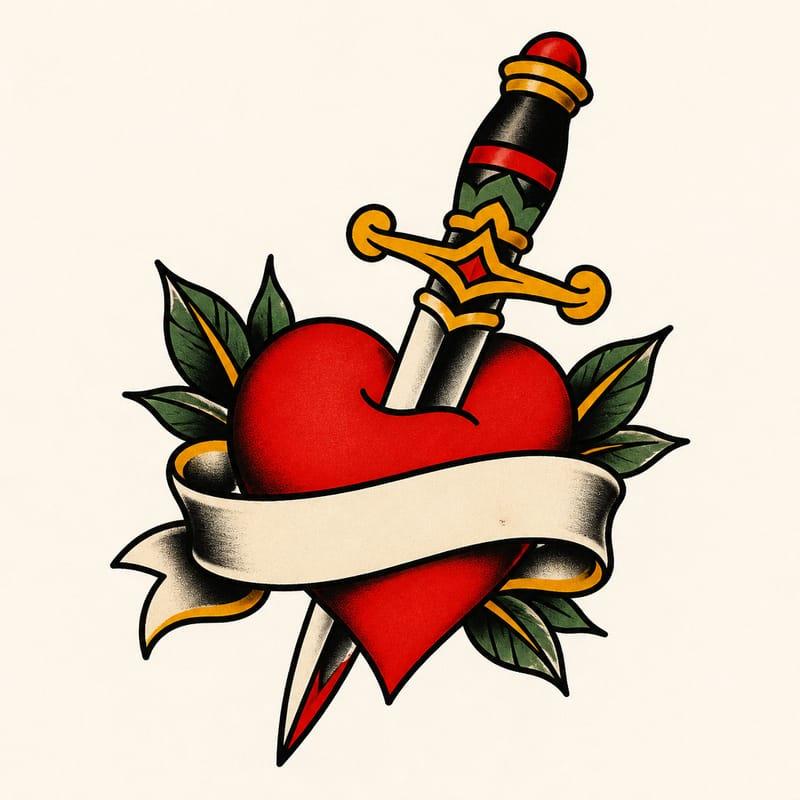 Heart and dagger
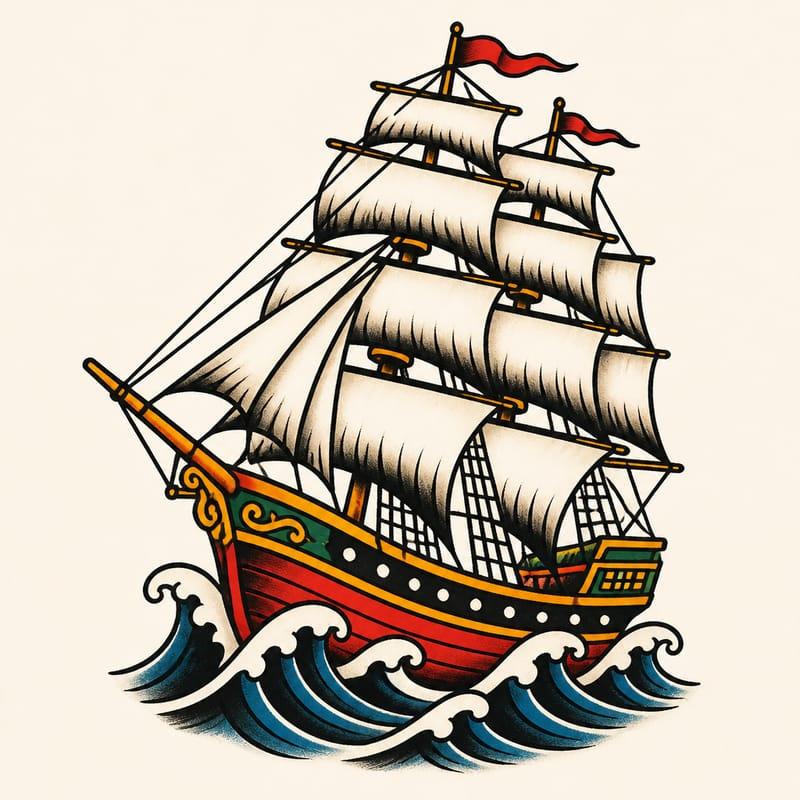 Full-rigged ship
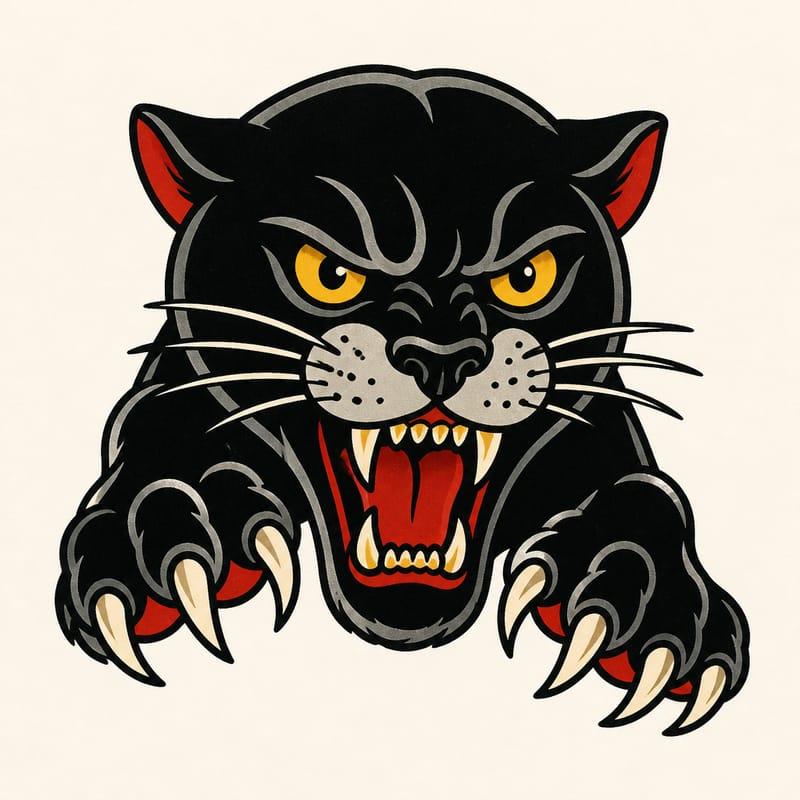 Panther
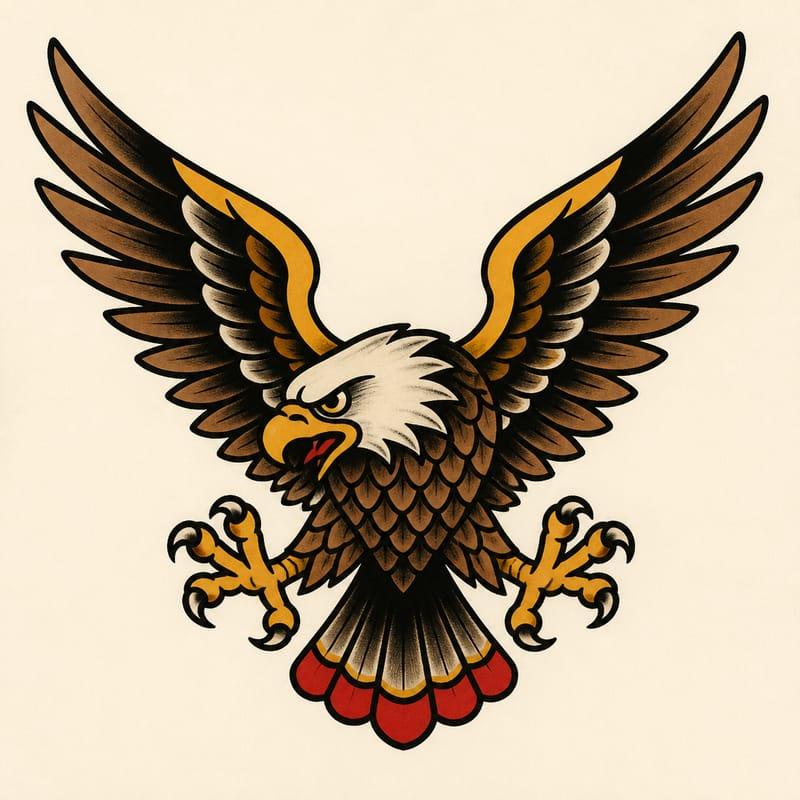 Eagle
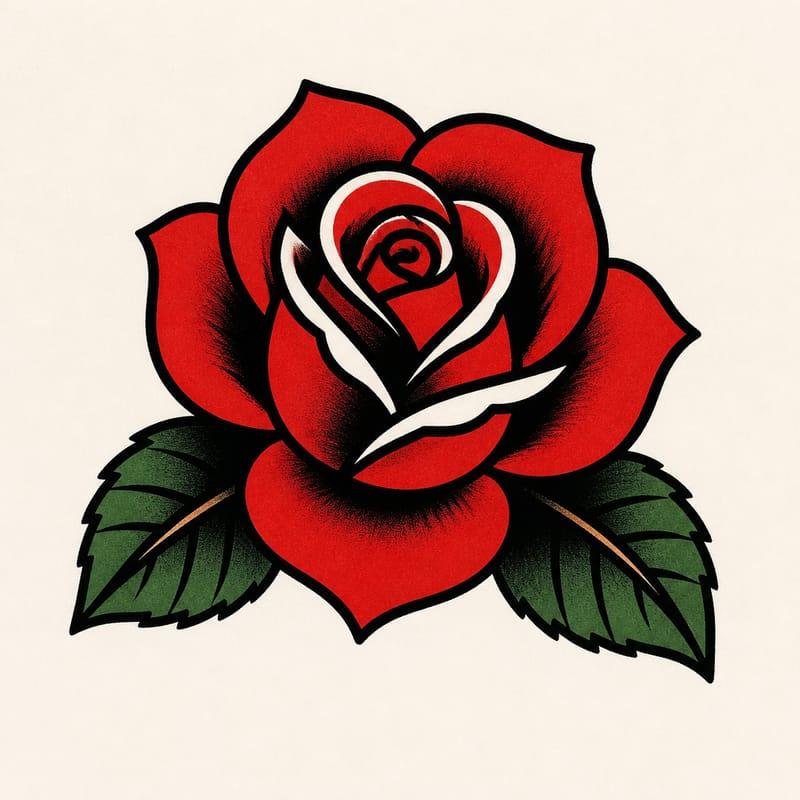 Rose
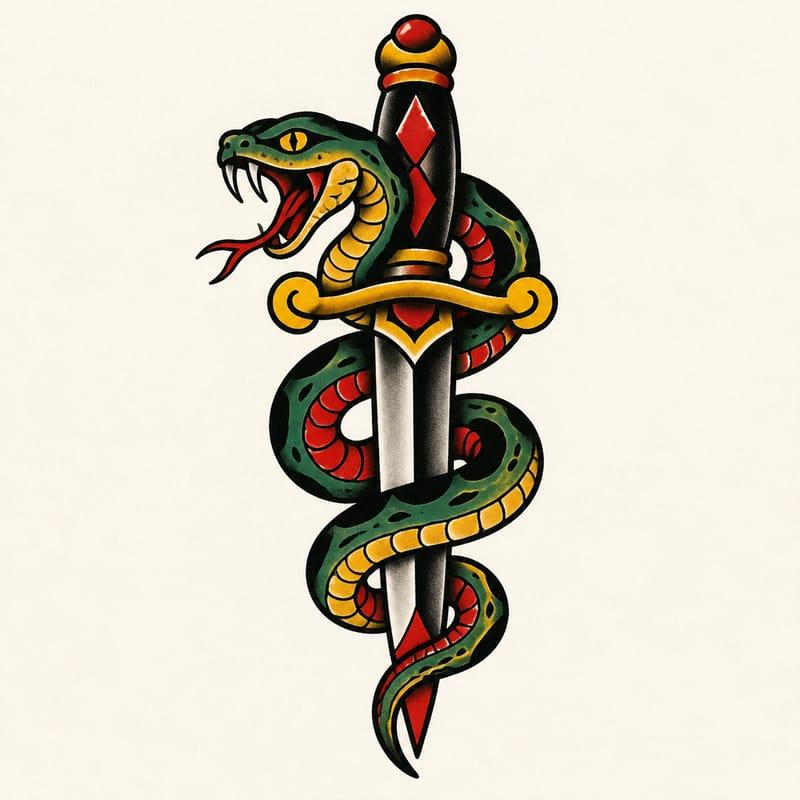 Snake and dagger
- Swallow
Most "traditional tattoo meanings" lists online repeat the same stories without saying where they come from. The table separates what a museum records about sailors' tattoos from readings that come from tattoo brands and guides. Both are useful; only the first is history. None of them is a rule about what your tattoo has to mean.
| Motif | Meaning recorded | Who records it |
|---|---|---|
| Swallow | Each one originally stood for 5,000 nautical miles at sea | Pacific Fleet Submarine Museum |
| Anchor | Originally a mariner who had crossed the Atlantic; today often a young sailor's first nautical tattoo | Pacific Fleet Submarine Museum |
| Dagger through a heart | Often with the motto "Death Before Dishonor": a relationship ended by unfaithfulness | Pacific Fleet Submarine Museum |
| Nautical star or compass rose | Helps the sailor always find the way back to port | Pacific Fleet Submarine Museum |
| Full-rigged ship | Rounding Cape Horn | Pacific Fleet Submarine Museum |
| Shellback turtle (also King Neptune, mermaids) | Crossing the equator | Pacific Fleet Submarine Museum |
| Golden dragon | Crossing the International Date Line into Asia | Pacific Fleet Submarine Museum |
| Hula girl or palm tree | Service in Hawaii | Pacific Fleet Submarine Museum |
| Pig and rooster, one on each foot | Thought to prevent drowning | Pacific Fleet Submarine Museum |
| "HOLD FAST" on the knuckles | Believed to give a firm grip on the rigging | Pacific Fleet Submarine Museum |
| Rose | Love | Tattoodo (industry guide) |
| Panther | Toughness; prowess and virility | Tattoodo; Sailor Jerry brand site |
| Eagle | Patriotism; America and honor | Tattoodo; Sailor Jerry brand site |
| Snake | Power; warding off evil | Sailor Jerry brand site |
What does a swallow tattoo mean for sailors?
According to the Pacific Fleet Submarine Museum, each swallow originally stood for 5,000 nautical miles underway. Guides add that the bird is a sign of making it home (Tattoodo), but that reading is industry lore rather than a museum record. Today a swallow is worn far more often for that idea of return, or simply as a classic design, than for miles at sea.
What does a heart with a dagger mean?
In the naval tradition the museum describes it as a relationship ended by unfaithfulness, often paired with "Death Before Dishonor" (Pacific Fleet Submarine Museum). Guides read daggers more broadly as courage, or as love paired with pain (Tattoodo). A dagger through a rose, a skull or a snake is a design choice as much as a message.
What does an anchor tattoo mean?
Originally, a mariner who had crossed the Atlantic. The museum adds that the anchor is often a young sailor's first nautical tattoo today, an initiation into naval service (Pacific Fleet Submarine Museum). Outside the navy, anchors are usually read as steadiness and paired with a name in a banner, such as "Mom".
What is traditional tattoo flash?
Flash is a sheet of ready-drawn designs. The Mystic Seaport Museum describes it as sample drawings from which sailors could choose their tattoo. Shops hung the sheets on the wall, the customer pointed at a design, and the tattooer put it on with a stencil. Flash is why traditional tattoos look so consistent: the same anchors, swallows and eagles were drawn, sold, traced and redrawn from shop to shop.
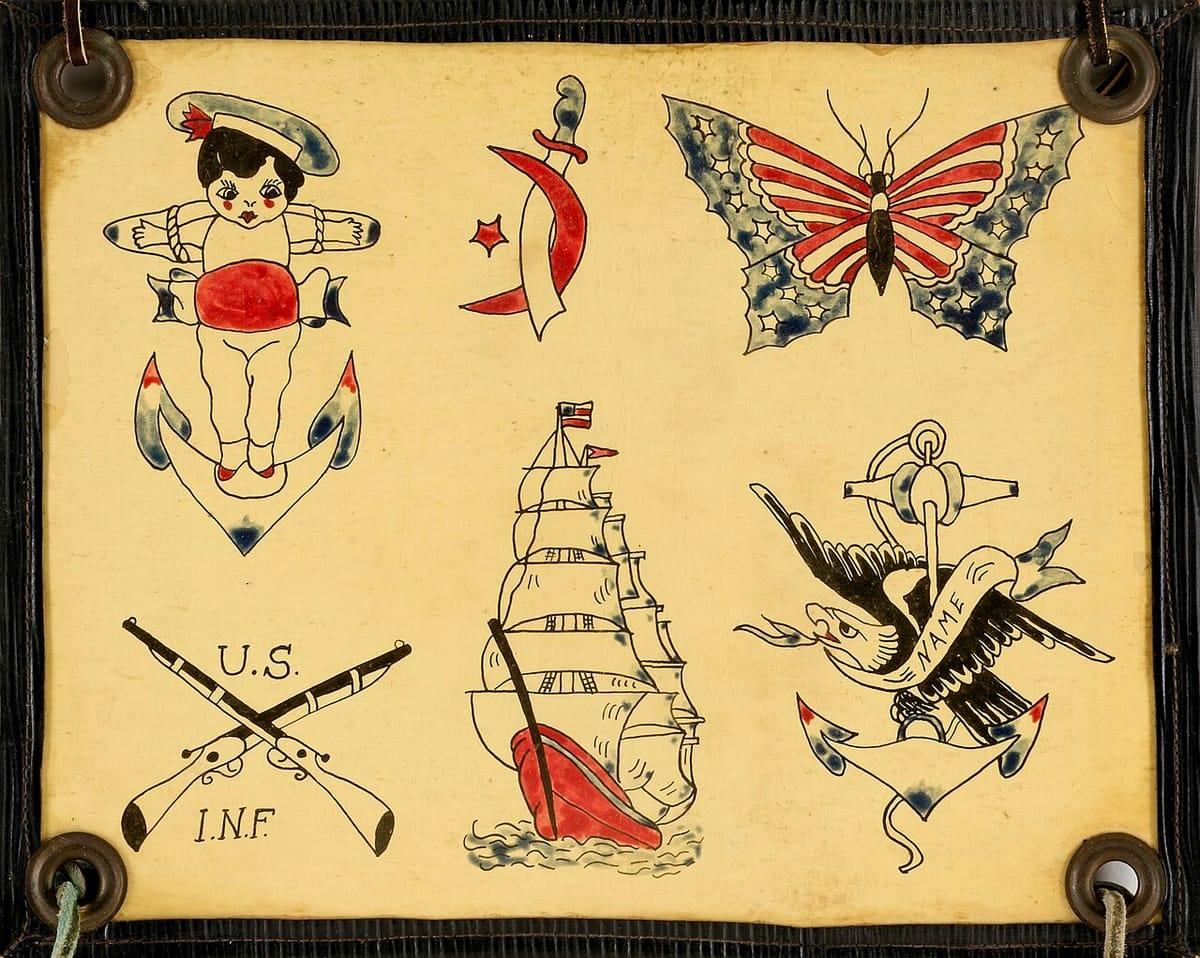
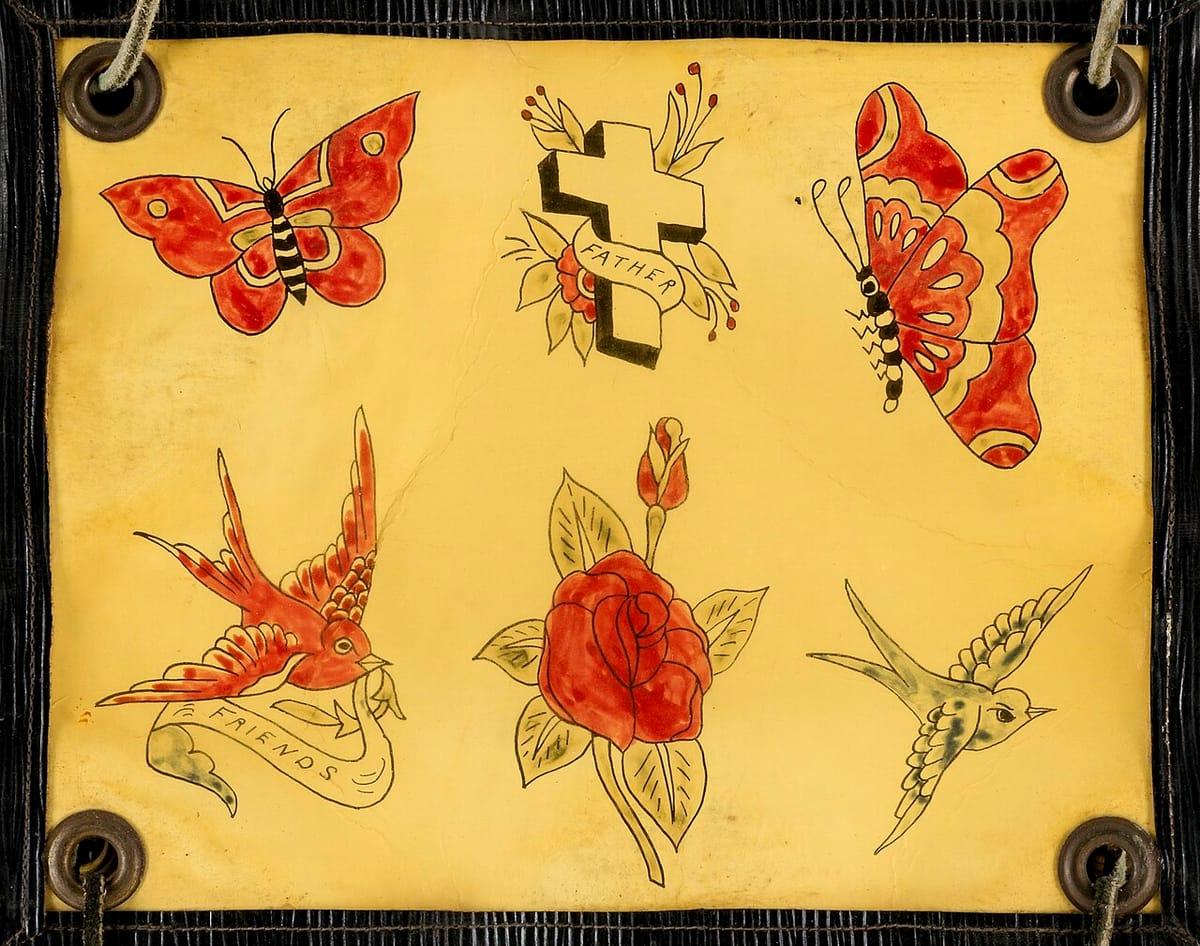
This sheet, in the Smithsonian American Art Museum, shows the vocabulary of military flash on one card: a sailing ship, an anchor, an eagle, crossed infantry rifles, a dagger. Notice the banner reading "NAME": the customer's name or a loved one's went in there. The eyelets and the cardboard backing show it was made to hang. A second sheet from the same set, below, has the swallow and the rose, with banners reading "FRIENDS" and "FATHER".
Museums started collecting flash early. In 1936 The Mariners' Museum in Newport News, Virginia, commissioned a flash sheet, "Designs of the Tattooers Art", from August Bernard Coleman, a tattooer settled in Norfolk by 1918, and bought his machines, needles and switchboard. Its president wrote that tattooing was "rapidly becoming a dead art"; the museum's curator notes that it proved to be wrong (The Mariners' Museum).
Can you get flash tattooed today?
Yes. Many traditional artists still paint flash sheets and sell those designs as drawn, often for walk-ins or flash days, while custom work is drawn for you. Two rules of thumb: a painted flash design belongs to the artist who drew it, so book it with them rather than taking it to another shop; and if you want a classic motif made your own, ask for a custom drawing in the traditional style. Searches like "traditional tattoo flash outlines" or "flash book" are usually people looking for designs to trace; an artist will always redraw a design to fit your body, so bring it as a reference.
Where did American traditional tattoos come from?
The style is the product of sailors, port towns and the electric machine. The Pacific Fleet Submarine Museum traces Western sailors' tattoos to Captain James Cook's Pacific voyages in the second half of the 18th century, which exposed Royal Navy sailors to Polynesian tattooing; the English word "tattoo" comes from the Polynesian tatau.
| When | What happened | Source |
|---|---|---|
| Second half of the 1700s | Cook's voyages bring Royal Navy sailors into contact with Polynesian tattooing | Pacific Fleet Submarine Museum |
| Late 1700s | Around a third of British and a fifth of American sailors have at least one tattoo | Pacific Fleet Submarine Museum |
| 1860s | Civil War sailors' tattoos commemorate the battle of the ironclads USS Monitor and CSS Virginia | Pacific Fleet Submarine Museum |
| December 8, 1891 | Samuel F. O'Reilly of New York is granted a patent for an electric tattooing machine | US Patent 464,801 |
| World War I | Navy recruits are encouraged to cover risqué tattoos, since perceived moral failings could disqualify them | Pacific Fleet Submarine Museum |
| 1930s | Norman Collins, later "Sailor Jerry", settles in Hawaii and tattoos sailors in Honolulu | Wikipedia, citing the Tattoo Archive and the press |
| 1936 | The Mariners' Museum commissions flash from Norfolk tattooer August Coleman | The Mariners' Museum |
| World War II | The huge expansion of the Navy helps tattoos gain wider social acceptance | Pacific Fleet Submarine Museum |
| 1973 | Sailor Jerry dies in Honolulu | Wikipedia |
| 21st century | Navy tattoo rules are liberalized, the least restrictive of the US military branches | Pacific Fleet Submarine Museum |
O'Reilly's patent describes a handle carrying an electric motor that drives one or several needles with an ink reservoir (Google Patents). Faster machines made walk-in tattooing from a wall of flash practical, and the style's look follows from that: designs simple enough to tattoo quickly, in a few colors, that would still read years later on a sailor's forearm.
Who was Sailor Jerry?
Sailor Jerry was Norman Keith Collins (1911 to 1973), the tattooer most associated with the American traditional look. He enlisted in the US Navy at 19, moved to Hawaii in the 1930s and worked from studios on Hotel Street and finally Smith Street in Honolulu's Chinatown. He drew on both sailor flash and Japanese tattooing, mixed his own pigments, and is credited with being among the first to use single-use needles and an autoclave (Wikipedia, citing the Tattoo Archive, Margo DeMello's Inked and the New York Times).
Mike Malone, one of the tattooers considered to take over his shop, bought it with its contents. In 1999 Ed Hardy and Malone founded Sailor Jerry Ltd. with Steven Grasse, which owns the rights to his art and launched the rum of the same name, bought by William Grant & Sons in 2008 (Wikipedia, citing Bloomberg Law and the New York Times). So "Sailor Jerry tattoos" means two things: his own flash, whose rights belong to a company, and the bold Honolulu style it stands for. If you want that look, ask a traditional artist for an original design rather than a copy of his sheets.
Traditional tattoo sleeves, sizes and placement
Traditional flash was drawn for flat, open areas: the outer forearm, the upper arm, the calf, the chest, the thigh. A traditional sleeve is usually a patchwork sleeve, separate designs collected over time with bare skin and small fillers (stars, dots, small flowers) between them, rather than one composition like a Japanese sleeve. That also makes traditional easy to start small and grow.
To give real numbers, the table uses median body measurements from ANSUR II, the US Army's anthropometric survey of 1,986 women and 4,082 men, the same data as our tattoo size guide. It is a military sample aged 17 to 58, so your own arm may be longer or shorter.
| Area | Women (median) | Men (median) | Reported pain | Traditional fit |
|---|---|---|---|---|
| Forearm (elbow to wrist, one side) | 9.5 x 5.2 in | 10.5 x 6.1 in | Lower | One flash piece, or two stacked |
| Upper arm (shoulder to elbow, one side) | 12.2 x 6.0 in | 13.2 x 7.0 in | Lower | Eagle, ship or panther |
| Full sleeve, shoulder to wrist | about 21.7 in long | about 23.7 in long | Lower, elbow middle | Patchwork of separate pieces |
| Thigh (crotch to knee, one side) | 13.1 x 12.1 in | 14.1 x 12.3 in | Outer lower, inner higher | Large single piece |
Widths are half the limb's circumference, roughly what you see from one side. "Traditional fit" is our planning suggestion, not a rule: the number of pieces in a patchwork sleeve depends entirely on their sizes. Pain tiers come from Pimentel et al. (2021), as in our tattoo pain chart. To check a design against your own arm, use the tattoo size calculator; the forearm, shoulder and sleeve guides cover each area.
Can a traditional tattoo be small?
Yes, as long as the design gets simpler as it gets smaller. Tattoodo notes that a typical flash piece is about palm-sized and that very small versions lose detail (Tattoodo). The heavy outline takes up a fixed width whatever the size, so on a tiny piece there is little room left for color inside it. Small traditional tattoos that work are single shapes: a swallow, a heart, a rose, a dagger, a star, an anchor. Feathers on an eagle or rigging on a ship need room. If your idea has a lot of detail, either size up or choose fewer elements. Our size guide shows the same design at several sizes on a forearm.
Prompt to try
“small american traditional rose tattoo, bold outline, red and green, simple shapes”
Generate this designTraditional tattoo lettering and banners
Lettering in traditional tattoos is part of the design. The flash sheets above show the pattern: a ribbon banner across the image, with one or two words in it, a name, "Mom", "Friends", "Father". Mottos such as "Death Before Dishonor" and knuckle words like "HOLD FAST" belong to the same family. The lettering is usually bold block capitals or a simple script, drawn by the artist to fit the banner, rather than a typed font. If you want a word in a banner, keep it short; long sentences do not fit the style.
Check the spelling of every name and date before the appointment. To test a name or a short word in different lettering, the name tattoo generator lets you try your exact wording first.
Do traditional tattoos age well?
Every tattoo softens as it ages, and no study compares how different styles hold up. What research does show is that part of fading comes from pigments breaking down in light, and that some pigment families are more stable than others (Hauri and Hohl, 2015). The American Academy of Dermatology notes that UV light can fade some tattoo inks, as can tanning beds and sunlamps, and recommends a broad-spectrum, water-resistant SPF 30 or higher on tattooed skin.
What artists widely report is that heavy outlines and solid fills keep a tattoo readable as its edges spread, which is the idea behind the shop saying "bold will hold" (quoted by Tattoodo, which also says yellow tends to fade first). That is artist experience, not a measured result. In practice, the things you control are size, so that the outline has room, and sun protection once the tattoo has healed. Our tattoo aftercare guide covers the first weeks.
Do traditional tattoos hurt more, and what do they cost?
The style itself does not change the pain much; the place and the time do. Pimentel and colleagues (2021) place forearms, biceps and triceps, shoulders and outer thighs in the lower tier of reported pain, calves and elbows in the middle, and chest, ribs and stomach in the higher tier. A survey of 1,092 tattooed people found that session length and stress predicted pain better than body area. Traditional pieces have one advantage there: flat fills and simple shapes usually take less time than gradients and fine detail at the same size.
Most studios charge a minimum for small pieces and an hourly rate for bigger ones. In our sample of 25 US studios that publish prices, checked on November 4, 2026, the minimum ranged from $80 to $200 (median $120) and the median hourly rate was $200. A palm-sized flash piece often fits in a short session; a full patchwork sleeve is many sessions. Our tattoo cost guide lists every studio and how quotes are built.
How to get a traditional tattoo designed
- Pick the motif first, and decide whether its old meaning matters to you or you just like how it looks. The table above shows which meanings have a historical record.
- Choose the color: full traditional palette, or black and grey traditional if you only wear black ink.
- Choose the area and size. Simple single shapes can go small; eagles, ships and panthers need palm size or more.
- Generate a few versions with the AI tattoo generator, keeping the prompt to the style's traits: "american traditional", "bold black outlines", "red, yellow and green", "flash".
- Preview the strongest one on your body with the tattoo visualizer to judge the size.
- Bring it to a traditional artist as a reference. They will redraw it with their own line and palette; do not ask them to copy another artist's flash.
Prompt to try
“american traditional eagle with spread wings and a blank banner, heavy black outlines, red, yellow and brown”
Generate this designRelated guides
Tattoo Styles Explained
The same rose drawn in eight styles, traditional included.
Japanese Tattoos
Irezumi motifs, sleeves and history, the other "traditional".
Blackwork Tattoos
Solid black designs when you want no color at all.
Realism Tattoos
Photo-like shading, the opposite of flat flash color.
Sleeve Tattoos
Planning a patchwork or a composed sleeve.
Forearm Tattoos
Inner and outer forearm, the classic flash spot.
Palm Tree Tattoo Ideas
Palm trees, a sailor's sign of service in Hawaii.
Memento Mori Tattoo Ideas
Skulls and hourglasses with a banner-ready motto.
Tattoo Size Guide
Body measurements and sizes drawn to scale.
Tattoo Pain Chart
Which areas artists and clients rate most painful.
Sources
- Pacific Fleet Submarine Museum, History: Naval Tattoos (2021) · checked November 10, 2026
- The Mariners' Museum and Park, Jeanne Willoz-Egnor, Tattooing... a dead art? (2020) · checked November 10, 2026
- Mystic Seaport Museum, Sailor Made: Folk Art of the Sea (exhibition page) · checked November 10, 2026
- Smithsonian American Art Museum, Tattoo Flash, 1998.84.50A (CC0) · checked November 10, 2026
- Smithsonian American Art Museum, Tattoo Flash, 1998.84.50C (CC0) · checked November 10, 2026
- Wikimedia Commons, Tattoo Flash SAAM-1998.84.50A · checked November 10, 2026
- Wikimedia Commons, Tattoo Flash SAAM-1998.84.50C · checked November 10, 2026
- Google Patents, US 464,801, S. F. O'Reilly, Tattooing machine (1891) · checked November 10, 2026
- Wikipedia (English), Sailor Jerry · checked November 10, 2026
- Tattoodo, American Traditional Tattoos: History and Meaning (industry guide, no author or date shown) · checked November 10, 2026
- Sailor Jerry, Traditional Tattoo Meanings (brand site) · checked November 10, 2026
- Club Tattoo, A Guide to Neo-Traditional vs. American Traditional Tattoos (studio blog, 2025) · checked November 10, 2026
- American Academy of Dermatology, Caring for tattooed skin · checked November 10, 2026
- Hauri U, Hohl C. Photostability and breakdown products of pigments currently used in tattoo inks. Curr Probl Dermatol, 2015 · checked November 10, 2026
- ANSUR II anthropometric survey (Penn State OpenLab) · checked November 10, 2026
- Pimentel et al. (2021), Frontiers in Virtual Reality, tattoo pain taxonomy · checked November 10, 2026
- Witkos and Hartman-Petrycka (2020), IJERPH, survey of 1,092 tattooed people · checked November 10, 2026
Traditional tattoo FAQ
What is the difference between traditional and old school tattoos?+
None in practice. Old school, American traditional, classic and trad are names for the same style: heavy even black outlines, a few flat colors (red, green, yellow, black), black shading and sailor flash subjects such as swallows, anchors, roses and daggers.
What is the difference between traditional and neo-traditional tattoos?+
Traditional uses one heavy, even outline, a small flat palette and as little detail as possible. Neo-traditional keeps the bold outer line but varies line weight inside it, opens the palette to jewel and muted tones with gradients, and adds ornament such as jewels, frames and detailed petals or feathers.
What does a swallow tattoo mean?+
In the naval tradition recorded by the Pacific Fleet Submarine Museum, each swallow originally stood for 5,000 nautical miles at sea. Tattoo guides also read it as a sign of making it home. Most people today wear it for that idea of return or simply as a classic design.
Who was Sailor Jerry?+
Norman Keith Collins (1911 to 1973), a Navy veteran and tattooer in Honolulu who is closely associated with the American traditional style. His art is now owned by Sailor Jerry Ltd., founded in 1999 by Ed Hardy, Mike Malone and Steven Grasse, which also launched the rum.
Can a traditional tattoo be black and grey?+
Yes. Black and grey traditional keeps the same heavy outlines and flash subjects and replaces color with black and grey shading. It is a variant of the style, often chosen by people who only wear black ink.
How big should a traditional tattoo be?+
A typical flash piece is about palm-sized. Simple single shapes such as a heart, star, rose or swallow can go smaller, but detailed motifs like eagles, ships and panthers need palm size or more so the heavy outline leaves room for color.
Tattoo planning tool
Generate a traditional tattoo reference
Describe your idea, generate it in any style, and preview it on your own skin before the needle.
Generate for freeFree to start
Explore more tattoo styles
- Japanese TattoosFlowing large-scale compositions inspired by irezumi.
- Geometric TattoosSymmetry, sacred geometry, clean lines and measured spacing.
- Realism TattoosDetailed black and grey or color designs with lifelike shading.
- Watercolor TattoosSoft color washes, painterly edges and expressive splashes.