
Watercolor Tattoos
A watercolor tattoo applies color the way a painter uses watercolor on paper: soft washes, gradients that bleed past the edges, splashes and drips, with a thin black outline, a bold black framework or no outline at all. The trade-off is aging. Tattoo artists widely report that soft, pale color softens sooner than black, which is why most recommend some black structure under the color (Tattoodo). Below, the same design drawn three ways shows why.
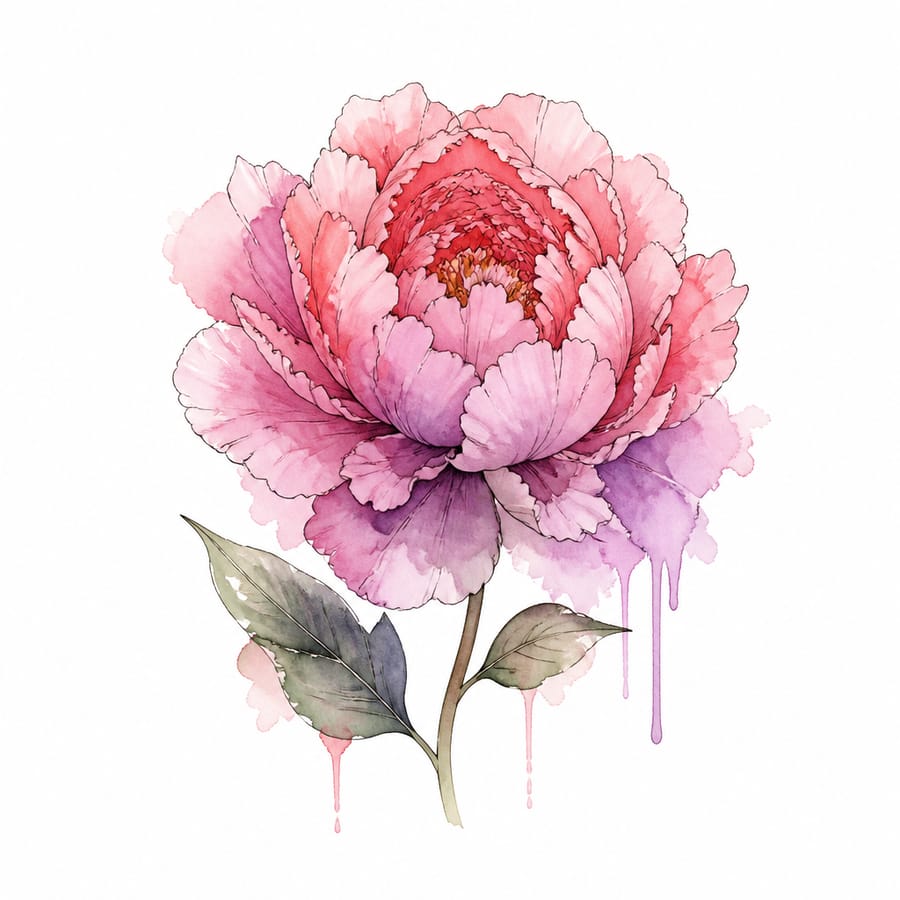
What does a watercolor tattoo look like?
Watercolor is less one look than a way of handling color, and the biggest decision is how much black sits under it. To keep everything else equal, we generated the same hummingbird and hibiscus with an AI image model in four watercolor structures.
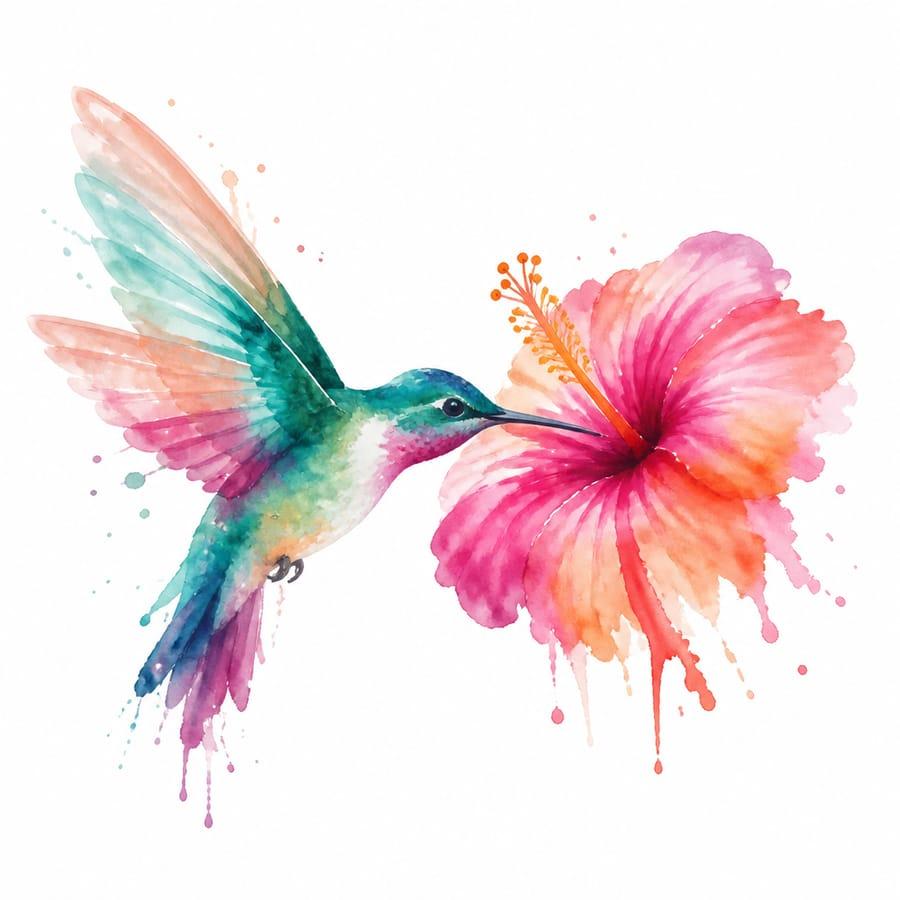 No outline
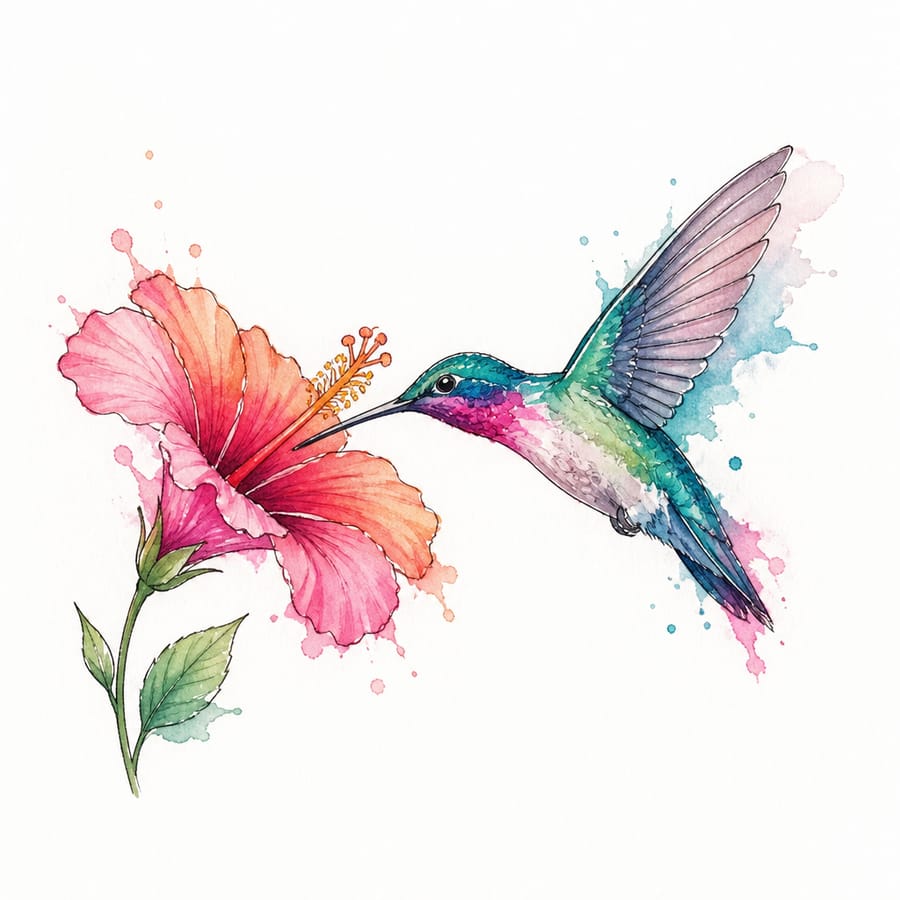 Thin outline
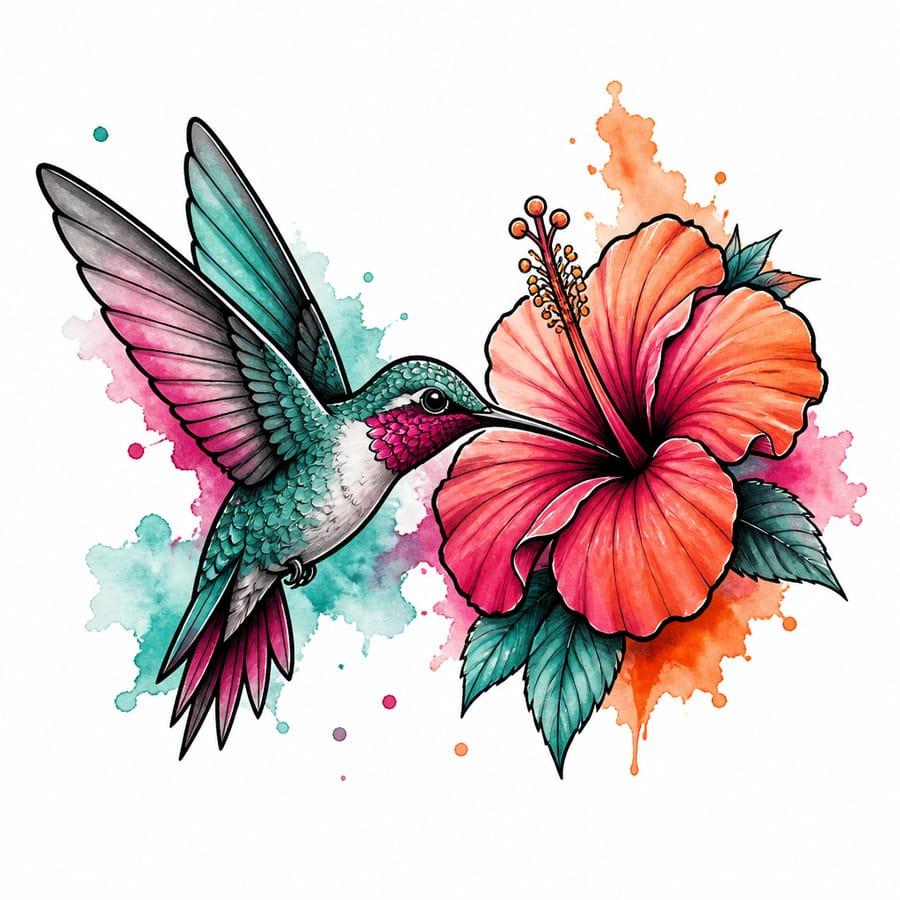 Black framework
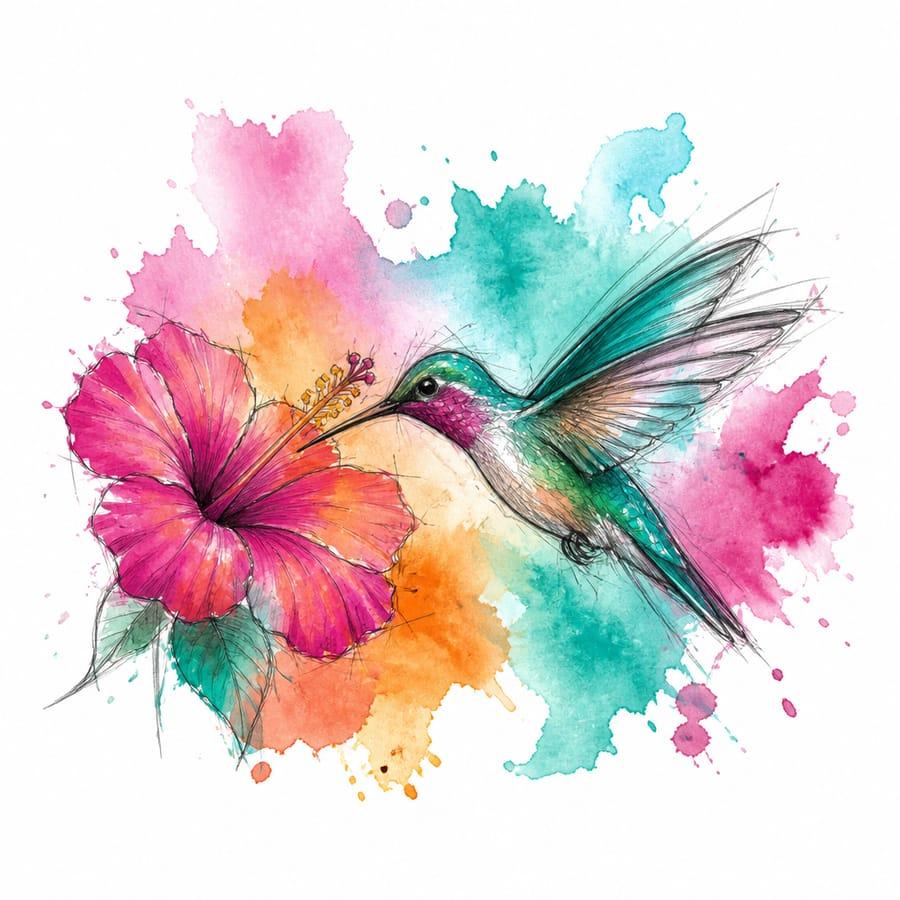 Sketch + splash
- No outline (pure watercolor): the image is built only from color washes and soft edges. It looks the most like a painting and depends entirely on color for its shape.
- Thin outline: a fine black line traces the subject and the color sits inside it, often spilling a little past it. Close to fine line work with a wash added.
- Black framework: bold lines and some black shading carry the drawing, and the watercolor sits behind it as a backdrop. This hybrid borrows from traditional and neo-traditional linework.
- Sketch + splash: loose black drawing lines over an abstract splash that does not follow the subject. The splash is decoration; the black sketch carries the image.
Typical marks of the style, whichever structure you pick: color that fades out instead of stopping at a line, visible brush-like strokes, drips running down, small dots of splatter, and white skin left open inside the design. Tattoodo describes the black part as the structure and the color as the wash; that vocabulary is useful when you talk to an artist.
Watercolor tattoo with black outline vs without: which lasts?
Every tattoo softens as the years pass: edges spread a little and color loses some strength. Nobody has measured how watercolor ages against other styles, so we cannot show you a real 10-year result. What we can show is why artists keep recommending an outline. We took three of the hummingbirds above and applied the exact same softening to each one: a blur, half the color saturation, and a 35% wash toward white.
- NoneNo outline, as designed
- ThinThin outline, as designed
- BlackBlack framework, as designed
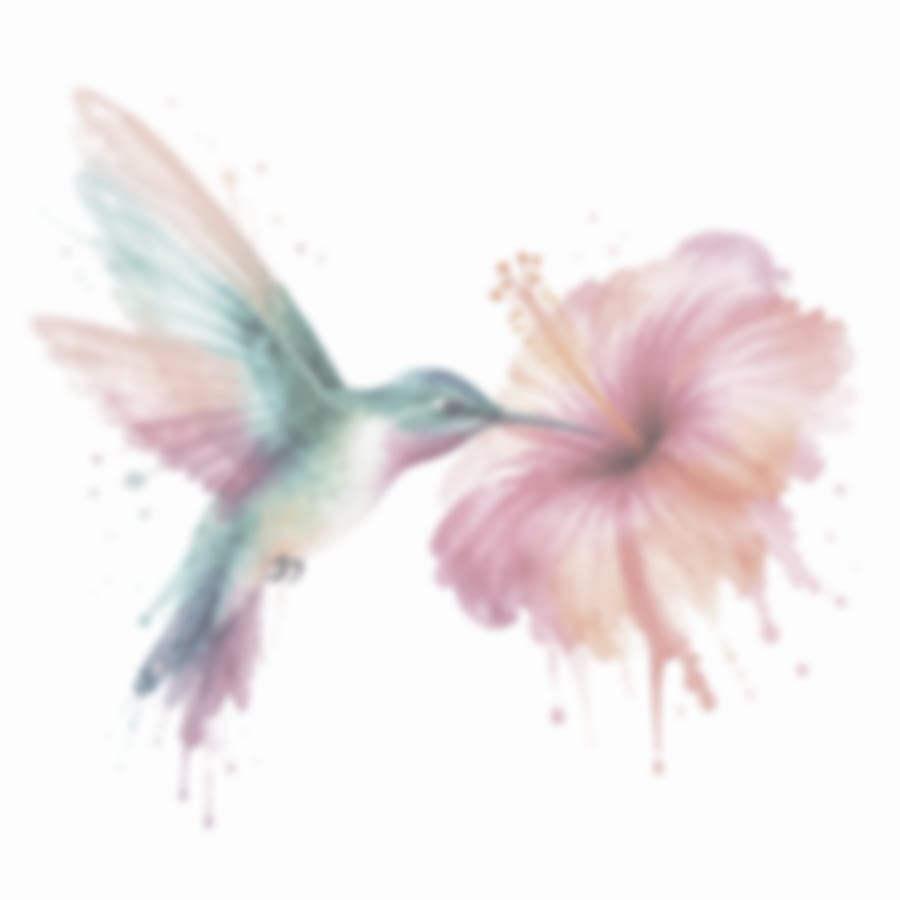 NoneNo outline, simulated softening
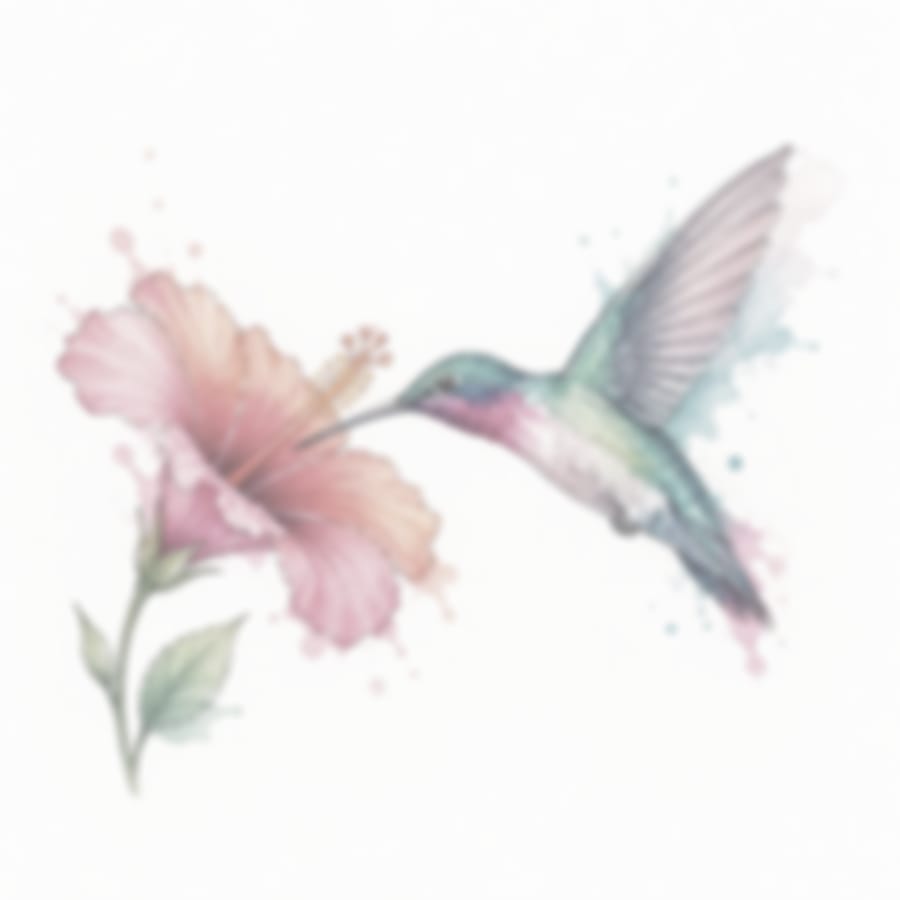 ThinThin outline, simulated softening
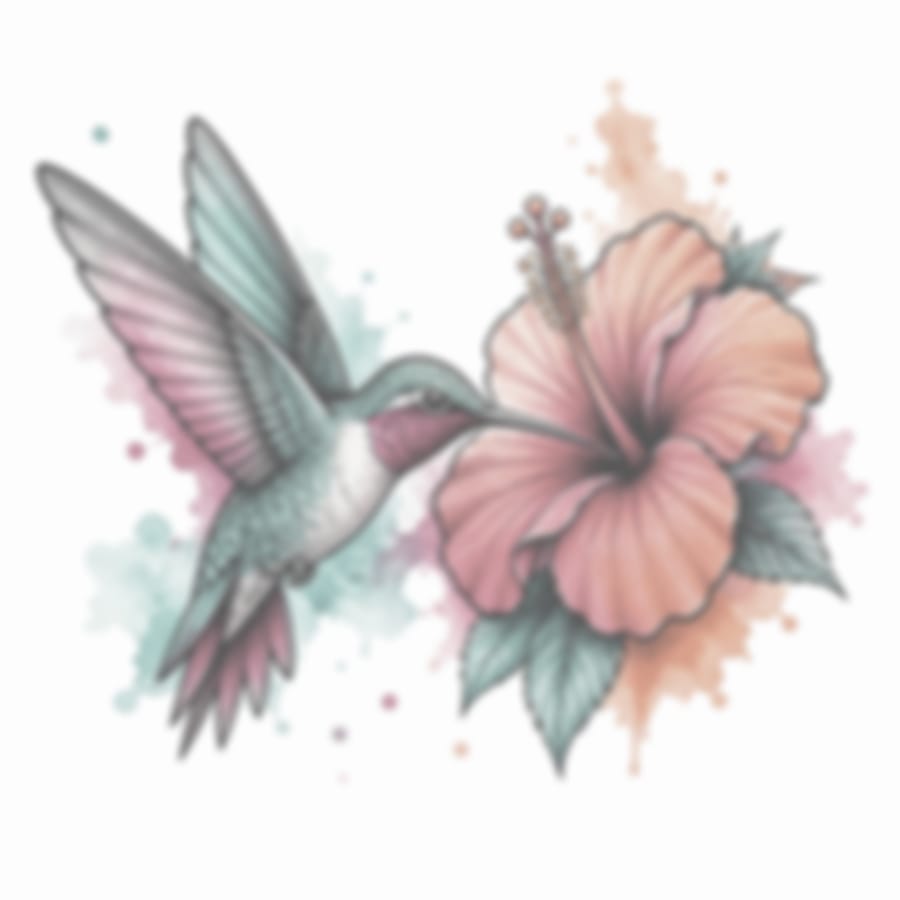 BlackBlack framework, simulated softening
Look at the bottom row. With no outline, the bird and the flower turn into two pale clouds, because color was the only thing defining their shape. The thin outline still traces the subject, faintly. The black framework still reads as a hummingbird at a glance, because black keeps its contrast after the color has weakened. That matches what the industry guides we read say in words: pieces without black linework blur faster than outlined ones, and a black base helps the design keep its structure as lighter tones fade (Tattoodo, Authority Tattoo, Chronic Ink). It is shared artist experience, not a study.
| No outline | Thin outline | Black framework | |
|---|---|---|---|
| Look | Most painterly, closest to paper | Delicate, illustrative | Bold, graphic, color as backdrop |
| What defines the shape | Color only | Fine line + color | Black lines and shading |
| How artists expect it to age | Softens soonest; may need touch-ups | In between; fine lines spread with time | Holds its shape longest |
| Suits | Abstract pieces, large soft florals | Flowers, birds, small symbols | Animals, portraits of subjects, bigger pieces |
| Ask for it as | "Pure watercolor, no outline" | "Fine line with watercolor wash" | "Black linework with watercolor background" |
If you love the outline-free look, you do not have to give it up. Two common compromises: keep the subject in thin black line and let only the background splash go outline-free, or choose an abstract design whose charm does not depend on a crisp silhouette, so softening matters less.
Prompt to try
“watercolor tattoo of a hummingbird and hibiscus, thin black fine line outline, soft teal and magenta wash bleeding past the lines”
Generate this designWatercolor tattoo vs regular color tattoo: what's the difference?
A regular color tattoo, such as American traditional or neo-traditional, packs color solidly inside a black outline, so each area is one flat, saturated color. A watercolor tattoo lets color thin out into gradients, overlap and run past the edges. Color realism blends color too, but to imitate a photo, not paint. Our tattoo styles guide draws one rose in eight styles if you want to compare them side by side.
| Watercolor | Traditional color | Color realism | |
|---|---|---|---|
| Outline | None, thin or bold | Bold black, always | Little or none |
| Color | Washes, gradients, bleeds | Flat, packed, saturated | Smooth, photographic blends |
| Black | Optional structure | Outline and shading | Shadows and depth |
| Typical subjects | Flowers, birds, koi, abstract | Flash: roses, swallows, daggers | Portraits, animals, nature |
| Our style page | This page | Traditional | Realism |
Do watercolor tattoos fade faster?
There is no study that tracks watercolor tattoos over time against other styles, so any answer mixes some chemistry with a lot of artist experience. The chemistry first. In laboratory tests reviewed by Hauri and Hohl (2015), from the State Laboratory of Basel in Switzerland, azo pigments (a family used for many yellows, oranges and reds) broke down under sunlight and laser light into several other substances, and some pigments degraded even under visible light alone. Phthalocyanine pigments (blues and greens), quinacridones and dioxazines were fairly photostable in the same tests.
| Pigment family | Typical colors | In the lab under light |
|---|---|---|
| Azo (incl. C.I. 11741, 12315, 12460) | Yellows, oranges, reds | Degraded under sunlight and laser light |
| Phthalocyanines (C.I. 74160, 74260) | Blues, greens | Fairly photostable |
| Quinacridones (C.I. 73915) | Magentas, pinks, reds | Fairly photostable |
| Dioxazines (C.I. 51319) | Violets | Fairly photostable |
Source: Hauri and Hohl, Curr Probl Dermatol 2015; color families are the usual hues of each pigment group. These were tests in vitro, not on skin, and they say nothing about a particular ink brand, so do not read the table as a list of colors that will or will not fade on you. They do explain why the same sun that fades a painting also fades a tattoo, and why Cleveland Clinic says UV rays can make ink fade more quickly and look washed out.
Then the artist experience. Tattoodo reports that pale yellows, pinks and pastels fade first, that pieces without black blur faster, and that larger pieces hold gradients better. Authority Tattoo, in an article medically reviewed by a dermatologist, says lighter colors fade faster than darker ones and adds an honest caveat: the style has not been around long enough to show what it looks like after 20 or 30 years. Chronic Ink, a studio that defends the style, still says watercolor may fade faster because it uses less ink and lacks bold outlines.
How do I make a watercolor tattoo age better?
- Give it a black structure. Even a thin outline, or black only on the subject, keeps the image readable as color softens (artist consensus, shown in the simulation above).
- Go bigger than you think. Gradients and small color details need room; tiny watercolor pieces have little to lose before they blur. Our tattoo size guide shows how much room each body part offers.
- Prefer richer colors over pastels for the parts that matter. Pale yellows, pinks and pastels are the colors guides say fade first.
- Choose a low-friction placement. Tattoodo lists the upper arm, thigh, calf, back and ribs among the spots that last longest, and hands, fingers and feet among those that wear fastest.
- Protect it from the sun once healed. Keep a new tattoo out of direct sun while it heals and do not put sunscreen on the fresh wound (Cleveland Clinic); after healing, Tattoodo recommends a broad-spectrum, water-resistant SPF 30 or higher.
- Ask about touch-ups before you book. Soft color can heal unevenly; find out whether the first touch-up is included.
Do watercolor tattoos work on dark skin?
They can, but the palette and the structure matter more. Tattoo ink sits under the top layer of skin, so it is always seen through the skin's own pigment: the darker the skin, the less a pale color stands out against it. Tattoodo notes that pastels show much less on darker skin and suggests richer colors plus a black structure for contrast. That is practitioner guidance, not a clinical study; we found no peer-reviewed research measuring how watercolor shows on different skin tones.
- Contrast first: deep blues, purples, greens and strong reds read better than pale yellow, peach or baby pink on deep skin, according to the artist guidance we read.
- Keep black in the design: a black outline or framework carries the image even where the color is subtle.
- Look for healed work on skin like yours: ask the artist for healed photos on similar skin tones, not only fresh ones on light skin.
- Ask about a color test: some artists offer a few small test dots of the colors you are considering, so you see how they heal on your skin before the full piece.
Where did watercolor tattoos come from?
Watercolor paint and tattooing met long before the style had a name. According to Tattoodo, flash sheets were traditionally colored with watercolor paint. On skin, though, those designs became bold outlines with solid color. Tattooing the wash itself, with its bleeds and splashes, is recent.
| When | What happened | Source |
|---|---|---|
| Traditional flash era | Flash sheets are colored with watercolor paint, but tattooed as bold outlines and solid color. | Tattoodo (industry guide) |
| May 2013 | WBUR profiles Brooklyn artist Amanda Wachob, whose abstract tattoos have a brush-stroked effect with ink spills and swirls. | WBUR Here & Now |
| Around 2013 | More art-school graduates enter tattooing and bring brushstroke and ink-spill effects with them. | Tattoodo (industry guide) |
| 2010s | The style spreads widely; purists debate whether it lasts. | Tattoodo, Chronic Ink (2017 update) |
No single artist is credited with inventing watercolor tattooing, and sources disagree on who came first, so we do not name a founder. The debate the 2010s started, art that looks great fresh versus tattoos built to last, is still the main question people ask about the style.
Watercolor tattoo ideas
Subjects with soft, natural color suit watercolor best: flowers, birds, fish, insects, feathers and landscapes, or a pure abstract stroke. These six were generated with AI as starting points; each uses at least a thin black line for structure.
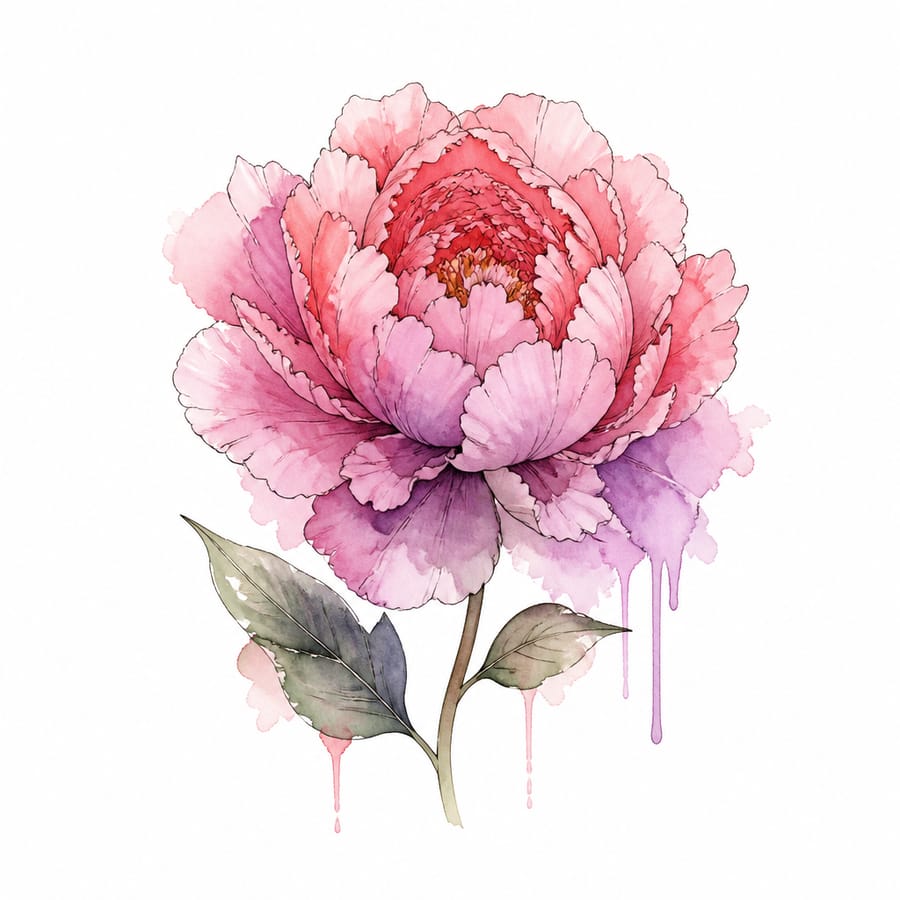 Peony
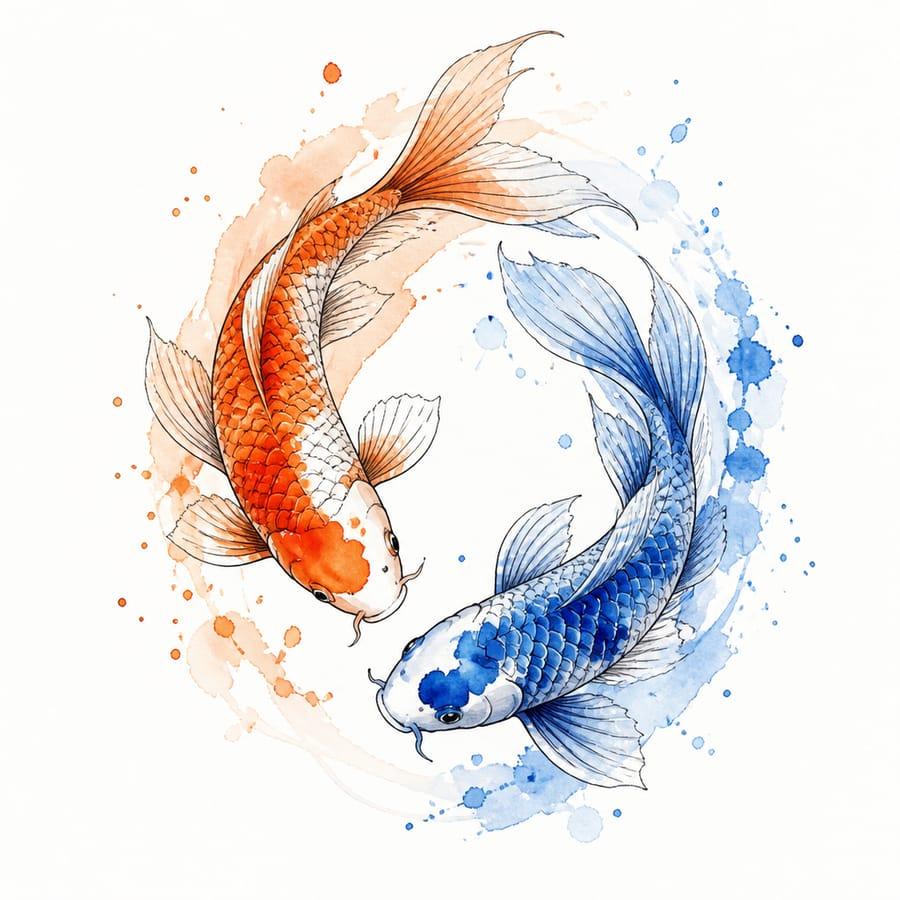 Koi pair
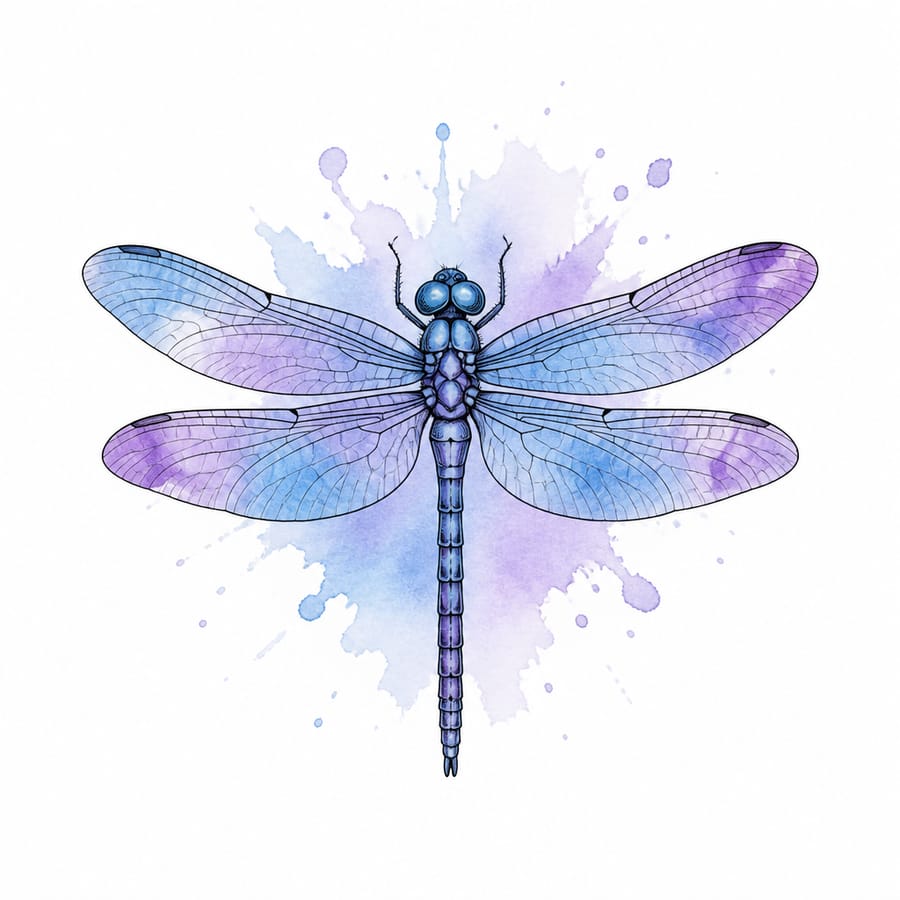 Dragonfly
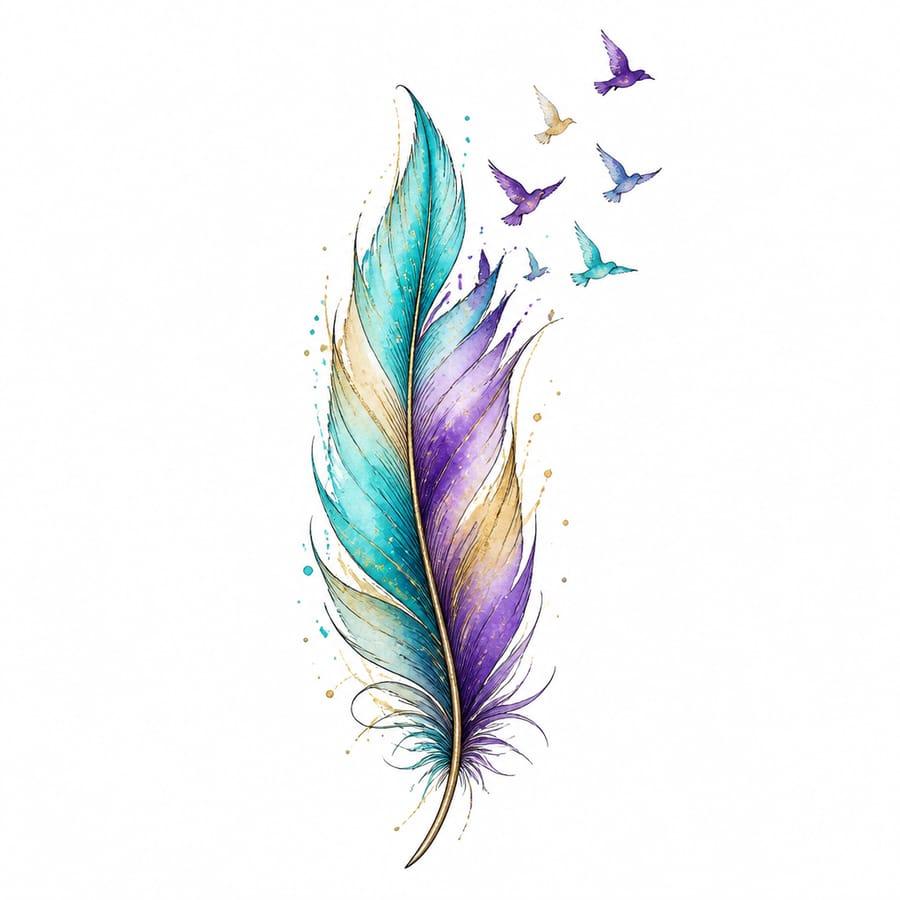 Feather and birds
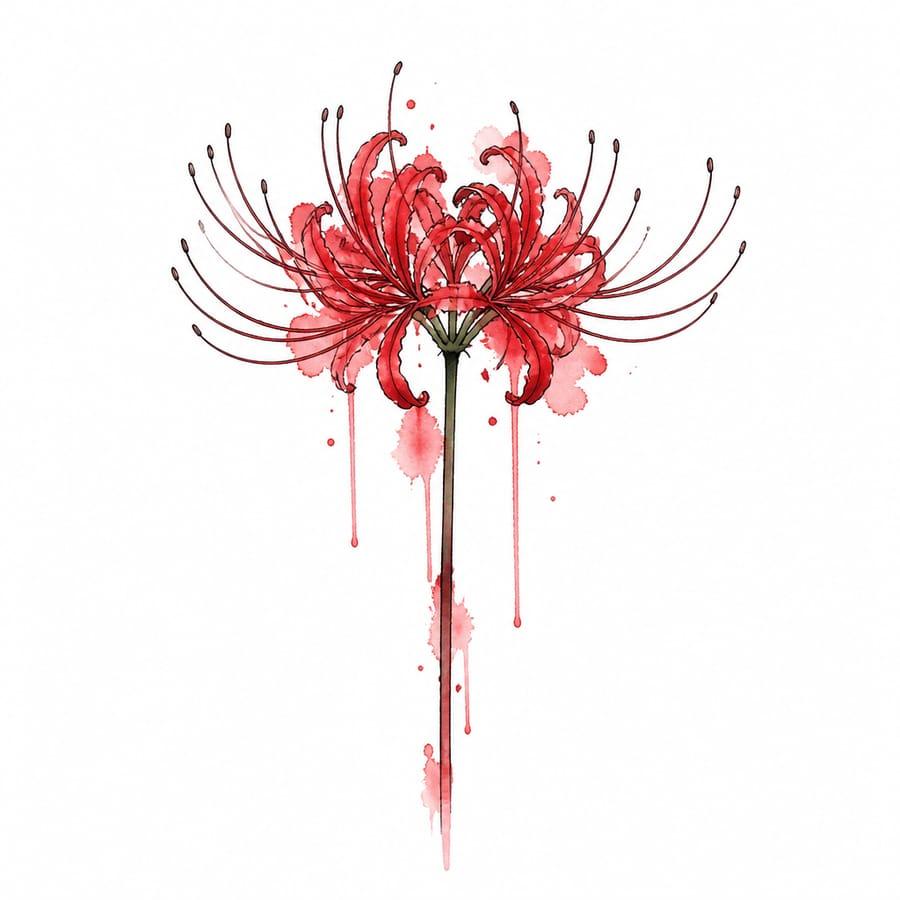 Spider lily
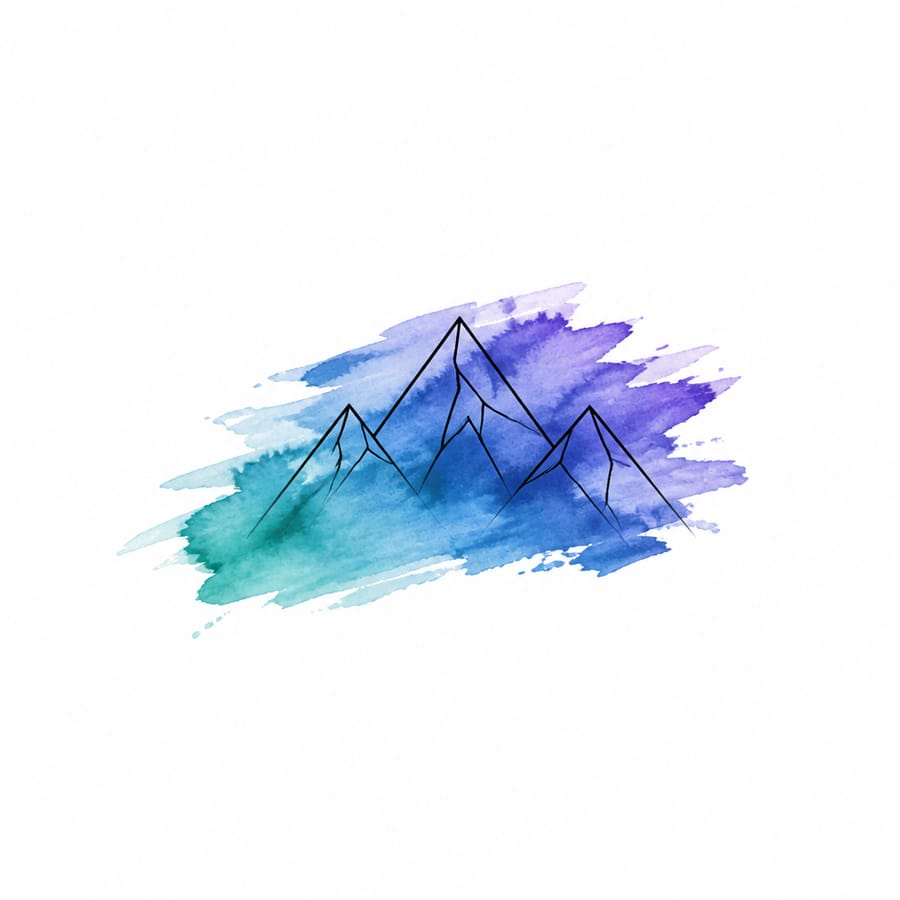 Mountain + brush stroke
- Flowers: peony, rose, lotus, poppy and wildflower bouquets. Petals are naturally soft-edged, so the bleed looks intentional.
- Koi: orange and blue fish with a splash for water. For the traditional Japanese version and its meaning, see Japanese tattoos.
- Birds and insects: hummingbirds, swallows, butterflies and dragonflies, whose wings are a natural place for translucent color.
- Feathers and birds in flight: a long, vertical shape that suits the forearm or ribs.
- Words and names: keep the lettering in solid black and put the watercolor behind it, never inside thin letters; soft color makes small text hard to read.
- Abstract: a single brush stroke or splash, alone or behind a fine-line symbol, mountain or constellation.
Prompt to try
“watercolor tattoo of a red spider lily on a long stem, thin black outline, deep crimson washes with soft drips”
Generate this designPrompt to try
“small geometric mountain outline in thin black line over a blue and violet watercolor brush stroke”
Generate this designBest placement and size for a watercolor tattoo
Watercolor wants room and little friction. The flat, low-friction areas industry guides recommend, upper arm, thigh, calf, back and ribs, are also the largest canvases on the body. Here is how much space each offers, using medians from ANSUR II, the US Army body measurement survey, as computed in our tattoo size guide.
Room on one side of each body part, drawn to scale
- Women (median)
- Men (median)
- 1 square = 1 inch
9.5 × 5.2 in · 10.5 × 6.1 in
12.2 × 6 in · 13.2 × 7 in
15.2 × 7.3 in · 16.3 × 7.7 in
13.1 × 12.1 in · 14.1 × 12.3 in
14.4 × 16.7 in · 16.3 × 18.8 in
3 in · 6 in · 10 in
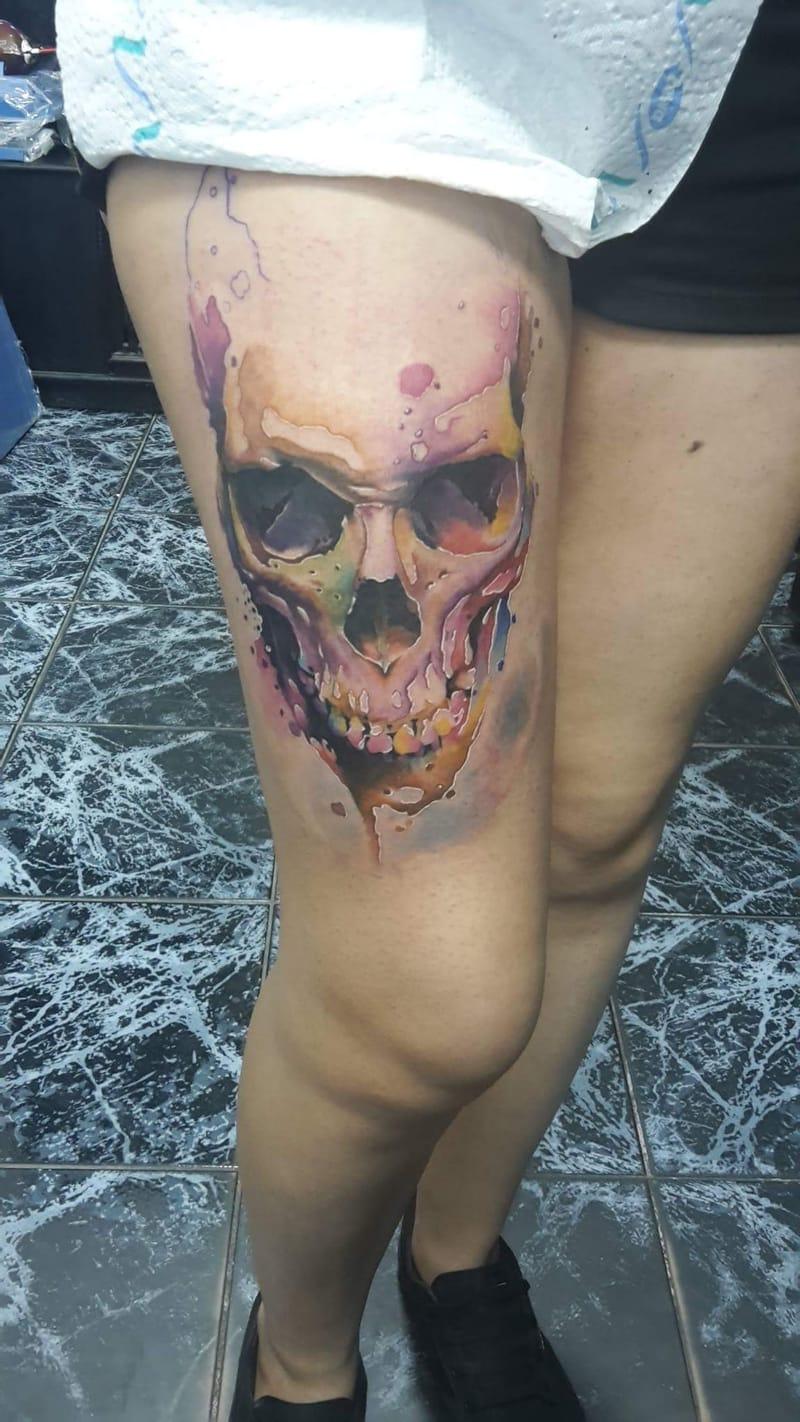
- Shoulder and upper arm: a rounded area where splashes can wrap. See the shoulder guide.
- Thigh: about 12 inches across one side, room for a large floral or a pair of koi. See the thigh guide.
- Forearm: long and narrow, 5 to 6 inches across one side; good for feathers and vertical florals, and easy to keep out of the sun with a sleeve. See the forearm guide.
- Ribs: low friction under clothing, but in the high pain tier of our tattoo pain chart, based on what artists report. See the rib guide.
- Hands, fingers and feet: the places guides say wear fastest; a poor match for soft color.
To check a design against your own measurements, use the tattoo size calculator, then preview it on a photo of your arm or leg before you book.
Do watercolor tattoos hurt more?
No study compares pain by tattoo style, so there is no evidence that watercolor itself hurts more. What research does show is that time matters. In a survey of 1,092 tattooed people (Witkoś and Hartman-Petrycka, 2020), longer tattooing time, bleeding and higher stress predicted more pain during tattooing, while body area was not a significant predictor in their model. Building soft color in layers can take a while, so a large watercolor piece may mean a long session; splitting it into several sittings is the practical answer. For spot-by-spot reports, see our tattoo pain chart.
How much does a watercolor tattoo cost?
We found no price survey specific to watercolor, so we will not quote a watercolor price. Most studios price anything beyond a small piece by time. In our sample of 25 US studios whose websites list prices (checked November 4, 2026), shop minimums ran from $80 to $200 with a median of $120, and hourly rates from $100 to $250 with a median of $200. The full list and method are in our tattoo cost guide.
| Example | Hypothetical time | At $200/hour |
|---|---|---|
| Small watercolor symbol | Within the shop minimum | $80 to $200 in the sample |
| Palm-size floral with thin outline | 2 hours | $400 |
| Forearm hummingbird with framework | 4 hours | $800 |
The hours are hypothetical and the totals are arithmetic, not quotes. Are watercolor tattoos more expensive? Only if they take longer: layered color, many hues and a large size add time, and so can a touch-up session if it is not included. For a planning range on your own design, try the tattoo price calculator.
How does a watercolor tattoo heal?
The same way as any tattoo. Cleveland Clinic says the top layer of skin typically heals by about two months, the deeper layers take several more months, and larger tattoos can take a few months to fully heal. During that time, keep it out of direct sunlight and do not apply sunscreen to it until it has healed. Our tattoo healing stages guide shows what is normal week by week, and the tattoo aftercare guide covers daily care.
Specific to watercolor: soft color can heal unevenly, with some areas lighter than planned. Tattoodo and Chronic Ink both treat a touch-up as the usual fix once the skin has fully healed. That is industry experience, not clinical data.
Can a watercolor tattoo be removed?
Yes, but color takes more work than black. In one retrospective study of 52 patients (Cannarozzo et al., 2021), professional tattoos with mixed colors needed 7.8 ± 1.1 laser sessions on average, against 6.3 ± 0.9 for professional dark tattoos; black and blue were treated at one wavelength and other colors at another. The authors cite earlier literature reporting that colored tattoos, especially green and yellow ones, respond poorly to laser. Those are one study's averages, not a forecast for your tattoo.
The American Academy of Dermatology notes that a single laser cannot remove all ink colors, and the FDA warns that removal may leave permanent scarring or not remove the tattoo completely. If you are unsure, a design with more black and fewer colors is easier to undo or cover later. For a rough budget, see the tattoo removal cost calculator.
Are watercolor tattoos a bad idea?
Not if you choose them knowingly. They are a bad match if you want a tiny piece that stays crisp for decades, if the design depends on pale color alone, or if it will sit on hands or feet. They are a good match if you love the painterly look, accept that it will soften, plan a black structure, give it room and protect it from the sun. The questions below help you find an artist who does it well.
- Ask for healed photos, at least a year old, not only fresh ones; watercolor always looks best on day one.
- Check that soft gradients look smooth when healed, without patchy or muddy spots.
- Look for healed work on a skin tone close to yours.
- Ask how much black the artist recommends for your design and placement, and why.
- Ask whether a touch-up is included and when it should happen.
These checks are common advice from artists, not research. Bring a reference image so you are both talking about the same structure and colors.
Prompt to try
“watercolor koi pair, one orange and one blue, fine black linework, loose blue water splash around them”
Generate this designPlan the rest of your watercolor tattoo
Tattoo Styles Explained
One rose drawn in eight styles, watercolor included.
Fine Line Tattoos
Thin-needle linework, the usual outline for watercolor.
Traditional Tattoos
Bold outlines and packed color, the opposite approach.
Japanese Tattoos
Koi, peonies and waves in their original tradition.
Tattoo Size Chart
How much room each body part has, in inches and cm.
Tattoo Pain Chart
Which spots hurt most, and why session length matters.
Tattoo Healing Stages
What normal healing looks like, week by week.
Tattoo Cost Guide
Prices and minimums from 25 US studios.
Sources
- Hauri U, Hohl C. Photostability and breakdown products of pigments currently used in tattoo inks. In: Tattooed Skin and Health, Curr Probl Dermatol vol 48, Karger, 2015 · checked 2026-11-10
- Cannarozzo G et al. Q-Switched 1064/532 nm laser with nanosecond pulse in tattoo treatment: a double-center retrospective study. Life (Basel), 2021 · checked 2026-11-10
- Witkoś J, Hartman-Petrycka M. Gender differences in subjective pain perception during and after tattooing. IJERPH, 2020 · checked 2026-11-10
- US FDA: Think Before You Ink, Tattoo Safety (updated December 17, 2024) · checked 2026-11-10
- American Academy of Dermatology: Laser tattoo removal · checked 2026-11-10
- American Academy of Dermatology: Keloids, causes · checked 2026-11-10
- American Academy of Dermatology: Keloids, overview (who gets keloids) · checked 2026-11-10
- Cleveland Clinic: Tattoo aftercare tips from a dermatologist (Shilpi Khetarpal, MD; March 20, 2026) · checked 2026-11-10
- ANSUR II: Anthropometric Survey of US Army Personnel (public data, OPEN Design Lab, Penn State) · checked 2026-11-10
- Wikimedia Commons: Svaba Tattoo.jpg, by Nemanja113, January 15, 2022 (CC BY-SA 4.0) · checked 2026-11-10
- WBUR Here & Now: Turning Tattoos Into Fine Art (May 6, 2013) · checked 2026-11-10
- Tattoodo: Watercolor Tattoos, Technique, Placement and How Long They Last (industry style guide) · checked 2026-11-10
- Authority Tattoo: What is a Watercolor Tattoo & How Long Does it Last? (Dan Hunter; medically reviewed by Jennifer T. Haley, MD; updated October 23, 2023) · checked 2026-11-10
- Chronic Ink: Watercolour tattoos and why you should love them (studio blog, 2017 update) · checked 2026-11-10
Watercolor tattoo FAQ
Do watercolor tattoos fade faster than other tattoos?+
No study has compared styles over time. Artists widely report that soft, pale color, especially yellows, pinks and pastels, softens sooner than black, and that designs without any black outline lose their shape first. Lab research also shows some pigments, including azo yellows and reds, break down under sunlight. Sun protection after healing and a black structure help.
Should a watercolor tattoo have a black outline?+
Most artists recommend at least some black: a thin outline, black on the subject only, or a bold framework with the watercolor behind it. The black keeps the image readable as the color softens. Outline-free watercolor works best for abstract designs whose charm does not depend on a crisp shape.
How long do watercolor tattoos last?+
The ink is permanent, like any tattoo. How long it looks the way it did on day one depends on the design, colors, size, placement and sun exposure. The style is too young for a reliable 20- or 30-year record, and touch-ups are a normal way to refresh soft color.
Do watercolor tattoos work on dark skin?+
They can. Pale colors show less on darker skin, so artists suggest richer, saturated colors and a black outline or framework for contrast. Ask for healed photos on similar skin tones and, if the artist offers it, a small color test. If you are prone to keloids, see a dermatologist first.
Are watercolor tattoos more expensive?+
Not by style alone. Most studios charge by time, so a watercolor piece costs more only if layered color, many hues or a large size take longer. In our sample of 25 US studios, hourly rates ranged from $100 to $250 with a median of $200, and minimums from $80 to $200.
Do watercolor tattoos hurt more?+
There is no evidence that the style itself hurts more. In a survey of 1,092 tattooed people, longer tattooing time, bleeding and stress predicted more pain, so a large piece built in layers is best split into several sessions.
Tattoo planning tool
Generate a watercolor tattoo reference
Describe your idea, generate it in any style, and preview it on your own skin before the needle.
Generate for freeFree to start