
Japanese Tattoos: Style, Motifs and What They Mean
A Japanese tattoo, called irezumi or wabori, is drawn with bold black outlines, a set vocabulary of subjects from Japanese art and folklore (koi, dragons, tigers, peonies, hannya masks) and a background of waves, clouds or wind bars. It is planned for a whole area of the body, which is why the style is known for sleeves, back pieces and bodysuits. Below: what the motifs mean, how a sleeve is composed, how big each piece is, and where the style comes from.
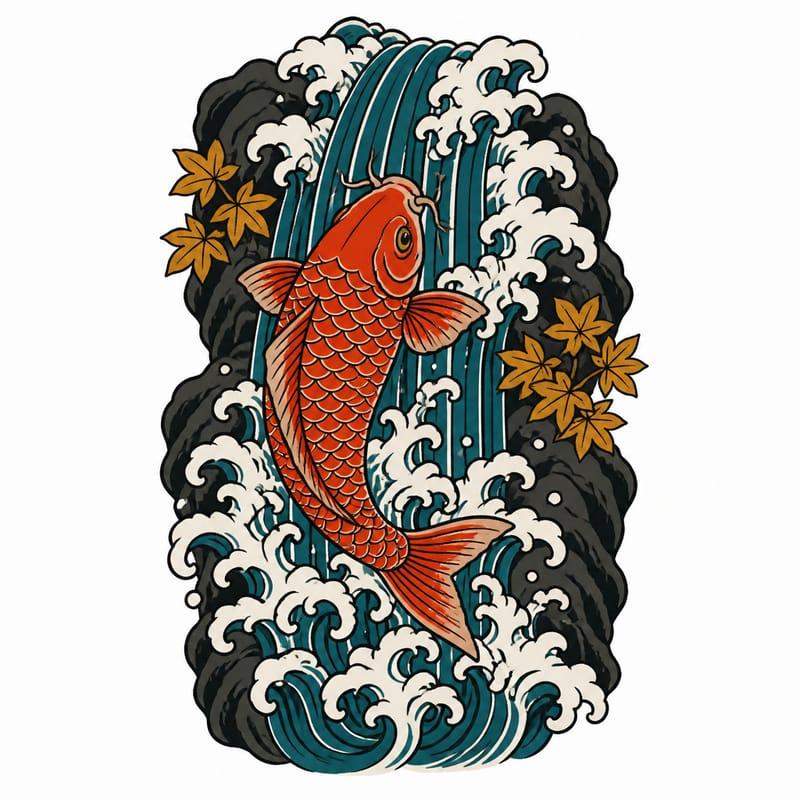
What is a Japanese tattoo called? Irezumi, horimono, wabori and tebori
Irezumi is the general Japanese word for tattoo; it literally means "inserting ink", and in English it is used for the traditional Japanese style. Horimono ("carving") is an older word for the same thing. Wabori ("Japanese carving") is the term Japanese artists use for the traditional style, as opposed to yōbori, Western-style tattooing, although many studios in Japan now do both (English Wikipedia; Japanese Wikipedia, citing Yamakoshi 2012 and Nakano 2007).
Tebori means tattooing by hand. The traditional tool, called nomi or tsukibō, is a handle with a bundle of needles fixed to the end; the artist pushes it into the skin by hand instead of using a machine. Hand-poking artists commonly use a machine for some steps, such as the outlines (Japanese Wikipedia, citing Yamamoto 2016 and McLaren 2015). A tattoo artist in this tradition is a horishi. The style does not depend on the tool: wabori is done both by hand and by machine.
Japanese tattoo symbols and meanings
The six designs below are AI illustrations we generated to show the main motifs in one consistent flash style. They are references, not historical artworks; an artist will redraw any of them to fit your body.
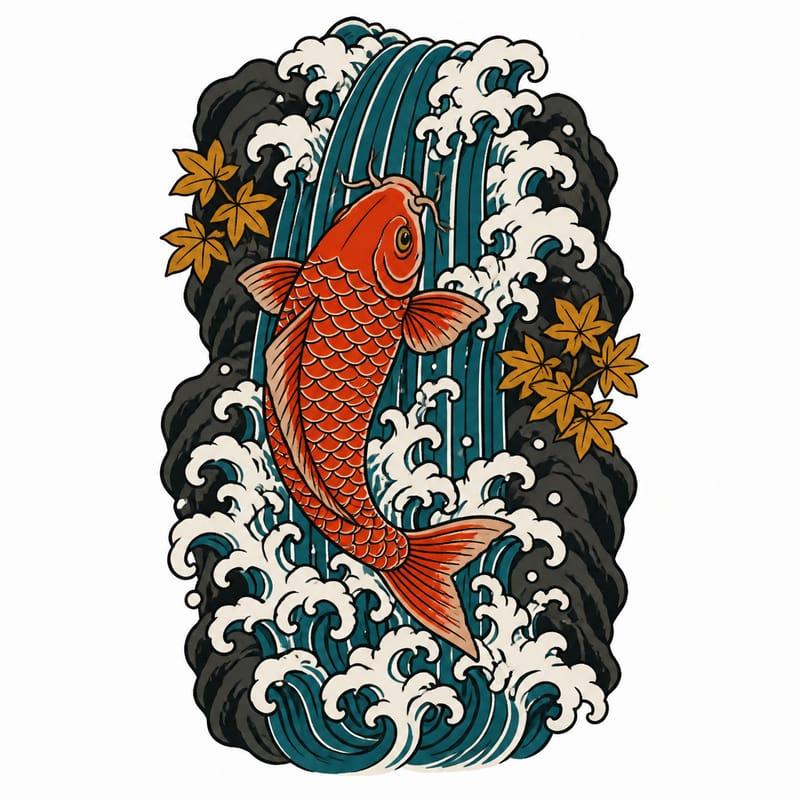 Koi climbing a waterfall
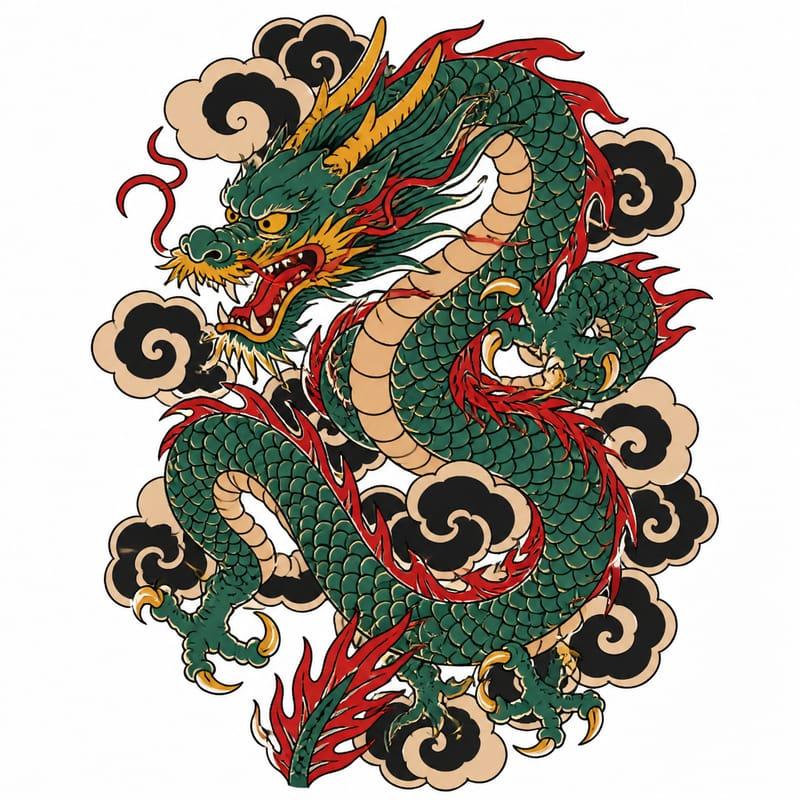 Dragon in clouds
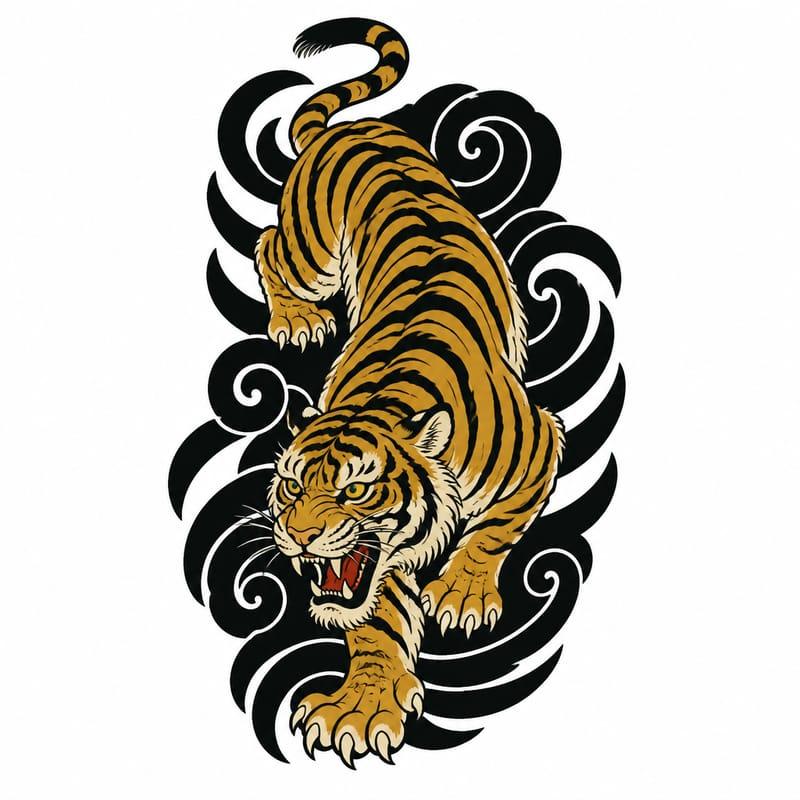 Tiger with wind bars
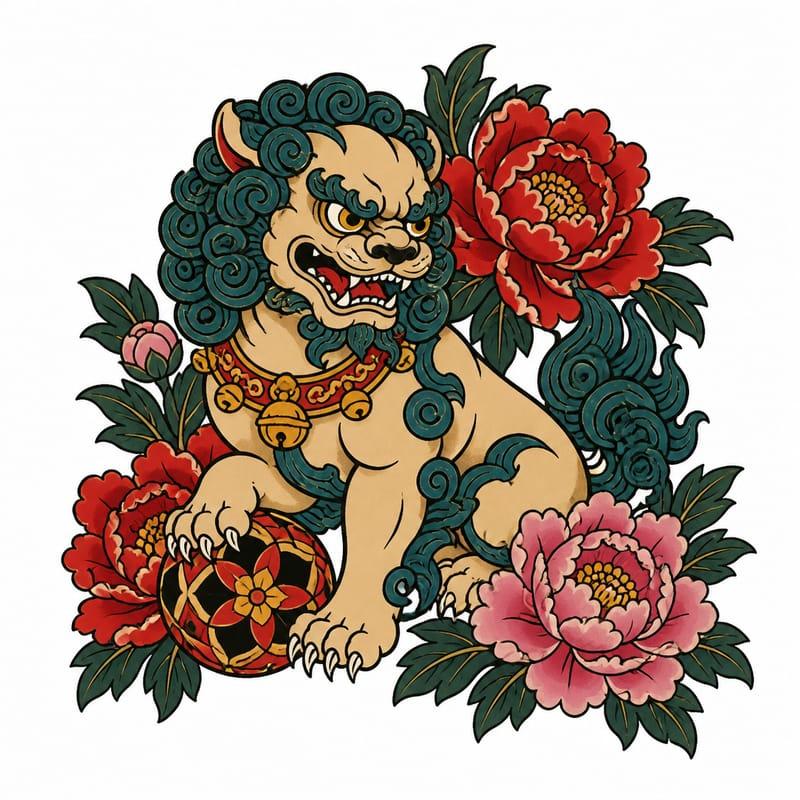 Lion with peonies
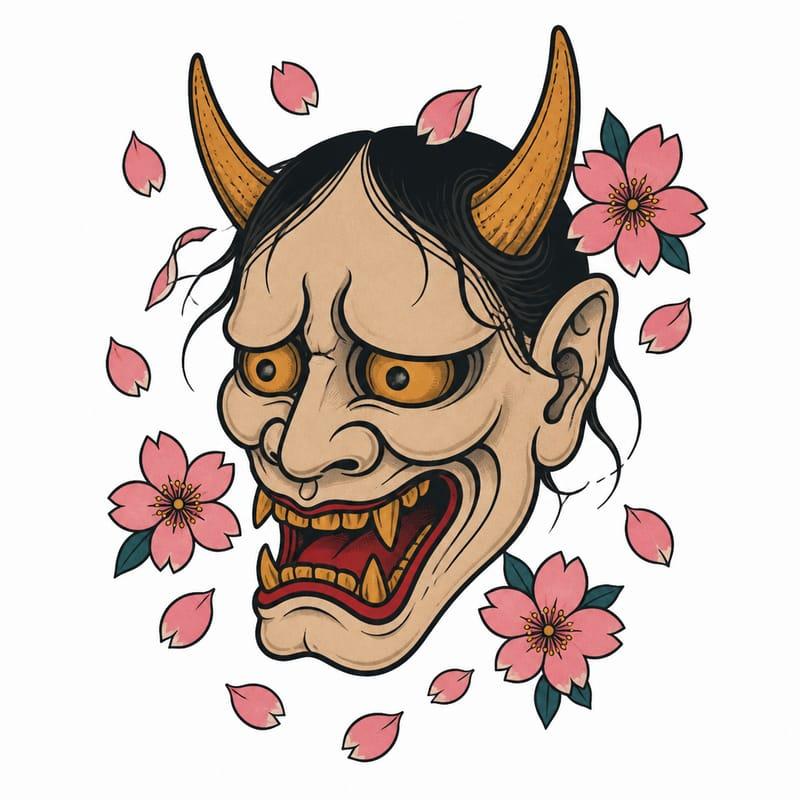 Hannya mask and cherry blossoms
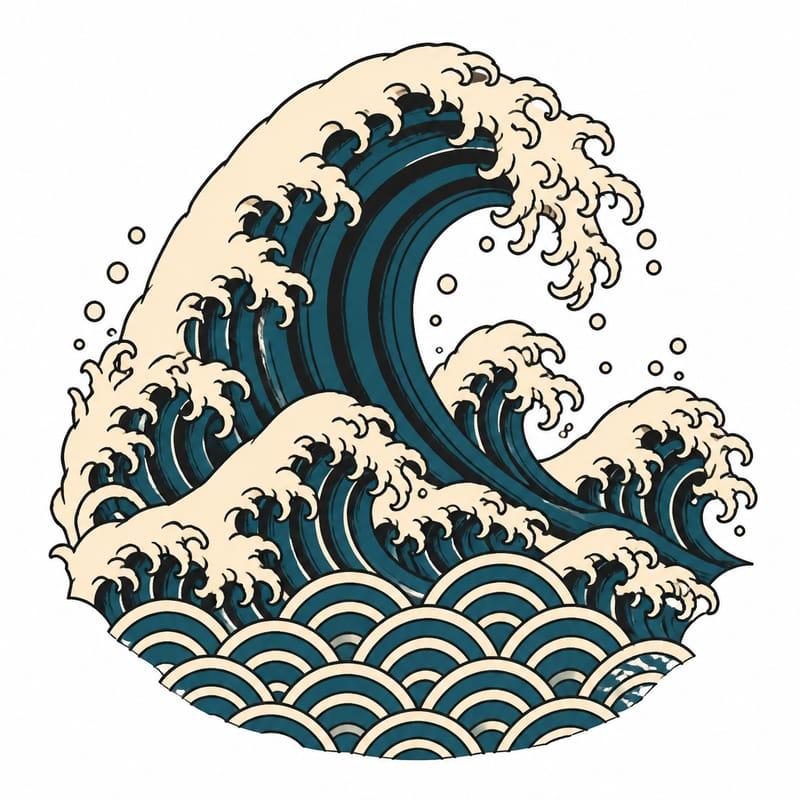 Waves and seigaiha
Most of these subjects come from Chinese and Japanese art, not from tattooing itself, so their meanings are the ones they carry in paintings, theater and festivals. The table gives the reading recorded by museum and art-history sources. Treat it as the common interpretation in Japanese art, not as a rule about what your tattoo has to mean.
| Motif | Commonly read as | Where it comes from |
|---|---|---|
| Koi climbing a waterfall | Effort rewarded, success | Chinese legend of a carp that turns into a dragon after swimming up a waterfall at the headwaters of the Yellow River; linked to the carp streamers of Japan's Boys' Day (JAANUS) |
| Dragon | Water, clouds and rain; heaven; a protector | Chinese mythological animal, shown emerging from clouds to bring rain; a protector of the Buddhist law in Buddhist art; in Japanese painting often read as a symbol of heroic leadership (JAANUS) |
| Tiger | The dragon's counterpart: earth and wind | In Chinese cosmology the tiger stands for the west, earth, autumn and wind, the dragon for the east, heaven, spring and rain; the pair appears on Zen temple screens from the Muromachi period (JAANUS) |
| Peony | Wealth and honor | Originally a Chinese flower, popularly called the "King of Flowers" (Kyoto National Museum) |
| Chinese lion (karajishi) with peonies | A guardian | Lion images guarded Buddhist temples and icons (JAANUS); in the noh play Shakkyō the lion dances among peonies (JAANUS) |
| Hannya mask | Jealousy and rage turned demonic | Noh mask of a woman turned into a serpent-demon by jealousy and hatred, worn in plays such as Aoi no Ue and Dōjōji (JAANUS) |
| Phoenix (hō-ō) | An auspicious bird | Imaginary Chinese bird, symbol of the south; in Japanese decoration its background was gradually replaced by peonies, cherry blossoms and chrysanthemums (JAANUS) |
| Seigaiha waves | The sea (a pattern, not a symbol) | Overlapping arcs of concentric circles, used in China to draw the sea on old maps and in Japan from the clothing of haniwa figures onward (JAANUS) |
| Water Margin heroes | Courage, outlaw bravado | Characters of the Chinese novel Suikoden were the most common subjects in Tamabayashi's 1936 survey of Japanese tattoos (Japanese Wikipedia) |
Why do dragons and tigers appear together?
Because they are a cosmological pair. In the Chinese system the dragon belongs to heaven and rain, the tiger to earth and wind (JAANUS). That is why Japanese-style tigers are so often drawn surrounded by wind bars, and dragons by clouds and water.
What does a koi climbing a waterfall mean?
It comes from the Chinese legend of the carp that swims up a waterfall and becomes a dragon, a parable of effort and success that Japanese artists painted throughout the Edo period (JAANUS).
What does a hannya mask tattoo mean?
The hannya is a theater mask, not a generic demon. In noh it shows a woman consumed by jealousy and hatred, with horns, metallic eyes and fangs (JAANUS). Two of those plays, Aoi no Ue and Dōjōji, tell of women betrayed or spurned by their lovers. What the mask means on your skin is personal, so talk it through with your artist.
Where did Japanese tattoos come from? A short history
Large pictorial tattoos took shape in the cities of the Edo period (1603 to 1868), and their imagery is tied to woodblock prints of the Chinese novel Water Margin (Suikoden), whose outlaw heroes are covered in tattoos. Curator Sarah E. Thompson notes it is still uncertain whether the prints followed an existing fashion or started it (Hyperallergic, on Thompson's Tattoos in Japanese Prints).
| When | What happened | Source |
|---|---|---|
| Early Edo period | Magistrates mark criminals' faces or arms with simple punitive tattoos (irezumi-kei) | Hyperallergic |
| 1757 | First Japanese edition of Suikoden | English Wikipedia, citing Shirane and Brandon |
| Late 1700s | Bandits wear large tattoos; the fashion spreads among young men in the cities and prohibitions follow | Hyperallergic |
| 1811, 1842 | Edo bans on tattooing, with only temporary effect | Japanese Wikipedia, citing the Tokugawa legal records |
| 1827 | Utagawa Kuniyoshi's One Hundred and Eight Heroes of the Popular Water Margin; the prints are used as a pattern book | Japanese Wikipedia, citing Miyashita 2015 |
| 1872 | The Meiji government bans tattooing | Japanese Wikipedia, citing Miyashita 2015 |
| 1948 | The new Minor Offenses Act has no tattoo clause, ending the ban | Japanese Wikipedia; English Wikipedia, citing DeMello 2007 |
| Early 2000s | The health ministry treats tattooing as a medical act, so artists without a medical license risk prosecution | Time Out Tokyo |
| 2016 | The Japan Tourism Agency asks spa operators to admit tattooed foreign tourists | Hyperallergic, citing the Japan Times |
| September 17, 2020 | Japan's Supreme Court rules that tattooing is not a medical act | Time Out Tokyo |
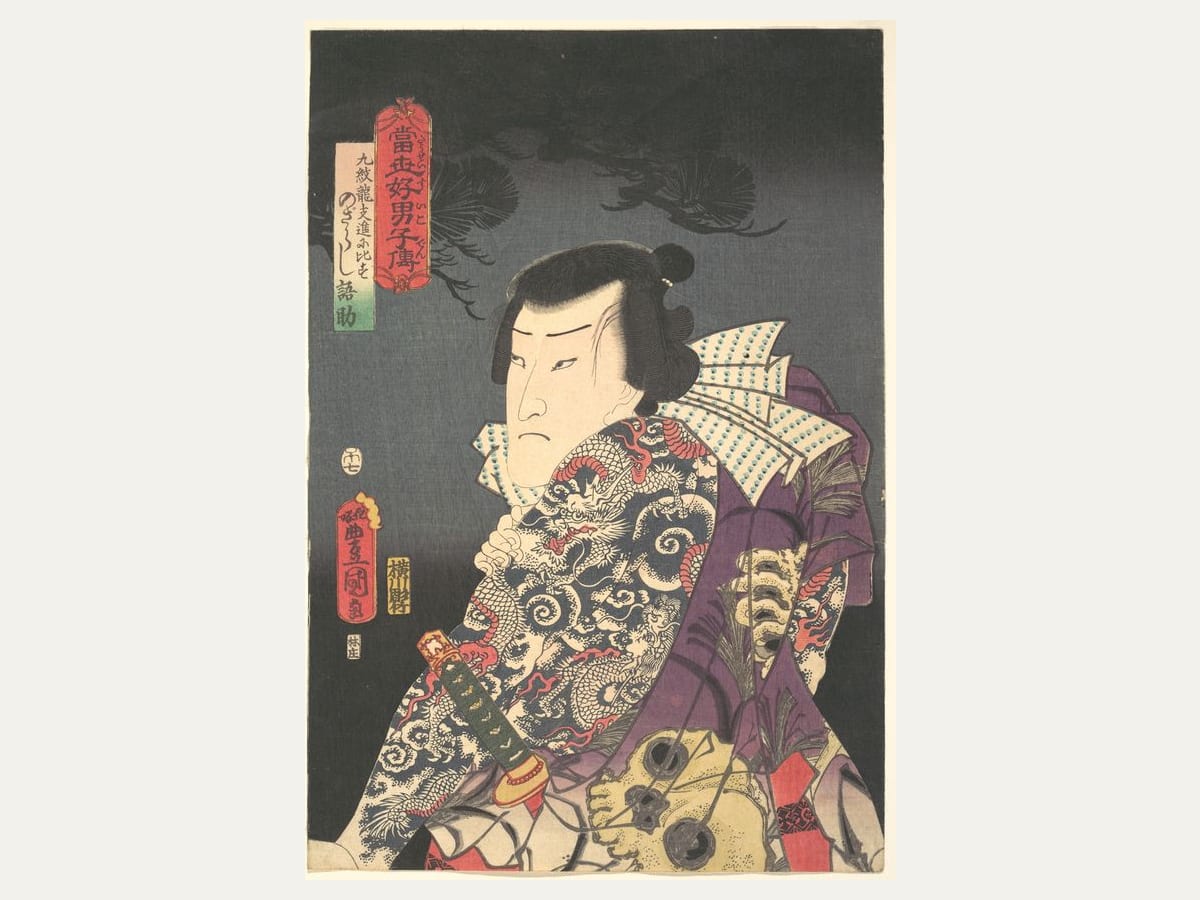
The print above, from the Met's collection, casts a kabuki actor as Shi Jin, the Suikoden hero whose body carries nine blue dragons (Japanese Wikipedia). Over the 20th century tattoos also became associated with organized crime, an image reinforced by the yakuza films of the 1960s (Japanese Wikipedia, citing Yamamoto). That history explains the bathhouse rules below; it does not describe people who wear the style today.
How is a Japanese sleeve, back piece or bodysuit composed?
A Japanese piece is built in layers: one main subject, a background that fills the space around it (waves, clouds, wind bars, flowers), and a planned edge where the tattoo stops. The Japanese terms below come from tattoo books cited on Japanese Wikipedia (Tamabayashi 1956, Nakano 2007) and its glossary.
- Nuki-bori: the subject alone, with no background frame.
- Gaku and gaku-bori: the gaku is the frame of clouds or waves drawn around the subject; it is considered specific to wabori.
- Mikiri: the boundary between tattooed and bare skin. Botan-mikiri is semicircular, butsukiri straight, and akebono-mikiri fades out.
- Nagasode: a sleeve that runs down to the wrist.
- Munewari: chest and belly tattooed with a bare strip left down the middle; donburi covers the front with no strip.
- Sōshinbori: a full bodysuit from the wrists to the ankles.
- Sujibori and bokashi: the outlines, then the shading. Beta-bokashi is solid fill, akebono-bokashi a gradient.
The open strip has a practical side: curator Sarah E. Thompson describes full Japanese tattoos that cover the body "from the neck to the elbows and knees", sometimes with a bare strip down the chest so they can be hidden under clothing or shown as desired (Hyperallergic).
Japanese tattoo sleeve lengths and sizes
There is no standard sleeve size: a sleeve is measured by the arm it goes on. To give real numbers, the map below uses the median body measurements from ANSUR II, the US Army's anthropometric survey of 1,986 women and 4,082 men, the same data as our tattoo size guide. It is a military sample aged 17 to 58, not the general population, so your arm can be longer or shorter.
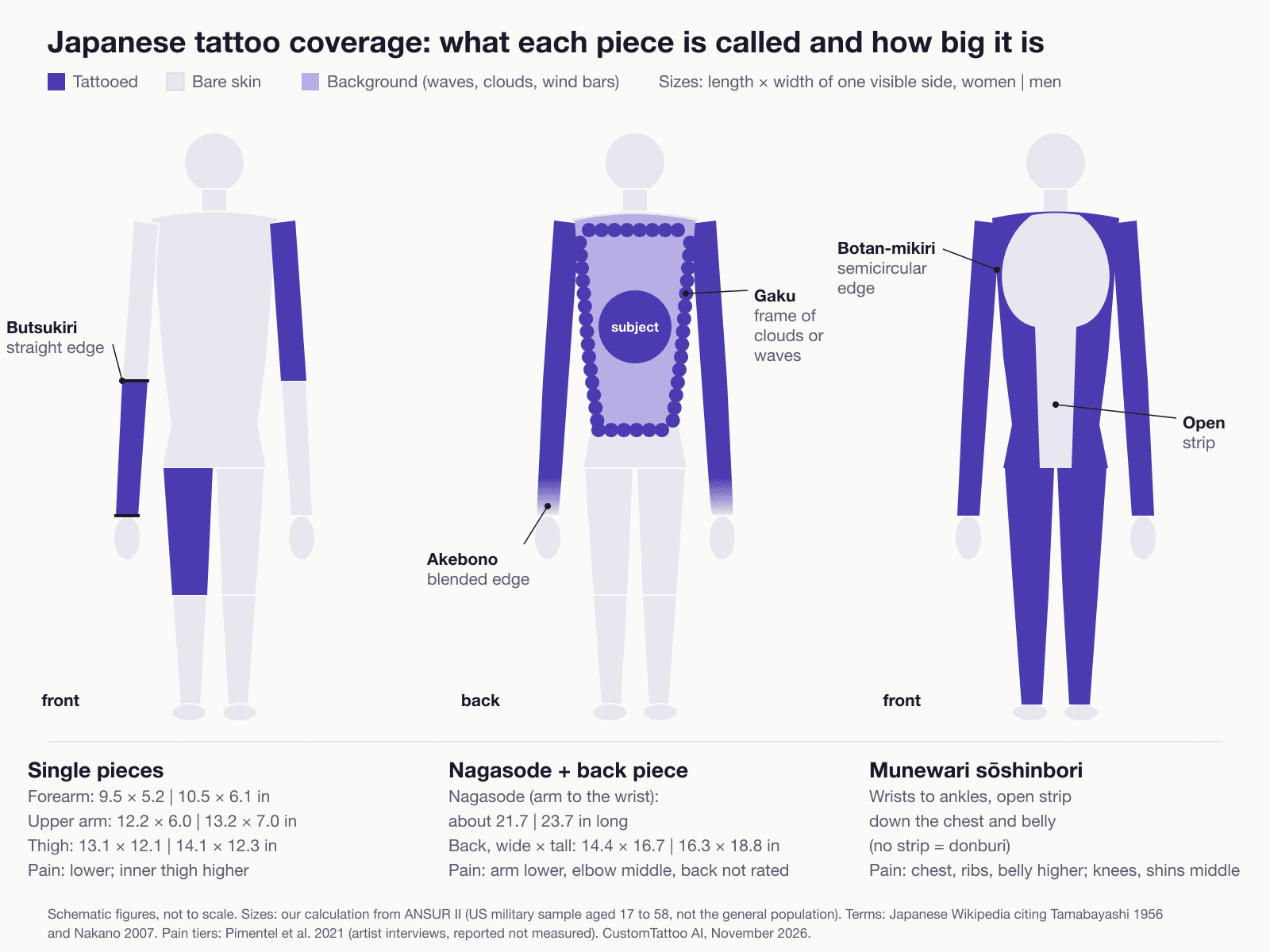
| Piece | Women (median) | Men (median) | Reported pain |
|---|---|---|---|
| Forearm piece (elbow to wrist, one side) | 9.5 × 5.2 in | 10.5 × 6.1 in | Lower |
| Upper-arm piece (shoulder to elbow, one side) | 12.2 × 6.0 in | 13.2 × 7.0 in | Lower |
| Nagasode, shoulder to wrist | about 21.7 in long | about 23.7 in long | Lower, elbow middle |
| Back piece (shoulder width × neck to waist) | 14.4 × 16.7 in | 16.3 × 18.8 in | Not rated |
| Thigh piece (crotch to knee, one side) | 13.1 × 12.1 in | 14.1 × 12.3 in | Outer lower, inner higher |
Widths are half the limb's circumference, roughly what you see from one side; a sleeve wraps all the way around, so it covers about twice that. To check a specific design on your own measurements, use the tattoo size calculator, and the sleeve placement guide to plan one.
Can a Japanese tattoo be small?
Yes, as a single motif. A koi, a peony, a wave or a small dragon can stand alone as a nuki-bori piece on the forearm, the shoulder or the calf. What a small piece loses is the background: there is little room for waves, clouds and wind bars to flow around the subject, and the style relies on bold, readable shapes rather than tiny detail. If you think you may extend it later, tell your artist, so the first piece is placed where a sleeve or a back piece can grow around it.
Black and grey or color Japanese tattoo?
Both have a history: traditional tattooers shaded with sumi ink and added color with Japanese painting pigments, later replaced by tattoo inks (Japanese Wikipedia, citing Tamabayashi 1956). Color pieces use bold outlines with flat fields of color, for example red koi and peonies against dark water. Black and grey pieces keep the same outlines and composition but shade everything in grey gradients, the bokashi described above, so the background reads as smoke or shadow. The choice is about the look you want and how it sits with your other tattoos; ask your artist for healed examples of both before deciding.
Does a Japanese sleeve or back piece hurt?
Large pieces cross areas with different reported pain. In interviews with tattoo artists and clients, Pimentel and colleagues (2021) placed the forearms, biceps and triceps, shoulders and outer thighs in the lower tier; the elbows, knees, shins and calves in the middle tier; and the chest, ribs, stomach, inner thighs and armpits in the higher tier. They did not rate the back and spine. A survey of 1,092 tattooed people found that body area stopped being a significant predictor of pain once session length, stress and bleeding were taken into account, which matters for big work done over long sessions. Our tattoo pain chart maps the full body, and tattoo healing stages covers aftercare between sessions. If anything about healing worries you, ask a doctor.
How long does a Japanese sleeve take and what does it cost?
A sleeve or back piece is done over several sessions: outlines first, then shading and color, with healing time in between. Japanese hand-tattooing even has its own unit of work: one hitohori covers roughly a fist-to-palm-sized area in about 45 minutes, and an old saying counts a full back as about a hundred of them (Japanese Wikipedia, citing Yamamoto 2016). That is a traditional tebori measure, not a quote for modern machine work. Most studios charge by the hour, so a large Japanese piece is priced by time and booked as a project; our tattoo cost guide compares hourly rates from 25 US studios.
Can you get a Japanese tattoo if you are not Japanese?
The style is practiced by artists around the world, so the real question is how, not who. What makes it respectful is knowing what you are wearing: learn where the motif comes from, avoid treating religious figures as decoration if you are unsure, and work with an artist experienced in Japanese tattooing, who will compose the piece for your body rather than copy a flash sheet.
Can you go to an onsen in Japan with tattoos?
Sometimes. Japan's national tourism organization explains that people with tattoos were traditionally banned from onsen because of the association of irezumi with crime, that more and more facilities now declare themselves tattoo-friendly, that some refuse tattoos even when covered with stickers, and that private baths (kashikiri buro) are an alternative (JNTO). Rules are set by each facility, so check before you go.
A related note: Japanese lettering or kanji is a different job from the Japanese style. If you want words in Japanese, have the text checked by a native speaker before it goes on skin.
How to plan a Japanese tattoo before you book
- Pick the main subject and decide what it should mean to you, using the table above as a starting point.
- Choose the area: a single forearm or shoulder piece, a sleeve, a back piece. The area decides how much background you get.
- Generate a few references with the AI tattoo generator, comparing subject and background combinations (koi with waves, dragon with clouds, tiger with wind bars).
- Preview the strongest one on your arm or back with the tattoo visualizer to judge scale.
- Bring the references to an artist who specializes in Japanese work. They will redraw it to flow with your muscles and plan the edges and sessions.
Related guides
Tattoo Styles Explained
The same rose drawn in eight styles, Japanese included.
Traditional Tattoos
Bold outlines and flat color from the American sailor tradition.
Blackwork Tattoos
Solid black designs and bold silhouettes.
Realism Tattoos
Photo-like shading in black and grey or color.
Sleeve Tattoos
Planning a half or full sleeve.
Thigh Tattoos
The largest canvas on the legs.
Samurai Tattoo Ideas
Samurai designs, a modern subject in Japanese-style work.
Spider Lily Tattoo Ideas
Red spider lily designs and where they fit.
Tattoo Size Guide
Body measurements and sizes drawn to scale.
First Tattoo Guide
What to decide before a first appointment.
Sources
- JAANUS, koi-no-takinobori (carp ascending a waterfall) · checked November 6, 2026
- JAANUS, ryuu (dragon) · checked November 6, 2026
- JAANUS, ryuuko-zu (dragon and tiger) · checked November 6, 2026
- JAANUS, karajishi (Chinese lion) · checked November 6, 2026
- JAANUS, Shishi (lion mask, noh play Shakkyō) · checked November 6, 2026
- JAANUS, hannya · checked November 6, 2026
- JAANUS, houou (phoenix) · checked November 6, 2026
- JAANUS, seigaiha · checked November 6, 2026
- Kyoto National Museum, The Peony: Flower of Wealth and Honor (2020) · checked November 6, 2026
- The Metropolitan Museum of Art, Utagawa Kunisada, Shi Jin the Nine Dragoned, 1854 (JP3359, public domain) · checked November 6, 2026
- Hyperallergic, Japan's Tattoo Art, in Classic Woodblock Prints (Edward M. Gómez, 2017) · checked November 6, 2026
- Wikipedia (Japanese), 日本の入れ墨 (Japanese tattooing) · checked November 6, 2026
- Wikipedia (Japanese), 刺青 (glossary: gaku, nuki-bori) · checked November 6, 2026
- Wikipedia (English), Irezumi · checked November 6, 2026
- Time Out Tokyo, Tattoo artists in Japan no longer need medical license to practise (2020) · checked November 6, 2026
- Japan National Tourism Organization, 7 tattoo-friendly onsen in Japan · checked November 6, 2026
- ANSUR II anthropometric survey (Penn State OpenLab) · checked November 6, 2026
- Pimentel et al. (2021), Frontiers in Virtual Reality, tattoo pain taxonomy · checked November 6, 2026
- Witkos and Hartman-Petrycka (2020), IJERPH, survey of 1,092 tattooed people · checked November 6, 2026
Japanese tattoo FAQ
What is a Japanese tattoo called?+
Irezumi, the Japanese word for tattoo, which literally means inserting ink. Japanese artists call the traditional style wabori, as opposed to yobori, Western-style tattooing. Horimono is an older word, and tebori means tattooing by hand with a bundle of needles on a handle.
Is Japanese tattoo style good for small tattoos?+
It works as a single motif, such as a koi, a peony, a wave or a small dragon on the forearm or shoulder. What a small piece loses is the background of waves, clouds and wind bars that gives the style its flow, which needs a larger area such as a sleeve, the back or a thigh.
What does a koi fish tattoo mean?+
A koi climbing a waterfall comes from the Chinese legend of a carp that becomes a dragon after swimming up a waterfall. In Japanese art it is read as a parable of effort and success, and it is linked to the carp streamers of Boys' Day.
What is a hannya mask tattoo?+
The hannya is a noh theater mask of a woman turned into a serpent-demon by jealousy and hatred, with horns, metallic eyes and fangs. People wear it for different reasons, so ask your artist how they would frame it.
Is tebori different from machine tattooing?+
Tebori is done by hand with a tool called nomi, a handle with a bundle of needles, instead of a tattoo machine. The design style can be the same either way, and many hand-poking artists still use a machine for some steps such as outlines.
Can you go to an onsen in Japan with tattoos?+
It depends on the facility. Japan's tourism organization says tattooed people were traditionally banned because of irezumi's association with crime, that more onsen now declare themselves tattoo-friendly, that some refuse tattoos even when covered, and that private baths are an alternative. Check the rules before you go.
Tattoo planning tool
Generate a japanese tattoo reference
Describe your idea, generate it in any style, and preview it on your own skin before the needle.
Generate for freeFree to start
Explore more tattoo styles
- Geometric TattoosSymmetry, sacred geometry, clean lines and measured spacing.
- Realism TattoosDetailed black and grey or color designs with lifelike shading.
- Watercolor TattoosSoft color washes, painterly edges and expressive splashes.
- Script TattoosNames, dates, quotes and lettering designed for readability.