
Vegvisir Tattoo: Meaning, Real Origin and Design Ideas
A vegvisir tattoo uses the Icelandic “wayfinder” stave: eight lines crossing at one point, each ending in its own small glyph. Its earliest known source is the Huld manuscript, compiled by Geir Vigfússon in Akureyri, Iceland, in 1860, which says the bearer will not lose their way in storms or bad weather. It is often sold as a Viking compass, but nothing ties it to the Viking Age, which ended some 800 years earlier.
10+ Vegvisir tattoo designs
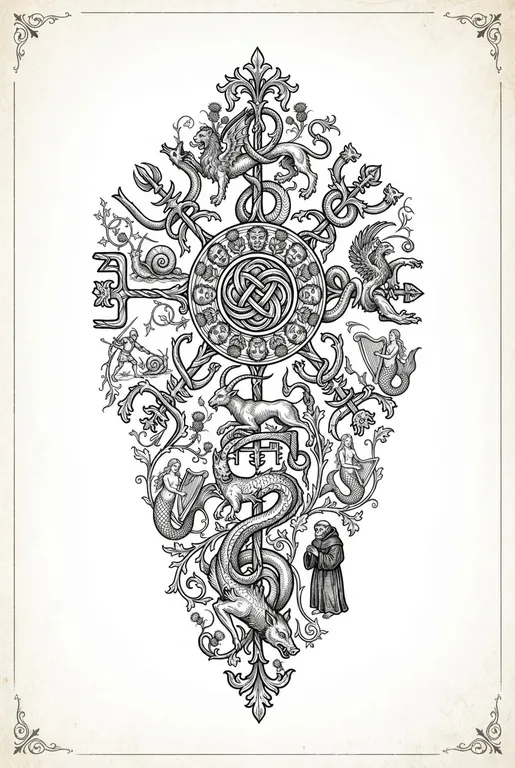
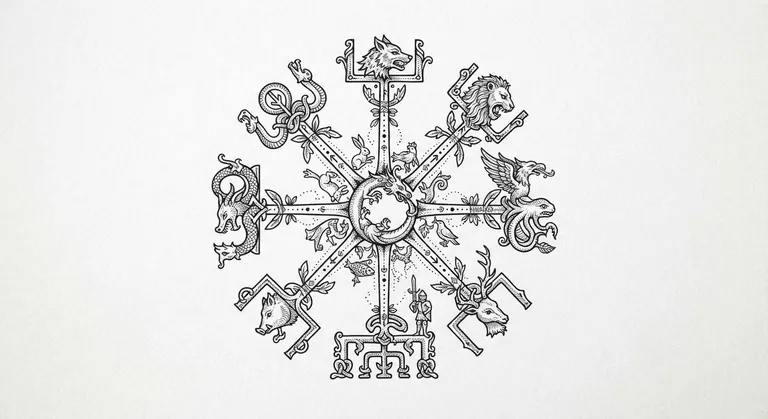
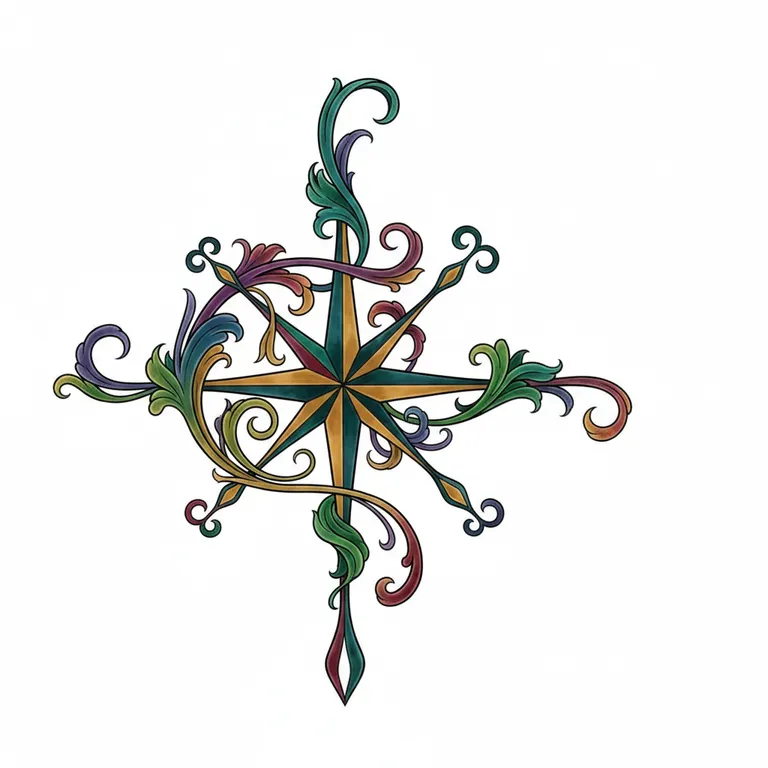
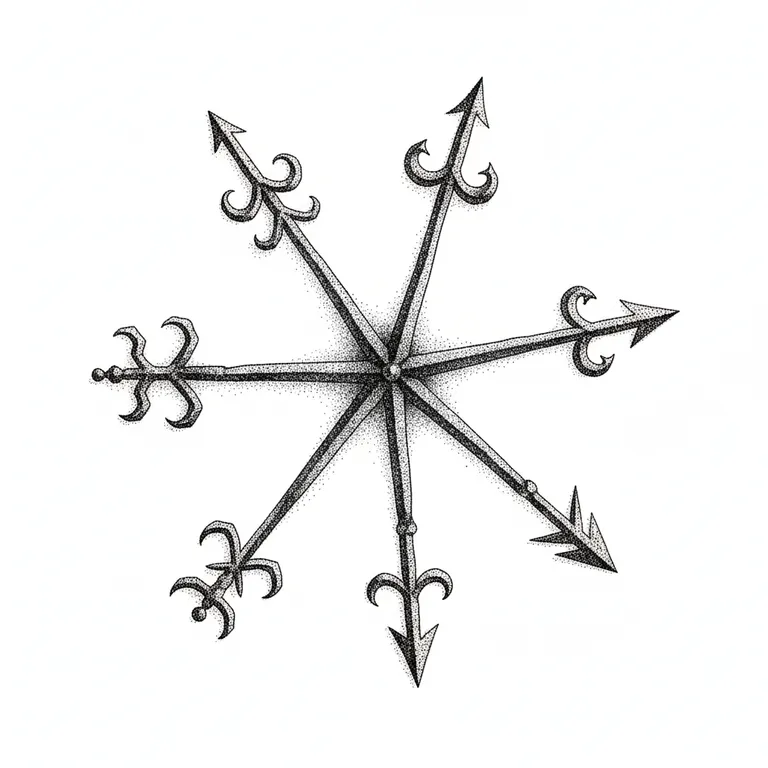
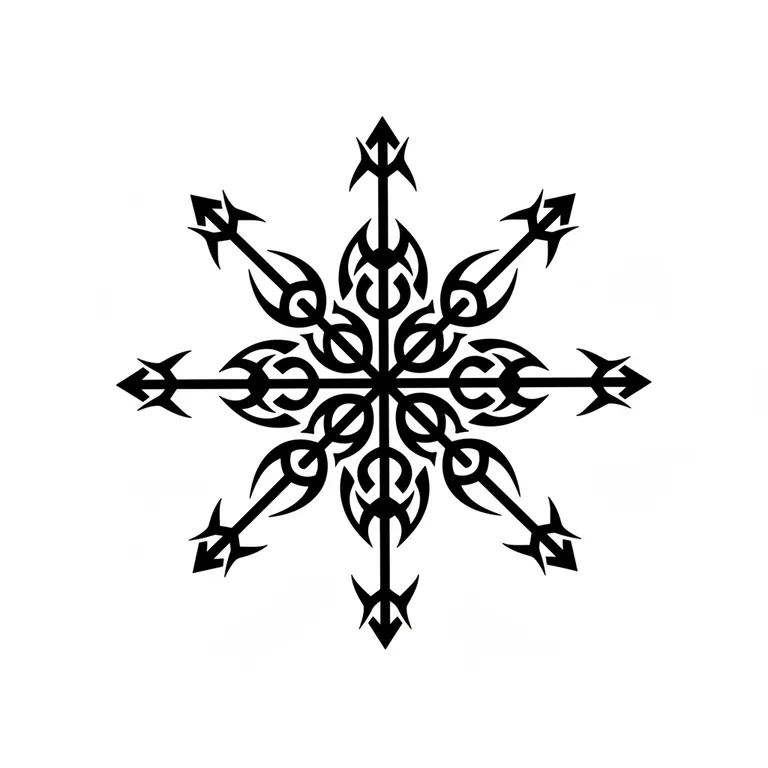
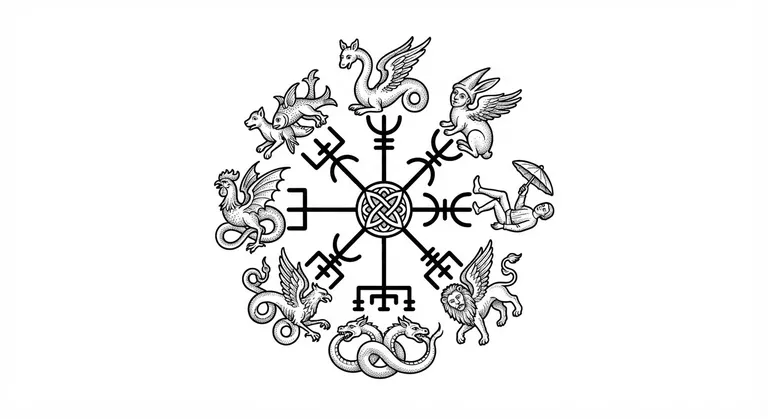
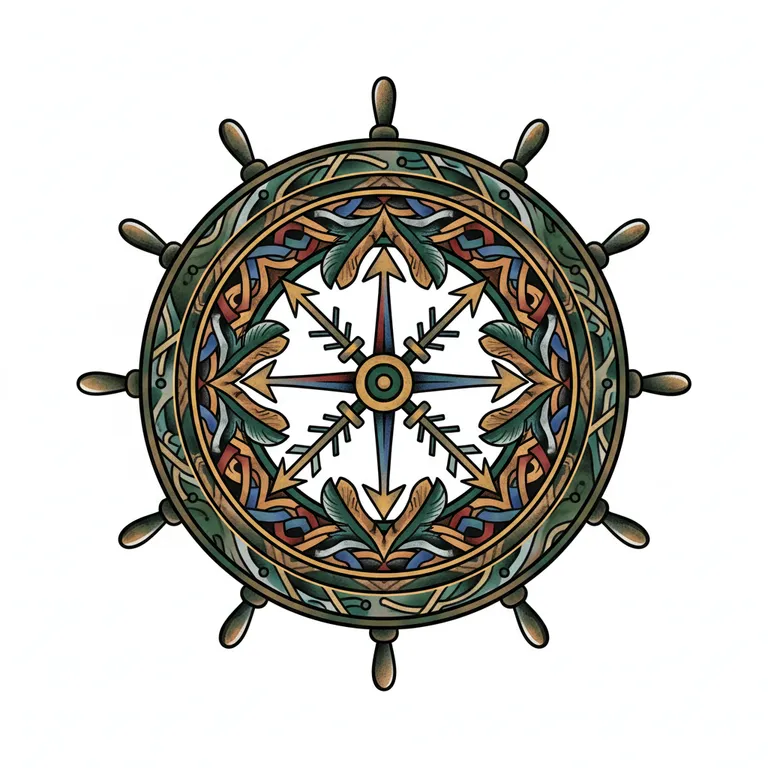
AI-generated vegvisir tattoo designs across popular styles. Tap any one to generate your own version and preview it on your skin.
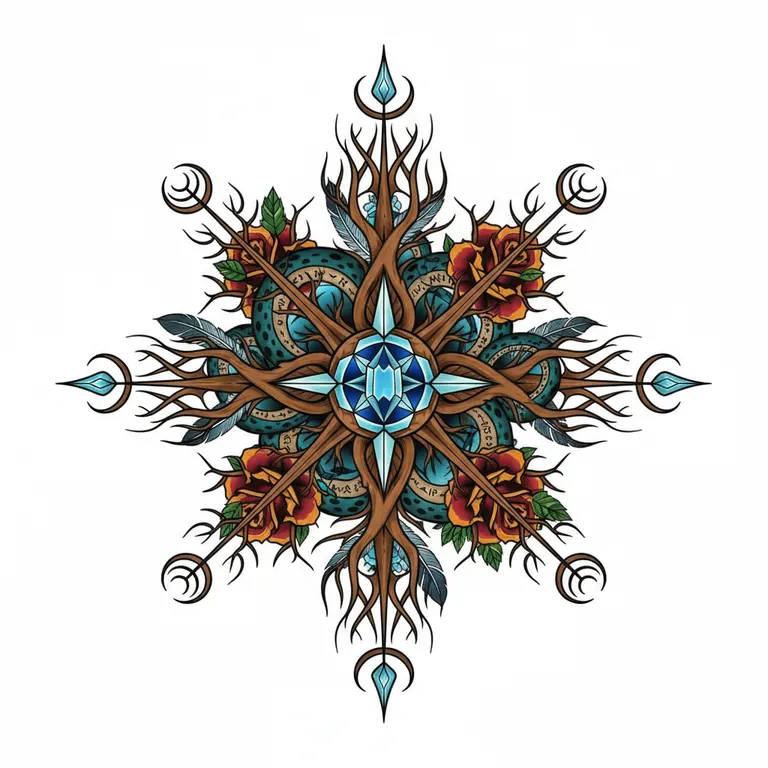
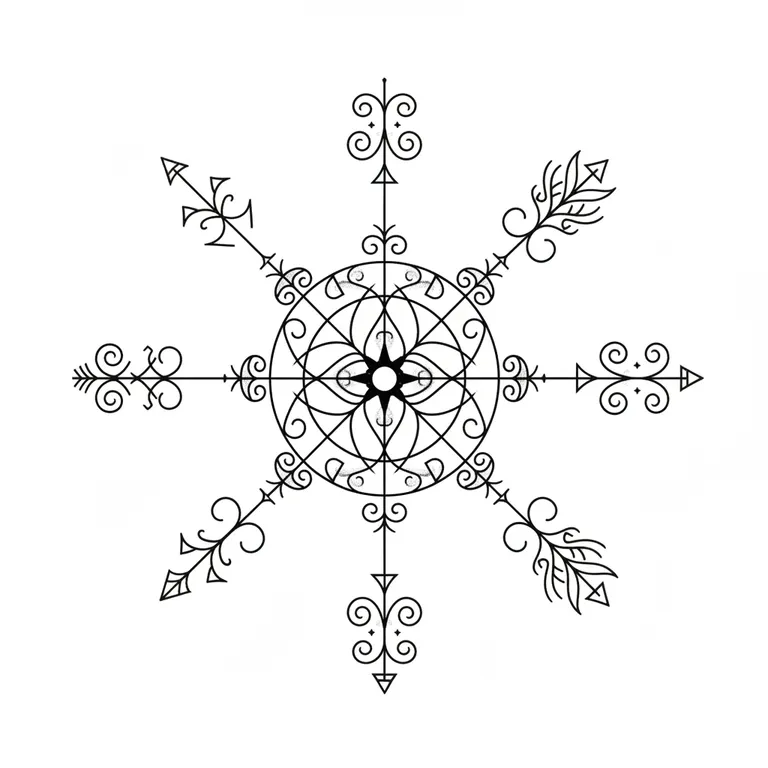


TL;DR
- •Meaning: a magical stave to carry so you don't get lost in storms or bad weather. As a tattoo it is commonly read as direction and guidance in life, a modern interpretation.
- •Age: first recorded in 1860, in an Icelandic manuscript. No Viking-Age runestone, object or saga shows it.
- •Original form: eight arms, each ending in a different glyph. No enclosing circle, no ring of runes; those are 20th-century additions.
- •Offensive? It is not on the ADL's hate-symbol list. Keep it distinct from Helm of Awe hybrids and from the Norse symbols that are on that list.
- •Size: the end-glyphs set the minimum. A 1.5-inch version fits near the wrist; 3 inches sits comfortably on one side of a forearm.
What does a vegvisir tattoo mean?
The meaning comes from one line of text. On page 60 of the Huld manuscript, under the sign and its name, the compiler wrote in Icelandic: Beri maður stafi þessa á sér villist maður ekki í hríðum né vondu veðri þó ókunnugur sé. In plain English: carry these staves and you will not lose your way in storms or bad weather, even where you do not know the way (translation based on Wikipedia and Tomáš Vlasatý). The vegvisir belongs to the Icelandic magical staves, or galdrastafir: signs that were carried, carved or drawn for a specific effect, from finding a thief to protecting livestock (Wikipedia).
The name says the same thing. Vegvísir joins vegur, “way, road”, and vísir, “one that shows”, so it means “wayfinder”, literally “way shower” (Wiktionary). In modern Icelandic the word also means a road sign. The same compound exists in Danish vejviser, Swedish vägvisare and German Wegweiser, all meaning a signpost or guide (Wikipedia).
As a tattoo, the vegvisir usually stands for finding your direction: getting through a hard period, a move, a recovery, or simply not losing yourself. That is a common modern interpretation, not something the manuscripts say. The 1860 text is practical: it is about getting home through bad weather. Both readings are honest, as long as you know which one is history and which one is yours.
Is the vegvisir a Viking symbol?
No. The Viking Age ran from about 800 to 1050 (Wikipedia), and the vegvisir first appears in 1860. No runestone, piece of jewelry or saga shows it (Skjalden). Wikipedia notes that it is often “erroneously called a Viking compass” (Vegvísir), and the researcher Tomáš Vlasatý concludes that, given the 800-year gap, it should not be connected to the Viking Age at all (Project Forlǫg). Life in Norway and Guide to Iceland, two sites that cover Nordic history for a general audience, say the same (Life in Norway; Guide to Iceland).
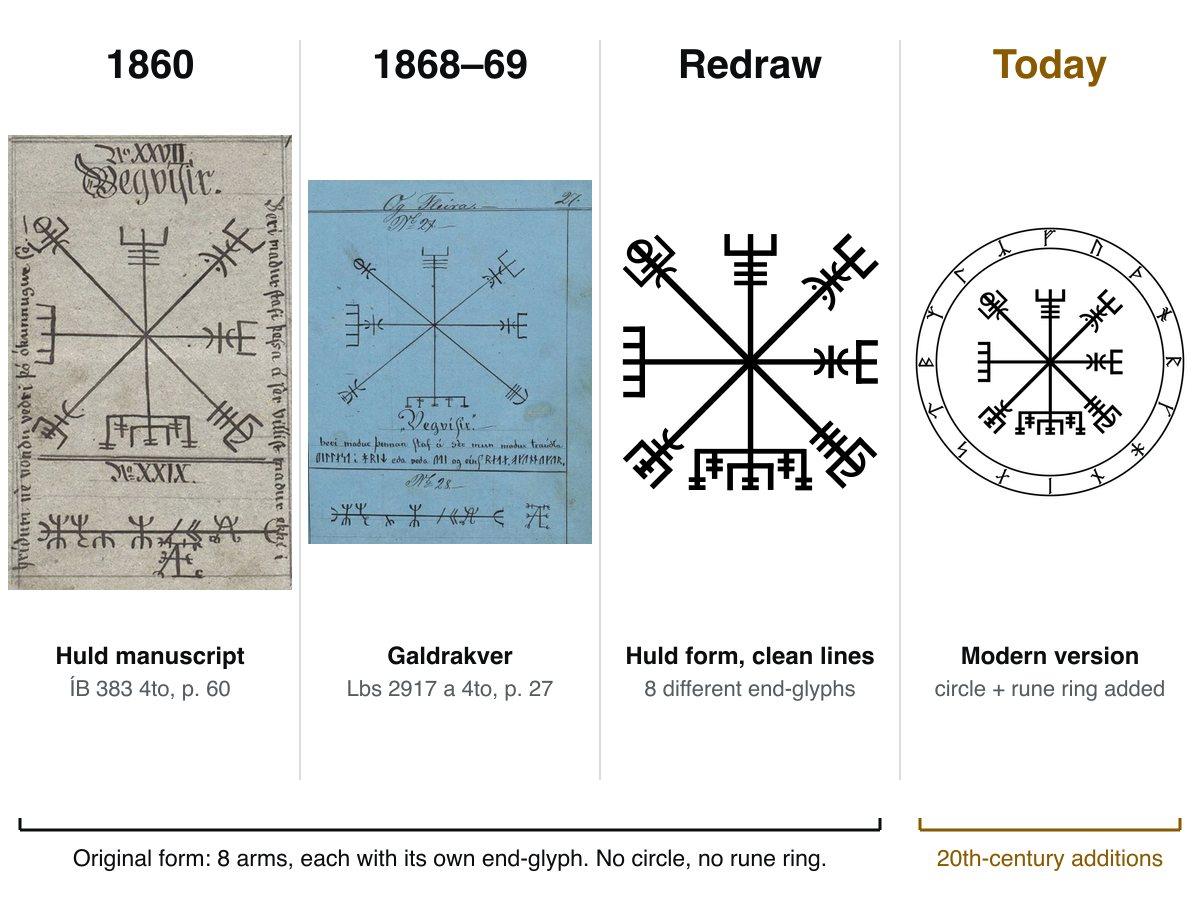
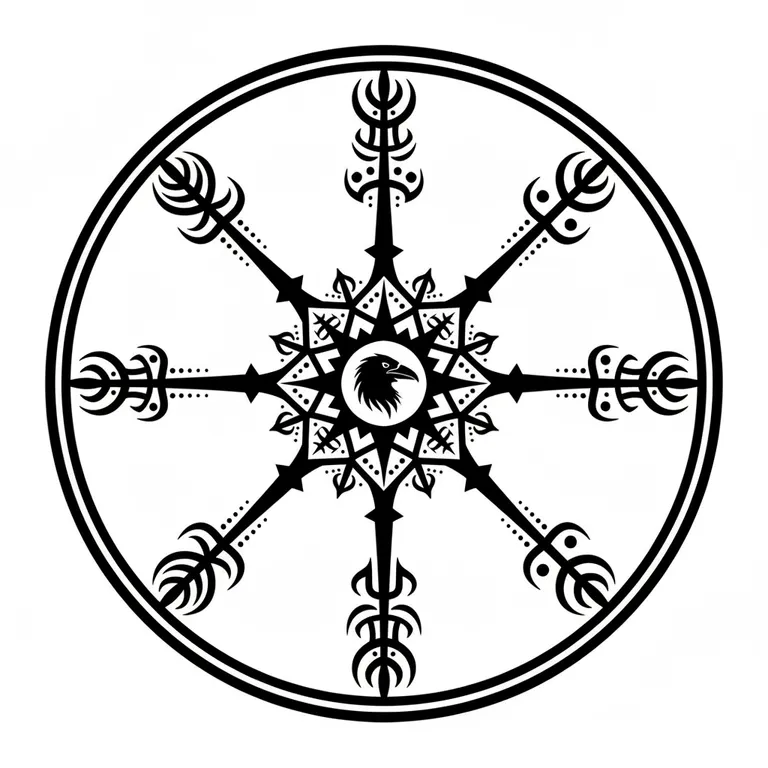
The three left panels share the same structure: eight arms, a different glyph at the end of each, and nothing around them. The right panel is what most shops sell as a vegvisir today. The circle and the rune ring are later additions, which is why the original looks oddly “squarish” next to it. Here is how the sign got from a notebook in northern Iceland to forearms everywhere.
| Date | What happened | Source |
|---|---|---|
| About 800–1050 | The Viking Age. No vegvisir on any runestone, object or saga | Wikipedia; Skjalden |
| 1860 | Huld manuscript (ÍB 383 4to), compiled by Geir Vigfússon in Akureyri: earliest known vegvisir, p. 60 | Wikipedia; de.wikipedia |
| 1868–69 | Galdrakver (Lbs 2917 a 4to) by Olgeir Geirsson, also in Akureyri: the same sign on p. 27 | Vlasatý |
| 19th century | A second Galdrakver (Lbs 4627 8vo), from the same area, ties the sign to Christian faith | Vlasatý |
| 1903 | Ólafur Davíðsson publishes Icelandic magical signs, most likely including the vegvisir, in a German folklore journal | Vlasatý; de.wikipedia |
| 1940 | Jochum M. Eggertsson prints it again in Galdraskræða Skugga | Vlasatý |
| 1982 | Björk gets a vegvisir tattoo | Vlasatý |
| 1989 | Stephen Flowers' English book The Galdrabók includes it, which spread the idea that it comes from the Galdrabók grimoire | Vlasatý; Wikipedia |
| 20th century onward | Circular versions, often with a rune ring, become the common form | Vlasatý |
What did the original vegvisir look like?
In both 19th-century drawings, eight straight lines cross at one point and each line ends in a different cluster of strokes: forks, crossbars, hooks and small curves. Vlasatý describes the originals as square in shape, without any runes around them, and dates the circular variants to the 20th century (Project Forlǫg). The Huld page also shows a second, quite different vegvisir under the first one (no. XXIX): a single horizontal line with glyphs along it. The 1868–69 manuscript has the same pair, numbered 27 and 28 (Wikimedia Commons).
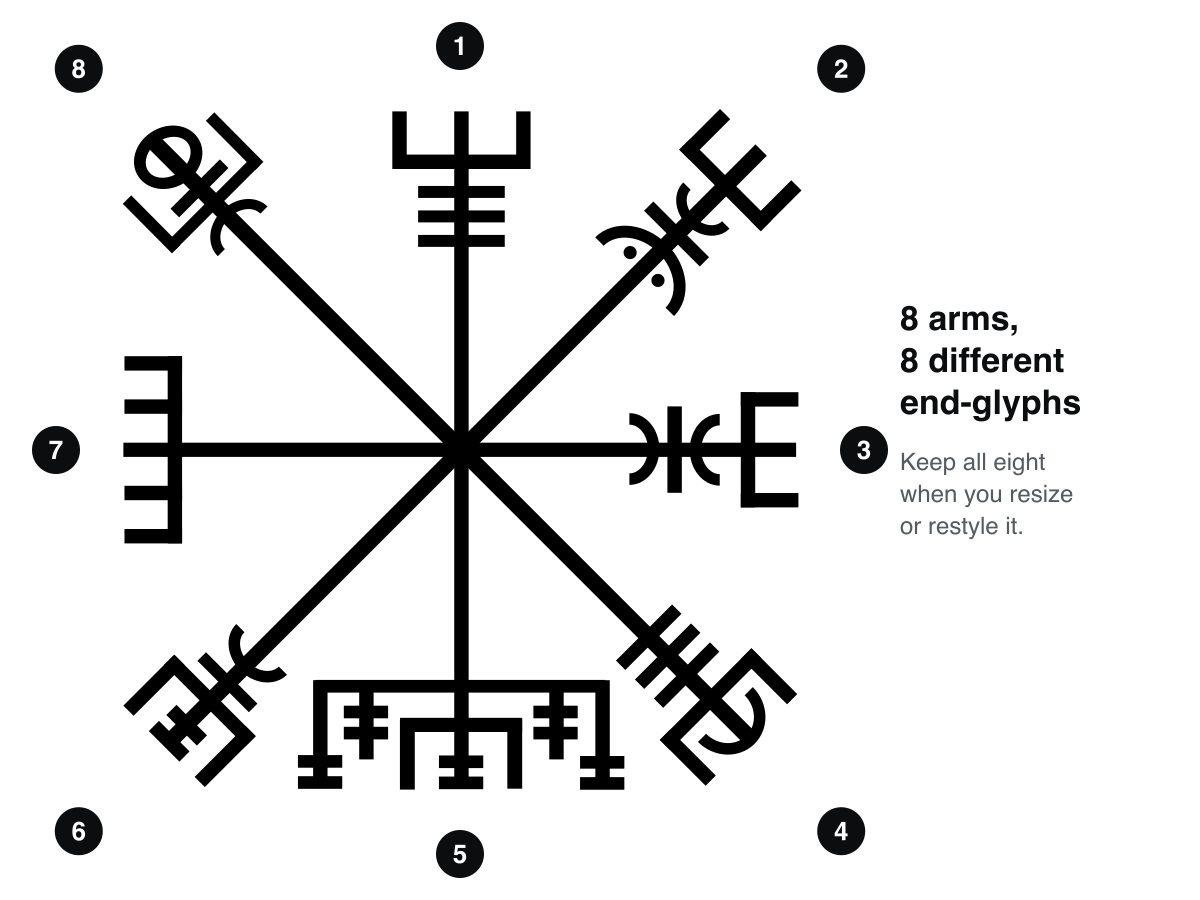
You will often read that the eight arms point to the eight directions of a compass, or that each glyph has its own meaning. None of the sources we checked says so, and the manuscripts give no meaning for the individual glyphs. What modern designs add is easy to list: an enclosing circle, a ring of Younger Futhark runes, and sometimes a tree (Yggdrasil), a raven or a wolf in the middle. Those can look great. They are just not part of the 1860 sign.
Is the vegvisir Christian or pagan?
The manuscripts were written in a Christian Iceland, and one of them says so. The note next to the vegvisir in Lbs 4627 8vo, as translated by Vlasatý, tells the reader to keep the sign under the left arm to avoid getting lost, and makes it work only “if you believe in God in the name of Jesus” (Project Forlǫg). Vlasatý goes further and argues that star-shaped signs like this reached Iceland from continental and English magic books in the tradition of “Solomon's” seals, citing a 15th-century English manuscript (Harley MS 5596). That is his interpretation, not a settled fact. It fits the broader picture, though: Wikipedia's article on the Ægishjálmur, citing Bauer and Pesch, says Icelandic magical symbols were inspired by medieval Latin magic texts such as the Clavis Salomonis (Wikipedia). The vegvisir is folk magic from Christian Iceland, not a relic of Norse religion.
Vegvisir vs Helm of Awe (Ægishjálmur): what's the difference?
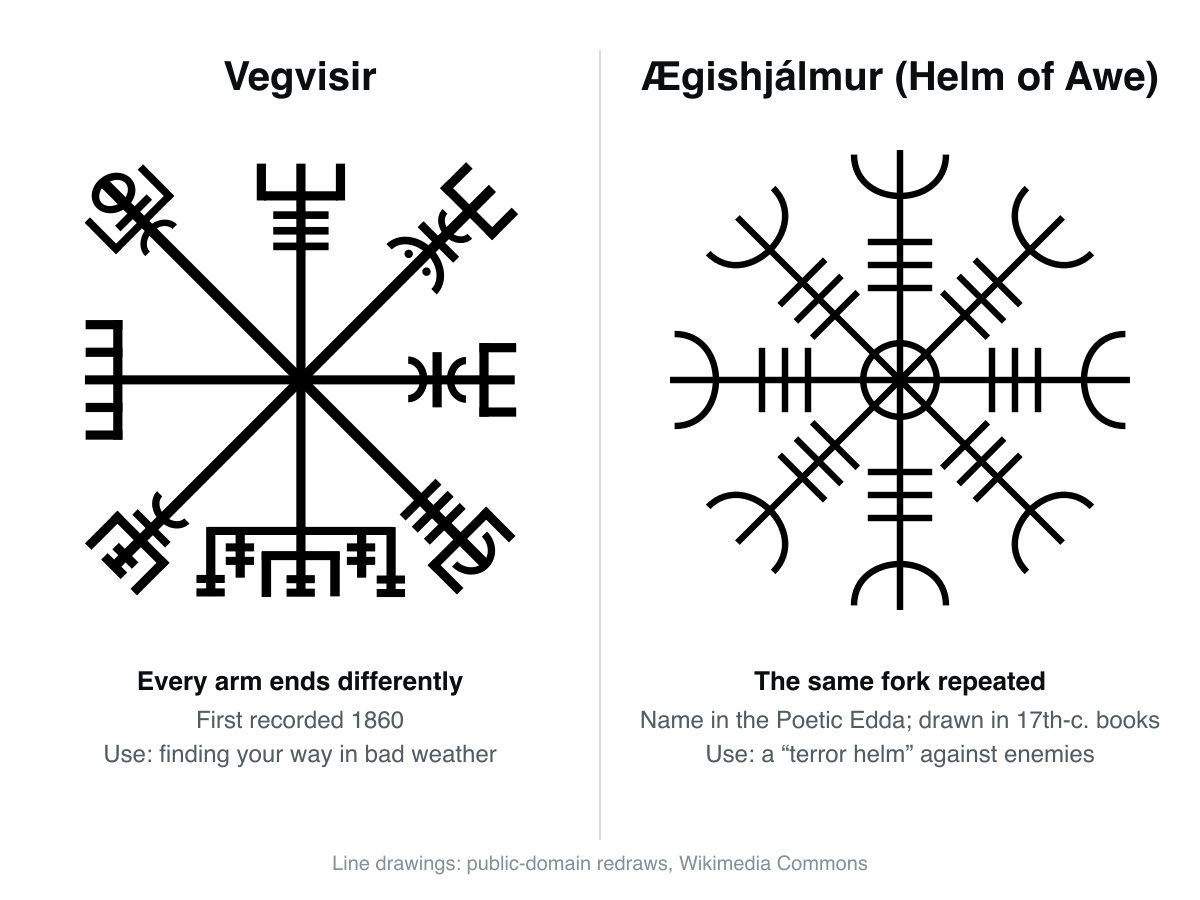
| Vegvisir | Ægishjálmur (Helm of Awe) | |
|---|---|---|
| Name | “Wayfinder” | “Helm of awe” or “terror helm” |
| Earliest record | Huld manuscript, 1860 | The name: the Old Norse poem Fáfnismál, as a helmet (Guide to Iceland). The sign: Icelandic magic books from about 1550–1670 (Wikipedia) |
| Stated use | Carry it so you don't get lost in bad weather | In a Galdrakver from about 1670: press it on your forehead when you expect enemies |
| Shape | Eight arms, every end-glyph different | Arms usually repeat the same fork and crossbars, often around a small circle |
| Short version | Guides | Guards |
Guide to Iceland sums it up as “one guides, the other guards” (Guide to Iceland). Both are eight-armed, both come from Icelandic magic books, and both are marketed as Viking, so they get mixed up. Wikipedia notes that designs combining features of both exist (Wikipedia). The quick test: if every arm ends in the same trident or fork, you are looking at a Helm of Awe, or a hybrid, not a vegvisir.
Is a vegvisir tattoo offensive?
On its own, it is generally not treated as a hate symbol. The vegvisir does not appear on the Anti-Defamation League's hate-symbol list as compiled on Wikipedia, and Scandification describes it as not directly associated with hate groups, while noting a debate about appropriation and commercialization of Norse symbols (Scandification). Researchers Alessia Bauer and Alexandra Pesch, cited on Wikipedia, found in 2023 that the vegvisir is rarely used by radical right-wing groups (Wikipedia).
The context around it matters more. Several Norse signs are on the ADL list, including the Odal rune, the valknut, the Tyr rune, the Wolfsangel, the Black Sun and Thor's hammer in racist use, and the list itself notes that some have ordinary religious uses too (Wikipedia). The same Bauer and Pesch research found the Ægishjálmur more popular in those circles than the vegvisir, with star shapes ending in trident-like forks used by right-wing extremists, and an Ægishjálmur-like sign influenced the logo of the Swedish neo-Nazi party Svenskarnas parti (Wikipedia). So a clean vegvisir with its eight different end-glyphs is the safest version. If you want runes or other symbols around it, check what they are, and ask your artist if you are unsure.
Why does Björk have a vegvisir tattoo?
According to Vlasatý, the Icelandic singer had the vegvisir tattooed in 1982, and from the 1990s described it as an ancient Viking sign that seafarers drew on their foreheads to find their way (Project Forlǫg). None of the 19th-century manuscripts says anything like that, and the forehead detail is closer to what a 17th-century Galdrakver says about the Helm of Awe. Guide to Iceland credits her arm tattoo with bringing these staves international attention (Guide to Iceland), and Wikipedia pictures her with it (Wikipedia). Her tattoo helped make the vegvisir popular, and with it the Viking label.
Where should a vegvisir tattoo go, and how big?
A vegvisir is roughly square, so it needs about as much width as height. That makes the width of the body part the real limit. These figures are median body measurements from ANSUR II, the US Army's 2012 body survey of 1,986 women and 4,082 men, as published in our tattoo size guide: room on one side of each area, women then men. Pain tiers come from our tattoo pain chart.
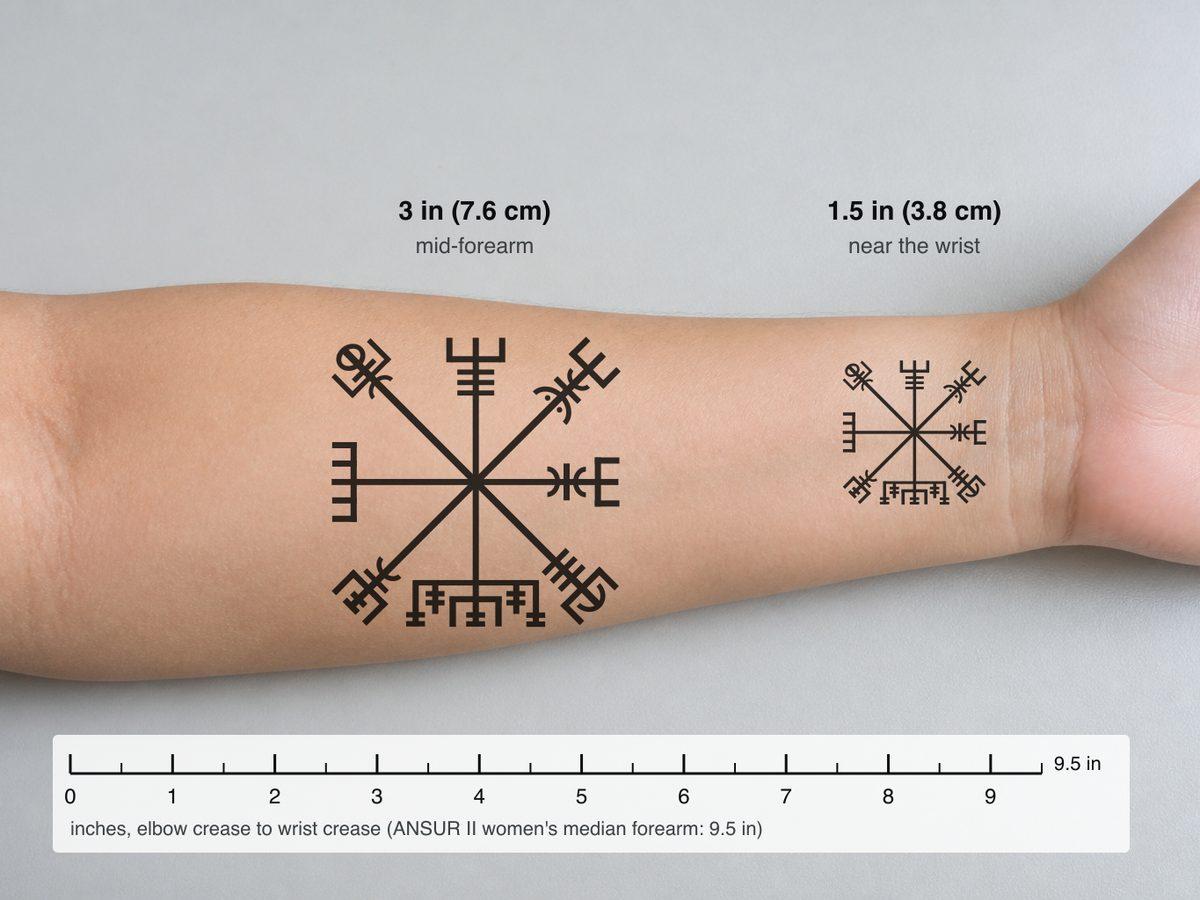
| Placement | Room on one side (women / men) | Pain tier | Vegvisir that fits |
|---|---|---|---|
| Wrist | 3.0 / 3.5 in across | Not rated | About 1 to 1.5 in |
| Back of the hand | About 3.1 / 3.5 in wide | Middle | Up to about 2.5 in |
| Forearm | 9.5 × 5.2 / 10.5 × 6.1 in | Lower | 2 to 4 in; wider starts to wrap |
| Upper arm and shoulder | 12.2 × 6.0 / 13.2 × 7.0 in | Lower | Up to about 5 or 6 in |
| Chest | Not in our measurement set | Higher | Centered on the sternum or over one side |
| Upper back | 14.4 × 16.7 / 16.3 × 18.8 in (whole back) | Not rated | Room for a large centerpiece |
The sizes in the last column are our arithmetic: a square design a bit narrower than the room on one side. ANSUR II measured military personnel aged 17 to 58, not the general population, so measure your own arm before you settle on a size. On pain, the tiers are what artists report, not measurements, and in a survey of 1,092 tattooed people the body area mattered less than session length, stress and bleeding.
How small can a vegvisir tattoo be?
The limit is the smallest end-glyph, not the overall size. In the clean redraw, the gaps between the crossbars on arm 1 are under 2% of the symbol's width (our measurement). At 1.5 inches, that is less than a millimeter of bare skin between lines, which is why tiny versions are often simplified. Our size guide gives the rule artists use: check the smallest important detail at the final size, simplify before you shrink, and ask your artist what minimum size they would tattoo this design at. There is no fixed number. To try sizes, use the tattoo size calculator.
How do I get an accurate vegvisir design?
- Start from the manuscript drawing, or a clean redraw of it, not from a random flash sheet.
- Count the end-glyphs. There should be eight, all different. Identical tridents on every arm make it a Helm of Awe.
- Choose the 1860 form or the modern one (circle, rune ring, or both) and say which in your brief.
- Check anything added around it: rune rings, ravens, wolves or knots. Know what each element is.
- Watch out for compass roses. Generators and flash sheets often swap in N/E/S/W arrows. A vegvisir has no cardinal points.
- Bring the reference image to your artist, and prepare clean linework with the tattoo stencil maker if you want a printable stencil.
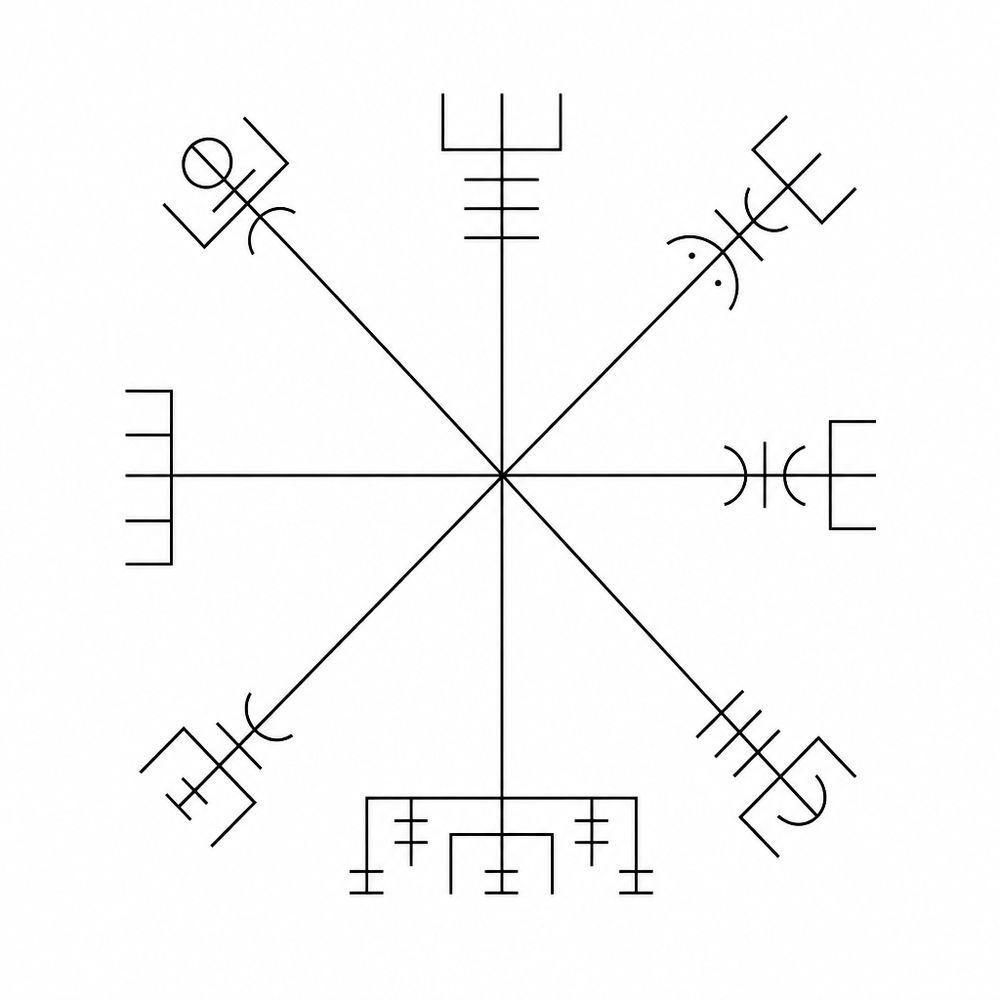 Fine line, 1860 form (AI-generated)
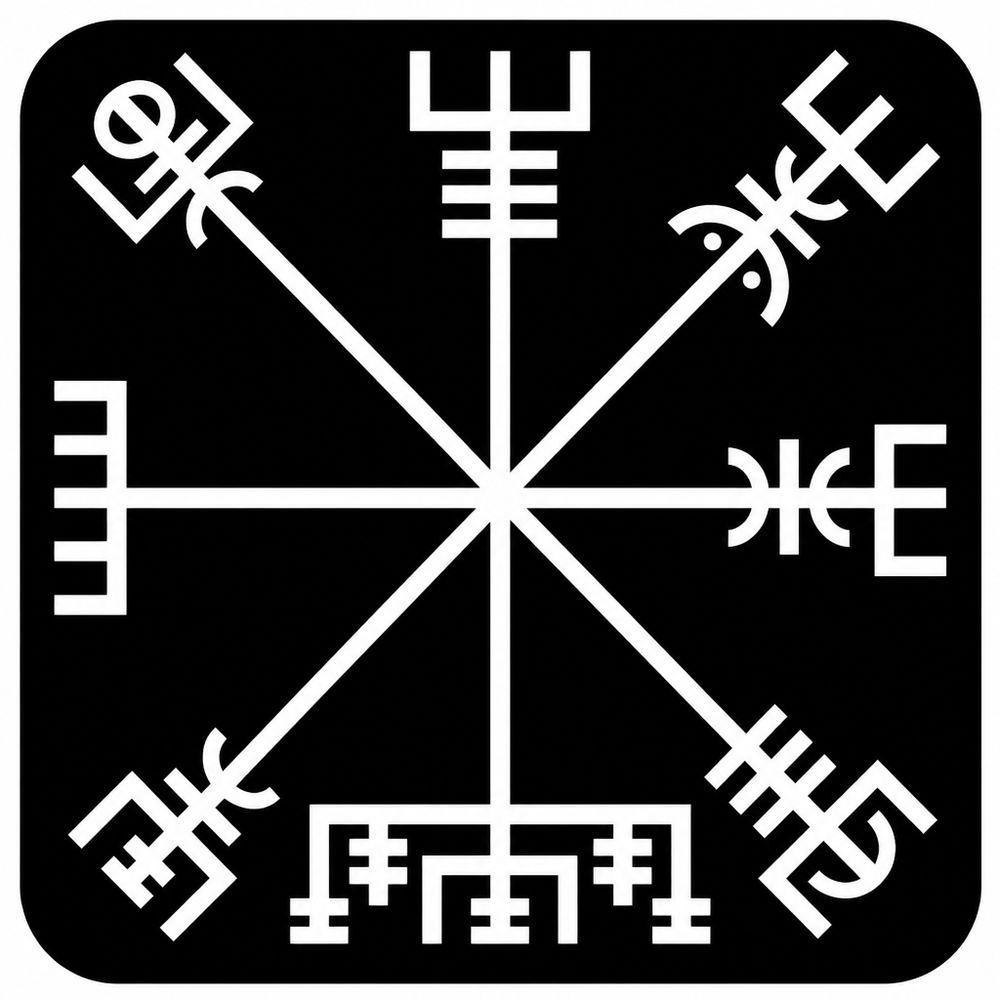 Blackwork, negative space (AI-generated)
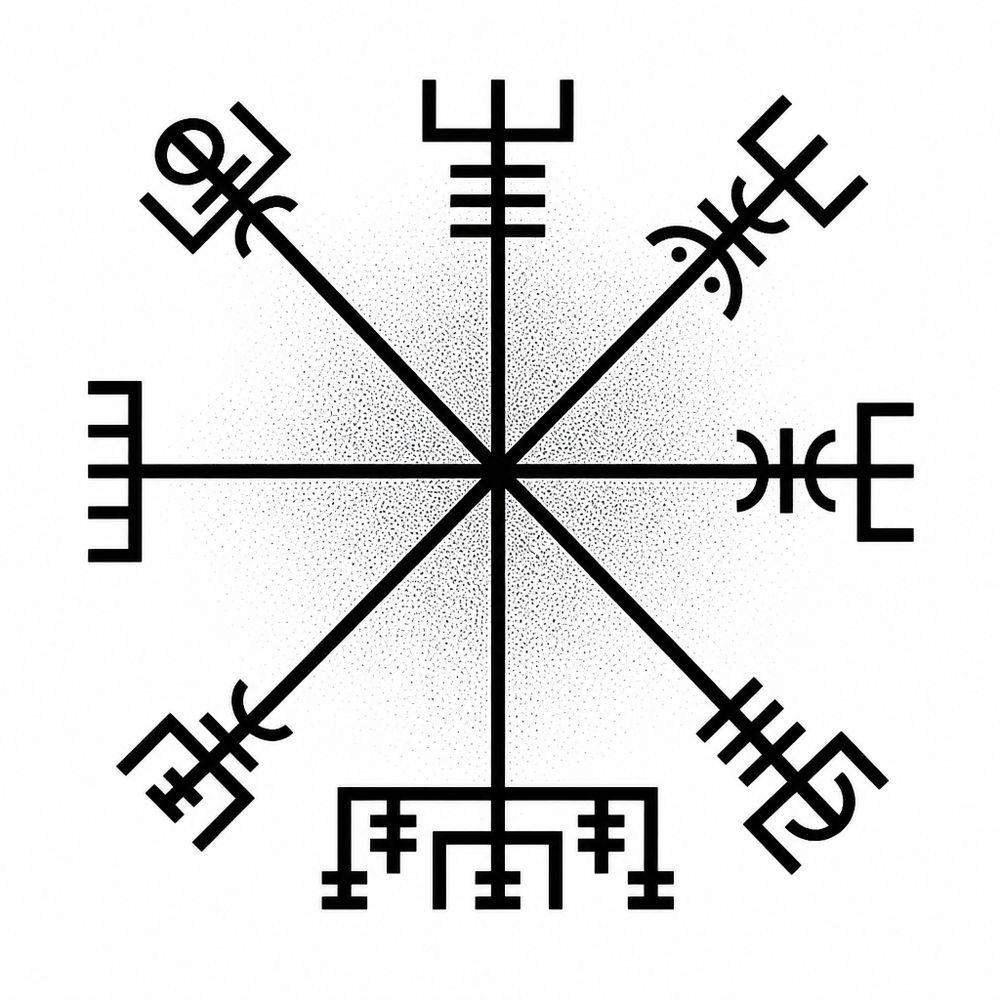 Dotwork shading (AI-generated)
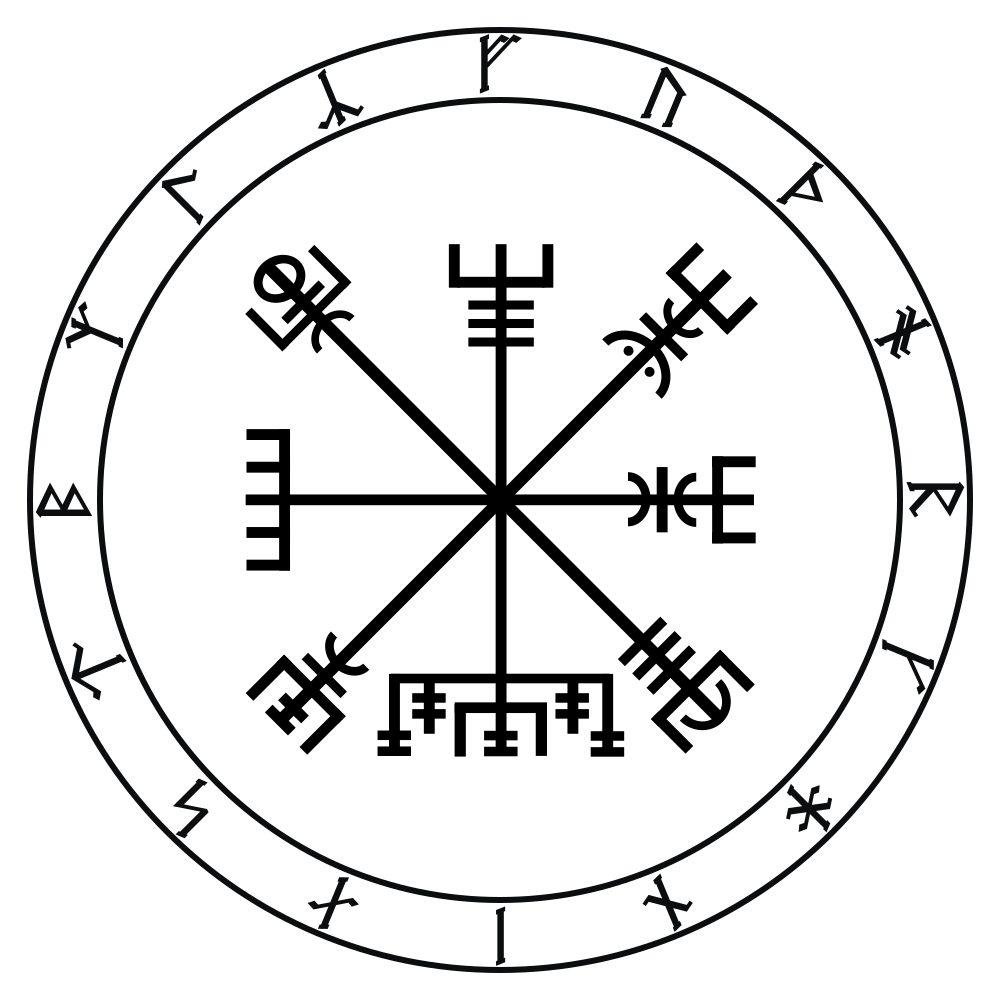 Modern circle and rune ring (drawn by us)
Fine line keeps the thin, pen-drawn look of the manuscripts and suits a wrist or forearm; heavy blackwork reads from further away and suits a larger piece on the shoulder or back. See the fine line style guide for how thin lines age.
Vegvisir with Yggdrasil or ravens: what do the combinations mean?
Neither manuscript pairs the vegvisir with a tree, a raven or a wolf. These are modern combinations, so the meaning is the one you give them: one modern pairing sets the vegvisir over Yggdrasil, the world tree of Norse mythology, to join direction with roots or family. If you combine them, keep the vegvisir's arms long enough that the eight end-glyphs stay clear of the central image.
Price depends on size, detail and your studio more than on the subject; the tattoo cost guide compares real studio minimums and hourly rates. Aftercare is the same as for any tattoo; the tattoo healing stages guide shows what to expect week by week.
Related ideas and guides
Yggdrasil Tattoo Ideas
The world tree of Norse mythology, often combined with a vegvisir.
Fenrir Tattoo Ideas
The bound wolf of Norse myth, in chains or breaking free.
Wolf Tattoo Ideas
Wolf designs from realism to blackwork.
Blackwork
Solid black, high-contrast designs that read from a distance.
Fine Line
Thin, delicate lines, closest to the manuscript drawings.
Forearm Tattoo Placement
How much room the forearm has, how it hurts and how it ages.
Tattoo Size Guide
Real body measurements and to-scale previews.
Sources
- Wikipedia: Vegvísir · checked November 6, 2026
- Tomáš Vlasatý, “Origins of the vegvísir symbol”, Project Forlǫg (2019) · checked November 6, 2026
- Wikimedia Commons: Huld manuscript, page 60 (1860), public domain · checked November 6, 2026
- Wikimedia Commons: Galdrakver by Olgeir Geirsson, page 27 (1868–69), public domain · checked November 6, 2026
- Wikimedia Commons: Vegvisir.svg (redraw of the Huld form), public domain · checked November 6, 2026
- Wikimedia Commons: Aegishjalmr.svg, public domain · checked November 6, 2026
- Wikipedia (German): Huld-Manuskript · checked November 6, 2026
- Wiktionary: vegvísir · checked November 6, 2026
- Wikipedia: Icelandic magical staves · checked November 6, 2026
- Wikipedia: Ægishjálmur (occult symbol), citing Bauer and Pesch (2023) · checked November 6, 2026
- Wikipedia: List of symbols designated by the ADL as hate symbols · checked November 6, 2026
- Scandification, “Norse Tattoos To Avoid” (Rebekah Carter) · checked November 6, 2026
- Guide to Iceland, “Vegvisir vs Aegishjalmur” (Hlín Eyjólfsdóttir, updated July 20, 2026) · checked November 6, 2026
- Skjalden, “Vegvisir Symbol Origin Facts and Sources” · checked November 6, 2026
- Life in Norway, “Vegvísir: The Truth of the Viking Compass” (Jess Scott) · checked November 6, 2026
- Wikipedia: Viking Age · checked November 6, 2026
- ANSUR II, OPEN Design Lab, Penn State · checked November 6, 2026
Vegvisir tattoo FAQ
What does vegvisir mean in English?+
“Wayfinder”, literally “way shower”: Icelandic vegur (way) plus vísir (one that shows). In modern Icelandic the word also means a road sign.
How old is the vegvisir?+
Its earliest known appearance is the Huld manuscript, compiled in Akureyri, Iceland, in 1860. Two more 19th-century Icelandic manuscripts show it. Nothing earlier is known, so it is about 800 years younger than the Viking Age.
Is the vegvisir in the Galdrabók?+
No. The Galdrabók is an older Icelandic grimoire. The vegvisir was linked to it through Stephen Flowers' 1989 English book, which spread the misattribution; the sign itself comes from 19th-century manuscripts.
Is a vegvisir tattoo offensive?+
On its own it is not on the ADL's hate-symbol list, and research cited on Wikipedia found it rarely used by far-right groups. Avoid hybrids with the Helm of Awe and pairings with listed symbols such as the Odal rune or the valknut, and ask your artist if unsure.
Do the runes around a vegvisir mean anything?+
The rune ring is a modern addition; the 1860 drawing has none. The manuscripts do use runic script in their captions, but not in a ring. Some modern rings simply list a runic alphabet in order, which spells nothing, so check any runes before you get them tattooed.
What's the difference between a vegvisir and a compass tattoo?+
A compass or compass rose has cardinal points (N, E, S, W) and arrow tips. A vegvisir has eight plain arms, each ending in a different magical glyph, and no directions. It is a 19th-century Icelandic charm, not a navigation tool.
Tattoo planning tool
Design your own Vegvisir tattoo
Describe your idea, generate it in any style, and preview it on your own skin before the needle.
Generate for freeFree to start
Explore more tattoo ideas
- Laugh Now Cry Later Tattoo IdeasA laugh now cry later tattoo uses the two theatre masks, one smiling and one crying, to capture a life philosophy: enjoy the moment now and deal with the consequences later.
- 999 Tattoo IdeasA 999 tattoo wears the number that flips 666 into something positive, made famous by Juice WRLD as turning pain and negativity into strength.
- Honeycomb Tattoo IdeasA honeycomb tattoo uses the bee's hexagonal pattern as a symbol of teamwork, hard work and community.
- Tutto Passa Tattoo IdeasA tutto passa tattoo wears the Italian phrase meaning 'everything passes', a quiet reminder that hard times are temporary.