
Laugh Now Cry Later Tattoo: Meaning, History and Design Ideas
A laugh now cry later tattoo shows two faces side by side, one laughing and one crying, usually the comedy and tragedy masks of the theatre. It is most often read as "enjoy life now, pay for it later", or as keeping a smile in public while the grief stays private. The masks go back to ancient Greek and Roman theatre; the motto, in its older form "smile now, cry later", comes from Chicano culture, where it became one of the best-known black and grey tattoo designs.
10+ Laugh Now Cry Later tattoo designs
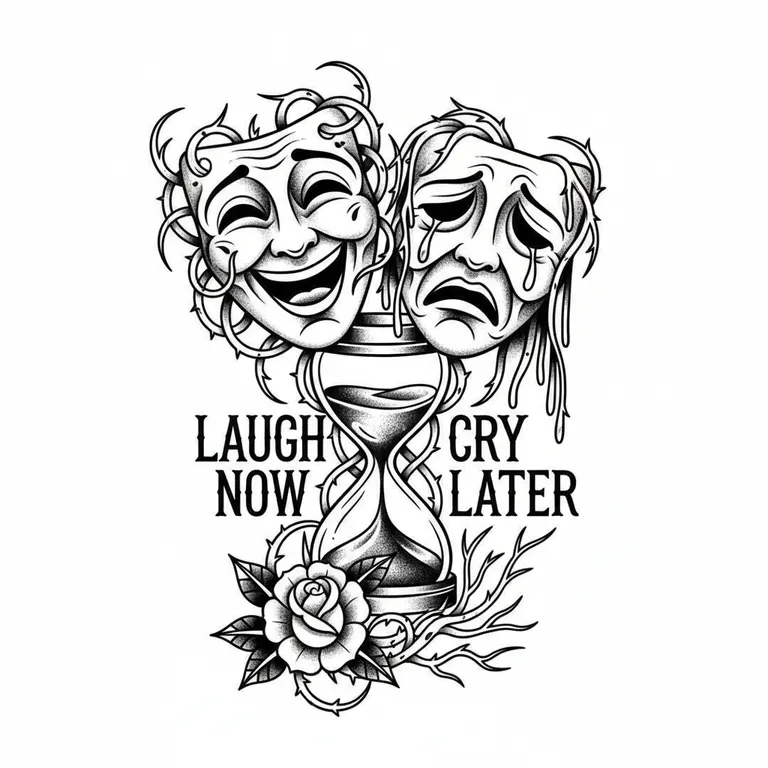
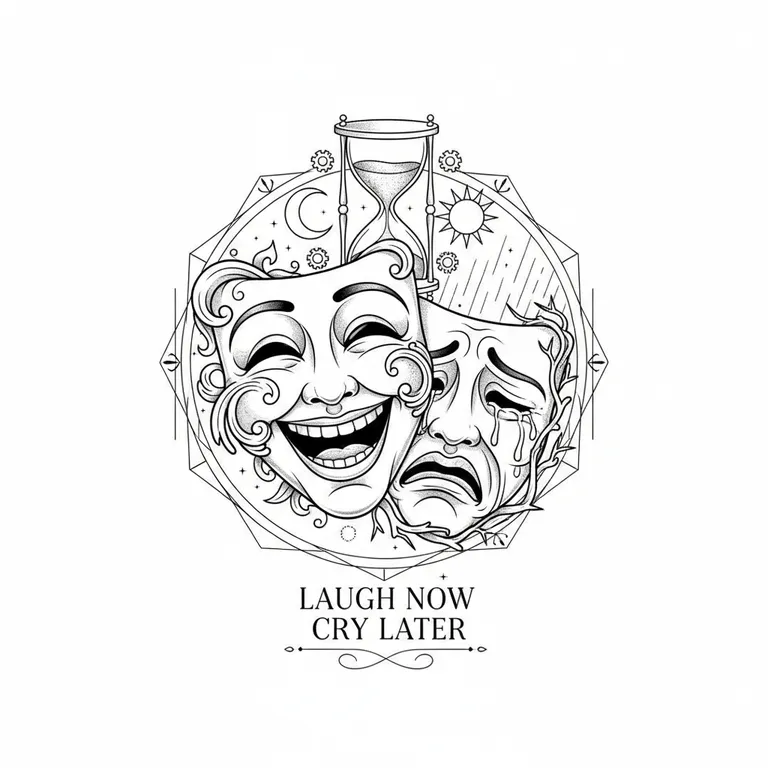
AI-generated laugh now cry later tattoo designs across popular styles. Tap any one to generate your own version and preview it on your skin.
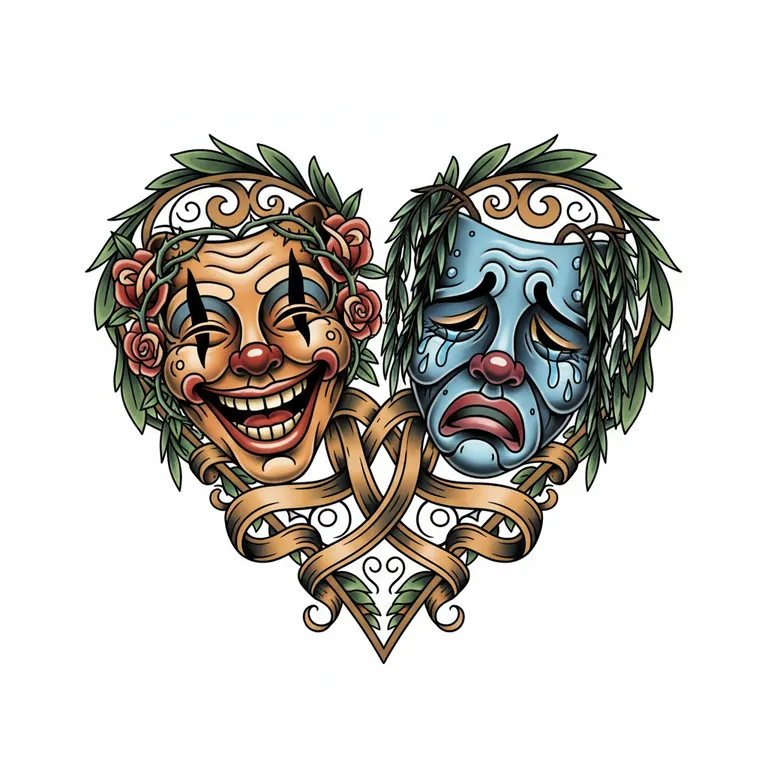
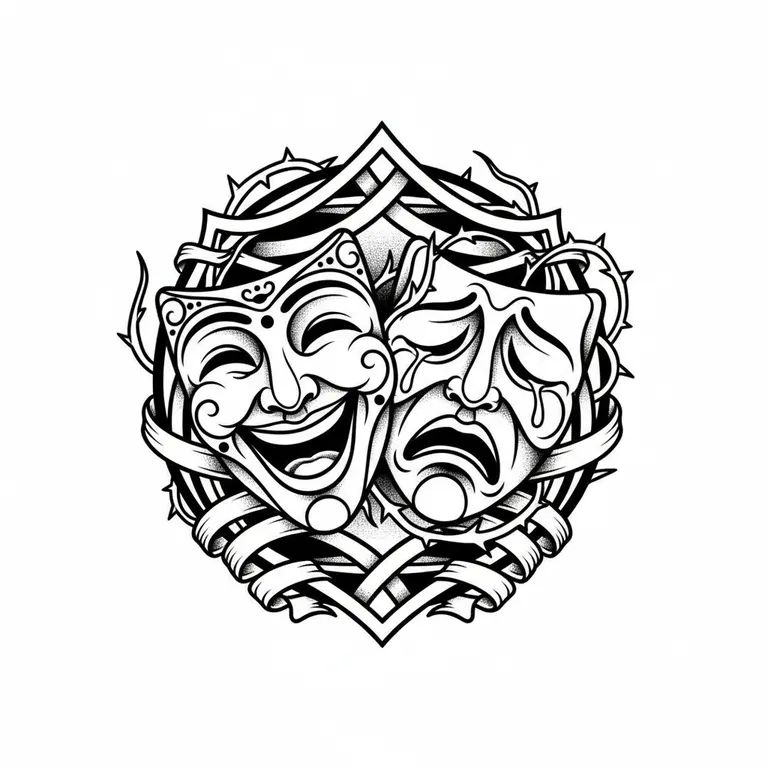
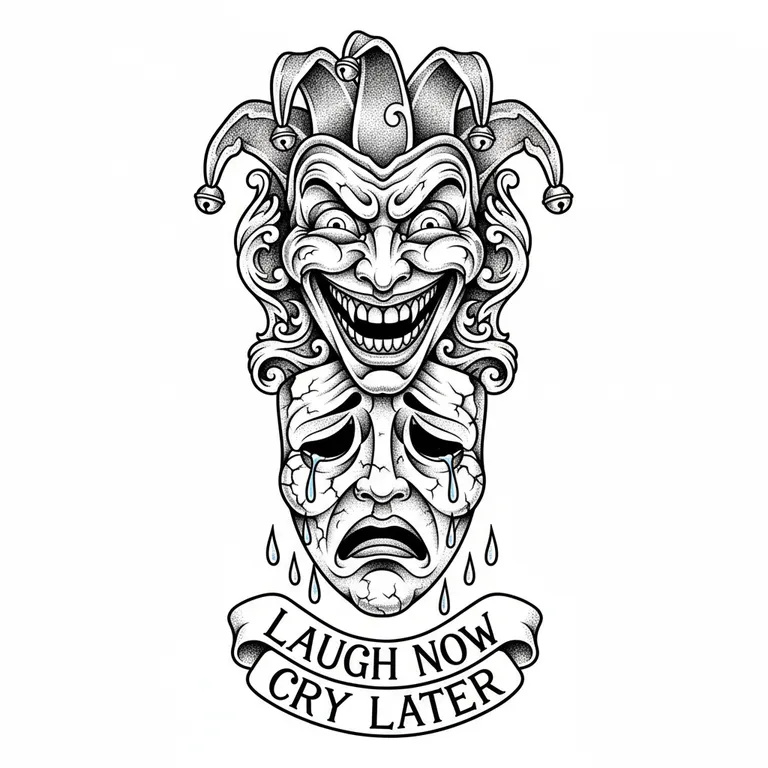
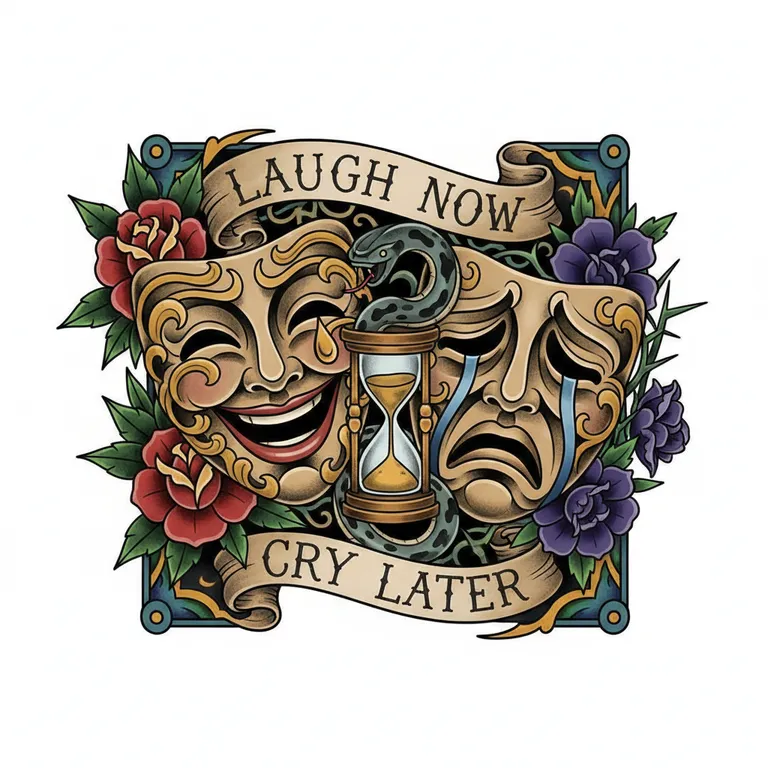


TL;DR
- •Meaning: the highs and lows of life side by side. The two common readings are "live for today, deal with it tomorrow" and "smile for the world, cry in private". Both are interpretations; the tattoo means what you put into it.
- •The masks: the comedy and tragedy masks of ancient theatre, held by the Muses Thalia (comedy) and Melpomene (tragedy).
- •The motto: "Smile Now, Cry Later" is a 1966 record by Sunny & the Sunliners. In tattooing it is tied to Chicano black and grey, which grew out of California prisons.
- •Gang tattoo? Not by itself. Researchers and the Vera Institute report that clown-face and Chicano tattoos are routinely misread as gang evidence.
- •Size: the tear drops are the first detail to go. On a 2 inch design each tear is under 3 mm tall.
What does a laugh now cry later tattoo mean?
The design always puts two opposite feelings next to each other. What people mean by it depends on how they read the order of the words, and the sources we found do not fix one meaning. The readings that come up again and again are these:
| Reading | What it says | Who tends to choose it |
|---|---|---|
| Live now, pay later | Enjoy the moment and accept the consequences when they come | People who want a reminder not to waste the good days |
| A brave face | Smile in public, keep the sadness for later or for private | People who have carried grief, hardship or a loss without showing it |
| Life's two sides | Joy and sorrow both belong to a life; neither lasts | People marking a hard period they came through |
| Theatre | Comedy and tragedy, the symbol of acting and the stage | Actors, drama students, theatre workers |
| Chicano heritage | A classic of Chicano black and grey art and its history | People connected to that culture or its tattoo tradition |
These are common interpretations, not definitions. Some people also use the two faces for mood swings or for hidden pain behind a smile; that is a personal reading too. Whichever one you mean, it helps to know the others, because people who see the tattoo will bring their own.
In Spanish the phrase is usually written sonríe ahora, llora después, which is how the Museum of Latin American Art titles Smile Now, Cry Later, a 2017 painting by the artist duo Tlacolulokos (Dario Canul and Cosijoesa Cernas) in its permanent collection.
What are the laugh now cry later masks called?
They are the comedy and tragedy masks, sometimes called the theatre masks or drama masks. In Greek myth they belong to two of the nine Muses: Thalia (Thaleia), the Muse of comedy, shown with a comic mask, and Melpomene, the Muse of tragedy, shown with a tragic mask, a sword, and sometimes cothurnus boots and an ivy wreath (both per the Theoi Project). The boots gave a second symbol of the pair: the tragic actor's high boot, the buskin, and the comic actor's thin-soled shoe, the sock (Wikipedia, Sock and buskin).
Actors in ancient Greek theatre really did wear masks. Only two or three actors were on stage at once, all men, and the masks let them switch characters and play women; the masks were made of organic materials and none survive, so what we know comes from vase paintings and later art (Wikipedia, Theatre of ancient Greece). Stylized comedy and tragedy masks have since come to stand for the performing arts in general, which is why the same pair appears on theatre posters and drama-school logos.
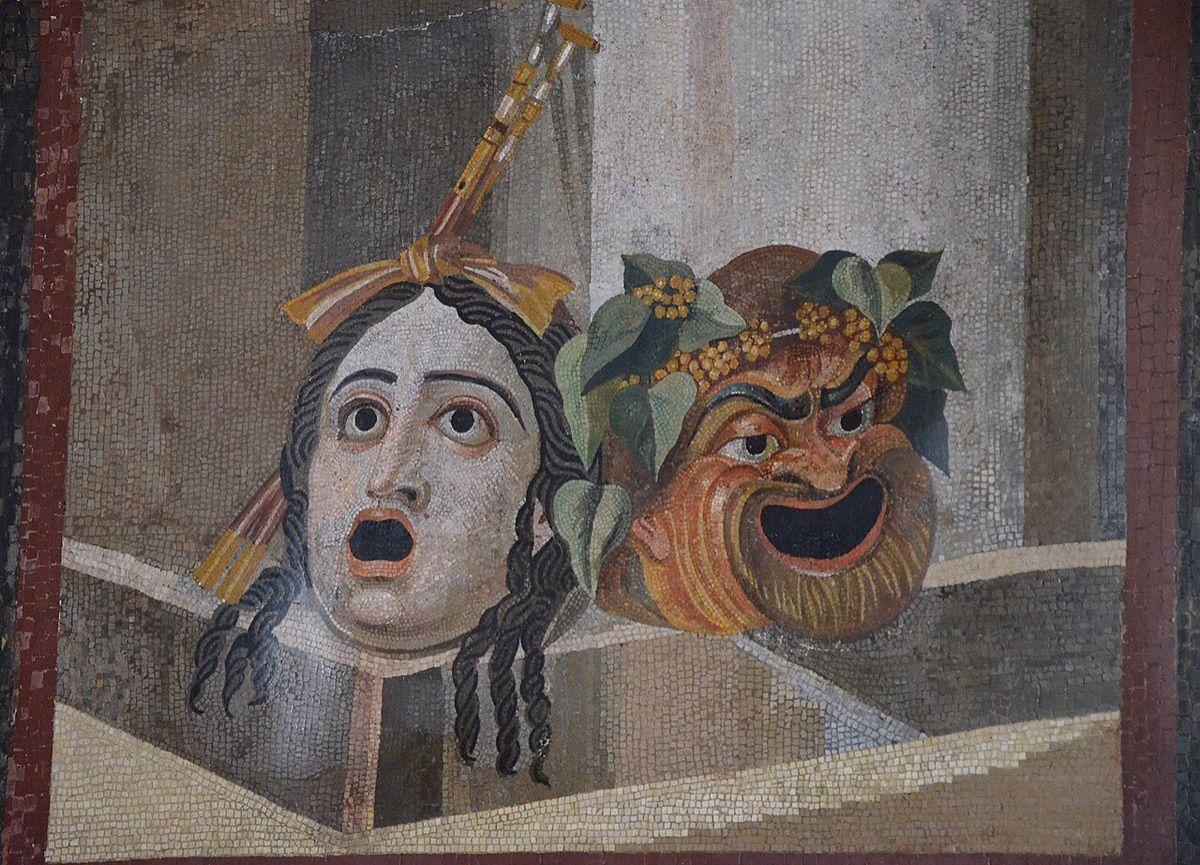
The Capitoline Museums describe the female mask with large eyes, a wide-open mouth and a ribbon in her curls, and the male mask with exaggerated, mocking features and a crown of ivy and berries, a decoration tied to the cult of Dionysus and the origins of Greek theatre. Look closely and neither face is crying. There are no tears in the ancient pair: the "crying" face of the tattoo is a later way of drawing tragedy.
Where does "smile now, cry later" come from?
The words are older than most tattoos that carry them. Smile Now, Cry Later is a song by Sunny Ozuna and the Sunliners, a Chicano band from San Antonio, Texas: the UCLA Frontera Collection holds the 45 on the Key-Loc label (KL-1002-A), and the band's discography lists an LP of the same name on Key-Loc in 1966 (Wikipedia). The archive files the song under unrequited love. Nothing we found says the record created the tattoo, but it is the earliest dated use of the phrase in our sources.
Chicano black and grey and the prisons
The tattoo style the design is known in grew out of California's prisons. NPR's Code Switch reported in 2018 that black and gray used to be called joint-style or prison-style: inmates built one-needle machines from ballpoint pens, guitar strings and parts of old stereos, and since there was no colored ink, they used black and watered it down to get gray. The result was finer lines and soft shading instead of the thick outlines and bright colors of traditional tattoos.
In the mid-1970s a shop in East Los Angeles, Good Time Charlie's Tattooland, switched its machines to a single needle for a mostly Mexican-American clientele who wanted that fine-line work. Freddy Negrete, who learned to tattoo in juvenile detention and is one of the people credited with taking the style mainstream, was hired there in 1977 (NPR, LA Weekly). One of his best-known early drawings, from his time in the California Youth Authority, was the comedy and tragedy masks with ornate lettering reading "smile now, cry later". He told NPR that if you ask most tattoo shops for a "smile now, cry later", the artist will know exactly what you mean. His 2016 memoir is titled Smile Now, Cry Later.
- Smile Now Cry Later LP
- 1966
- Smile Now Cry Later LP
- Sunny & the Sunliners, Key-Loc
- Negrete joins Good Time Charlie's
- 1977
- Negrete joins Good Time Charlie's
- East Los Angeles (NPR)
- Homemade prison machines
- 1 needle
- Homemade prison machines
- Black ink, watered down for gray
- Shown at a museum
- 2018
- Shown at a museum
- Tattoo, Natural History Museum of Los Angeles
That history is why the design means more than a pair of faces to many people who wear it: in Chicano art it sits next to roses, Catholic imagery, portraits and lettering, the same repertoire Negrete describes drawing on stationery for other inmates. In 2018 Chicano black and grey was a large part of the Tattoo exhibition at the Natural History Museum of Los Angeles (NPR). If the design matters to you for that reason, an artist who works in that tradition is the natural choice.
How did the two faces change from the Roman stage to the tattoo?
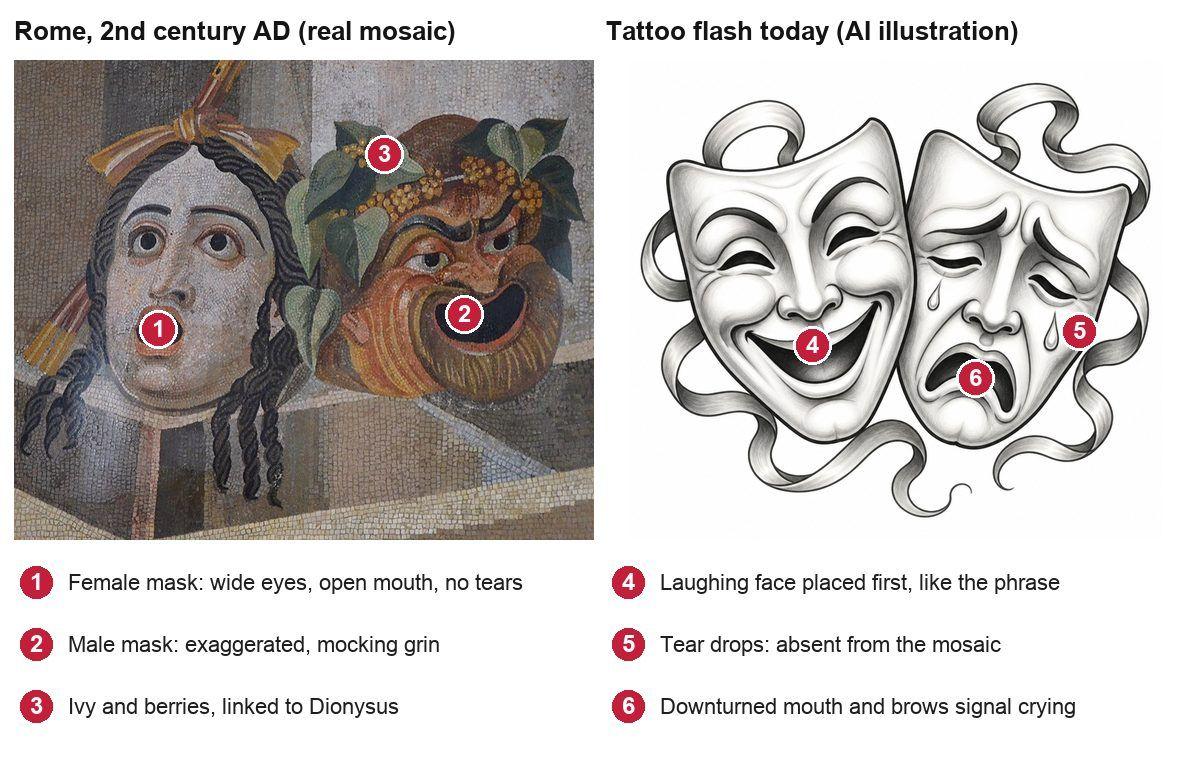
Put the oldest pair next to a typical flash sheet and four changes stand out. First, tears: the ancient tragic face gapes but does not weep, while the tattoo version almost always adds one or more tear drops, because a tear reads instantly at a glance. Second, the mouths: the tattoo turns the corners of one mouth up and the other down, so the contrast works even as a silhouette. Third, the order: in the mosaic the comic mask is on the right; in the tattoo the laughing face usually comes first, matching the order of the words. Fourth, the decoration: the ivy and berries of Dionysus give way to ribbons, roses, hats, dice or lettering.
None of these is a rule. If you want a classical look, you can ask for masks without tears, with the ivy wreath, or with the tragic face on the left. If you want the classic Chicano look, the tears, the ribbon and smooth gray shading are what artists and clients usually mean.
Is laugh now cry later a gang tattoo?
Not by itself. The image comes from the theatre, the motto from a love song, and the design is a standard request in tattoo shops, according to Negrete. But the question in autocomplete is real, and the honest answer is that some people, including police and immigration officers, have read these designs as gang signs.
We do not list gang symbols, and we do not think the design needs defending: it is worn by people of every background for every reason in the table above. If you are not Chicano and want the design, the respectful move is to know where it comes from, as above, and to choose an artist who does black and grey well, often an artist from that tradition.
Laugh now cry later tattoo ideas
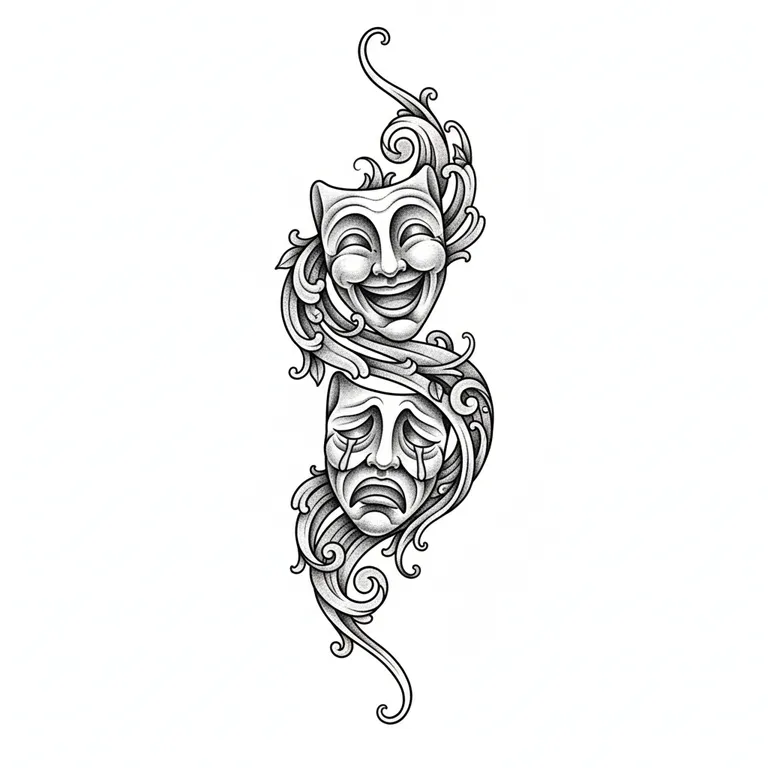
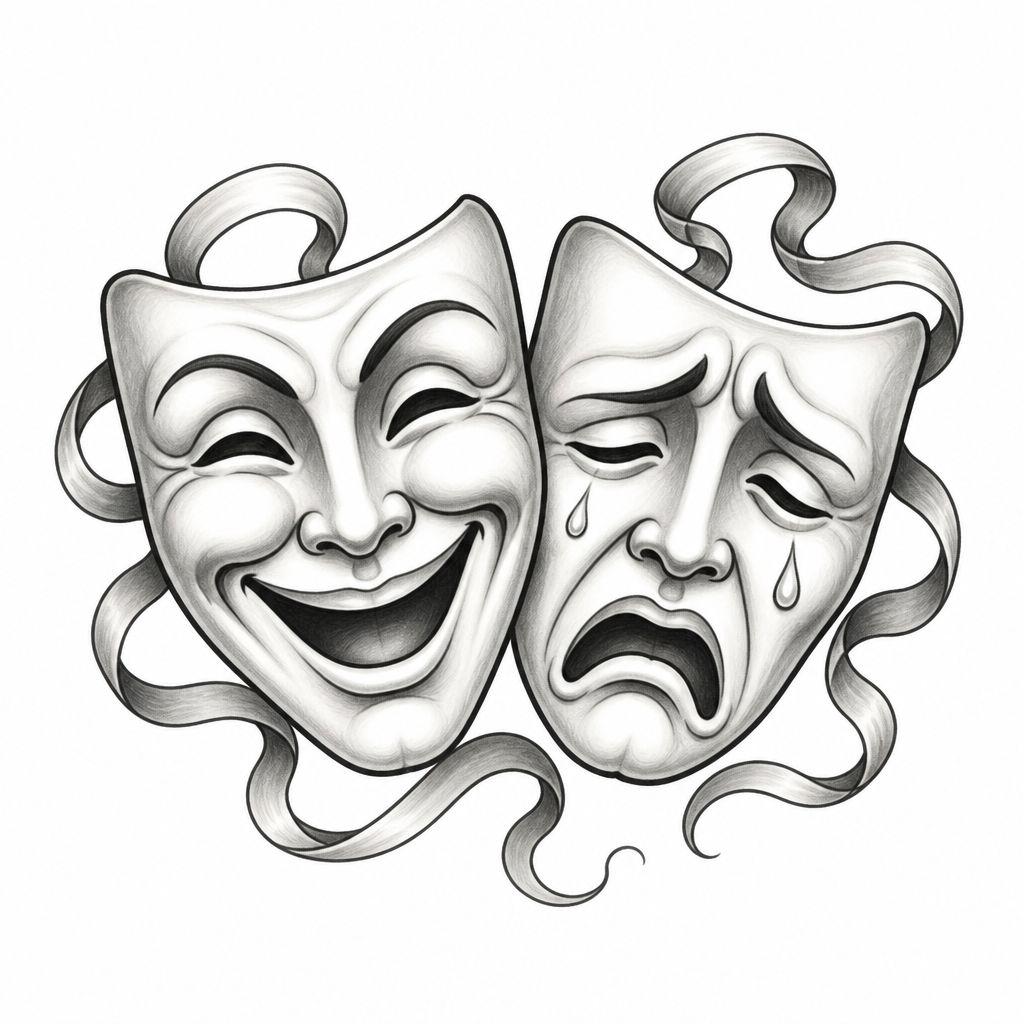 The Chicano standardClassic masks, black and grey
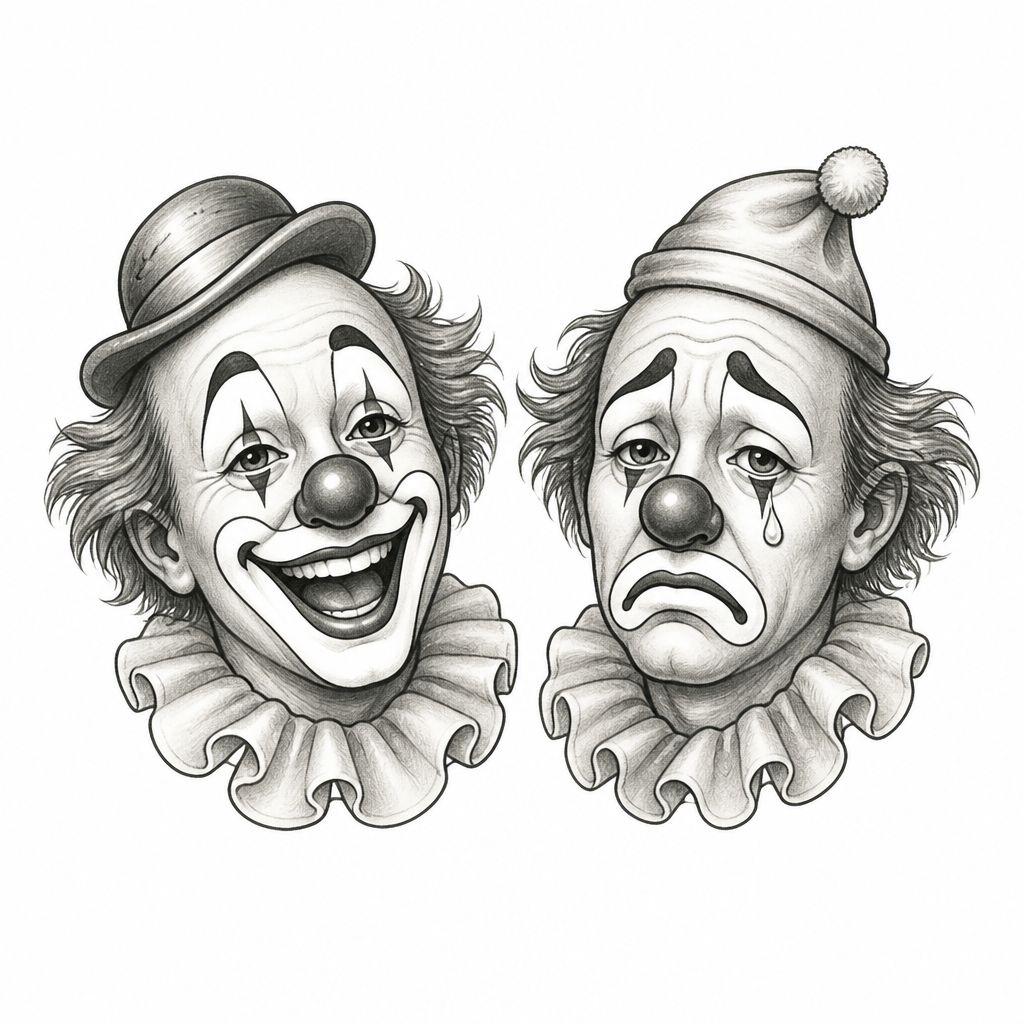 Sad clown on the rightTwo clowns (payasos)
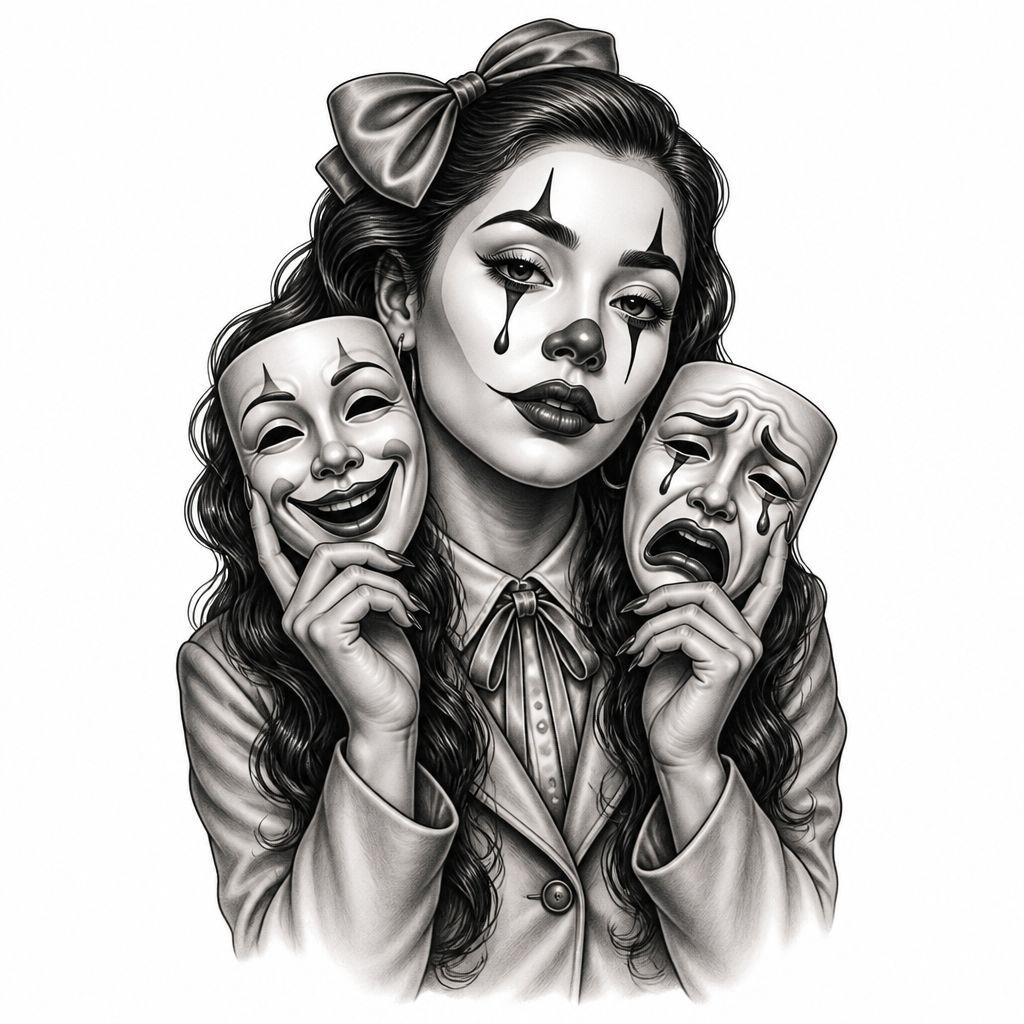 Portrait versionPayasa with masks
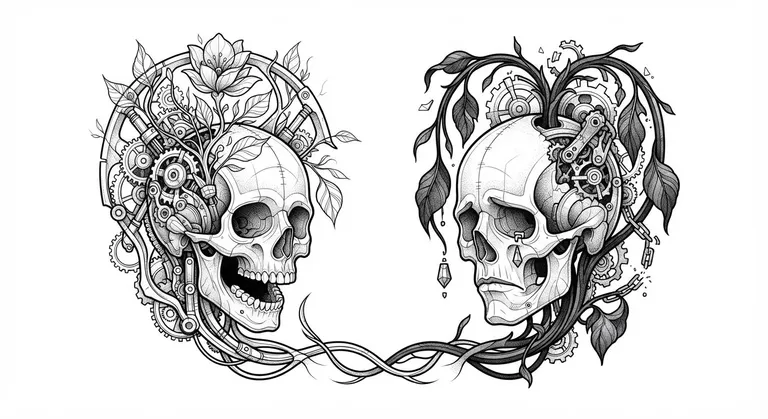
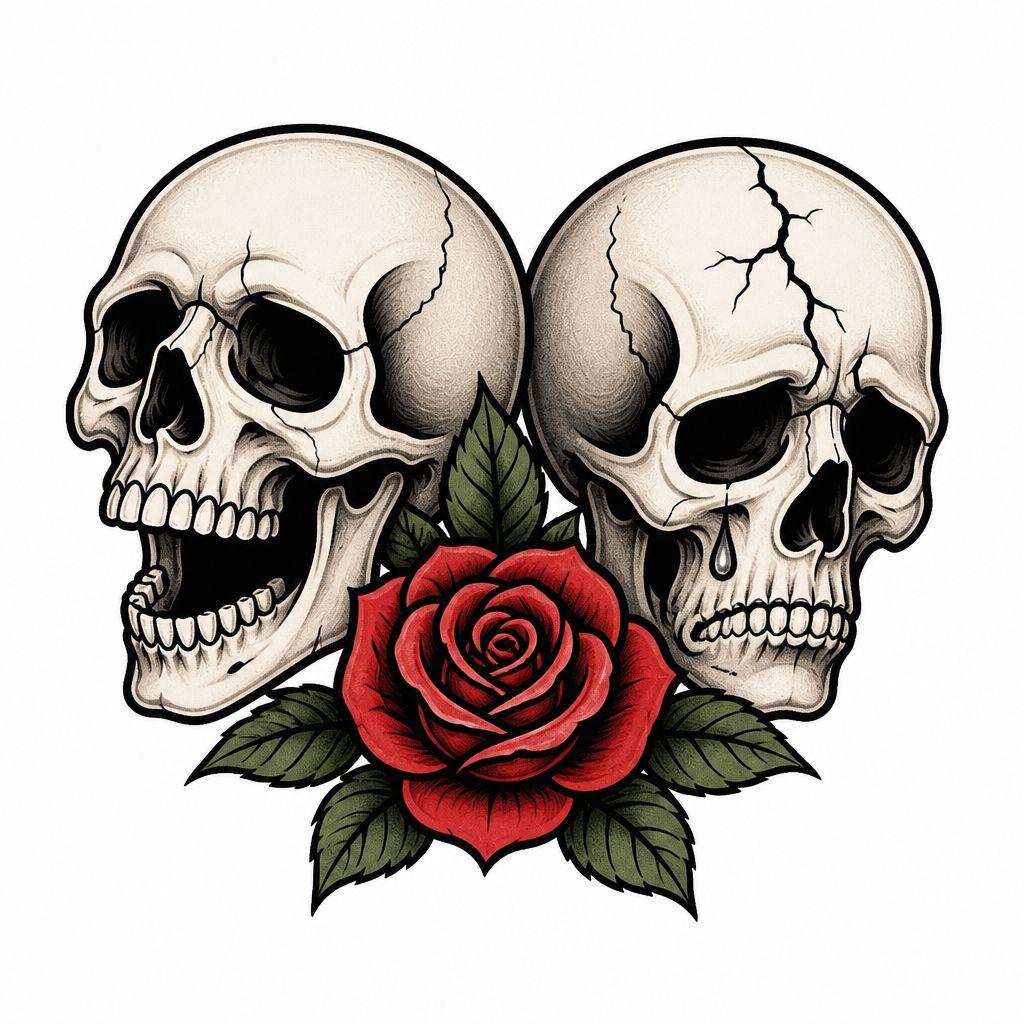 Neo-traditionalSkulls and a rose
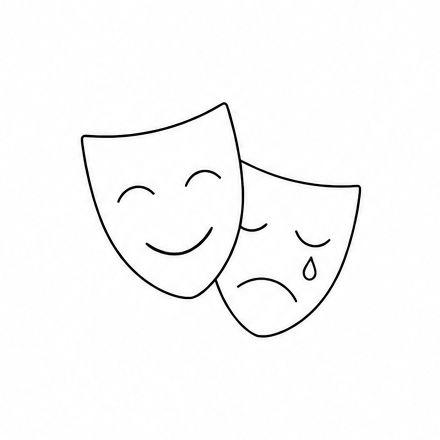 Simplest small versionMinimal fine line
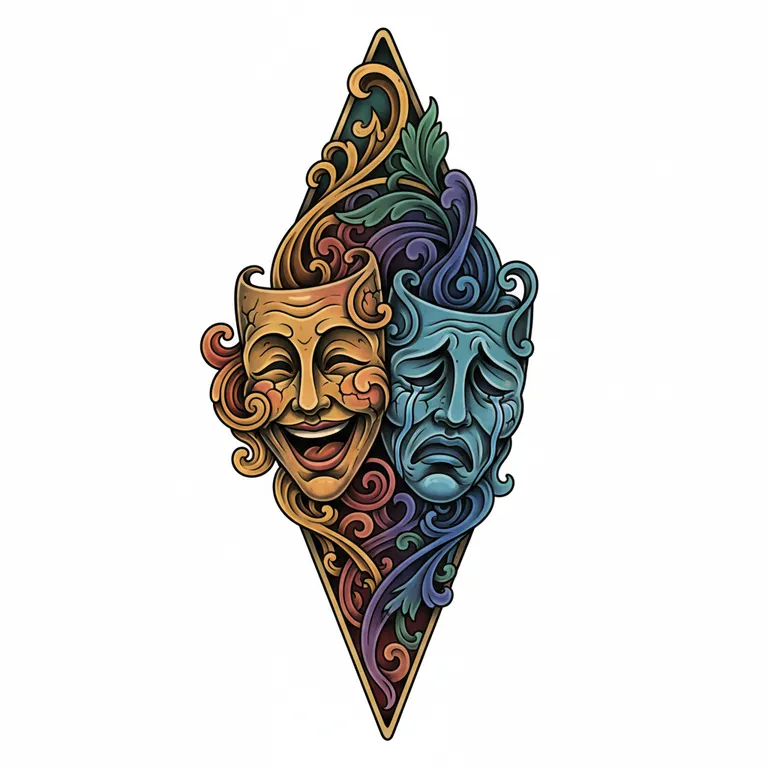
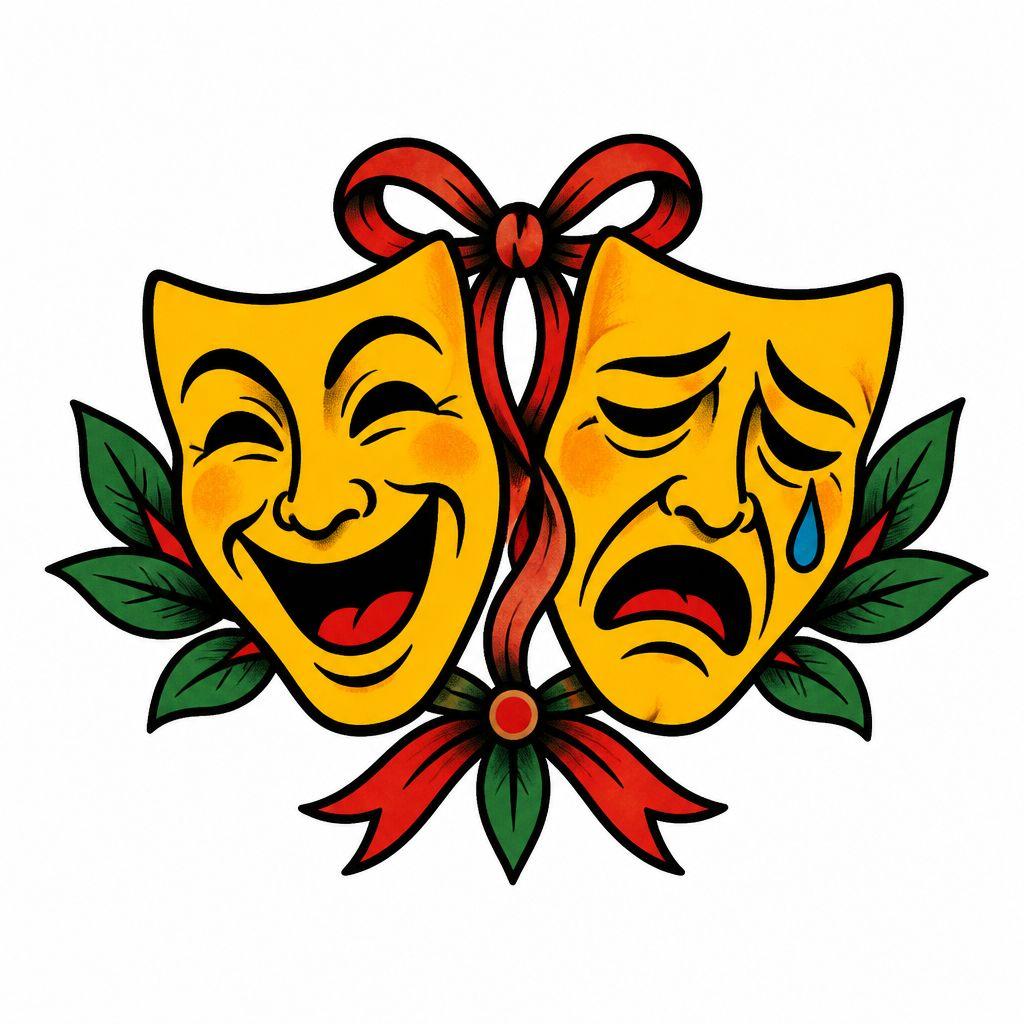 Bold color, bold linesAmerican traditional
These six cover most of what people search for. A few notes on each, so you know what to ask for:
- Classic masks: the version on most flash sheets. Ribbons, a banner with the words, roses or dice are the usual additions. It is the one to choose if you want the design to be read instantly.
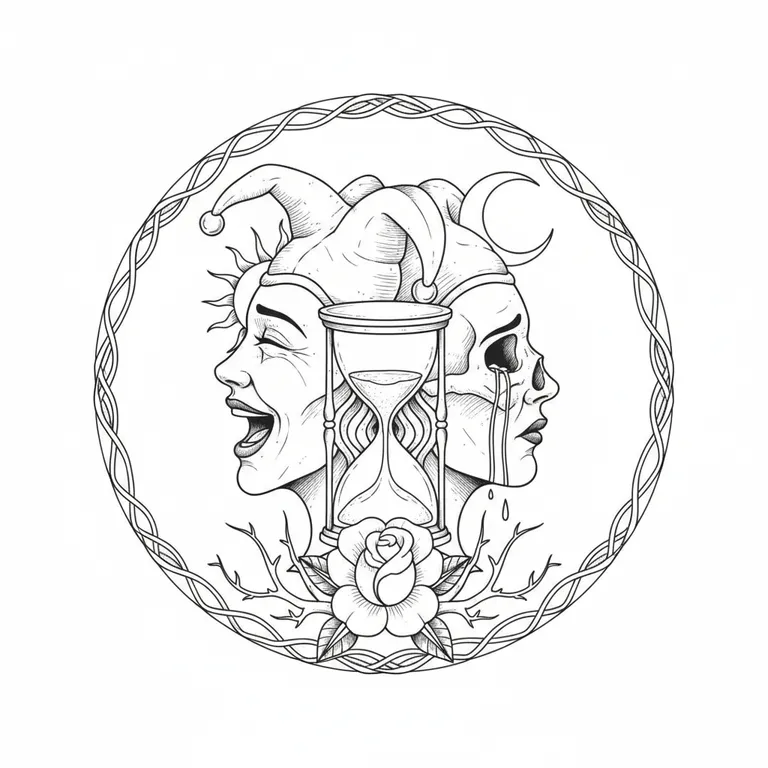
- Clown masks (payasos): the same idea with clown faces, one grinning, one with a painted tear. The Vera Institute calls a pair of clown faces "a popular tattoo" (more on that above). A sad clown on its own keeps only the second half of the message. If you are after a menacing clown instead, that is a different search; see our joker tattoo ideas.
- Payasa: a woman in clown makeup, often holding the two masks or with one tear painted on her cheek. It turns the design into a portrait, so it needs room (a forearm, calf or thigh) and an artist who does faces well.
- Skulls: one laughing skull, one weeping skull. It adds mortality to the message, close to a memento mori.
- Minimal fine line: two outlines and a tear. It is the only version that really works small, and it gives up the shading that makes the classic look.
- American traditional: yellow or white masks with heavy outlines and solid color, sometimes with a red ribbon and a blue tear. Bold outlines and flat color are what artists usually recommend when a design has to stay readable from a distance and at smaller sizes.
Prompt to try
“laugh now cry later masks with a banner reading smile now cry later, Chicano black and grey, for the forearm”
Generate this designWhich tattoo style suits laugh now cry later?
The design is strongly linked to black and grey realism, the style that grew out of the Chicano single-needle work above: smooth gray gradients, no outlines on the faces, and the tears drawn as highlights. It needs size to work, because the shading is what makes the faces read. American traditional uses bold outlines and a few flat colors and survives at smaller sizes. Fine line gives the minimal outline version. Blackwork can turn the pair into two solid black and skin-tone silhouettes. For the same subject drawn in eight styles, see tattoo styles explained.
If you want the words, they are usually set in Chicano-style script or Old English lettering on a banner above or below the faces. Our script tattoo guide shows how lettering styles compare and how small each one can go, and the name tattoo generator keeps the exact spelling when you generate lettering.
How small can a laugh now cry later tattoo be?
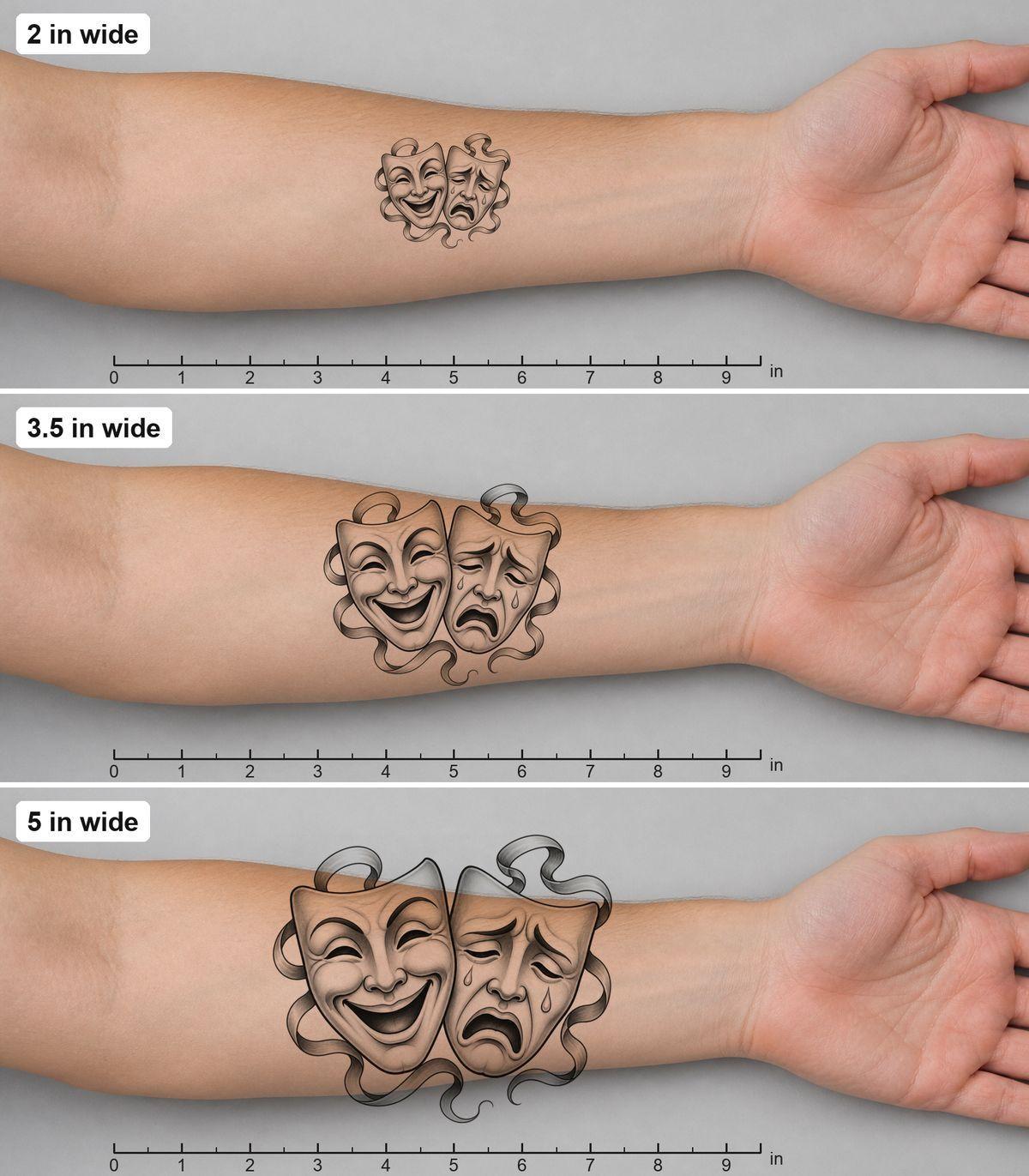
Height of one tear drop, by design width
- 2 in wide2.8 mm tall, 1.2 mm wide
- 3.5 in wide4.9 mm tall, 2.1 mm wide
- 5 in wide7.0 mm tall, 3.1 mm wide
The detail that carries the meaning is also the smallest: the tear. At 2 inches wide the whole tear is under 3 mm tall, and the light space inside it is a fraction of a millimeter. Artists generally warn that small enclosed spaces in shaded work fill in as the ink settles and spreads over the years, so a tiny shaded pair tends to end up as two gray ovals. At 3.5 inches the faces, mouths and tears all have room, and 5 inches gives space for ribbons or a banner. Below about 2 inches, switch to the fine line or traditional version, which rely on lines rather than shading.
The forearm in the diagram is the median length for women in ANSUR II, the US Army's 2012 body survey; men's forearms are about an inch longer. Measure your own arm, then try sizes on a photo of it with the tattoo size calculator.
Prompt to try
“small comedy and tragedy masks tattoo, 2 inches, fine line outlines with one tear, for the wrist”
Generate this designWhere should a laugh now cry later tattoo go?
The two faces sit side by side, so the design is usually wider than it is tall and suits areas with width. The table gives the room each area offers, from the ANSUR II medians in our tattoo size guide, and the pain tier artists reported in Pimentel et al. (2021), as summarized in our tattoo pain chart.
| Placement | Room (women / men) | What fits | Reported pain |
|---|---|---|---|
| Forearm | 9.5 × 5.2 / 10.5 × 6.1 in, one side | The classic pair at 3 to 5 in, shaded | Lower |
| Shoulder, upper arm | 12.2 × 6.0 / 13.2 × 7.0 in | Masks with a banner, or a payasa portrait | Lower |
| Chest | No matching figure | A wide pair across one pec or the full chest with lettering | Higher |
| Calf, lower leg | 15.2 × 7.3 / 16.3 × 7.7 in | A tall payasa or stacked masks | Middle |
| Thigh | 13.1 × 12.1 / 14.1 × 12.3 in | A large piece with roses or a full scene | Outer: lower. Inner: higher |
| Hand | 7.1 × 3.1 / 7.6 × 3.5 in | A simplified pair on the back of the hand | Middle |
| Neck | No matching figure | A small pair on the side of the neck | Higher |
| Sleeve | Whole arm | One element among roses, clocks and lettering | Varies by area |
ANSUR II measured US Army personnel aged 17 to 58, not the general population, so measure yourself too. "What fits" is our reading of those dimensions. Pain tiers are what six artists and two customers at one shop reported, not measurements, and in a survey of 1,092 tattooed people the body area did not predict pain once session length, stress and bleeding were counted. Hands and necks are the most visible spots and, given the misreading above, the ones to think about twice if your job or travel makes that a concern.
How do I get a clean laugh now cry later stencil?
Shaded black and grey designs are transferred as outlines; the artist adds the shading by hand. That means a good stencil keeps only the edges that matter: the outline of each face, the eyes, the curve of each mouth and the outline of each tear. If a stencil has too many lines, the faces lose their expression. Once you have a design, the tattoo stencil maker turns it into transfer lines you can check, and you can print it at the exact size you picked above to see it on your arm before booking.
Prompt to try
“laugh now cry later clown masks stencil, clean outlines only, no shading”
Generate this designIs it "smile now, cry later" or "laugh now, cry later"?
Both are used for the same design. In the sources we found, "smile now, cry later" is the older wording: the 1966 record and Negrete's drawing both use it. "Laugh now, cry later" is the title of Ice Cube's 2006 album and of Drake's single with Lil Durk, released on August 14, 2020, which is why "laugh now cry later meaning Drake" shows up in searches. Neither is a tattoo source: they are later uses of the phrase. If you want the words in the tattoo, pick the version that matches what you mean; "smile" fits the brave-face reading, "laugh" the live-for-today one.
How much does it cost, and how do I look after it?
There is no set price for a laugh now cry later tattoo. Size and shading set the time in the chair, and smooth black and grey faces take longer than outlines. Our study of how much a tattoo costs explains how artists price, and the tattoo price calculator gives an estimate for your size and area. Black and grey heals like any other tattoo; follow your artist's instructions and our tattoo aftercare guide, and keep it out of the sun once healed so the soft grays do not fade.
Related tattoo ideas and guides
Joker Tattoo Ideas
Darker clown faces, cards and wild-card symbolism.
Memento Mori Tattoo Ideas
Skulls, hourglasses and other reminders that the good days do not last.
Gemini Tattoo Ideas
Twin faces and two-sided designs for the zodiac's double sign.
Tutto Passa Tattoo Ideas
"Everything passes": lettering for hard times you came through.
Black and Grey Realism
The shading style the classic masks are drawn in.
Script Tattoo Style
Lettering for a "smile now, cry later" banner, compared by size.
Sources
- NPR Code Switch, "Black And Gray ... And Brown: A Tattoo Style's Chicano Roots" (Shereen Marisol Meraji, April 15, 2018) · checked November 11, 2026
- LA Weekly, "How East L.A. Tattoo Legend Freddy Negrete Helped Chicano Gang Tattoos Evolve Into a Beloved Art Form" (Josh Chesler, August 26, 2016) · checked November 11, 2026
- UCLA Library, Frontera Collection: Sunny Ozuna and the Sunliners, "Smile Now, Cry Later", Key-Loc KL-1002-A · checked November 11, 2026
- Wikipedia, "Sunny & the Sunglows" (discography: Smile Now Cry Later, Key-Loc 3001, 1966) · checked November 11, 2026
- Museum of Latin American Art, OaxaCalifornia, stop 6: Tlacolulokos, Smile Now, Cry Later (2017) · checked November 11, 2026
- Theoi Project, "Melpomene" · checked November 11, 2026
- Theoi Project, "Thaleia" · checked November 11, 2026
- Wikipedia, "Sock and buskin" · checked November 11, 2026
- Wikipedia, "Theatre of ancient Greece" (masks) · checked November 11, 2026
- Musei Capitolini, "Mosaic with scenic masks", inv. MC0392 · checked November 11, 2026
- Vera Institute of Justice, "People Are Being Deported Because of Their Tattoos" (Nazish Dholakia, May 6, 2025) · checked November 11, 2026
- Beth C. Caldwell, "Why tattoos are such an unreliable marker of gang membership", The Conversation via WLRN (April 8, 2025) · checked November 11, 2026
- Beth Caldwell, "Reifying Injustice: Using Culturally Specific Tattoos as a Marker of Gang Membership", 98 Wash. L. Rev. 787 (2023) · checked November 11, 2026
- Wikipedia, "Laugh Now, Cry Later" (Ice Cube album, 2006) · checked November 11, 2026
- Wikipedia, "Laugh Now Cry Later (song)" (Drake featuring Lil Durk, 2020) · checked November 11, 2026
- Pimentel et al., tattoo pain and VR, Frontiers in Virtual Reality (2021), Table 1 · checked November 11, 2026
- Witkoś and Hartman-Petrycka, survey of 1,092 tattooed people, IJERPH (2020) · checked November 11, 2026
- ANSUR II anthropometric survey, OPEN Design Lab, Penn State · checked November 11, 2026
- Photo: Carole Raddato, "Mosaic depicting theatrical masks of Tragedy and Comedy", Wikimedia Commons, CC BY-SA 2.0 · checked November 11, 2026
Laugh Now Cry Later tattoo FAQ
What does a laugh now cry later tattoo mean?+
It puts a laughing face beside a crying one to show the highs and lows of life. The usual readings are "enjoy life now and deal with the consequences later" and "keep a smile in public and the grief in private"; both are interpretations, so the meaning is the one you give it.
What are the laugh now cry later masks called?+
They are the comedy and tragedy masks, also called theatre or drama masks. In Greek myth the comic mask belongs to Thalia, the Muse of comedy, and the tragic mask to Melpomene, the Muse of tragedy.
What does smile now cry later mean in Chicano culture?+
"Smile Now, Cry Later" is a 1966 record by the Chicano band Sunny & the Sunliners, and the masks with that motto became a classic of Chicano black and grey tattooing, a style that grew out of California prisons. Tattoo artist Freddy Negrete drew the design in the California Youth Authority and says most shops know it by name.
Is laugh now cry later a gang tattoo?+
Not by itself: it is a theatre symbol and a common tattoo request. But clown-face and Chicano-style tattoos have been misread as gang evidence by authorities, according to the Vera Institute and legal research by Beth Caldwell, so be aware it can be misread, especially next to numbers or place names.
Is it smile now cry later or laugh now cry later?+
Both name the same design. "Smile now, cry later" is the older wording in our sources (the 1966 record and Negrete's drawing); "Laugh Now, Cry Later" is also the title of an Ice Cube album (2006) and a Drake song (2020).
How small can a laugh now cry later tattoo be?+
A shaded pair needs about 3 inches or more for the faces and tears to read; at 2 inches each tear is under 3 mm tall. For a small tattoo, choose a fine line or traditional version that relies on outlines instead of shading.
Tattoo planning tool
Design your own Laugh Now Cry Later tattoo
Describe your idea, generate it in any style, and preview it on your own skin before the needle.
Generate for freeFree to start
Explore more tattoo ideas
- 999 Tattoo IdeasA 999 tattoo wears the number that flips 666 into something positive, made famous by Juice WRLD as turning pain and negativity into strength.
- Honeycomb Tattoo IdeasA honeycomb tattoo uses the bee's hexagonal pattern as a symbol of teamwork, hard work and community.
- Tutto Passa Tattoo IdeasA tutto passa tattoo wears the Italian phrase meaning 'everything passes', a quiet reminder that hard times are temporary.
- Gemini Tattoo IdeasA gemini tattoo represents the zodiac sign of the twins, a symbol of duality, curiosity and communication.