
Gaara Tattoo Ideas: the 愛 (Love) Kanji at Real Size
Gaara's tattoo is the Japanese kanji 愛 (ai), which means love. In Naruto he carves it into his forehead as a child, after the uncle he trusted attacks him, as a sign that he will love only himself; his story then turns that love outward. For a tattoo, copy the exact character (13 strokes), keep it about half an inch tall or larger so the strokes stay apart, and have someone who reads Japanese check the stencil before the needle touches skin.
What does Gaara's tattoo mean?
Gaara is one of the main rivals, then allies, in Masashi Kishimoto's Naruto, which ran in Weekly Shonen Jump from 1999 to late 2014 and fills 72 volumes in the English edition (VIZ Media). He carries the one-tailed beast Shukaku sealed inside him and controls sand. The mark on his forehead is the kanji 愛, love, and the reason he has it is the heart of his story.
How the mark changes meaning through Gaara's story
Age six
Carved after a betrayal
- His father, the Fourth Kazekage, orders Gaara's uncle Yashamaru to attack him and to tell him that no one, not even his mother, loved him.
- Gaara uses his sand to carve 愛 into his forehead. His motto becomes 自愛 (jiai), love for oneself.
Chunin Exams
A demon who loves only himself
- He fights for himself alone; CBR sums up the mark at this point as a reminder that he had only himself.
- Naruto defeats him, shows him empathy and tells him his strength comes from love and friendship, not hatred.
Later arcs
Love for others
- Gaara turns protector of his village and becomes the Fifth Kazekage.
- Screen Rant reports his motto changing from 自愛 to 慈愛 (affection) and 未来 (future).
The war
His mother's love
- His reanimated father admits the sand that always shielded him was his mother Karura's love, not the beast's power.
According to Screen Rant (Daniel Forster, 2017), Gaara was six when he carved the symbol, after Yashamaru's attack, to stress the self-love he had adopted as his motto. GameRant adds that Yashamaru's words convinced him he was unlovable, and CBR describes the mark as a constant reminder that he fought only for himself. The turn comes later: per GameRant, losing to Naruto changes him and he becomes the Fifth Kazekage, and per CBR, his reanimated father finally confesses during the war that the sand that had always protected Gaara was his mother's love.
So what does a Gaara tattoo mean on a real person? The same word can carry the whole arc, and wearers commonly choose one point on it: self-love after a hard time, love that survives being misunderstood, a parent's love, or simply a love of the series. Those readings are interpretations, not rules; the character itself only says love.
What does the kanji on Gaara's forehead say?
It says 愛, read ai in Japanese, meaning love, affection or favourite. Jisho, which draws on the KANJIDIC dictionary data, lists it with 13 strokes, the heart radical 心, a grade-4 school kanji and level N3 of the Japanese proficiency test. If you searched for "Gaara forehead tattoo copy and paste", here it is as text: 愛 (Unicode U+611B). Copying it as text, not from a screenshot, gives your artist a clean outline in any font.
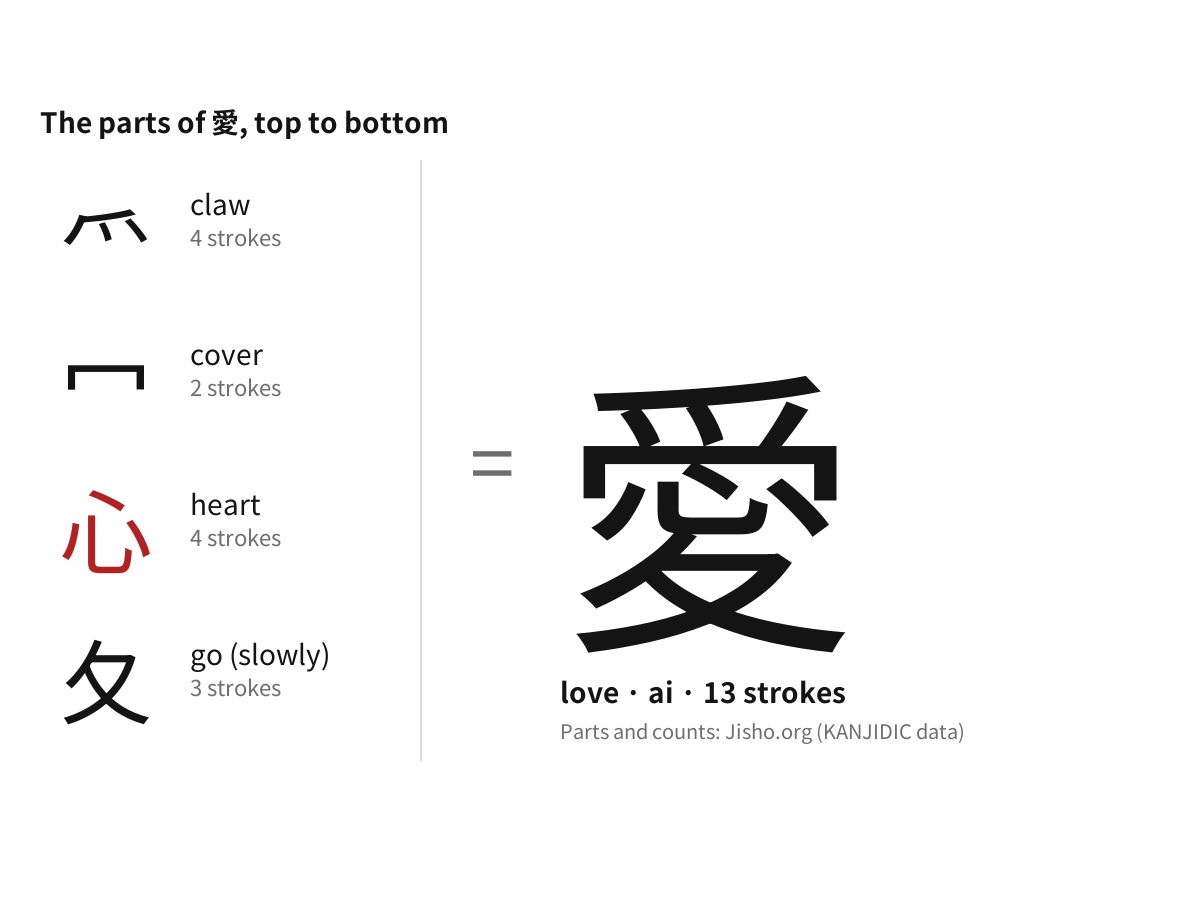
The character is built in four layers, stacked from top to bottom: 爫 (a claw), 冖 (a cover), 心 (a heart) and 夂 (to go). Several popular Gaara pages say 愛 has a heart on the left and "acceptance" on the right. That is not how the character is built: nothing in 愛 sits side by side, and the heart is in the middle, not on one side. The stacking matters for a tattoo, because it means the 13 strokes are piled into one column, and that is what makes the character hard to keep sharp at small sizes.
Is 愛 Japanese or Chinese?
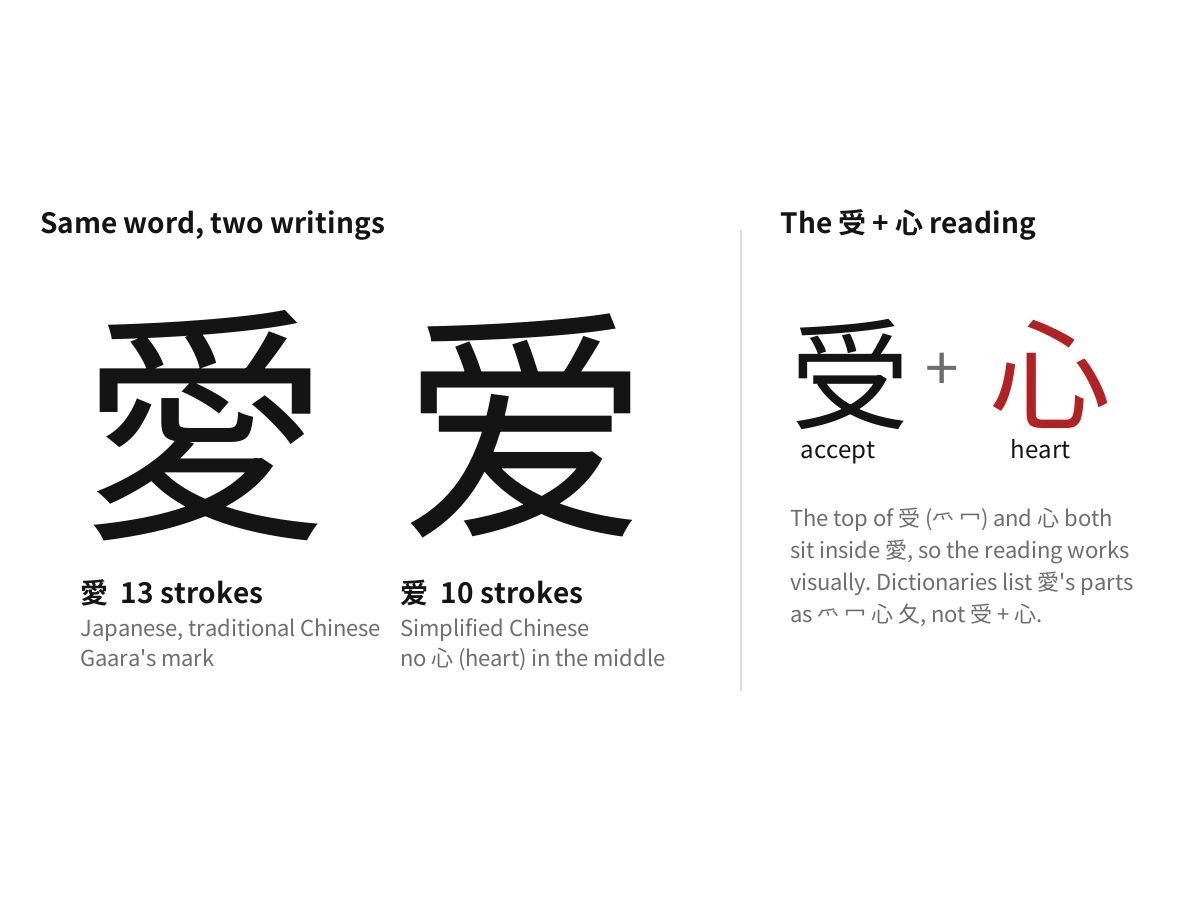
Both. Chinese characters came to Japan as kanji, and 愛 is written the same way in Japanese and in traditional Chinese. Simplified Chinese, used in mainland China, writes it 爱: Wiktionary lists that form as the simplified variant of 愛, with 10 strokes. The visible difference is that 爱 drops the heart 心 from the middle. If you want Gaara's mark, or you searched for "love Chinese tattoo" and found 爱, check which one your design uses.
About the story's version: Screen Rant writes that a prophecy in the series links two marks on Gaara's hands, 受 (to accept) and 心 (heart), which together make up love. Visually it works, because the top of 受 (爫 and 冖, per Jisho) and 心 both sit inside 愛. It is wordplay, not the dictionary breakdown, which ends in 夂 rather than 又.
One more piece of vocabulary that comes up in searches: 自愛 (jiai), Gaara's first motto. Jisho gives it two senses: self-love, and taking care of oneself, as in the everyday letter closing ご自愛ください, "please take care of yourself". If you want the self-love reading spelled out, 自愛 is a real word, but it is two characters, so it needs twice the room.
How small can a love kanji tattoo be?
Smaller than most people think is safe, and larger than most people ask for. The limit is not the word but the space between strokes. As our small tattoo guide explains, a tattoo line starts about as wide as the needle, roughly 0.25 to 0.35 mm, and softens over the years; when two lines sit closer than that softening, they merge. A 13-stroke character packed into one column is exactly the kind of design where that happens first. We tested it.
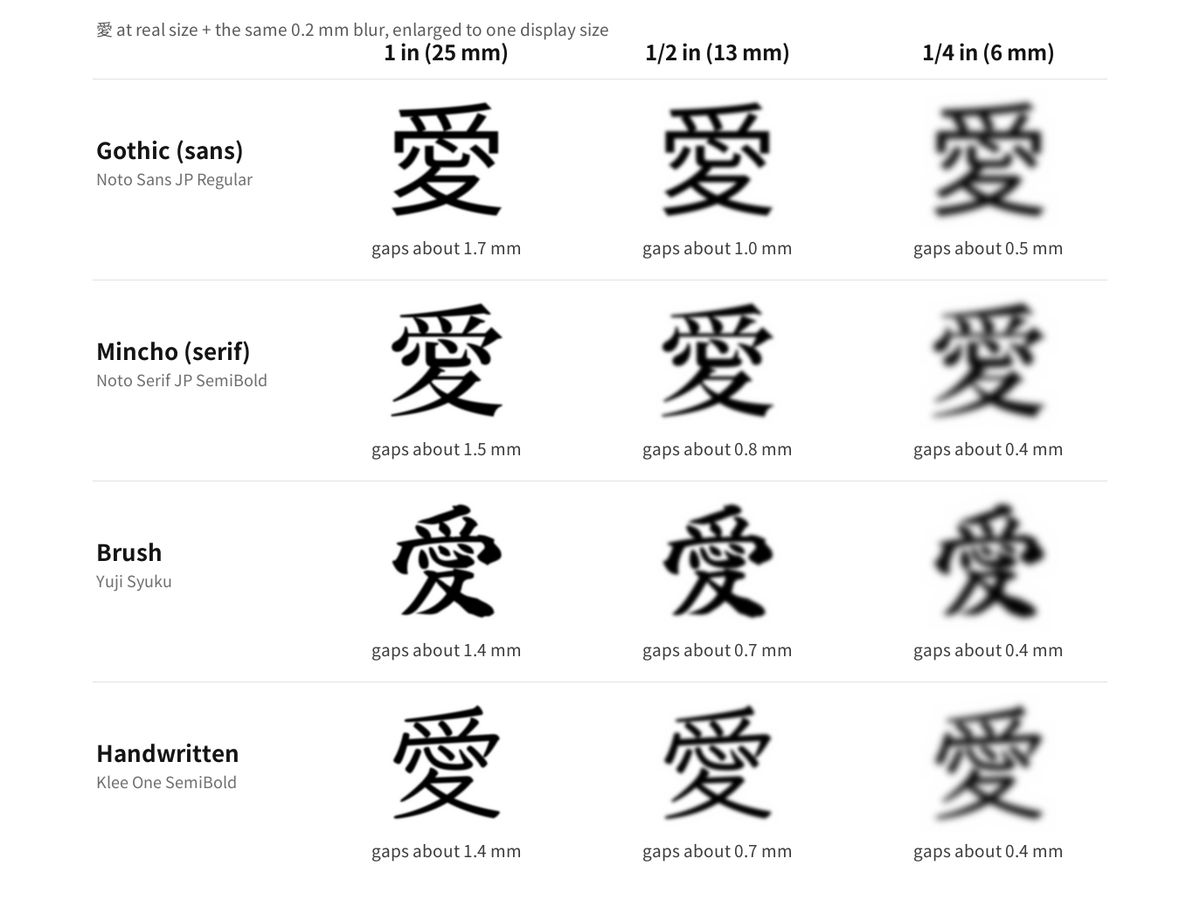
| Style (font) | Strokes a vertical line crosses | Gap at 1 in | Gap at 1/2 in | Gap at 1/4 in |
|---|---|---|---|---|
| Gothic (Noto Sans JP Regular) | 6 | 1.7 mm | 1.0 mm | 0.5 mm |
| Mincho (Noto Serif JP SemiBold) | 7 | 1.5 mm | 0.8 mm | 0.4 mm |
| Brush (Yuji Syuku) | 6 | 1.4 mm | 0.7 mm | 0.4 mm |
| Handwritten (Klee One SemiBold) | 7 | 1.4 mm | 0.7 mm | 0.4 mm |
Read the last column next to the needle width. At a quarter of an inch, the average gap is 0.35 to 0.5 mm: barely more than one liner line, and the narrowest gaps, around the dots of 爫 and inside 心, are far tighter than the average. At half an inch, the average gap is 0.7 to 1 mm, about two to three line widths. At one inch there is plenty of room. That is our measurement on fonts, not a rule from a medical body or a tattoo association, and your artist may redraw the strokes to open them up. But it explains what artists often say about small kanji: below about half an inch, the character tends to turn into a dark blot over the years.
- strokes in 愛
- 13
- strokes in 愛
- Jisho / KANJIDIC
- strokes stacked in one column
- 6 to 7
- strokes stacked in one column
- crossed by a vertical line through the middle, our count
- average gap at 1/4 in
- 0.4 mm
- average gap at 1/4 in
- about one needle line, our measurement
- smallest size we would plan
- ≈ 1/2 in
- smallest size we would plan
- average gaps 0.7 to 1 mm
What those sizes look like on an arm
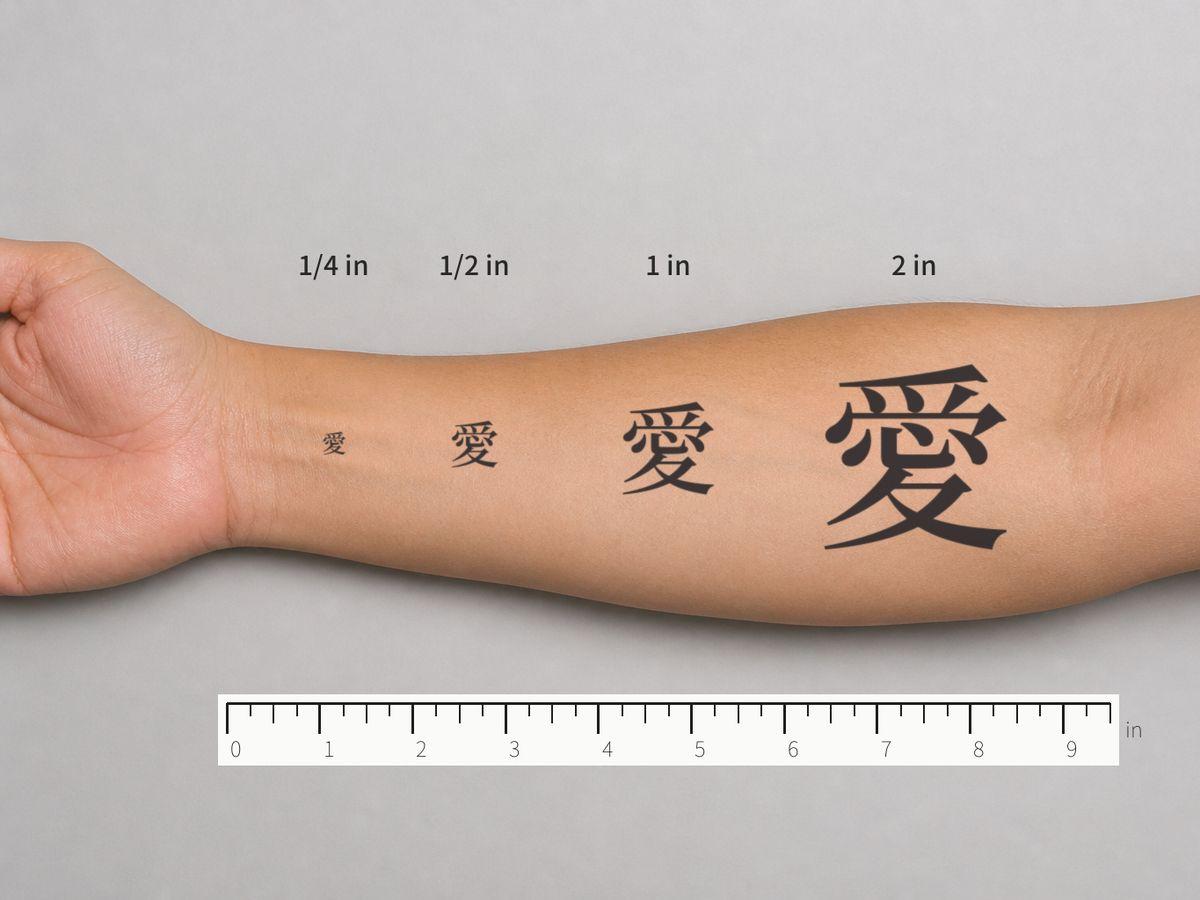
At 1/4 inch the character is a speck on the arm, and its strokes already touch on screen. At 1/2 inch it reads as a small, discreet mark; at 1 inch it is clearly legible from across a table; at 2 inches it becomes a statement piece on the forearm. To try sizes on a photo of your own arm, use the tattoo size calculator; for how to measure yourself, see the tattoo size guide.
Prompt to try
“1 inch 愛 love kanji tattoo in clean mincho brush style, inner forearm, black ink, open spacing between strokes”
Generate this designWhich font or style suits a 愛 tattoo?
The four styles in the test are the main families you will see for a kanji tattoo. They all spell the same character; they differ in how much contrast they give the strokes, and in how they behave small.
| Style | What it looks like | Small size | Suits |
|---|---|---|---|
| Gothic (sans) | Even, blocky strokes, like signage | Opens up best: widest gaps in our test | Small and minimal tattoos, behind the ear, finger, wrist |
| Mincho (serif) | Thick and thin strokes with small wedges, like print | Thin hairlines and wedges fill in first | 1 inch and up, forearm, chest |
| Brush | Calligraphy with tapered, uneven strokes | Ink blobs close the dots of 爫 and 心 | Larger pieces, red or black, with an ensō or wash |
| Handwritten | Pen-like strokes, open and even | Behaves close to gothic | A softer look at small and medium sizes |
Two things to watch. First, brush fonts and calligraphy sometimes use semi-cursive shapes where strokes join: compare the bottom 夂 of the brush row with the gothic one. That is normal in calligraphy, but it is a reason to have a fluent reader confirm the version you choose. Second, bold weights do not help at small size; heavier strokes leave less space between them. For lettering styles more broadly, see the script tattoo style guide and the Japanese tattoo style guide.
Can AI draw the love kanji correctly?
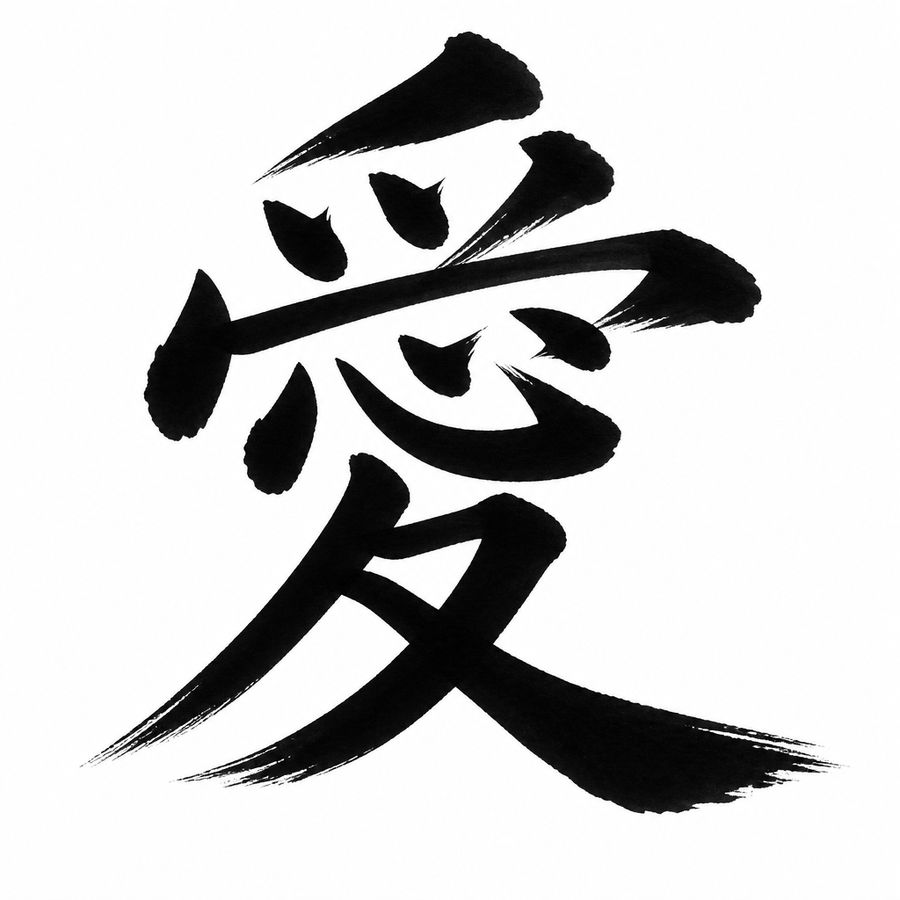 AIAI-generated brush 愛: we counted the 13 strokes against the dictionary parts
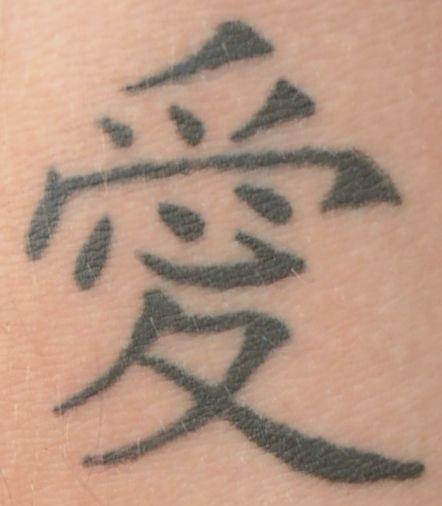 Real photoA real 愛 tattoo: same parts, same order, in a print-like style
Sometimes. We asked an image model for a single brush-painted 愛 and checked the result stroke by stroke against the parts listed by Jisho: the slanted stroke and three dots of 爫, the two strokes of 冖, the four of 心 and the three of 夂 are all there, 13 in total. This one came out right. Image models can also produce characters that look Japanese but have a missing or extra stroke, which is why our other designs on this page use font glyphs set by us rather than characters drawn by the model. Whatever the source, AI, a font or a website, count the strokes and get a fluent reader to look before the stencil.
The real tattoo on the right shows what a healed 愛 of moderate size looks like: the dots of 爫 and the dots of 心 are still separate, and the long sweep of 夂 anchors the bottom. That is the effect to aim for at your chosen size.
Red or black love kanji?
Autocomplete shows many people searching for the love kanji in red. Red is a design choice with two practical points. The first is health: the American Academy of Dermatology says allergic reactions to tattoo ink most often involve red, though any color can cause one, and that a reaction can appear right away or weeks, years or even decades later, usually only in the reacting color. The AAD advises telling your artist about a mild reaction and seeing a board-certified dermatologist if it lasts more than one or two weeks, and getting immediate medical care if a reaction comes with symptoms elsewhere in the body, such as trouble breathing, a racing heart, dizziness or hives. This page has not been reviewed by a clinician.
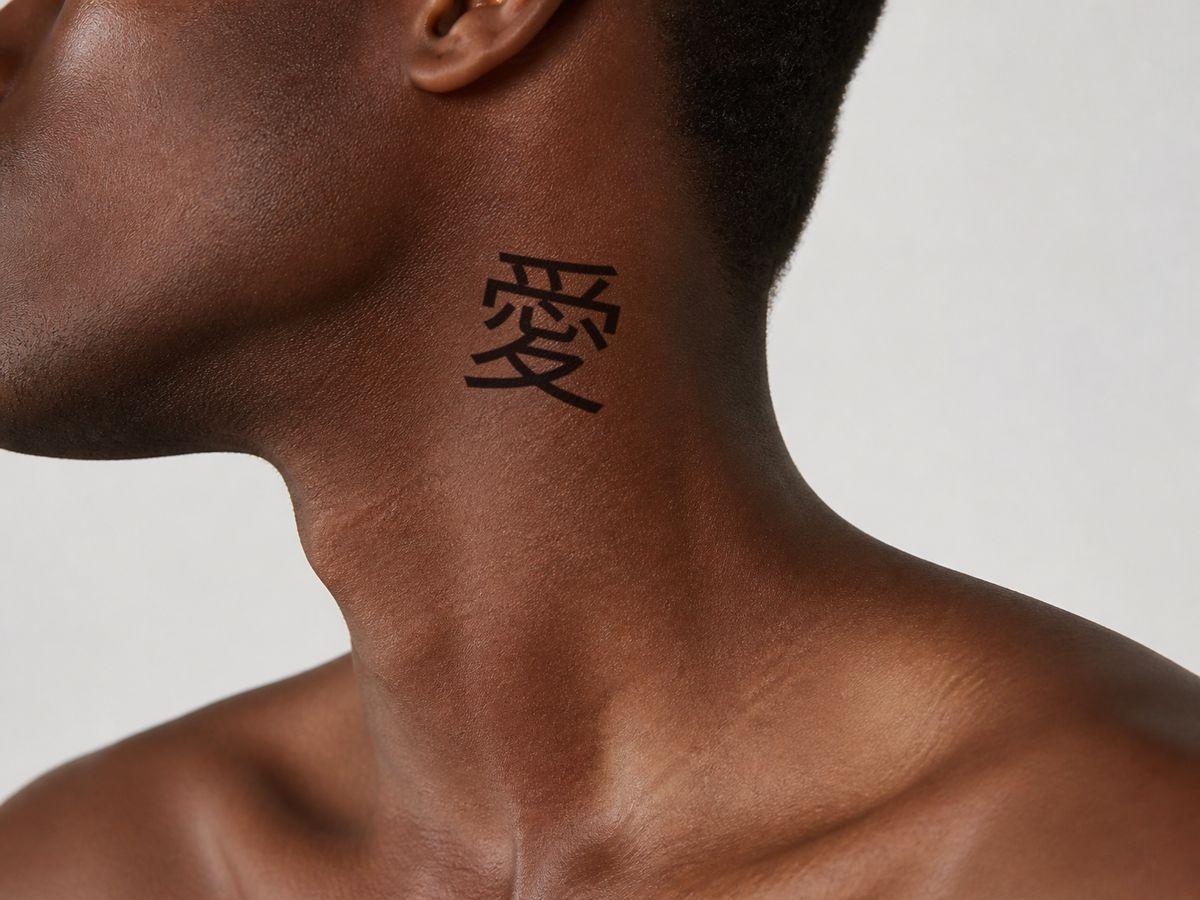
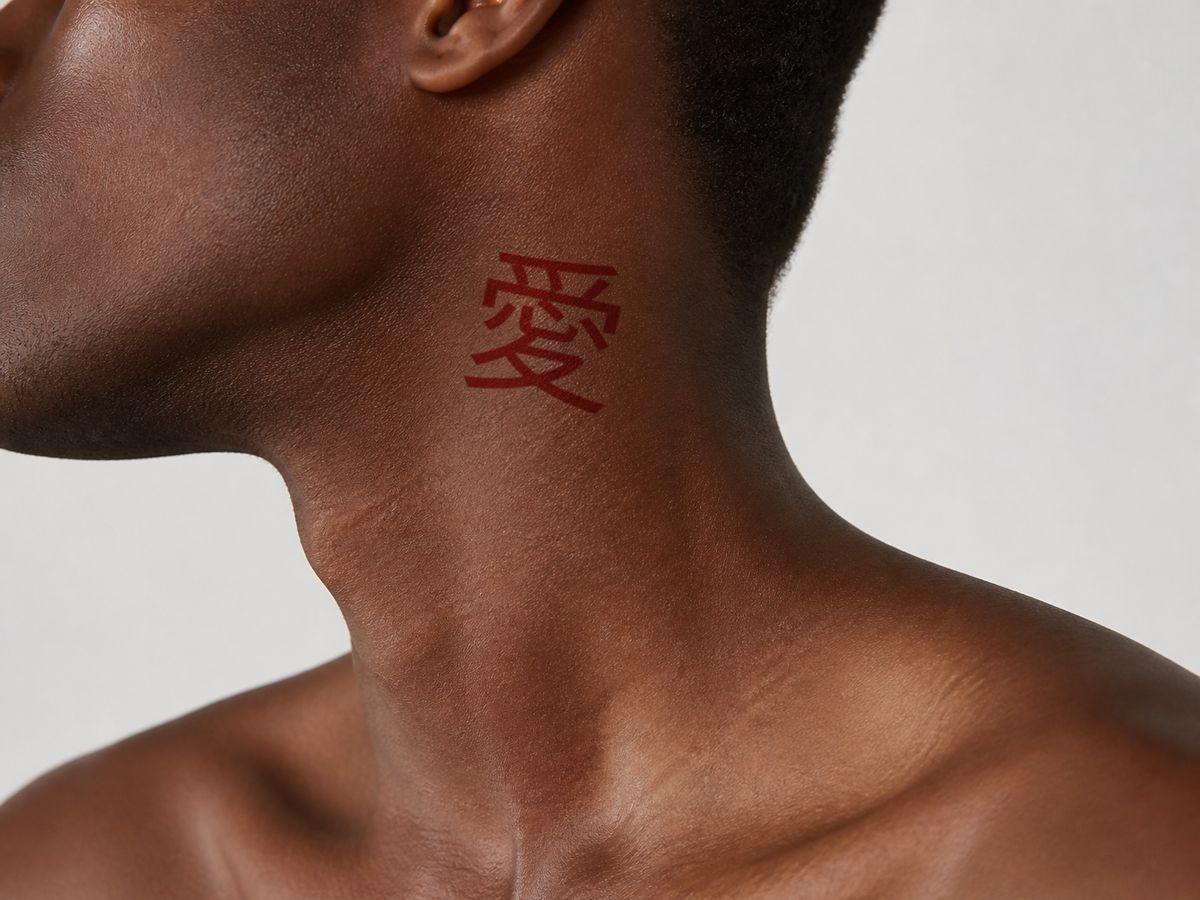
The second point is contrast. Red is a lighter value than black, so it stands out less against the skin, and the difference grows on deeper skin tones, as the simulation above suggests. We found no study that measures this, so treat it as a planning question for your artist rather than a rule: ask to see healed red work on skin like yours, and consider a black outline with red inside if you want both. A black 愛 is the safest choice for legibility at small sizes.
Where to put a Gaara tattoo: neck, hand or behind the ear?
Autocomplete shows the usual spots for this tattoo: the neck, the hand, behind the ear, the forearm, the wrist, the chest and the forehead itself, copying the character. Here is how they compare, using the median body measurements from our tattoo size guide where the survey has them, and the pain tiers in our tattoo pain chart.
| Spot | Room (women / men) | 愛 that fits | Pain tier |
|---|---|---|---|
| Behind the ear | Not measured in ANSUR II | About 1/2 in, gothic or handwritten | High (head and neck) |
| Side of the neck | Not measured in ANSUR II | 1 to 2 in, vertical | High |
| Back of the hand | 7.1 × 3.1 / 7.6 × 3.5 in | About 1 in | Middle |
| Wrist, one side | 3.0 / 3.5 in across | 1/2 to 1 in | Not tiered (called tender) |
| Forearm | 9.5 × 5.2 / 10.5 × 6.1 in | 1 to 3 in, any style | Lower |
| Chest or shoulder | Wide | 2 in and up, brush with an ensō | Chest high, shoulder lower |
Room is length times half the circumference, our calculation from ANSUR II medians of US Army personnel, not the general population; the survey has no measurement for the area behind the ear. Pain tiers come from what artists and customers reported in Pimentel et al. (2021), not measurements. In a survey of 1,092 tattooed people, session length and stress predicted pain better than body area, and a single kanji is usually a short session.
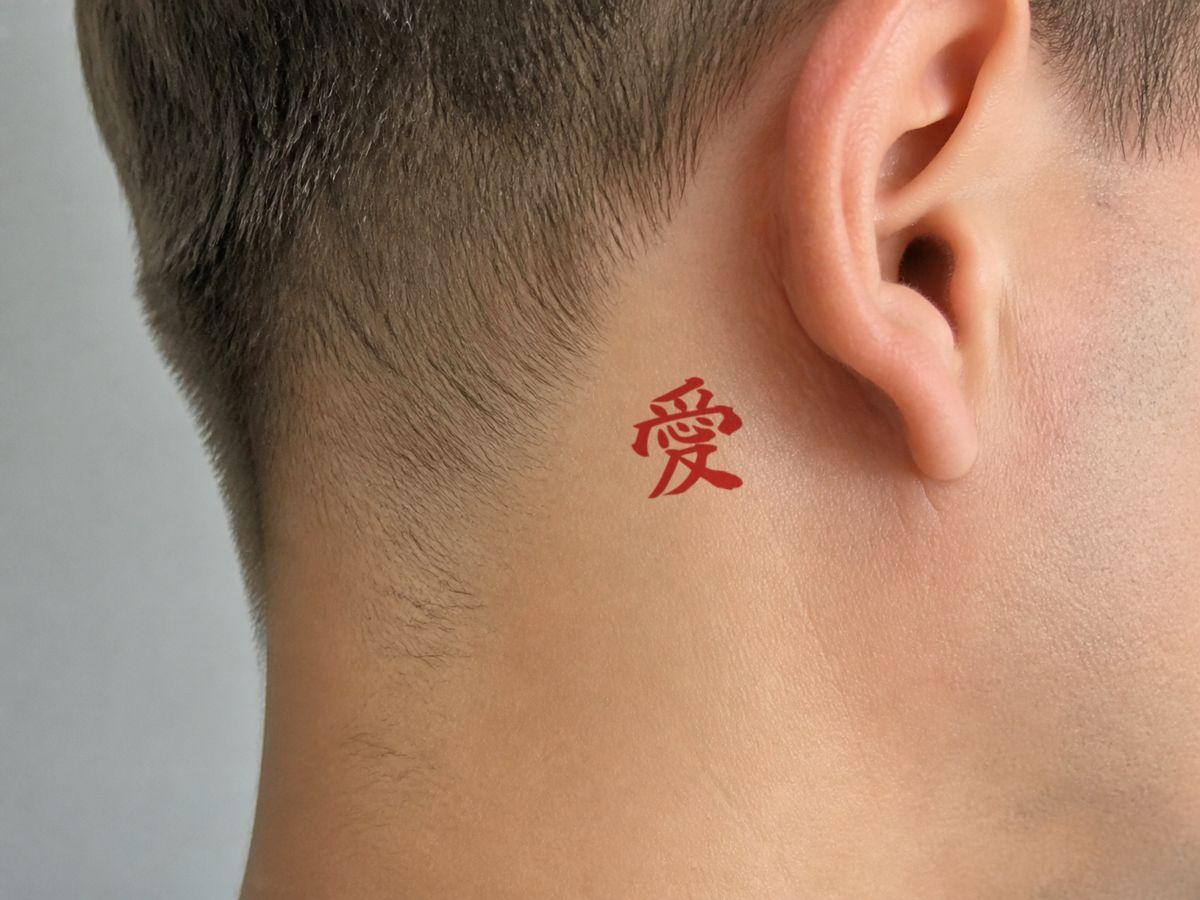
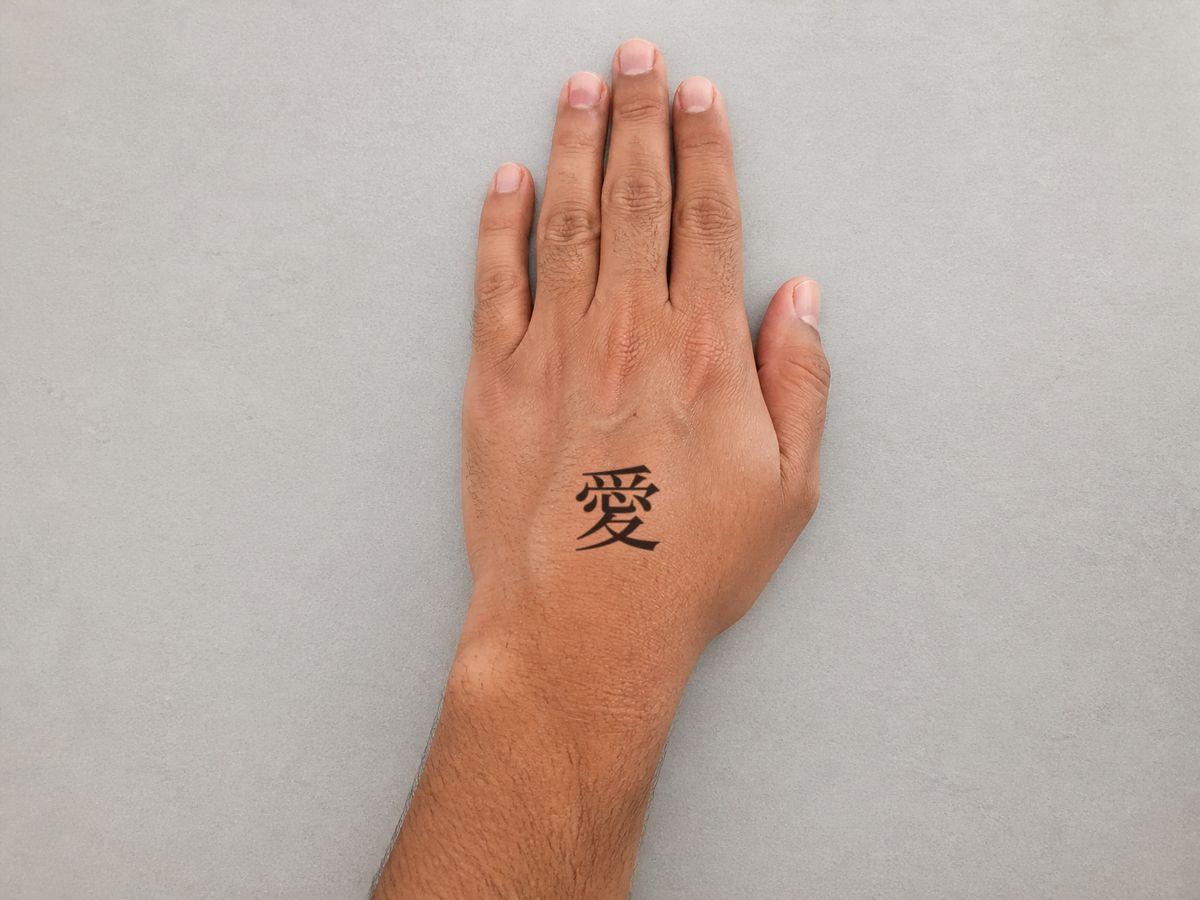
Behind the ear is the classic small spot for this character, and the reason the size test matters most there: the skin is thin, the area is curved, and the space only fits a small mark. Keep it at about half an inch and in an open style. On the hand, the skin flexes and is exposed to wear and sun, and artists commonly say hand tattoos soften faster; the hand placement guide covers that. The side of the neck takes a larger, vertical 愛 and is one of the most visible places you can choose. The forearm is the easy option, with the most room and a lower pain tier; see the forearm placement guide. A forehead tattoo, copying Gaara exactly, is the most visible and permanent choice of all; give it more thought than any other spot.
Prompt to try
“1/2 inch black 愛 love kanji tattoo behind the ear, simple gothic strokes, wide spacing”
Generate this designGaara tattoo ideas that are not the character
Gaara himself, his gourd and the symbol of his village are copyrighted designs belonging to the series' creator and publisher. Fan tattoos of the character exist, but this page does not reproduce them, and it is worth asking your artist to draw an original piece rather than trace official art. The kanji, the sand and the story are yours to use. Some directions that keep the meaning without copying the character:
- The kanji alone. The most common Gaara tattoo, and the one this page is built around. Pick the size first, then the style.
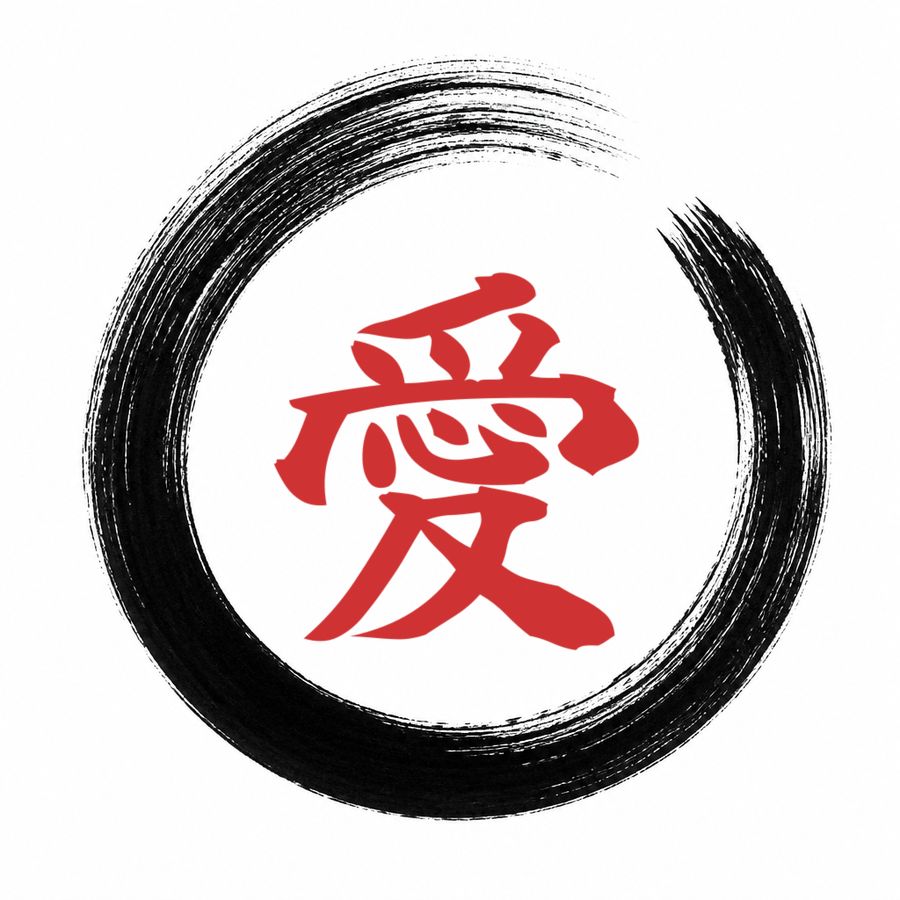
- 愛 in an ensō. The brushed circle of Zen calligraphy frames the character and gives a larger piece a clear outline. Keep the circle open so it does not crowd the strokes.
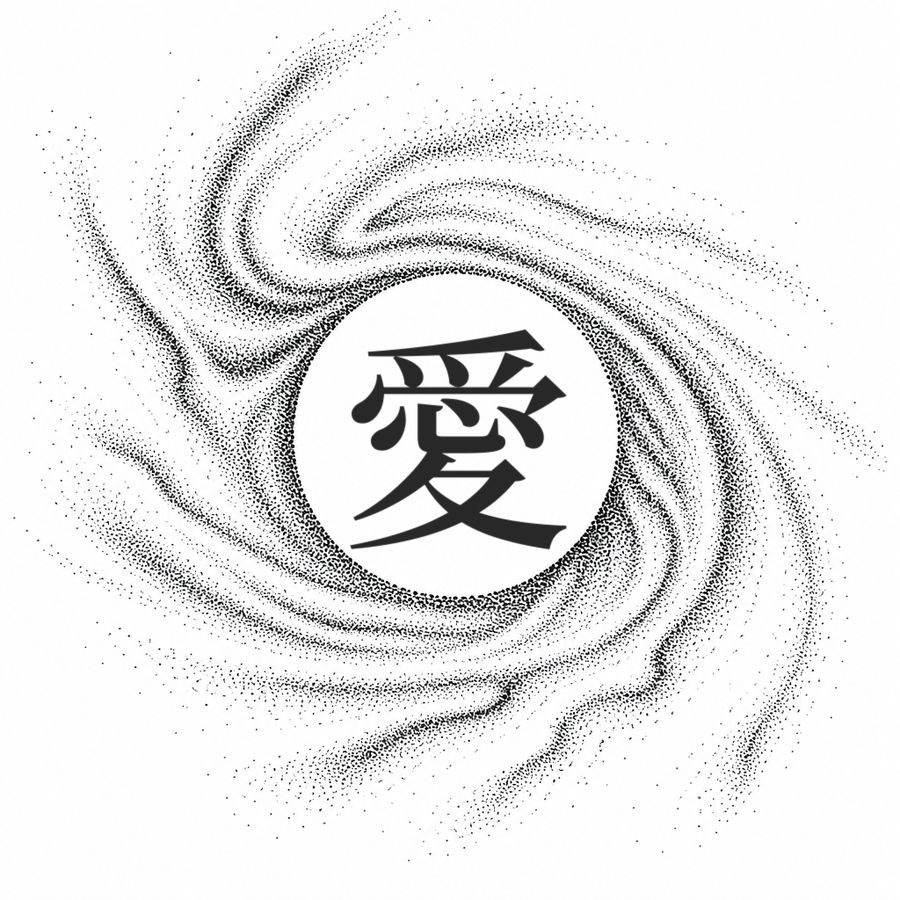
- Sand and wind. Dotwork sand swirling around the character points to Gaara's power without drawing him; the grain texture also suits blackwork artists.
- A different 愛. The character has a history outside anime: the Tohoku Tourism Promotion Organization notes that the samurai and scholar Naoe Kanetsugu's helmet, marked with the character for love, is displayed at Uesugi Jinja shrine in Yonezawa. A helmet-crest 愛 or a samurai piece is a nod that only fans will place; see samurai tattoo ideas.
- The name. Screen Rant gives Gaara's name in kanji as 我愛羅, which contains the same 愛. Three characters need about three times the length, and the meaning of the name is debated, so check it with a fluent reader.
Prompt to try
“red brush 愛 love kanji inside an open black ensō circle, 3 inch tattoo for the shoulder”
Generate this designBefore you book: get the kanji checked
- Copy the character as text. 愛 (U+611B), not 爱, and not a screenshot of an anime frame.
- Pick the size before the style. About half an inch is the smallest we would plan; 1 inch or more for mincho or brush.
- Count the strokes on the stencil. 13: four in 爫, two in 冖, four in 心, three in 夂.
- Check that the stencil is not mirrored. 愛 is not symmetrical, so a flipped transfer prints a character that does not exist. The tattoo stencil maker lets you preview the linework, and your artist will handle the transfer.
- Ask for healed work. Small lettering and red ink look different after healing; ask your artist for healed photos of similar pieces, and follow their aftercare. Our tattoo aftercare guide covers the first weeks.
Related tattoo ideas and guides
Naruto Tattoo Ideas
The wider series: symbols, kanji like 忍 and designs that avoid copying characters.
Samurai Tattoo Ideas
Armor, helmets and the warrior figure, for a 愛 crest with history.
Spider Lily Tattoo Ideas
Another Japanese motif fans often pair with anime pieces.
999 Tattoo Ideas
Another small, meaningful mark, with the same small-size font test.
Japanese Tattoo Style
Traditional irezumi and how it differs from a single kanji.
Small Tattoo Ideas Guide
How small a tattoo can go, and why tight lines blur.
Sources
- VIZ Media press release, "VIZ Media Previews New NARUTO Releases..." (May 5, 2015) · checked November 11, 2026
- Daniel Forster, "Naruto: Things You Didn't Know About Gaara", Screen Rant (Oct 8, 2017) · checked November 11, 2026
- Sarah Martin, "Top 10 Anime Characters With Face Markings, Ranked", CBR (May 12, 2022) · checked November 11, 2026
- Areeba Khan, "10 Saddest Naruto Backstories Ranked by Pure Trauma", CBR (May 23, 2026) · checked November 11, 2026
- Ahmed Rehan Nasir, "Naruto: Why Did the Fourth Kazekage Attempt to Assassinate [SPOILER]?", GameRant (Jan 31, 2023) · checked November 11, 2026
- Roxxy Haze, "Naruto: Gaara's Redemption from Villain to Hero", GameRant (Dec 29, 2023) · checked November 11, 2026
- Jisho.org, kanji 愛 (KANJIDIC data) · checked November 11, 2026
- Jisho.org, kanji 爫, 冖, 夂 · checked November 11, 2026
- Jisho.org, kanji 受 · checked November 11, 2026
- Jisho.org, word 自愛 (JMdict data) · checked November 11, 2026
- Wiktionary, 爱 · checked November 11, 2026
- American Academy of Dermatology, "Tattoos: 7 unexpected skin reactions and what to do about them" · checked November 11, 2026
- Tohoku Tourism Promotion Organization, Uesugi Jinja Shrine · checked November 11, 2026
- Wikimedia Commons, File:Tattoo Glyph 愛.jpg (사랑, public domain) · checked November 11, 2026
- Google Fonts repository, SIL Open Font License fonts (Noto Sans JP, Noto Serif JP, Noto Sans SC, Yuji Syuku, Klee One) · checked November 11, 2026
- ANSUR II: Anthropometric Survey of US Army Personnel (public data, OPEN Design Lab, Penn State) · checked November 11, 2026
- Pimentel D et al. The Effects of VR Use on Pain Experienced During a Tattoo Procedure: A Pilot Study. Frontiers in Virtual Reality, 2021 · checked November 11, 2026
- Witkoś J, Hartman-Petrycka M. Gender Differences in Subjective Pain Perception during and after Tattooing. IJERPH, 2020 · checked November 11, 2026
Gaara tattoo FAQ
What does Gaara's tattoo mean?+
It is the kanji 愛 (ai), love. In Naruto, Gaara carves it into his forehead at six, after his uncle Yashamaru attacks him on his father's orders, as a sign that he will love only himself. Later in the story he learns to care for others and becomes the Fifth Kazekage, so wearers often read it as self-love, love that outlasts being misunderstood, or a parent's love.
Why does Gaara have a tattoo on his forehead?+
According to Screen Rant, Gaara carved the symbol himself with his sand when he was six, after Yashamaru's attack, to stress the self-love he had taken as his motto. CBR and GameRant describe it as a reminder that he believed he was unloved and had only himself.
What is the kanji on Gaara's forehead, to copy and paste?+
愛 (Unicode U+611B), read ai and meaning love. It has 13 strokes. Do not confuse it with 爱, the simplified Chinese form with 10 strokes and no heart in the middle.
How small can a love kanji tattoo be?+
In our font test, at 1/4 inch the average gap between the stacked strokes of 愛 is only about 0.4 mm, close to the width of one needle line, so the character tends to blur. At 1/2 inch the gaps are 0.7 to 1 mm. We would plan about half an inch as a minimum, and 1 inch or more for brush or serif styles.
Is red ink a good idea for a Gaara tattoo?+
It is a design choice. The American Academy of Dermatology says allergic reactions to tattoo ink most often involve red, sometimes years later. Red also shows less contrast than black, especially on deeper skin tones, so ask your artist for healed red work on skin like yours.
Is the love kanji Japanese or Chinese?+
Both. 愛 is the Japanese kanji and the traditional Chinese character for love. Simplified Chinese writes it 爱. Gaara's mark is 愛.
Tattoo planning tool
Design your own Gaara tattoo
Describe your idea, generate it in any style, and preview it on your own skin before the needle.
Generate for freeFree to start
Explore more tattoo ideas
- Archangel Michael Tattoo IdeasAn archangel michael tattoo depicts the warrior angel who defeats evil, sword or scales in hand.
- The World Is Yours Tattoo IdeasA the world is yours tattoo wears the iconic phrase made famous by Scarface and hip-hop culture.
- Spider Lily Tattoo IdeasA spider lily tattoo features the striking red higanbana flower, famous in Japanese culture for its links to death, farewell and rebirth.
- Trust No One Tattoo IdeasA trust no one tattoo is a bold reminder to rely on yourself and stay guarded after being let down.