
Veni Vidi Vici Tattoo: Meaning, Pronunciation and Ideas
Veni, vidi, vici is Latin for "I came, I saw, I conquered". Julius Caesar used the three words after beating King Pharnaces at Zela, in what is now Turkey, in 47 BC: Plutarch says he wrote them to a friend in Rome, Suetonius that he carried them on a placard in his triumph (Plutarch; Suetonius). Below: the ancient sources, how to pronounce and spell it, the phrase rebuilt from real Roman letters, four fonts measured at the same width, and designs and sizes to scale.
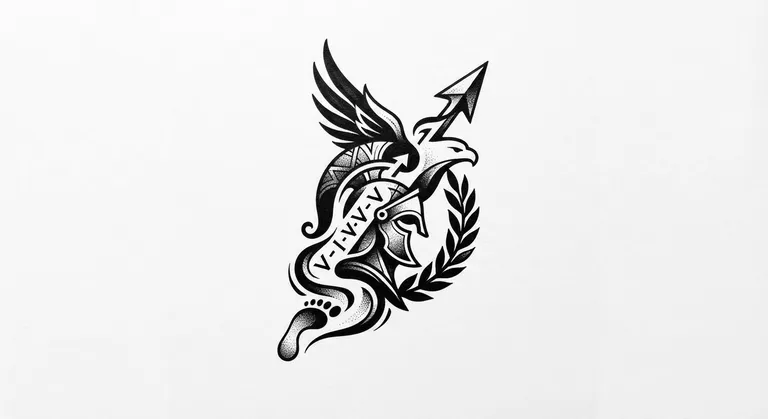
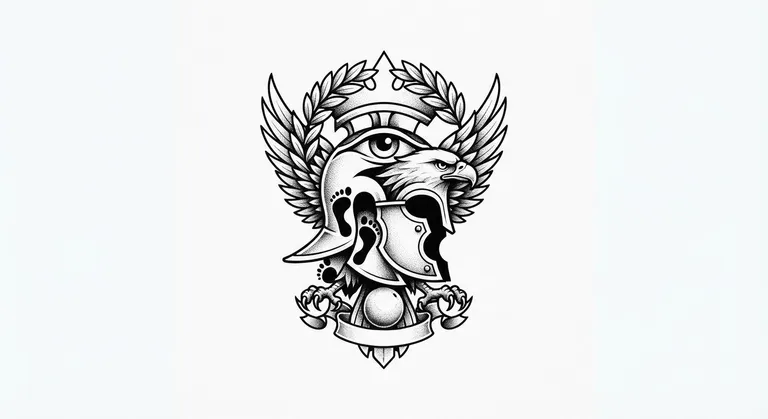
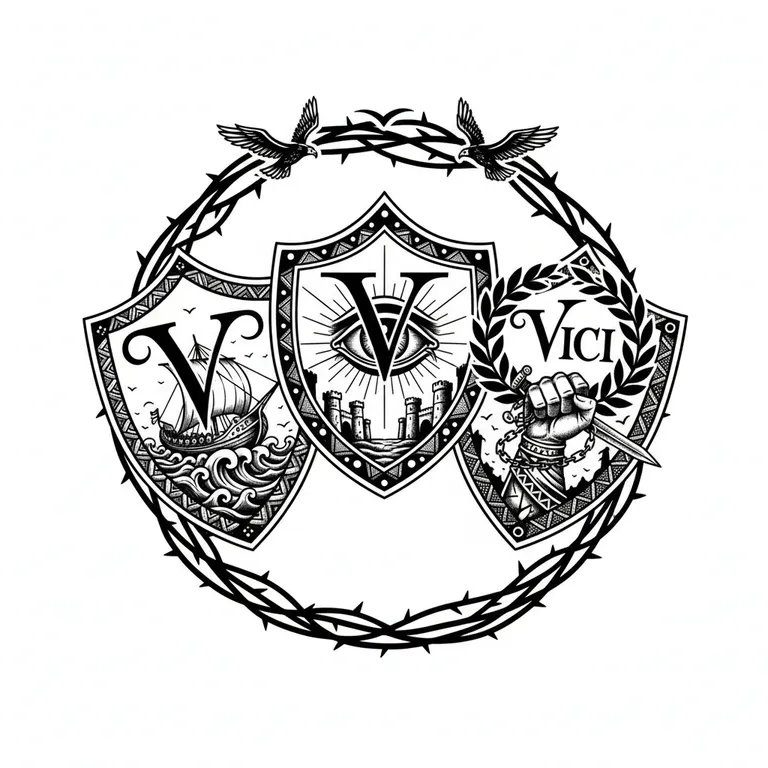
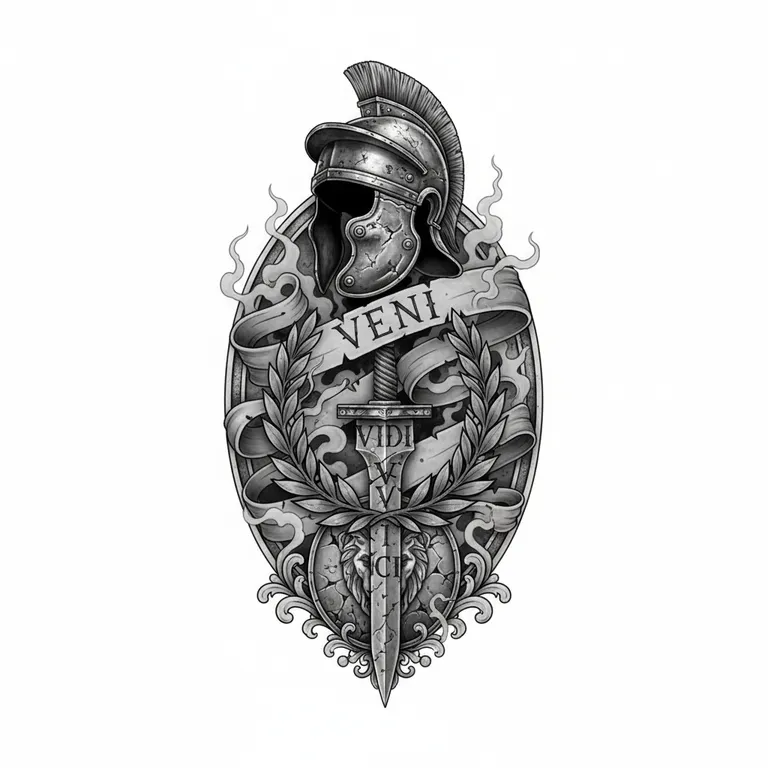
10+ Veni Vidi Vici tattoo designs
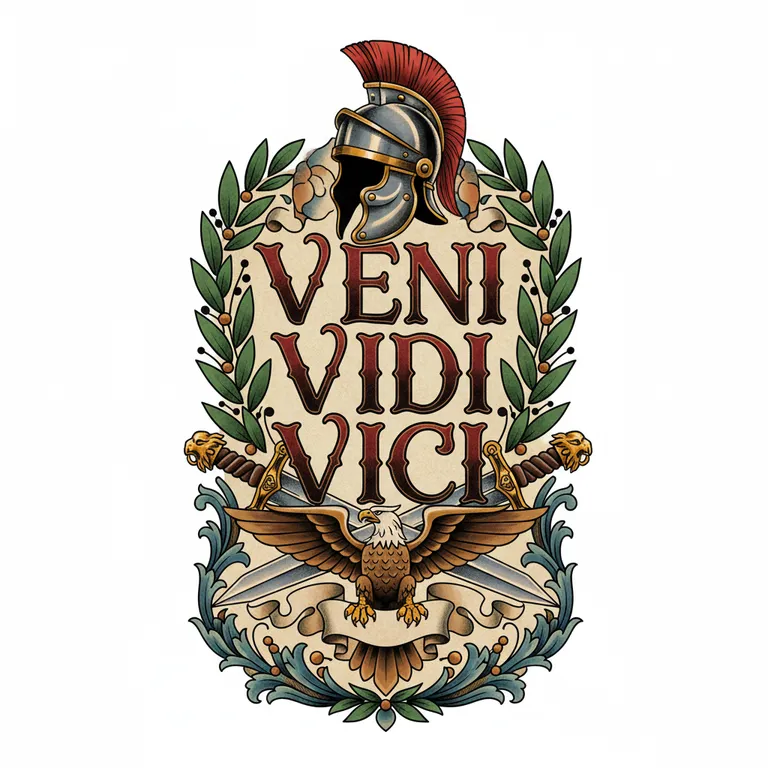
AI-generated veni vidi vici tattoo designs across popular styles. Tap any one to generate your own version and preview it on your skin.







What does veni vidi vici mean?
Word for word, it is three verbs in the past tense, each in the first person: vēnī "I came" (from veniō), vīdī "I saw" (from videō) and vīcī "I conquered" (from vincō) (Wiktionary: veni, vidi, vici). There is no "and" and no object: it does not say what was conquered. Plutarch, writing in Greek, pointed out why the Latin works so well: the three words share the same ending, which gives the line "a brevity which is most impressive" (Caesar 50.4, Perrin translation).
Caesar's point was speed. Suetonius says the placard did not list "the events of the war, as the others did, but the speed with which it was finished" (Divus Julius 37.2). As a tattoo, people bring their own reading to it. These are common interpretations, not definitions:
- A finished fight. Recovery from an illness or an addiction, a degree, a hard year behind you. The tattoo marks that it is done.
- A way of working. Show up, look hard, finish the job. Closer to Caesar's own meaning: decisive and quick.
- Roman history. For people who simply love the period, paired with Roman imagery rather than a personal story.
- Love, with a twist. Songwriters have bent the line for a long time: the 1936 song "These Foolish Things" has "You came, you saw, you conquered me" (Wikipedia). If that is your reading, the English line may say it better than the Latin.
Who said veni vidi vici, and when?
Julius Caesar, after the Battle of Zela in 47 BC, near the modern town of Zile in northern Turkey. Wikipedia dates the battle to August 2, 47 BC (Battle of Zela); the ancient writers below give no day. The enemy was Pharnaces II, son of Mithridates, who had beaten one of Caesar's commanders and taken land in Asia Minor while Caesar was busy in Egypt. Suetonius says Caesar "vanquished him in a single battle within five days after his arrival and four hours after getting sight of him" (Divus Julius 35.2). Three ancient authors mention the words, and they do not tell quite the same story:
| Author | Written | What the text says | Source |
|---|---|---|---|
| Plutarch | In Greek, about 150 years after the battle | Caesar announced the battle to "one of his friends at Rome, Amantius" in three words. Plutarch gives them in Greek, ēlthon, eidon, enikēsa, then notes that in Latin they share the same ending. | Caesar 50, Perrin (1919); Greek text |
| Suetonius | In Latin, early 2nd century AD | In his Pontic triumph, Caesar "displayed among the show-pieces of the procession an inscription of but three words". The Latin text prints them as VENI : VIDI : VICI. | Divus Julius 37.2, Rolfe (1913); Latin text |
| Appian | In Greek, 2nd century AD | "Of this battle he wrote to Rome the words, 'I came, I saw, I conquered.'" | Civil Wars 2.91, Loeb translation |
- words, one ending
- 3
- words, one ending
- vēnī, vīdī, vīcī
- from arrival to victory
- 5 days
- from arrival to victory
- Suetonius, Divus Julius 35.2
- after first sighting the enemy
- 4 hours
- after first sighting the enemy
- Suetonius, Divus Julius 35.2
- Battle of Zela
- 47 BC
- Battle of Zela
- XLVII in Roman numerals
What does veni vidi vici look like in real Roman letters?
No copy of Caesar's placard survives in any source we read, so the closest thing is Roman monumental lettering from the same culture. The best-known example is the inscription on the base of Trajan's Column in Rome, dedicated in AD 113, which Wikipedia calls "perhaps the most famous example of Roman square capitals" (Trajan's Column). It even contains the word CAESARI. Every letter of veni vidi vici appears in it, so we cut them out of a photo of the stone, one by one, and put the phrase back together.
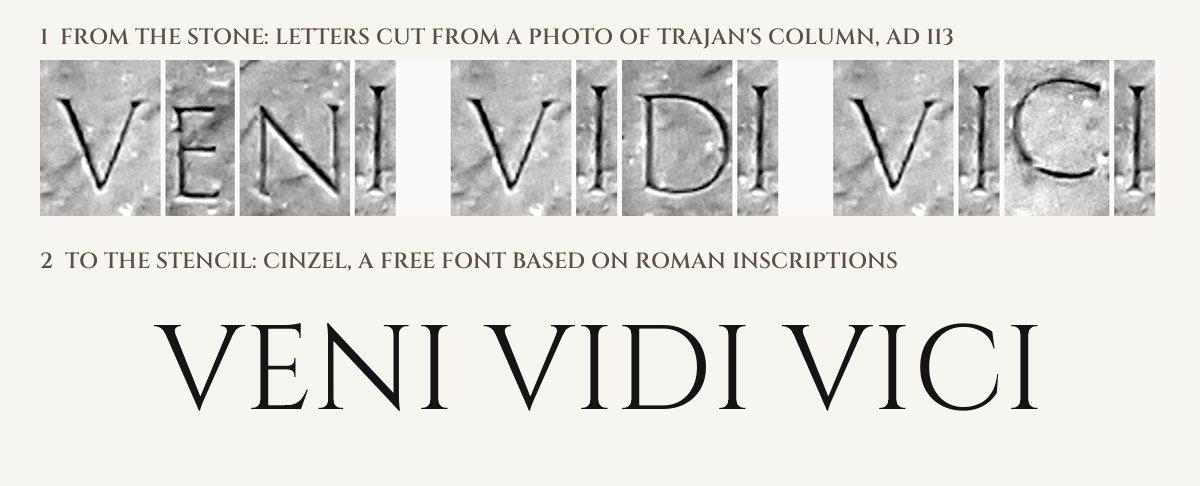
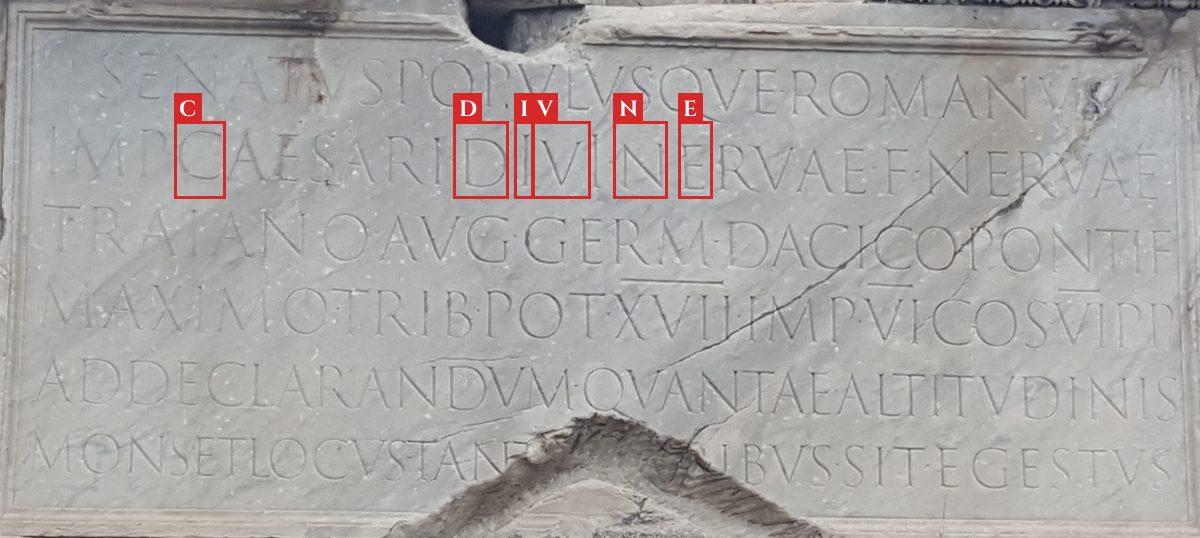
Three details from the stone matter for a tattoo. First, there is no U: SENATVS and POPVLVS are spelled with a V, because Latin used one letter for both sounds. Second, there are no lowercase letters and no accents or long-vowel marks; capitals with generous spacing are the authentic look. Third, words are separated by small dots in places, and Suetonius's Latin text prints the phrase with separators too, so VENI · VIDI · VICI with centered dots is a historically grounded layout, not a decoration. The commercial typeface Trajan (Carol Twombly, 1989) is based on this inscription (Wikipedia); Cinzel, used above, is a free alternative in the same spirit.
Prompt to try
“VENI · VIDI · VICI in classical Roman capitals with centered dots between the words, one line, thin serifs, black ink, for the inner forearm”
Generate this designHow do you pronounce veni vidi vici?
There are three accepted ways, and none of them changes the spelling of your tattoo. The respellings below are ours; the phonetic symbols come from Wiktionary and Wikipedia.
| Pronunciation | Sounds like | IPA | When it is used |
|---|---|---|---|
| Classical Latin | WAY-nee WEE-dee WEE-kee | [ˈweː.niː ˈwiː.diː ˈwiː.kiː] | How Caesar's generation is reconstructed to have spoken: V sounds like English W, C is always hard like K (Wiktionary) |
| Ecclesiastical (Church) Latin | VEH-nee VEE-dee VEE-chee | [ˈvɛː.ni ˈviː.di ˈviː.t͡ʃi] | The modern Italian-style Latin of the Catholic Church and most choirs: V as in "very", C before I as CH (Wiktionary) |
| English | VAY-nee VEE-dee VEE-chee | /ˈveɪni ˈviːdi ˈviːt͡ʃi/ | What most English speakers say; Wiktionary's English entry also lists the classical W-K version (Wiktionary) |
So yes, "veni vidi vici pronounced with a W" is correct for Classical Latin, and "VEE-chee" is correct for Church Latin and everyday English. The long vowels are what the macrons in vēnī vīdī vīcī mark. You do not need them on skin: the Trajan inscription above has none, and they turn into tiny dashes that blur first.
Is it veni vidi vici or vini vidi vici?
Punctuation is your choice: commas (veni, vidi, vici), centered dots, or plain spaces are all fine. Capital or lowercase is a style decision too, since Romans had only capitals.
Veni vidi vici in English, Greek, Spanish, French and Italian
| Language | Phrase | Source |
|---|---|---|
| Latin | Veni, vidi, vici | Suetonius, Latin text |
| English | I came, I saw, I conquered | Wiktionary |
| Ancient Greek | ἦλθον, εἶδον, ἐνίκησα (ēlthon, eidon, enikēsa) | Plutarch, Caesar 50, Greek text |
| Spanish | Llegué, vi, vencí | Wikipedia (es) |
| French | Je suis venu, j'ai vu, j'ai vaincu | Wikipedia (fr) |
| Italian | Venni, vidi, vinsi | Wikipedia (it) |
If you choose the Greek, have the stencil checked letter by letter against the source text above: the breathing marks and accents are part of the spelling, and image generators cannot be trusted with them.
Variations: venimus vidimus vicimus and more
| Phrase | Meaning | Where it comes from | Status |
|---|---|---|---|
| Venimus, vidimus, vicimus | We came, we saw, we conquered | Plural of the same verbs (Wiktionary: vicimus) | Grammatical; a team or couple version |
| Venimus, vidimus, Deus vicit | We came, we saw, God conquered | Attributed to King Jan III Sobieski after the Battle of Vienna, 1683 (Wikipedia) | Historical variant; suits a faith-based piece |
| Veni, vidi, amavi | I came, I saw, I loved | amāvī is "I loved" (Wiktionary); no ancient source found | Modern wordplay |
| Curio, Cesare venne, e vide e vinse | Curio, Caesar came, saw and conquered | Opening of Handel's opera Giulio Cesare, 1724 (Wikipedia) | Italian, for opera lovers |
Can you write veni vidi vici in Roman numerals?
Not as a number: it is a sentence, not a quantity. But look at the letters. Ten of its twelve letters, V, I, D and C, are also Roman numeral symbols; only E and N are not. That is why the phrase sits so naturally next to a date in numerals. What people usually mean by "veni vidi vici roman numerals" is one of these:
- A personal date under the phrase. The day you finished treatment, got sober, graduated. Convert it with the Roman numeral tattoo generator and check it twice; the Roman numeral tattoo ideas guide covers date formats.
- Caesar's year. 47 is XLVII. Bear in mind that Romans never wrote "BC": the BC/AD count was devised in 525 by the monk Dionysius Exiguus, and in Caesar's day years were named after the consuls in office (Wikipedia: Anno Domini). "XLVII BC" is a modern mix, fine as a design choice.
- The Roman way of marking numerals. On the Trajan inscription above, numbers carry a bar across the top (Wikipedia calls it a titulus) so they are not read as words (Trajan's Column). A thin bar over your date makes the same distinction on skin.
Prompt to try
“veni vidi vici in Roman capitals with a date in Roman numerals underneath, thin bar above the numerals, fine line, 4 inches wide, forearm”
Generate this designWhich font is best for a veni vidi vici tattoo?
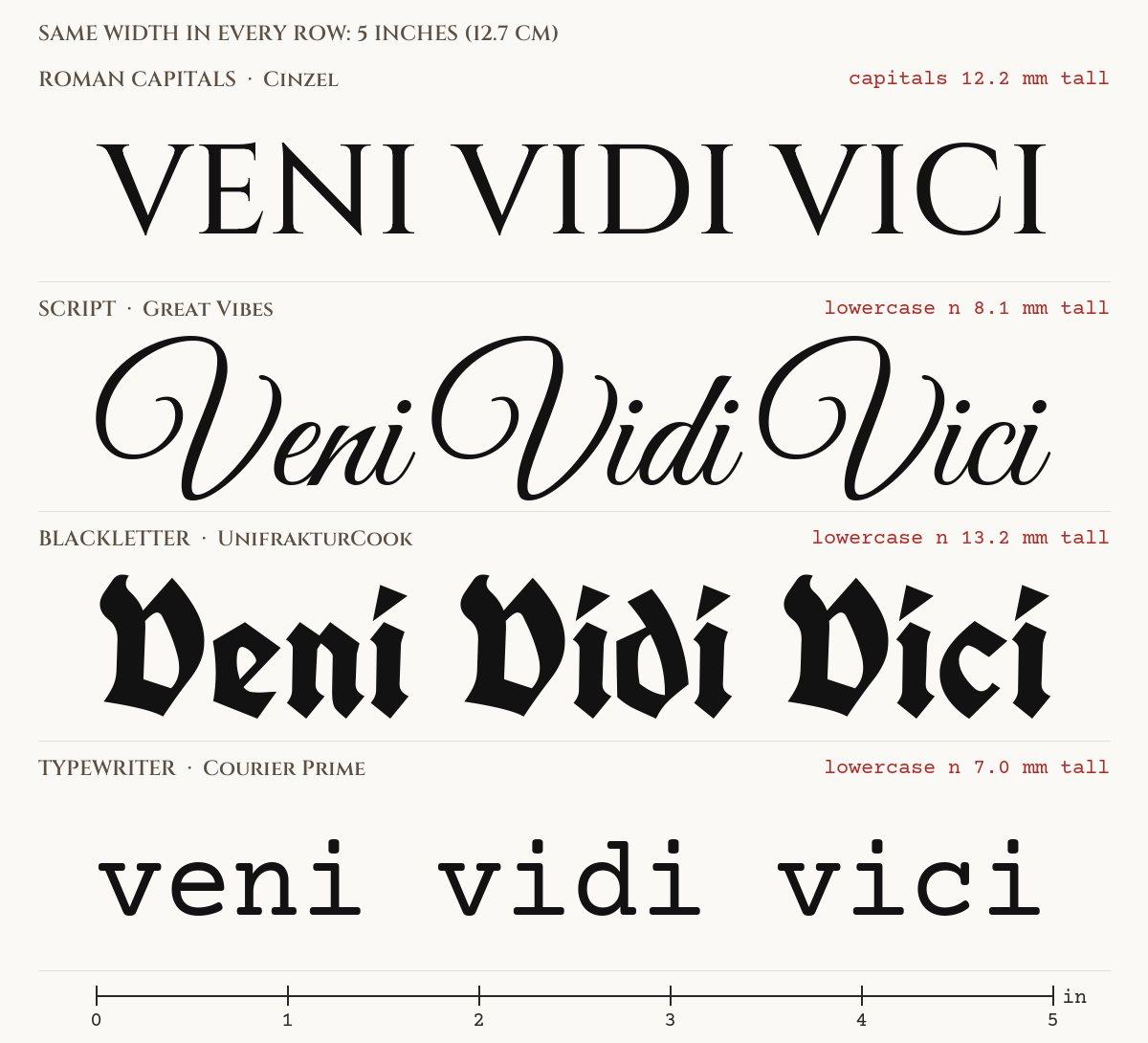
Fix the width (the space you have on the body) and the font decides how tall the letters get. At 5 inches wide we measured:
Height of the small letters at 5 in wide
- Blackletter (UnifrakturCook)13.2 mm
- Roman capitals (Cinzel)12.2 mm
- Script (Great Vibes)8.1 mm
- Typewriter (Courier Prime)7.0 mm
- Roman capitals are the historical match and the most even to read: all twelve letters are the same height, built from straight strokes and two round ones (D and C). They suit forearms, chests and collarbones. This is what people mean by a "veni vidi vici Roman font".
- Script answers "veni vidi vici in cursive". It is elegant, but at the same width its lowercase is about a third shorter than Cinzel's capitals, and the big flourished capital Vs eat width. Give it more length than you would give capitals; see script tattoos for how lettering ages.
- Blackletter is dark and compact, with the tallest lowercase of the four. Look closely at our sample, though: in this Fraktur face the capital V is a rounded shape that, to eyes used to modern type, looks a lot like a B. "Beni Bidi Bici" is a real risk, so test your exact font before committing.
- Typewriter is the plainest and the smallest at a given width. It suits a minimal or ironic take, and fine line work.
Do not ask an AI image generator to spell Latin: models drop or swap letters. For exact text, set the words in the name tattoo generator, which uses real fonts, then bring that file to your artist.
Veni vidi vici and Julius Caesar tattoo ideas
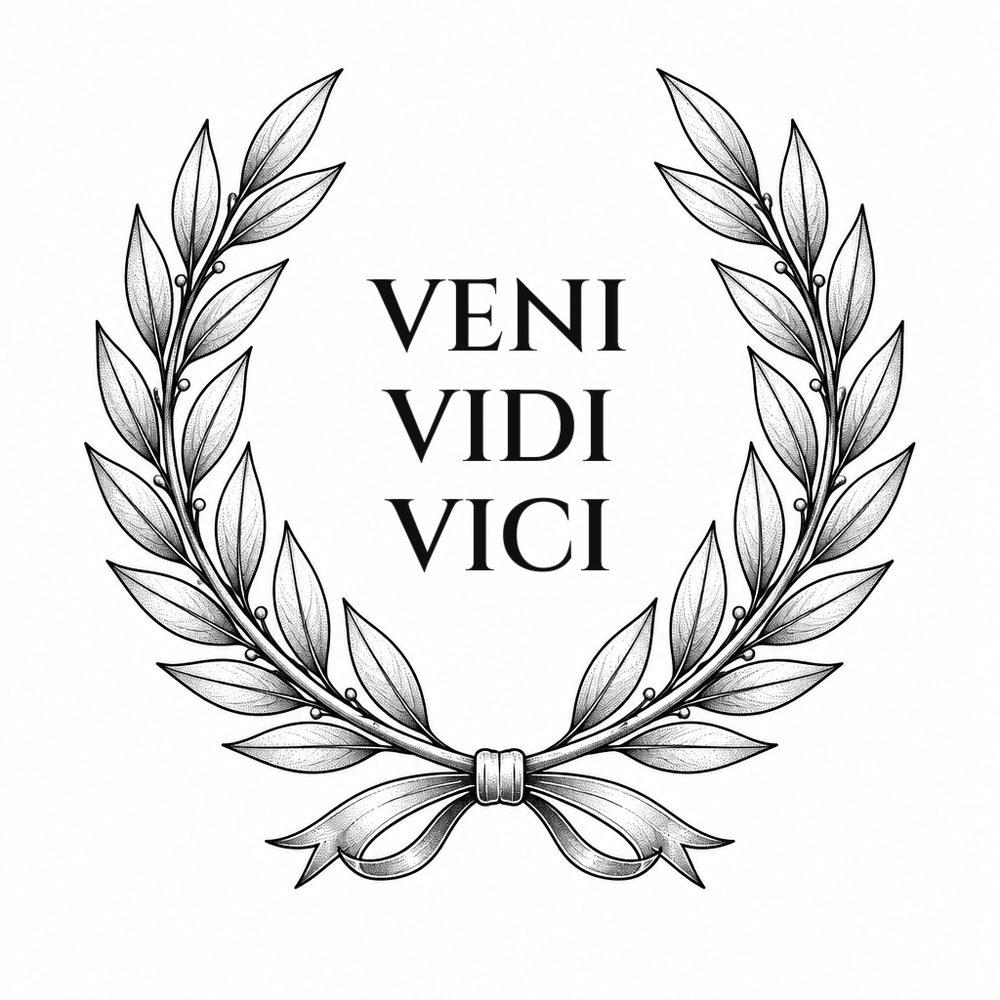 Fine line or stippleLaurel wreath, stacked
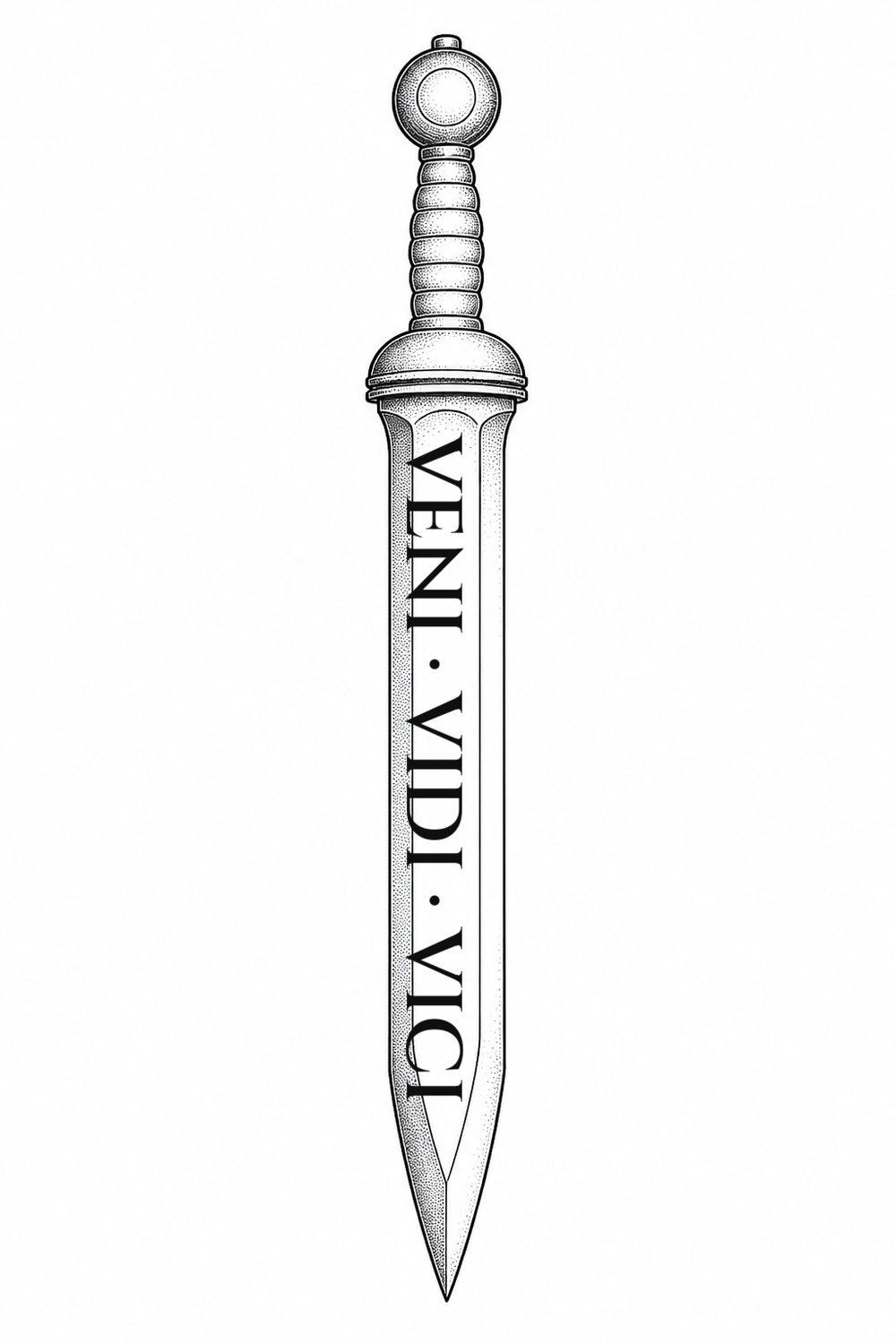 Forearm or spineGladius, text on the blade
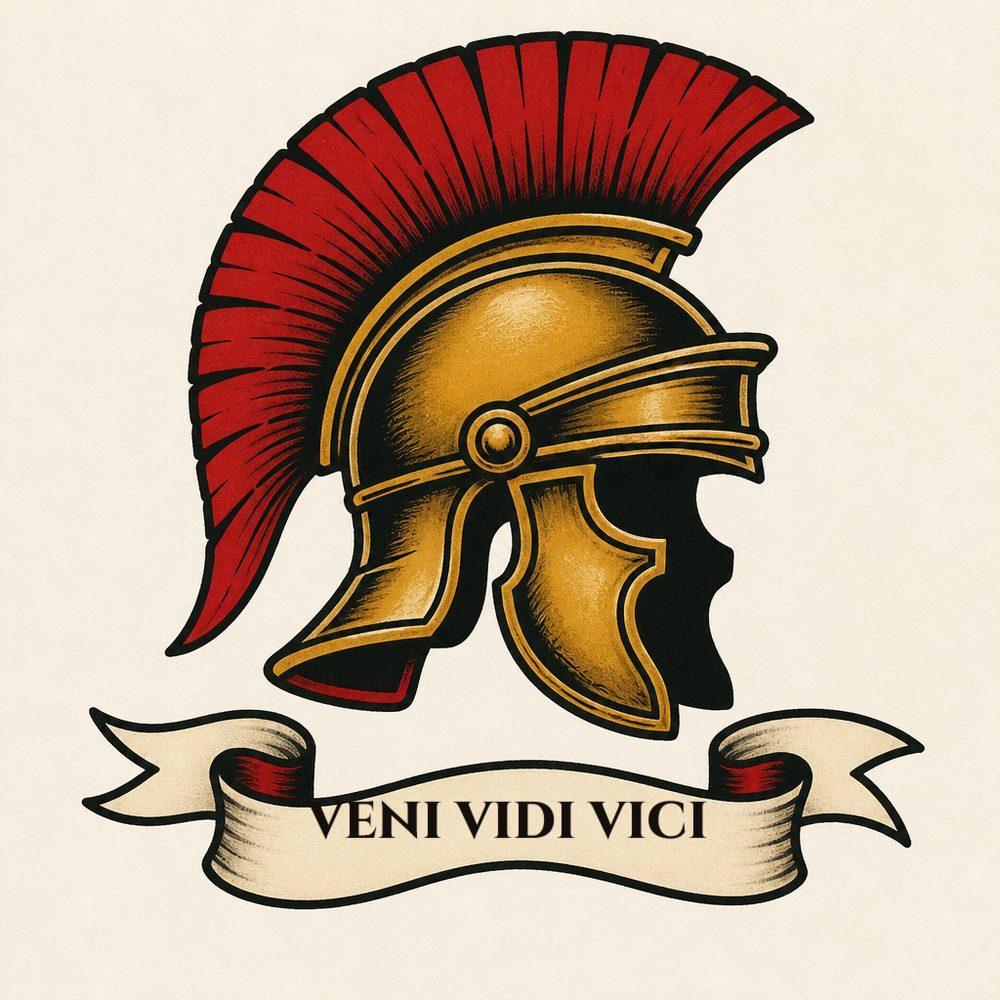 Traditional, colorCenturion helmet and banner
 Realism, largeCaesar bust with the phrase
Why the laurel wreath fits. It is not just a generic victory symbol here. Suetonius says Caesar, troubled by his baldness, welcomed no honor more than "the privilege of wearing a laurel wreath at all times" (Divus Julius 45.2). A wreath around the phrase points straight at the man who said it.
Swords and helmets. "Veni vidi vici tattoo on chest with sword" is a frequent search: a vertical gladius gives long text a natural line to follow, and a helmet with a banner is a classic flash layout. Pick the traditional style for bold outlines and a few flat colors, or blackwork for solid black.
A Julius Caesar tattoo. A portrait needs room and a realism artist, so think upper arm, calf, chest or a sleeve rather than a forearm strip. Our bust is AI-invented; for a historically faithful face, ask your artist to work from photos of an ancient portrait bust in a museum collection. Caesar also pairs with other classical themes: see Zeus tattoo ideas for Greek mythology, or a samurai if what you want is the warrior idea rather than Rome itself.
Prompt to try
“small veni vidi vici in fine line Roman capitals with a tiny laurel branch underline, 3 inches wide, collarbone”
Generate this designWhere should a veni vidi vici tattoo go, and how big?
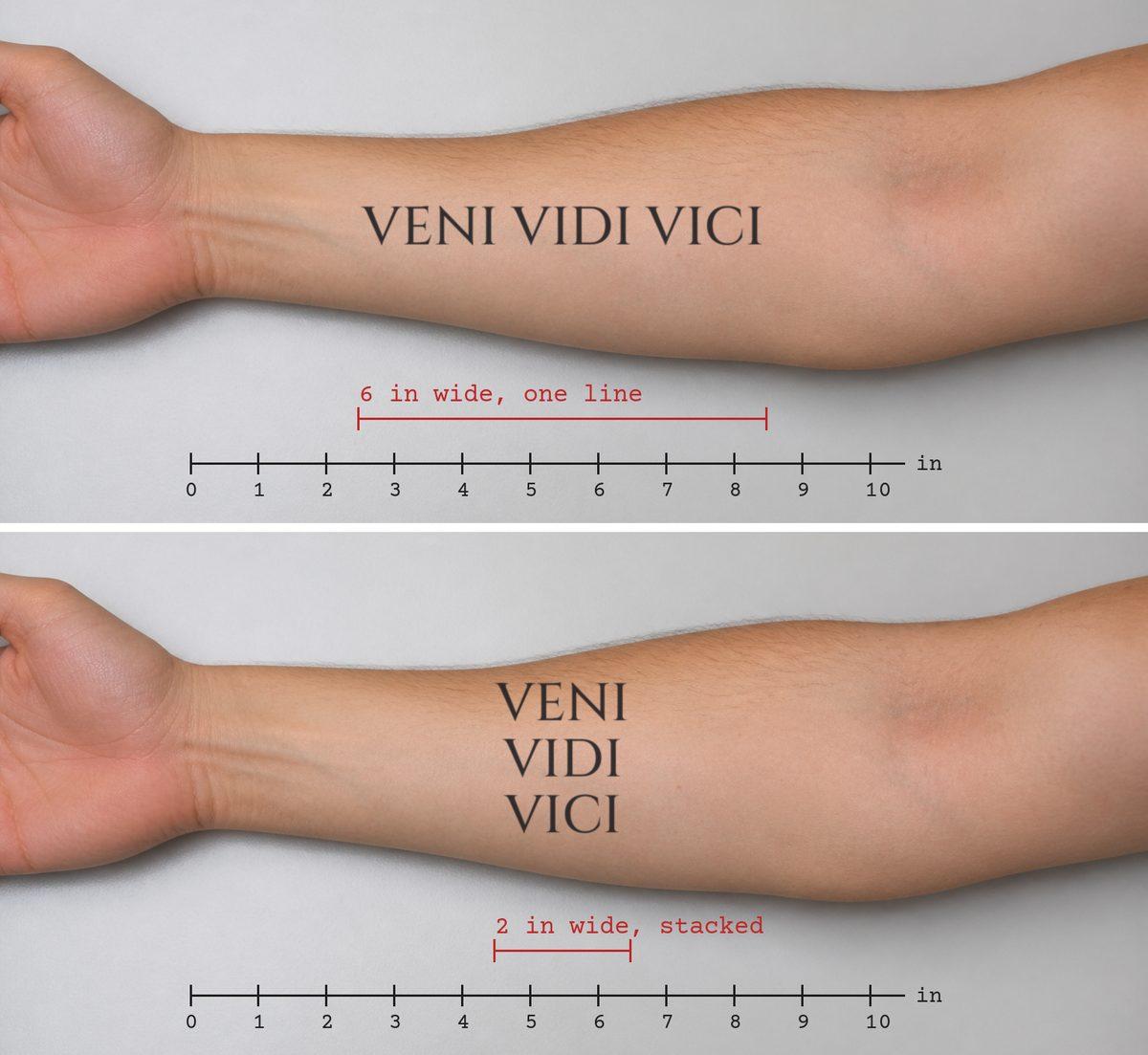
The phrase is long and thin: fourteen characters on one line, or three short words that stack. That shape decides where it fits. One line along the forearm uses its length, about 9.5 to 10.5 inches from wrist to elbow by the ANSUR II medians (a US Army survey, so a guide, not a rule). Stacked, the three words make a near-square block that suits a wreath, the chest or the back of the arm. As a reference, the same Cinzel line at 3 inches wide has capitals only 7.4 mm tall, about half the 6-inch version; check how small your artist is comfortable going.
| Placement | Room, women / men | Pain tier (artists) | Layout that fits |
|---|---|---|---|
| Forearm | 9.5 × 5.2 / 10.5 × 6.1 in | Lower | One line along the arm, or a gladius with the text on the blade |
| Chest and collarbone | No survey figure | Higher | One line under the collarbones (searched as "top of chest"), or a wreath centered on the sternum |
| Ribs | No survey figure | Higher | One long line or a vertical stack following the ribcage |
| Upper arm, biceps | 12.2 × 6.0 / 13.2 × 7.0 in | Lower | Stacked block, helmet with banner, or a Caesar portrait |
| Shoulder and back | Back 14.4 × 16.7 / 16.3 × 18.8 in | Shoulders lower; back not rated | Large wreath or bust, or a single line across the shoulder blades |
| Neck | No survey figure | Higher | A short line on the side or back of the neck; very visible |
| Hand | 7.1 × 3.1 / 7.6 × 3.5 in | Middle | One word per finger or a small stack; lines blur faster here |
Room figures come from our tattoo size guide; pain tiers are what artists reported in Pimentel et al., 2021, collected on our tattoo pain chart, not measurements. In a survey of 1,092 tattooed people, body area was not a significant predictor of pain once session length, stress and bleeding were counted, so a short line on the ribs can be easier than a long session on the forearm. To size the design for your own arm, use the tattoo size calculator.
Is veni vidi vici an arrogant tattoo?
It started as a boast, and an English dictionary entry still glosses the phrase as describing "a belligerent attitude" (Wiktionary). Caesar was also crowing about an easy war: Suetonius says he often remarked on "Pompey's good luck" in winning fame against "such feeble foemen" (Divus Julius 35.2). And the man behind it fought a civil war against fellow Romans, which not everyone admires. Most people who wear it today mean something smaller and more personal: a hard thing they faced and finished. If the swagger bothers you, the plural venimus, vidimus, vicimus shares the win, and Sobieski's "God conquered" version hands it away entirely.
What should you bring to your artist?
- The exact text, typed. VENI VIDI VICI, with your chosen punctuation (commas, dots or spaces) and case. Check it letter by letter on the stencil.
- The font file or a sample. Roman capitals, script, blackletter or typewriter; print it at the real size.
- A size and a spot. Width in inches or cm, measured with the size calculator.
- A reference for any image. A design from the gallery above or one you generated, plus what to change; the stencil maker turns it into line art.
- A budget. Shop minimums and hourly rates vary; see how much a tattoo costs.
- Aftercare time. Read tattoo aftercare before you book; if it is your first, start with the first tattoo guide.
Prompt to try
“veni vidi vici in elegant script on one line, fine line, 5 inches wide, along the inner forearm”
Generate this designRelated tattoo ideas and guides
Memento Mori Tattoo Ideas
Remember you must die: the Latin phrase, its symbols and where they come from.
Amor Fati Tattoo Ideas
Love of fate, a short Latin line that suits the same fonts.
Tutto Passa Tattoo Ideas
Everything passes, in Italian, for a quieter take on getting through.
Script Tattoos
Lettering styles, how small text can go and how it ages.
Roman Numeral Tattoo Ideas
Dates and milestones in numerals, to pair with the phrase.
Tattoo Size Guide
How much room each body part has, in inches and cm.
Sources
- Plutarch, Life of Caesar 50, trans. Bernadotte Perrin, Loeb 1919 (LacusCurtius) · checked November 11, 2026
- Plutarch, Caesar 50, Greek text (Perseus Digital Library) · checked November 11, 2026
- Suetonius, Divus Julius 35, 37, 45, Loeb 1913 translation (LacusCurtius) · checked November 11, 2026
- Suetonius, Divus Julius, Latin text (The Latin Library) · checked November 11, 2026
- Appian, Civil Wars II.91, Loeb translation (LacusCurtius) · checked November 11, 2026
- Wikipedia, Veni, vidi, vici · checked November 11, 2026
- Wikipedia, Battle of Zela (47 BC) · checked November 11, 2026
- Wikipedia, Julius Caesar · checked November 11, 2026
- Wikipedia, Trajan's Column · checked November 11, 2026
- Wikipedia, Anno Domini · checked November 11, 2026
- Wiktionary, veni, vidi, vici · checked November 11, 2026
- Wiktionary, veni · checked November 11, 2026
- Wiktionary, vidi · checked November 11, 2026
- Wiktionary, vici · checked November 11, 2026
- Wiktionary, vicimus · checked November 11, 2026
- Wiktionary, amavi · checked November 11, 2026
- Fundéu, «veni, vidi, vici» · checked November 11, 2026
- Wikipedia (es), Veni, vidi, vici · checked November 11, 2026
- Wikipedia (fr), Veni, vidi, vici · checked November 11, 2026
- Wikipedia (it), Veni, vidi, vici · checked November 11, 2026
- Wikimedia Commons, Inscription, Trajan's Column (MumblerJamie, CC BY-SA 2.0) · checked November 11, 2026
- Google Fonts, Cinzel (SIL Open Font License) · checked November 11, 2026
- Google Fonts repository, SIL Open Font License fonts · checked November 11, 2026
- ANSUR II, The OPEN Design Lab, Penn State · checked November 11, 2026
- Pimentel et al. (2021), Frontiers in Virtual Reality · checked November 11, 2026
- Witkos & Hartman-Petrycka (2020), IJERPH · checked November 11, 2026
Veni Vidi Vici tattoo FAQ
What does veni vidi vici mean?+
It is Latin for "I came, I saw, I conquered": three past-tense verbs in the first person, with the same ending. Julius Caesar used it after defeating Pharnaces II at Zela in 47 BC, to stress how fast the war was won. As a tattoo it usually marks a hard thing faced and finished.
How do you pronounce veni vidi vici?+
In Classical Latin it is WAY-nee WEE-dee WEE-kee, because V sounded like W and C was always hard. In Church Latin and usual English it is VEH-nee (or VAY-nee) VEE-dee VEE-chee. The spelling of the tattoo is the same either way.
Who said veni vidi vici, and to whom?+
Julius Caesar. Plutarch says he wrote the three words to a friend in Rome named Amantius, Appian that he wrote them "to Rome", and Suetonius that they were carried on a placard in his Pontic triumph. None of the three says the message went to the Senate.
Is it veni vidi vici or vini vidi vici?+
Veni vidi vici. "Vini" and "vinci" are common misspellings, and the order (came, saw, conquered) is fixed. Check the stencil letter by letter before the session.
Can you write veni vidi vici in Roman numerals?+
No, it is a sentence, not a number. People often pair it with a date in numerals: 47, the year of Zela, is XLVII, or use the Roman numeral generator for a personal date.
How big should a veni vidi vici tattoo be?+
On one line in Roman capitals, 5 to 6 inches along the forearm gives letters about 12 to 15 mm tall. Stacked in three lines, about 2 inches wide works on the forearm or chest. Script needs more width than capitals for the same letter height.
Tattoo planning tool
Design your own Veni Vidi Vici tattoo
Describe your idea, generate it in any style, and preview it on your own skin before the needle.
Generate for freeFree to start
Explore more tattoo ideas
- Cerberus Tattoo IdeasA cerberus tattoo depicts the three-headed dog that guards the gates of the Greek underworld.
- Zeus Tattoo IdeasA zeus tattoo honours the king of the Greek gods, ruler of the sky and wielder of the thunderbolt.
- Anubis Tattoo IdeasAn anubis tattoo features the jackal-headed Egyptian god who guides souls into the afterlife.
- Kraken Tattoo IdeasA kraken tattoo depicts the giant sea monster of Nordic legend, all tentacles and dread from the deep.